
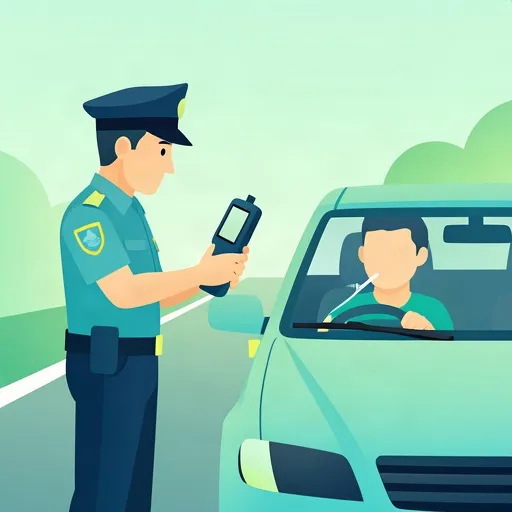
As of May 2024, Belgian police have modernized their roadside alcohol screening procedures to improve efficiency. This update affects how breathalyzer tests are conducted, making it critical for students to know the current legal requirements for the theory exam and real-world compliance.
Article content overview
Road safety enforcement in Belgium has undergone significant modernization to enhance the efficiency of police controls. For learner drivers and those preparing for their theory exam, staying updated on these changes is not just a matter of compliance; it is a fundamental requirement for understanding current Belgian traffic legislation. As of May 1, 2024, the legal framework governing roadside alcohol screening has been updated to reflect the capabilities of next-generation testing technology.
Historically, drivers in Belgium were entitled to request a 15-minute waiting period before performing an official breathalyzer test. This "sursis" was intended to ensure that the test measured alcohol in the alveolar air rather than residual alcohol lingering in the mouth after a recent drink. However, modern police breathalyzers are now sophisticated enough to distinguish between mouth alcohol and deep-lung alveolar air.
Because these new devices provide rapid, reliable, and precise measurements immediately, the 15-minute waiting period has been officially abolished. This procedural shift ensures that traffic checks are more efficient and that enforcement is immediate, discouraging the assumption that one can "wait out" the accuracy of a police test. In the context of your theory exam, it is crucial to recognize that this delay is no longer a legal right for drivers.
In addition to the removal of the waiting period, the technical requirements for conducting a breath test have been adjusted to ensure broader accessibility and operational efficiency. Previously, a driver was required to exhale a minimum volume of 1.9 liters into the testing device. Recognizing that this volume could be challenging for some individuals to provide consistently, the legal threshold has been lowered to 1.2 liters.
This change facilitates the "end of the breath" principle, allowing for more accurate readings even when a driver cannot provide a large volume of air. By lowering the threshold, police can obtain valid samples more effectively. For theory students, this underscores that the test is designed to be conclusive and that cooperation with the officer's instructions is mandatory.
Refusing a breath test or an breath analysis is a serious legal violation. Under Belgian law, refusal to submit to a required alcohol screening can result in immediate legal sanctions, similar to testing over the legal limit.
It remains essential for every driver to understand the standard legal limits enforced on Belgian roads. While the general limit for most drivers is 0.5 per mille (equivalent to 0.22 mg/l of exhaled air), professional drivers and those holding a learner's permit or provisional license are often subject to stricter requirements.
This refers to the air from the deepest part of the lungs, where gas exchange occurs. Because this air has a consistent ratio of alcohol to the blood, it is the standard used for breathalyzer testing in Belgium.
| Driver Category | Blood Alcohol Limit (g/l) | Breath Alcohol Limit (mg/l) |
|---|---|---|
| Standard Drivers | 0.5‰ | 0.22 mg/l |
| Professional Drivers | 0.2‰ | 0.09 mg/l |
The Belgian driving theory exam focuses heavily on the responsibilities of the driver and the legal consequences of driving under the influence. Questions often involve scenarios where you must identify the correct procedure following an accident or a routine check. You must be prepared to answer questions that reflect the current law, meaning any mention of a 15-minute waiting period in old study materials should be disregarded in favor of these updated regulations.
Belgian roadside alcohol screening procedures were updated in May 2024, eliminating the historical 15-minute waiting period and reducing the required exhalation volume from 1.9 to 1.2 liters. These changes reflect the improved accuracy of modern breathalyzer technology that can distinguish between residual mouth alcohol and alveolar air immediately. Learners must know the current legal alcohol limits—0.5‰ for standard drivers and 0.2‰ for professional drivers—as the theory exam will test current law. The screening process involves a preliminary sampler, followed by a full breath analysis if alcohol is detected, with refusal carrying the same legal consequences as testing over the limit.
A short set of high-value points that capture the most important ideas from this article.
The 15-minute waiting period before a breathalyzer test was abolished as of May 1, 2024, because modern devices can distinguish mouth alcohol from alveolar air immediately.
The required breath exhalation volume was lowered from 1.9 liters to 1.2 liters, making the test more accessible while still capturing accurate end-of-breath samples.
Standard drivers face a legal limit of 0.5‰ (0.22 mg/l), while professional drivers are held to a stricter limit of 0.2‰ (0.09 mg/l).
A positive screening triggers a full breath analysis, and results of 0.22 mg/l or higher generally result in an immediate temporary driving ban.
Refusing a breath test or breath analysis carries the same legal consequences as testing over the legal limit.
May 1, 2024 marks the official abolition of the 15-minute waiting period—this is a current legal right removal, not an optional delay.
The minimum breath volume for a valid test is now 1.2 liters, not the old 1.9-liter requirement.
The sampler device is a preliminary screening tool; the formal breath analysis is the precise test that determines legal compliance.
Professional drivers include truck, bus, and taxi operators and must comply with the stricter 0.2‰ threshold.
Alveolar air from deep in the lungs is used for testing because it maintains a consistent ratio with blood alcohol content.
Relying on old study materials that mention the 15-minute waiting period, which is no longer a legal right as of May 2024.
Assuming that providing insufficient breath volume invalidates the test entirely, rather than understanding the device captures the end-of-breath sample for accuracy.
Confusing the preliminary sampler device with the formal breath analysis—the sampler is for quick pre-selection, not evidentiary measurement.
Forgetting that professional drivers and learner's permit holders are subject to the stricter 0.2‰ limit, not the standard 0.5‰ limit.
Underestimating the severity of refusal—refusing a test carries identical penalties to failing the test under Belgian law.
Article content overview
A short set of high-value points that capture the most important ideas from this article.
The 15-minute waiting period before a breathalyzer test was abolished as of May 1, 2024, because modern devices can distinguish mouth alcohol from alveolar air immediately.
The required breath exhalation volume was lowered from 1.9 liters to 1.2 liters, making the test more accessible while still capturing accurate end-of-breath samples.
Standard drivers face a legal limit of 0.5‰ (0.22 mg/l), while professional drivers are held to a stricter limit of 0.2‰ (0.09 mg/l).
A positive screening triggers a full breath analysis, and results of 0.22 mg/l or higher generally result in an immediate temporary driving ban.
Refusing a breath test or breath analysis carries the same legal consequences as testing over the legal limit.
May 1, 2024 marks the official abolition of the 15-minute waiting period—this is a current legal right removal, not an optional delay.
The minimum breath volume for a valid test is now 1.2 liters, not the old 1.9-liter requirement.
The sampler device is a preliminary screening tool; the formal breath analysis is the precise test that determines legal compliance.
Professional drivers include truck, bus, and taxi operators and must comply with the stricter 0.2‰ threshold.
Alveolar air from deep in the lungs is used for testing because it maintains a consistent ratio with blood alcohol content.
Relying on old study materials that mention the 15-minute waiting period, which is no longer a legal right as of May 2024.
Assuming that providing insufficient breath volume invalidates the test entirely, rather than understanding the device captures the end-of-breath sample for accuracy.
Confusing the preliminary sampler device with the formal breath analysis—the sampler is for quick pre-selection, not evidentiary measurement.
Forgetting that professional drivers and learner's permit holders are subject to the stricter 0.2‰ limit, not the standard 0.5‰ limit.
Underestimating the severity of refusal—refusing a test carries identical penalties to failing the test under Belgian law.
Explore related topics, search based questions, and concepts that learners often look up when studying Belgium Alcohol Test Updates. These themes reflect real search intent and help you understand how this topic connects to wider driving theory knowledge in Belgium.
Find clear and practical answers to common questions learners often have about Belgium Alcohol Test Updates. This section helps explain difficult points, remove confusion, and reinforce the key driving theory concepts that matter for learners in Belgium.
No, the 15-minute waiting period ('sursis') was officially abolished on May 1, 2024. Modern police equipment is now capable of performing accurate tests immediately.
Yes, the required exhalation volume for the breath test has been reduced from 1.9 liters to 1.2 liters to make the process more efficient and accessible for all drivers.
The updates were implemented to simplify roadside screening procedures and improve the efficiency of alcohol control without compromising the accuracy or reliability of the results.
Continue your learning journey by exploring related articles and guides on specific Belgian traffic situations, advanced road signs, or vehicle safety topics. Use our search to pinpoint what you need to review next, deepening your understanding for your driving license theory exam.