
In Belgium, cyclists are treated as vulnerable road users with specific legal protections that every driver must know to navigate safely. This guide covers the mandatory yielding rules at intersections, the specific regulations for cycle streets or fietsstraten, and the legal requirements for safe overtaking. By mastering these concepts, you will be prepared to handle complex priority scenarios commonly found in the Belgian theory exam.
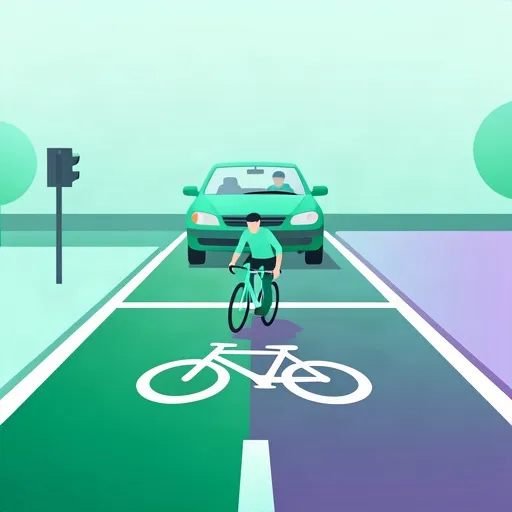
Article content overview
In Belgium, cyclists are recognized as vulnerable road users, and the Belgian Highway Code provides them with specific legal protections that every driver must master. Whether you are driving in Flanders, Wallonia, or the Brussels-Capital Region, understanding how to interact with cyclists at intersections and within cycle streets is a cornerstone of the Belgian driving theory exam. Failing to yield correctly or misunderstanding the status of a cyclist on the road is not just an exam failure point—it is a significant contributor to real-world traffic accidents.
One of the most frequent scenarios in the Belgian theory exam involves a driver intending to turn right while a cyclist is traveling straight ahead. Many learners mistakenly believe that if they are in front of the cyclist, they have the right of way. However, under the Belgian Highway Code, you must yield to any cyclist or moped rider traveling on a cycle path you are crossing, even if they are behind your vehicle when you begin your turn.
If you fail to check your right mirror and blind spot for approaching cyclists before turning, you risk cutting them off. This maneuver is considered a critical error in both practical driving and theoretical assessments because it places a vulnerable road user in immediate danger. Always assume the cyclist is there, reduce your speed, and ensure your path is clear before executing the turn.
Cycle streets, designated by the F111 and F113 signs, represent a unique environment where the traditional hierarchy of the road changes. In these zones, the road is designed primarily for cyclists, and motor vehicle drivers are considered guests. A key rule to remember for your exam is that while you are permitted to drive in a cycle street, you are strictly prohibited from overtaking any cyclist.
You must adjust your driving pace to match the cyclists ahead of you. If a cyclist is moving slower than your preferred speed, you must remain behind them until you have cleared the F113 sign. Overtaking a cyclist in a cycle street is a clear violation of the law and is frequently tested as a "serious error" in theory questions.
The law is very specific regarding how much space you must give a cyclist when overtaking them outside of a cycle street. To ensure safety, you must maintain a lateral distance of at least 1 meter when driving within built-up areas. This distance increases to at least 1.5 meters when you are outside built-up areas, where vehicle speeds are typically higher and the wind blast from a passing car can easily destabilize a cyclist.
In 30 km/h zones or lower, cyclists have additional rights that may surprise new drivers. They are legally permitted to ride two abreast and may position themselves in the middle of the traffic lane if it is too narrow for a vehicle to pass safely. As a driver, you must be patient, maintain a safe distance, and only overtake when the maneuver can be completed entirely within the legal safety margins.
| Scenario | Rule for Drivers |
|---|---|
| Turning right across a bike lane | Yield to all cyclists, even if they are behind you. |
| In a Cycle Street (Fietsstraat) | Overtaking cyclists is strictly forbidden. |
| Overtaking in built-up areas | Minimum 1 meter lateral distance required. |
| Overtaking outside built-up areas | Minimum 1.5 meters lateral distance required. |
| Narrow roads / Limited space | Wait behind the cyclist; do not force a pass. |
The Belgian Highway Code grants cyclists special protections as vulnerable road users, and drivers must yield to them in specific situations. When turning right across a cycle path, you must always yield to cyclists regardless of their position. Cycle streets (fietsstraten) designated by F111 signs require drivers to stay behind cyclists without overtaking, while F113 signs indicate the end of these restrictions. Safe overtaking demands at least 1 meter lateral distance in built-up areas and 1.5 meters outside them, and drivers must wait if these distances cannot be maintained. Understanding these rules is essential for both passing the Belgian theory exam and ensuring road safety.
A short set of high-value points that capture the most important ideas from this article.
When turning right across a cycle path, always yield to cyclists even if they are behind your vehicle
In cycle streets (fietsstraten), drivers are guests and overtaking cyclists is strictly prohibited
Minimum lateral passing distance is 1 meter in built-up areas and 1.5 meters outside built-up areas
In 30 km/h zones, cyclists can legally ride two abreast and position themselves in the middle of narrow lanes
If you cannot maintain the required lateral distance when overtaking, you must wait behind the cyclist
F111 sign marks the start of a cycle street where overtaking is forbidden and maximum speed is 30 km/h
F113 sign marks the end of the cycle street where normal rules resume
Cyclists are classified as vulnerable road users under Belgian traffic law
The Dutch Reach technique involves opening car doors with the opposite hand to avoid hitting cyclists
In Belgium, priority from the right applies unless traffic signs indicate otherwise
Assuming you have priority over a cyclist when turning right because your vehicle is ahead
Attempting to overtake cyclists inside a cycle street (fietsstraat) zone
Forgetting the mandatory 1-meter minimum lateral distance when passing cyclists in urban areas
Not checking mirrors and blind spots for cyclists before turning across a cycle path
Assuming cyclists must move aside in narrow lanes when drivers want to pass
Article content overview
A short set of high-value points that capture the most important ideas from this article.
When turning right across a cycle path, always yield to cyclists even if they are behind your vehicle
In cycle streets (fietsstraten), drivers are guests and overtaking cyclists is strictly prohibited
Minimum lateral passing distance is 1 meter in built-up areas and 1.5 meters outside built-up areas
In 30 km/h zones, cyclists can legally ride two abreast and position themselves in the middle of narrow lanes
If you cannot maintain the required lateral distance when overtaking, you must wait behind the cyclist
F111 sign marks the start of a cycle street where overtaking is forbidden and maximum speed is 30 km/h
F113 sign marks the end of the cycle street where normal rules resume
Cyclists are classified as vulnerable road users under Belgian traffic law
The Dutch Reach technique involves opening car doors with the opposite hand to avoid hitting cyclists
In Belgium, priority from the right applies unless traffic signs indicate otherwise
Assuming you have priority over a cyclist when turning right because your vehicle is ahead
Attempting to overtake cyclists inside a cycle street (fietsstraat) zone
Forgetting the mandatory 1-meter minimum lateral distance when passing cyclists in urban areas
Not checking mirrors and blind spots for cyclists before turning across a cycle path
Assuming cyclists must move aside in narrow lanes when drivers want to pass
Explore related topics, search based questions, and concepts that learners often look up when studying Belgian Cycling Rules. These themes reflect real search intent and help you understand how this topic connects to wider driving theory knowledge in Belgium.
Find clear and practical answers to common questions learners often have about Belgian Cycling Rules. This section helps explain difficult points, remove confusion, and reinforce the key driving theory concepts that matter for learners in Belgium.
Yes, if you are turning right across a cycle path, you must yield to cyclists and moped riders on that path, even if they are behind your vehicle when you begin your turn.
In a cycle street, cyclists are given priority; they may use the full width of the lane, and motor vehicles are strictly prohibited from overtaking cyclists.
You must leave at least 1 meter of lateral distance in built-up areas and at least 1.5 meters outside built-up areas when overtaking cyclists.
In 30 km/h zones and below, cyclists may use the full width of the lane if it is safer or if the road is too narrow to pass them safely.
Continue your learning journey by exploring related articles and guides on specific Belgian traffic situations, advanced road signs, or vehicle safety topics. Use our search to pinpoint what you need to review next, deepening your understanding for your driving license theory exam.