
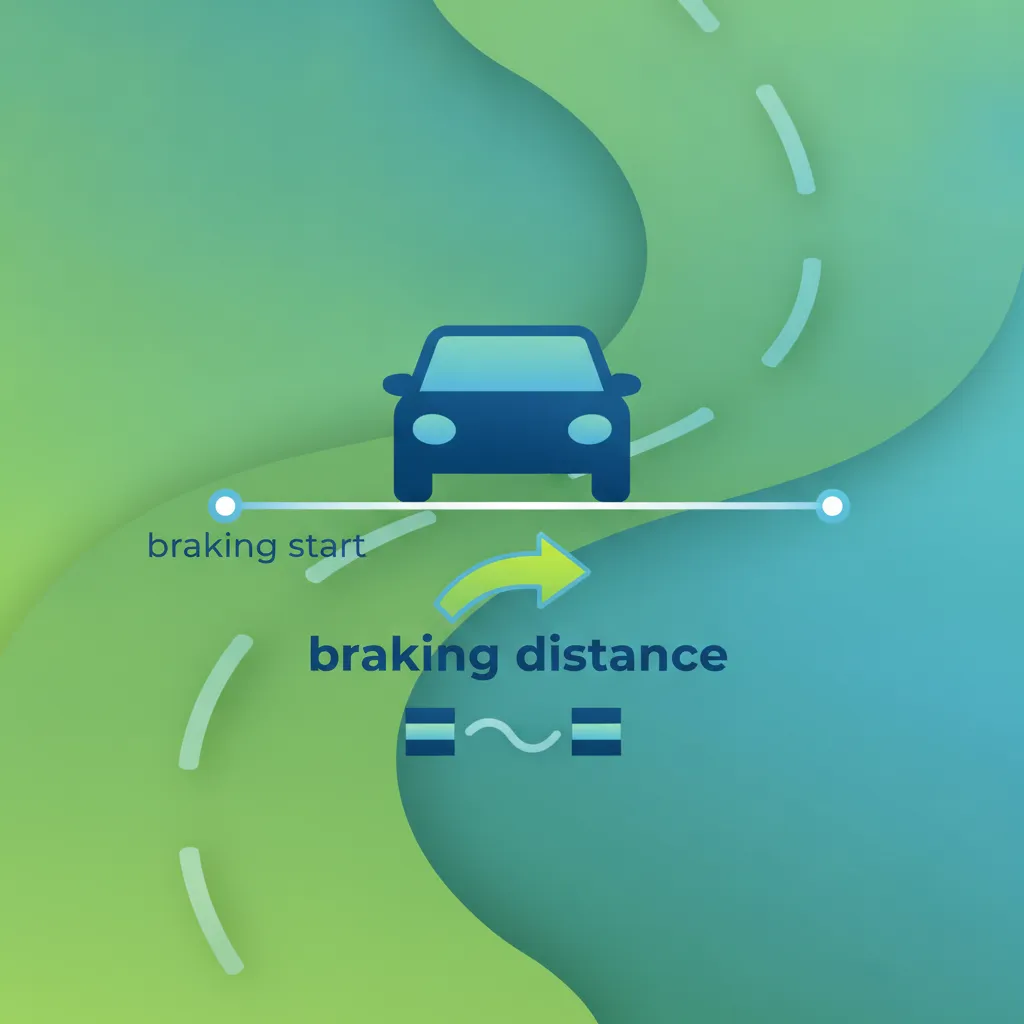
Braking distance is the critical measurement of how far your vehicle travels once you engage the brakes until it comes to a complete stop. This distance is not constant; it dramatically changes based on your speed, the road surface, and your vehicle's condition. For your Belgian driving theory test, it's essential to understand these influencing factors and how to adjust your driving to ensure adequate stopping capacity in all conditions.
Theory topic content overview
Read the full theory topic guide for Braking Distance with structured, easy-to-scan content built for learners in Belgium. This detailed section explains the exact rule, meaning, traffic context, comparison points, and exam logic behind this Belgian driving theory topic so you can study faster, understand the concept more clearly, and avoid common interpretation mistakes on the theory test.
Braking distance, known in French as distance de freinage and in Dutch as remweg, is a fundamental concept for every driver in Belgium. It defines the precise distance your vehicle travels from the moment you firmly depress the brake pedal until it comes to a complete halt. This is a critical component of overall stopping distance and is heavily emphasized in Belgian driving theory due to its direct impact on road safety.
Unlike reaction distance, which involves human perception and decision-making, braking distance is purely about the physical process of your vehicle slowing down and stopping once the brakes are engaged. Understanding the factors that influence this distance is paramount for preventing collisions on Belgian roads.
For both your Belgian driving theory exam and everyday safe driving, a clear understanding of braking distance is indispensable.
The most significant factor influencing braking distance is your vehicle's speed. This relationship is not linear; it's exponential:
This principle is vital for the Belgian theory exam. For example, if your braking distance at 30 km/h is 9 metres, at 60 km/h (double the speed), it won't be 18 metres, but closer to 36 metres. This dramatic increase is due to the vehicle's kinetic energy, which must be dissipated by the braking system and tire friction. Many drivers fail to grasp just how much extra space they need at higher speeds, leading to dangerous situations.
Beyond speed, several other elements critically influence how quickly your vehicle can stop on Belgian roads:
Road Surface Conditions:
Tyre Condition:
profondeur de profil / profiel diepte) have less grip, especially on wet surfaces, greatly increasing braking distance. Belgian law specifies minimum tread depths.pneus hiver / winterbanden) offer better grip in cold and snowy conditions, reducing braking distance compared to summer tyres.Vehicle Condition:
Road Gradient:
This is a critical area for the Belgian theory exam. Let's clarify the definitions:
distance de réaction / reactieafstand): The distance your vehicle travels from the moment a driver perceives a hazard until they begin to apply the brakes. For an attentive driver, this is typically around one second. Factors like fatigue, distraction, alcohol, or drugs significantly increase reaction time and thus reaction distance.distance de freinage / remweg): The distance your vehicle travels after the brakes are applied until the vehicle comes to a complete stop. This is purely mechanical.distance d'arrêt / stopafstand): The total distance your vehicle travels from the moment a driver perceives a hazard until the vehicle is fully stationary. It is the sum of reaction distance and braking distance.
Many accidents occur because drivers confuse these concepts or only account for braking distance, forgetting the crucial reaction time involved.
Consider these situations on Belgian roads:
Nationale Road (National Road): You're travelling at 70 km/h on a typically winding national road when a deer suddenly appears from the roadside. Your reaction distance (around 1 second) means you'll cover roughly 19.4 metres before you even touch the brakes. If the road is wet, your braking distance will be significantly extended, potentially by another 25 metres on top of the dry braking distance, dramatically increasing the total stopping distance and the likelihood of a collision.Ring (Ring Road): You're on the Brussels Ring at 90 km/h and traffic ahead suddenly slows. If you only consider the braking distance for a dry road, you might not leave enough room. The sheer volume of traffic and the often-wet conditions in Belgium demand a much greater safety margin to allow for your reaction time and the increased braking distance.Zone 30: Even at 30 km/h in a residential zone 30, a child could step into the road. While braking distance is shorter at lower speeds, your reaction distance is still a factor. The total stopping distance can still be significant enough to prevent a quick stop, highlighting that speed limits are maximums, not always safe speeds.distance d'arrêt includes both phases. Many learners focus only on the mechanical stopping part.To ensure safety on Belgium's roads and to excel in your driving theory exam, always remember:
By truly understanding braking distance – remweg or distance de freinage – and its many influencing factors, you become a safer, more responsible driver equipped for any challenge on Belgian roads.
Braking distance is the mechanical distance a vehicle travels from brake application to full stop, fundamentally governed by speed, road surface conditions, tire condition, and vehicle maintenance. The relationship between speed and braking distance is exponential, meaning doubling speed roughly quadruples braking distance. In Belgium's often wet climate, stopping distances increase significantly on wet roads, requiring drivers to maintain larger safety margins. Understanding the distinction between reaction distance (the human perception phase, typically one second for an attentive driver) and braking distance (purely mechanical) is essential for calculating total stopping distance and avoiding rear-end collisions. Modern safety systems like ABS and ESP assist with vehicle control but do not eliminate the need for proper speed management, following distances, and regular vehicle maintenance.
A short set of high-value points that capture the most important ideas from this theory explanation.
Braking distance is the mechanical distance traveled from brake application to complete stop, separate from the human reaction phase.
Doubling your speed roughly quadruples your braking distance due to exponential kinetic energy relationship.
Road surface conditions dramatically affect braking distance: wet roads, ice, snow, and loose surfaces all increase required stopping distance.
Stopping distance equals reaction distance plus braking distance; ignoring either component leads to dangerous miscalculations.
Vehicle maintenance, especially tire tread depth and brake condition, directly determines your actual braking performance.
At 30 km/h braking distance is about 9 metres, but at 60 km/h it becomes approximately 36 metres (quadrupled).
On wet roads at 70 km/h, you need approximately 25 metres more stopping distance than on dry roads.
Stopping distance = Reaction distance + Braking distance.
ABS maintains steering control during emergency braking but does not necessarily shorten overall braking distance.
Worn tires with insufficient tread depth greatly increase braking distance, especially on wet surfaces.
Assuming braking distance doubles when speed doubles, when it actually quadruples.
Only considering braking distance while forgetting reaction distance when calculating safe following distance.
Over-relying on ABS and ESP to compensate for poor road conditions or excessive speed.
Failing to adjust speed and following distance for Belgium's frequently wet road conditions.
Neglecting regular checks of tire tread depth and brake system condition.
Start with a short, direct summary of Braking Distance before reading the full explanation below.
Braking distance is the total distance a vehicle covers from the instant the driver presses the brake pedal until the vehicle becomes fully stationary. It is a crucial component of overall stopping distance, which also includes reaction distance. In Belgium, understanding how speed, road conditions, and vehicle maintenance impact this distance is vital for both traffic safety and the theory exam.
Review the most important terms, rule signals, and traffic concepts linked to Braking Distance.
Explore related theory topic pages connected to Braking Distance and continue with the next useful rule explanation.
See the common search queries learners use when trying to understand Braking Distance in Belgium.

Start your comprehensive preparation for the Belgian driving licence theory exam. Dive into our expertly curated topics, master the road rules and concepts, and build the confidence you need to pass your test and drive safely on Belgian roads. Begin mastering theory today.
Explore Belgian Theory TopicsTheory topic content overview
A short set of high-value points that capture the most important ideas from this theory explanation.
Braking distance is the mechanical distance traveled from brake application to complete stop, separate from the human reaction phase.
Doubling your speed roughly quadruples your braking distance due to exponential kinetic energy relationship.
Road surface conditions dramatically affect braking distance: wet roads, ice, snow, and loose surfaces all increase required stopping distance.
Stopping distance equals reaction distance plus braking distance; ignoring either component leads to dangerous miscalculations.
Vehicle maintenance, especially tire tread depth and brake condition, directly determines your actual braking performance.
At 30 km/h braking distance is about 9 metres, but at 60 km/h it becomes approximately 36 metres (quadrupled).
On wet roads at 70 km/h, you need approximately 25 metres more stopping distance than on dry roads.
Stopping distance = Reaction distance + Braking distance.
ABS maintains steering control during emergency braking but does not necessarily shorten overall braking distance.
Worn tires with insufficient tread depth greatly increase braking distance, especially on wet surfaces.
Assuming braking distance doubles when speed doubles, when it actually quadruples.
Only considering braking distance while forgetting reaction distance when calculating safe following distance.
Over-relying on ABS and ESP to compensate for poor road conditions or excessive speed.
Failing to adjust speed and following distance for Belgium's frequently wet road conditions.
Neglecting regular checks of tire tread depth and brake system condition.
Start with a short, direct summary of Braking Distance before reading the full explanation below.
Braking distance is the total distance a vehicle covers from the instant the driver presses the brake pedal until the vehicle becomes fully stationary. It is a crucial component of overall stopping distance, which also includes reaction distance. In Belgium, understanding how speed, road conditions, and vehicle maintenance impact this distance is vital for both traffic safety and the theory exam.
Review the most important terms, rule signals, and traffic concepts linked to Braking Distance.
Explore related theory topic pages connected to Braking Distance and continue with the next useful rule explanation.
See the common search queries learners use when trying to understand Braking Distance in Belgium.
Start your comprehensive preparation for the Belgian driving licence theory exam. Dive into our expertly curated topics, master the road rules and concepts, and build the confidence you need to pass your test and drive safely on Belgian roads. Begin mastering theory today.
Explore Belgian Theory TopicsUse this exam-focused revision tip to understand how Braking Distance is likely to appear in theory questions for learners in Belgium. This section helps you identify the most testable part of the rule, avoid common traps, and remember the concept more effectively during Belgian driving theory exam preparation.
For the Belgian theory exam, pay close attention to questions about the relationship between speed and braking distance. Remember that if your speed doubles, your braking distance roughly quadruples. Also, be aware that adverse weather conditions (rain, ice, snow) dramatically extend the required stopping distance, a common trap in exam scenarios.
Read direct answers to the most common learner questions about Braking Distance in Belgium. This FAQ focuses on rule confusion, practical meaning, comparison with similar concepts, and the exact uncertainties that appear most often in Belgian driving theory revision and exam preparation.
Braking distance is the distance your vehicle travels from the moment you apply the brakes until it comes to a complete halt. It is distinct from reaction distance, which occurs before braking begins.
In Belgium, as in other countries, braking distance increases exponentially with speed. Doubling your speed roughly quadruples your braking distance due to the increase in kinetic energy. This is a crucial concept for safe driving and the Belgian theory exam.
Stopping distance is the total distance a vehicle needs to stop, comprising both the reaction distance (the time it takes the driver to react and apply brakes) and the braking distance (the distance covered while braking).
Key factors influencing braking distance include road grip (e.g., wet, icy, or gravel surfaces), tire condition (wear, pressure), the vehicle's braking system (maintenance, type), and the vehicle's weight or load.
In Belgium, wet, icy, or snow-covered roads significantly reduce tire grip, leading to much longer braking distances. Drivers must adjust their speed and increase following distances to compensate for these conditions, especially during Belgian winters.
While Anti-lock Braking Systems (ABS) help maintain steering control during emergency braking by preventing wheel lock-up, they do not always significantly shorten the braking distance on all surfaces. On loose surfaces like gravel, ABS might even slightly increase it, though it improves control.
Ready to focus your Belgian driving theory revision? Utilize our powerful search tool to pinpoint exact topics, road signs, or difficulty levels. Engage with practice questions that directly address your learning needs and solidify your understanding of Belgian traffic laws for your upcoming exam.