
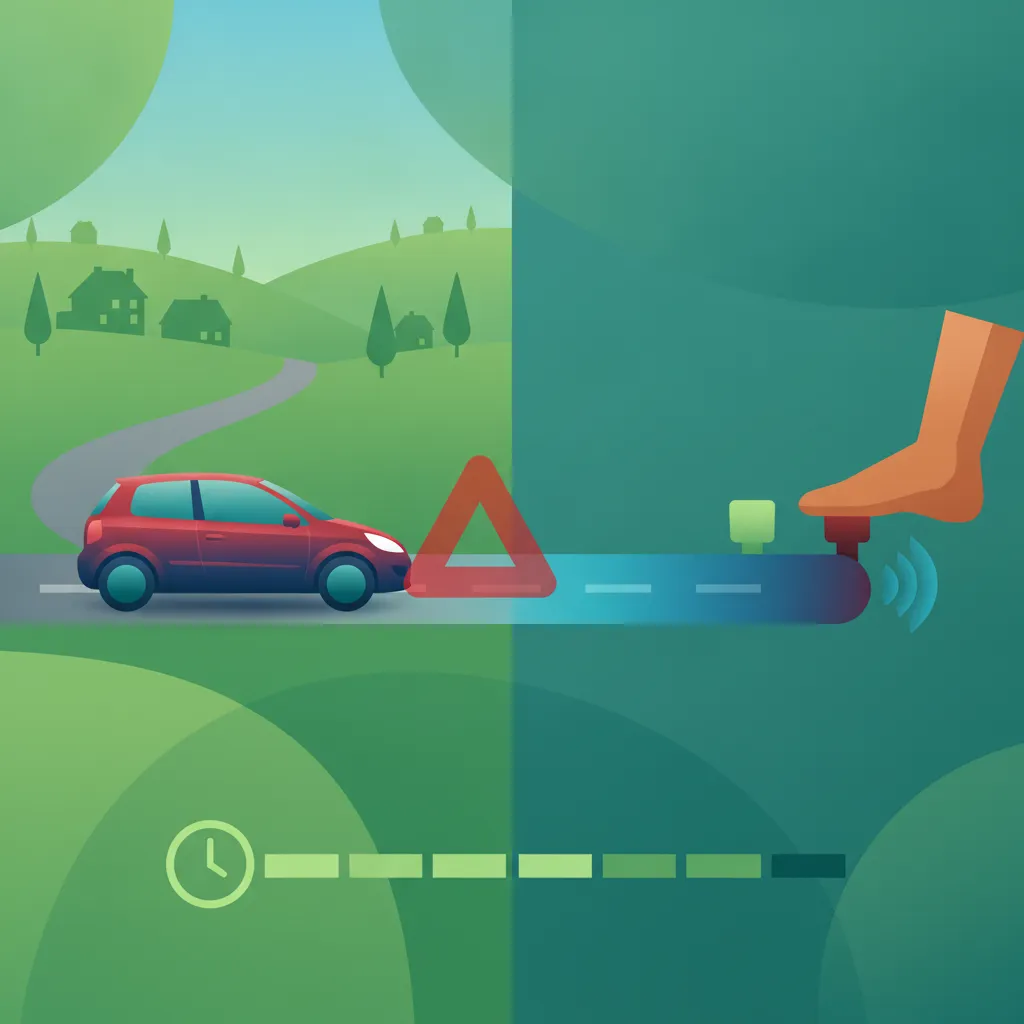
Reaction distance is the meters your vehicle covers from the moment you identify a hazard until you physically start to apply the brakes. It's a critical component of safe driving in Belgium, directly influenced by your speed, alertness, and various internal and external factors. Understanding this concept is fundamental for hazard perception and maintaining adequate safety margins on Belgian roads.
Theory topic content overview
Read the full theory topic guide for Reaction Distance Explained with structured, easy-to-scan content built for learners in Belgium. This detailed section explains the exact rule, meaning, traffic context, comparison points, and exam logic behind this Belgian driving theory topic so you can study faster, understand the concept more clearly, and avoid common interpretation mistakes on the theory test.
Reaction distance is a fundamental concept in Belgian driving theory that often goes underestimated. It refers to the crucial distance your vehicle travels from the precise moment you perceive a hazard until you physically begin to apply the brakes. This is the 'thinking and acting' phase before any deceleration from braking takes effect.
Understanding reaction distance is vital for every Belgian driver, as it forms the initial and often significant part of your total stopping distance. It's a direct measure of your responsiveness to unexpected situations on the road.
Your reaction distance is a direct consequence of your reaction time, which typically involves three distinct mental and physical phases:
For an alert and attentive driver, this entire process usually takes approximately one second (AWSR). During this seemingly short second, your vehicle continues to travel at its current speed, covering a considerable distance.
In Belgium, with its dense road network, varied traffic (including many vulnerable road users like cyclists and pedestrians), and sometimes unpredictable conditions, reaction distance becomes paramount for road safety:
The relationship between speed and reaction distance is linear: the faster you drive, the further your vehicle travels during your reaction time.
Even with a consistent one-second reaction time:
This demonstrates that even a small increase in speed translates to many extra meters covered before you even start to brake. VIAS research also highlights that at higher speeds, a driver's field of vision (gezichtsveld) narrows, requiring more time for perception and potentially lengthening the perception-reaction time.
While one second is a general average for an attentive driver, many factors can significantly lengthen this crucial period, increasing your reaction distance and collision risk:
It's common for learners to confuse reaction distance with braking distance, or to assume they are the same. Understanding the difference is vital for your theory exam and practical driving in Belgium:
In simple terms: Your brain works during reaction distance, your brakes work during braking distance. Both are crucial for safe stopping.
Consider these situations on Belgian roads:
Belgian driving theory candidates often make these errors regarding reaction distance:
To manage your reaction distance effectively and enhance road safety in Belgium:
Understanding and respecting reaction distance is a cornerstone of responsible driving in Belgium. It's not just about knowing the rule; it's about internalizing its impact on safety and adapting your driving behaviour accordingly.
Reaction distance measures the distance covered during the time it takes you to perceive a hazard, decide to brake, and physically move your foot to the pedal—typically about one second for an attentive driver. This distance increases linearly with speed, meaning at 50 km/h you travel roughly 14 meters before brakes engage, while at 120 km/h on a Belgian motorway you cover over 33 meters. Factors such as distraction, fatigue, alcohol, poor visibility, and inexperience can substantially lengthen reaction time beyond this baseline. Understanding that reaction distance is distinct from braking distance—and that both combine to form total stopping distance—is essential for safe following distances and passing Belgian driving theory exams.
A short set of high-value points that capture the most important ideas from this theory explanation.
Reaction distance is the distance your vehicle travels from spotting a hazard to your foot touching the brake pedal, before any deceleration begins.
The relationship between speed and reaction distance is linear: faster speed means more meters covered during your one-second average reaction time.
Your total stopping distance equals reaction distance plus braking distance—both are essential, and braking is not instantaneous.
Distraction, fatigue, alcohol, stress, poor visibility, and inexperience all significantly extend your reaction time beyond the normal one-second baseline.
Belgian law prohibits handheld phone use while driving specifically because it can increase reaction time by 20% to 40% or more.
Reaction time involves three phases: perception, processing/decision-making, and physical action—your brain works during reaction distance, your brakes work during braking distance.
At 50 km/h in Belgium, you travel roughly 14 meters before braking begins; at 120 km/h on the E19 motorway, this extends to over 33 meters.
AWSR data shows rear-end collisions account for over 15% of personal injury accidents in Wallonia, highlighting why adequate safety distances matter.
The '2 crocodiles' rule taught in Belgium gives you a practical buffer that accounts for your reaction time.
VIAS research indicates higher speeds narrow your field of vision, potentially lengthening perception time beyond the standard one-second assumption.
Assuming braking is instantaneous and that stopping begins immediately upon recognizing a hazard, which dramatically underestimates required safety distance.
Confusing reaction distance with braking distance or using the terms interchangeably, when they refer to completely different phases of stopping.
Believing their personal reaction time is always faster than the one-second average used in theory calculations, leading to overconfidence in following distances.
Overlooking how personal states like mild fatigue, stress, or distraction can significantly extend reaction time even when the driver feels capable.
Not adjusting speed for conditions, assuming the legal speed limit alone is sufficient regardless of visibility, road complexity, or traffic density.
Start with a short, direct summary of Reaction Distance Explained before reading the full explanation below.
Reaction distance is the distance your vehicle travels while you perceive a hazard, process it, and move your foot to the brake pedal. Even a fully attentive driver typically takes roughly one second to react, during which time the vehicle continues moving at its current speed. This distance increases directly with your speed and is significantly extended by factors such as distraction, fatigue, or alcohol, making it a critical part of your total stopping distance.
Review the most important terms, rule signals, and traffic concepts linked to Reaction Distance Explained.
Explore related theory topic pages connected to Reaction Distance Explained and continue with the next useful rule explanation.
See the common search queries learners use when trying to understand Reaction Distance Explained in Belgium.

Start your comprehensive preparation for the Belgian driving licence theory exam. Dive into our expertly curated topics, master the road rules and concepts, and build the confidence you need to pass your test and drive safely on Belgian roads. Begin mastering theory today.
Explore Belgian Theory TopicsTheory topic content overview
A short set of high-value points that capture the most important ideas from this theory explanation.
Reaction distance is the distance your vehicle travels from spotting a hazard to your foot touching the brake pedal, before any deceleration begins.
The relationship between speed and reaction distance is linear: faster speed means more meters covered during your one-second average reaction time.
Your total stopping distance equals reaction distance plus braking distance—both are essential, and braking is not instantaneous.
Distraction, fatigue, alcohol, stress, poor visibility, and inexperience all significantly extend your reaction time beyond the normal one-second baseline.
Belgian law prohibits handheld phone use while driving specifically because it can increase reaction time by 20% to 40% or more.
Reaction time involves three phases: perception, processing/decision-making, and physical action—your brain works during reaction distance, your brakes work during braking distance.
At 50 km/h in Belgium, you travel roughly 14 meters before braking begins; at 120 km/h on the E19 motorway, this extends to over 33 meters.
AWSR data shows rear-end collisions account for over 15% of personal injury accidents in Wallonia, highlighting why adequate safety distances matter.
The '2 crocodiles' rule taught in Belgium gives you a practical buffer that accounts for your reaction time.
VIAS research indicates higher speeds narrow your field of vision, potentially lengthening perception time beyond the standard one-second assumption.
Assuming braking is instantaneous and that stopping begins immediately upon recognizing a hazard, which dramatically underestimates required safety distance.
Confusing reaction distance with braking distance or using the terms interchangeably, when they refer to completely different phases of stopping.
Believing their personal reaction time is always faster than the one-second average used in theory calculations, leading to overconfidence in following distances.
Overlooking how personal states like mild fatigue, stress, or distraction can significantly extend reaction time even when the driver feels capable.
Not adjusting speed for conditions, assuming the legal speed limit alone is sufficient regardless of visibility, road complexity, or traffic density.
Start with a short, direct summary of Reaction Distance Explained before reading the full explanation below.
Reaction distance is the distance your vehicle travels while you perceive a hazard, process it, and move your foot to the brake pedal. Even a fully attentive driver typically takes roughly one second to react, during which time the vehicle continues moving at its current speed. This distance increases directly with your speed and is significantly extended by factors such as distraction, fatigue, or alcohol, making it a critical part of your total stopping distance.
Review the most important terms, rule signals, and traffic concepts linked to Reaction Distance Explained.
Explore related theory topic pages connected to Reaction Distance Explained and continue with the next useful rule explanation.
See the common search queries learners use when trying to understand Reaction Distance Explained in Belgium.
Start your comprehensive preparation for the Belgian driving licence theory exam. Dive into our expertly curated topics, master the road rules and concepts, and build the confidence you need to pass your test and drive safely on Belgian roads. Begin mastering theory today.
Explore Belgian Theory TopicsUse this exam-focused revision tip to understand how Reaction Distance Explained is likely to appear in theory questions for learners in Belgium. This section helps you identify the most testable part of the rule, avoid common traps, and remember the concept more effectively during Belgian driving theory exam preparation.
Remember that in Belgian driving theory questions, reaction distance is the *initial* part of stopping distance, occurring *before* braking begins. Always account for the time it takes to perceive, process, and act, especially when considering speed, distractions, or impaired driving. Don't assume braking is instantaneous.
Read direct answers to the most common learner questions about Reaction Distance Explained in Belgium. This FAQ focuses on rule confusion, practical meaning, comparison with similar concepts, and the exact uncertainties that appear most often in Belgian driving theory revision and exam preparation.
For an alert driver, the average reaction time is approximately one second. However, this can be extended significantly by factors like distraction or fatigue, leading to a longer reaction distance.
Reaction distance is the distance traveled by your vehicle from the moment you perceive a hazard until you start applying the brakes. Braking distance, on the other hand, is the distance traveled from when you apply the brakes until the vehicle comes to a complete stop. Together, they form the total stopping distance.
Reaction distance is directly proportional to speed. The faster you drive, the more meters your vehicle covers during your reaction time before you even begin to slow down, even if your reaction time itself doesn't change.
Distraction (e.g., mobile phone use), fatigue, alcohol or drug consumption, stress, and poor visibility are major factors that can significantly lengthen your reaction time and thus your reaction distance on Belgian roads.
The Belgian driving theory test frequently includes questions about hazard perception and how driver state, external conditions, and speed affect reaction distance. Understanding this concept is crucial for correctly assessing collision risks.
Maintaining a safe following distance, typically at least 2 seconds behind the vehicle in front, is designed to account for both your reaction distance and potential braking distance. This provides enough time to react and stop safely on Belgian roads.
Ready to focus your Belgian driving theory revision? Utilize our powerful search tool to pinpoint exact topics, road signs, or difficulty levels. Engage with practice questions that directly address your learning needs and solidify your understanding of Belgian traffic laws for your upcoming exam.