Understanding the unique requirements for tunnel driving is essential for both your safety on the road and your success in the Danish driving theory exam. This guide explains the strict prohibitions on stopping and turning, the rules regarding tunnel-specific signage, and the vital actions required if you encounter an emergency while underground.
Article content overview
Driving through a tunnel requires a higher level of alertness compared to open-road driving. In Denmark, major infrastructure projects like the Limfjordstunnel in Aalborg and the Øresund tunnel connecting Copenhagen to Peberholm are critical arteries for national traffic. Because these environments are confined and artificial, Danish traffic law—Færdselsloven—imposes specific regulations designed to prevent accidents and ensure the safety of all road users. Understanding these rules is not only vital for your personal safety but also a key requirement for passing your Danish driving theory exam.
When you enter a tunnel in Denmark, you are entering a high-regulation zone. The most fundamental rule is that you must always drive with your dipped headlights (nærlys) switched on, regardless of how well-lit the tunnel appears. This ensures that your vehicle is visible to both oncoming traffic and vehicles ahead, even if there are sudden changes in light levels or smoke.
In addition to lighting requirements, tunnels are strictly controlled environments where typical behaviors like stopping or reversing are prohibited. You must maintain a steady speed, follow the signaled lane instructions, and keep a significant distance from the vehicle in front of you. If a lane is marked with a red cross, it is closed, and you must merge into the open lane as soon as it is safe to do so.
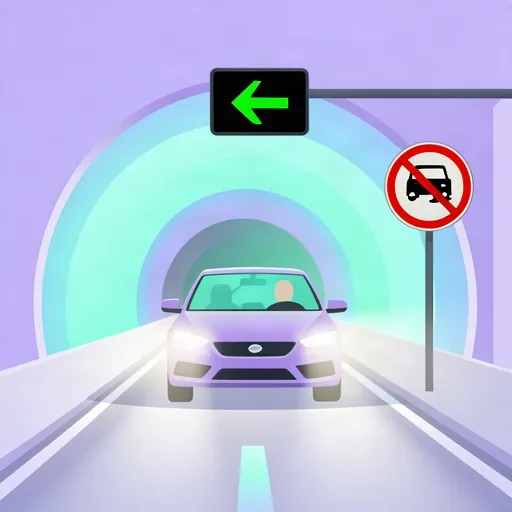
One of the most frequently tested topics in the Danish theory exam regarding tunnel safety is the restriction on vehicle types. Due to the risk of fire and potential gas accumulation, vehicles powered by Liquefied Petroleum Gas (LPG) or similar flammable pressurized gases are strictly prohibited from entering Danish road tunnels.
If you experience a vehicle breakdown or encounter a fire inside a tunnel, the priority is to clear the roadway and alert emergency services. If your vehicle is still mobile, attempt to drive it out of the tunnel. If you must stop, use the dedicated emergency niches (nødnicher) indicated by signage. If you cannot reach a niche, pull over as far to the right as possible and turn off your engine.
Tunnels in Denmark are equipped with advanced Intelligent Transport Systems (ITS) to manage traffic flow. These systems can change speed limits or close lanes dynamically based on traffic density or incidents. Pay close attention to overhead variable message signs and lane signals, as these override standard road rules.
Understanding these systems is essential because the theory exam often presents scenarios where a driver must decide how to react to a sudden lane closure or an emergency vehicle entering the tunnel. Always prioritize the instructions provided by the digital signals above the tunnel entrance or inside the tube itself.
Driving in Danish road tunnels requires strict adherence to specific safety regulations under Færdselsloven. The most critical rules are the mandatory use of dipped headlights for visibility and the absolute prohibition of LPG-powered vehicles due to fire risk in enclosed spaces. In emergencies, the protocol is clear: activate hazard lights, use emergency niches or pull right, switch off the engine, evacuate to marked exits, and call 112. Dynamic ITS signage and lane signals take precedence over standard road rules, and failing to follow them represents a common exam-relevant mistake.
A short set of high-value points that capture the most important ideas from this article.
Dipped headlights (nærlys) are mandatory in all Danish tunnels regardless of how well-lit the interior appears
Vehicles powered by LPG or flammable pressurized gases are strictly prohibited from entering Danish road tunnels due to fire and explosion risk
Use designated emergency niches (nødnicher) for breakdowns; if unavailable, pull as far right as possible and switch off your engine
Intelligent Transport Systems (ITS) can dynamically change speed limits or close lanes, and their signals override standard road rules
If you must evacuate, proceed to exits marked with the green running figure sign and call 112 from emergency phones
Red cross over a lane means it is closed—merge into the open lane immediately and safely
Even if you can see well inside a tunnel, other drivers cannot see your vehicle without headlights on
LPG restrictions apply to all major tunnels including Limfjordstunnel and Øresund tunnel
Always follow overhead variable message signs over any posted static signage
The emergency number in Denmark is 112 for police, ambulance, and fire services
Believing that good tunnel lighting makes headlights optional—nærlys is legally required regardless
Attempting to reverse or turn around in a tunnel if you miss your exit, which is strictly prohibited
Failing to activate hazard lights immediately when experiencing a breakdown in a tunnel
Not keeping sufficient distance from the vehicle ahead, reducing reaction time in confined tunnel environments
Ignoring dynamic ITS lane signals because they differ from the standard posted speed limit
Article content overview
A short set of high-value points that capture the most important ideas from this article.
Dipped headlights (nærlys) are mandatory in all Danish tunnels regardless of how well-lit the interior appears
Vehicles powered by LPG or flammable pressurized gases are strictly prohibited from entering Danish road tunnels due to fire and explosion risk
Use designated emergency niches (nødnicher) for breakdowns; if unavailable, pull as far right as possible and switch off your engine
Intelligent Transport Systems (ITS) can dynamically change speed limits or close lanes, and their signals override standard road rules
If you must evacuate, proceed to exits marked with the green running figure sign and call 112 from emergency phones
Red cross over a lane means it is closed—merge into the open lane immediately and safely
Even if you can see well inside a tunnel, other drivers cannot see your vehicle without headlights on
LPG restrictions apply to all major tunnels including Limfjordstunnel and Øresund tunnel
Always follow overhead variable message signs over any posted static signage
The emergency number in Denmark is 112 for police, ambulance, and fire services
Believing that good tunnel lighting makes headlights optional—nærlys is legally required regardless
Attempting to reverse or turn around in a tunnel if you miss your exit, which is strictly prohibited
Failing to activate hazard lights immediately when experiencing a breakdown in a tunnel
Not keeping sufficient distance from the vehicle ahead, reducing reaction time in confined tunnel environments
Ignoring dynamic ITS lane signals because they differ from the standard posted speed limit
Explore related topics, search based questions, and concepts that learners often look up when studying Danish Tunnel Driving Rules. These themes reflect real search intent and help you understand how this topic connects to wider driving theory knowledge in Denmark.
Find clear and practical answers to common questions learners often have about Danish Tunnel Driving Rules. This section helps explain difficult points, remove confusion, and reinforce the key driving theory concepts that matter for learners in Denmark.
No, vehicles powered by or carrying LPG (liquefied petroleum gas) tanks are strictly prohibited in Danish road tunnels due to the high risk of fire and explosion in confined spaces.
If possible, move your vehicle to the nearest emergency bay (nødniche). If you must stop, turn on your hazard lights, switch off the engine, leave the vehicle immediately, and proceed on foot to the nearest emergency exit marked with a green sign.
Yes, you must have your dipped headlights (nærlys) switched on at all times when driving through a tunnel in Denmark to ensure you are visible and to adapt to the changing light conditions.
No, reversing and making U-turns are strictly prohibited in all tunnels. These actions create an extreme danger to other road users in a confined environment.
Continue your learning journey by searching for additional articles or browsing our comprehensive topic categories. Deepen your knowledge of Danish road law, vehicle mechanics, and hazard perception to ensure complete preparation for your official theory exam.