
Driving while distracted by a mobile device is a major contributor to traffic accidents and carries severe legal consequences in Denmark. This guide outlines exactly what you are permitted to do, the requirements for hands-free systems, and the penalties you face for violating these essential road safety rules.
Article content overview
Driving on Danish roads demands your full and undivided attention. According to the Danish Road Traffic Act (Færdselsloven), mobile phone usage while driving is strictly regulated to prevent distracted driving, which remains one of the most common causes of serious traffic accidents in Denmark. Whether you are preparing for your theory exam or have recently received your driving license, understanding these rules is essential to maintaining road safety and avoiding significant legal penalties.
Under section 55 of the Danish Road Traffic Act, a driver is strictly prohibited from holding a mobile phone or any other similar communication device while the vehicle is in motion. It is a common misconception that this rule only applies when the vehicle is moving at speed. In the eyes of Danish law, being stationary at a traffic light, in a queue, or during a stop in traffic still counts as "driving." Therefore, picking up your phone to check a message or change a playlist while waiting for a green light is a direct violation of the law.
Distracted driving occurs when a driver engages in any activity that diverts their attention from the primary task of operating the vehicle safely. This includes not only phone usage but also adjusting complex multimedia systems, eating, or being significantly distracted by passengers.
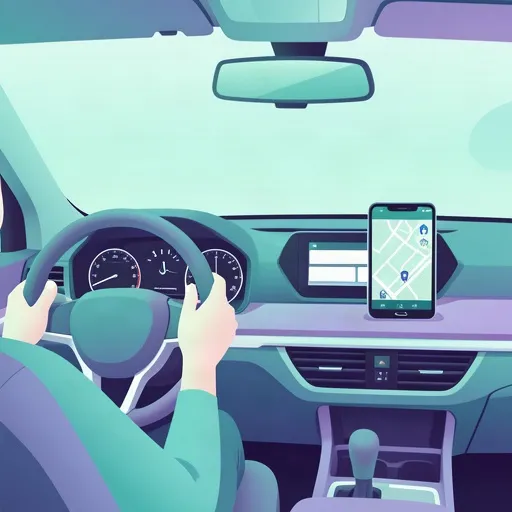
The law does not ban the use of mobile devices entirely, but it mandates that any use must be "hands-free." To legally use a mobile phone for navigation or communication while driving, the device must be securely fixed in a dedicated holder or mount. The mount must be installed in a way that allows you to operate the device or view the screen without holding the phone in your hand.
If you are using your smartphone as a GPS navigator, it must be placed in a holder on the dashboard or windshield, provided that it does not obstruct your field of vision. Simply resting the phone on your lap, the passenger seat, or the center console is not considered "hands-free" and remains illegal. Furthermore, while the device is in a holder, you may use it for navigation or hands-free calls, but you should avoid repetitive or complex interactions that take your eyes off the road for extended periods.
Even if your phone is mounted in a holder, avoid manually typing addresses or searching for new destinations while the vehicle is moving. Always input your destination before you depart, or pull over safely to a parking area if you need to adjust your route.
Since the 2022 road safety reforms, the penalties for using a handheld mobile phone while driving have become significantly stricter. The Danish authorities enforce these rules through a system of fines (bøde) and penalty points (klip). A first-time offense typically results in a fine of DKK 1,500 and a penalty point on your driving license.
For new drivers, accumulating "klip" is particularly dangerous, as the threshold for suspension is lower. If you commit a second offense within a three-year period, the fine doubles to DKK 3,000, and you will receive an additional penalty point. If you accumulate too many points within a specific timeframe, your right to drive will be suspended, requiring you to undergo a re-examination process to regain your license.
| Action | Legality |
|---|---|
| Holding the phone while driving | Prohibited |
| Holding the phone while at a red light | Prohibited |
| Using phone mounted in a holder | Permitted |
| Using a headset/Bluetooth for calls | Permitted |
| Resting phone on lap for navigation | Prohibited |
The focus of the theory exam and practical instruction is to ensure you understand that safety depends on your readiness to react to hazards. Using a mobile phone, even hands-free, can lead to cognitive distraction. Danish driving education encourages drivers to set up their technology before the journey begins. If a situation arises where you must use your phone for an emergency or urgent navigation adjustment, the only legal way to do so is to steer the vehicle off the road and come to a complete, safe stop in a parking space or lay-by.
Denmark enforces strict rules against handheld mobile phone use while driving under Section 55 of Færdselsloven, with the legal definition of driving including stationary periods such as waiting at traffic lights. Any mobile phone use must be hands-free, meaning the device must be securely mounted in a holder that allows operation without manual handling, particularly when using GPS navigation. The penalty system has become stricter since 2022, imposing fines of DKK 1,500 for first offenses and DKK 3,000 for second offenses within three years, along with penalty points that can lead to license suspension. Safe practice involves configuring all devices before starting the engine and pulling over to a legal stopping place if device interaction becomes necessary during the journey.
A short set of high-value points that capture the most important ideas from this article.
Danish law prohibits holding a mobile phone while driving, including while stationary at traffic lights or in queues
Hands-free use requires the device to be securely mounted in a dedicated holder on the dashboard or windshield
Using your phone as a GPS requires it to be in a holder that allows viewing without holding the device
Cognitive distraction occurs even with hands-free devices, so drivers should minimize device interactions while moving
The legal definition of driving in Denmark includes being stationary at intersections or in traffic
Section 55 of Færdselsloven is the specific law governing mobile phone use while driving in Denmark
First offense penalty is DKK 1,500 plus one penalty point; second offense within three years doubles to DKK 3,000 plus another point
Accumulating too many Klip points can lead to license suspension and mandatory re-examination
Resting a phone on your lap, passenger seat, or center console does not count as hands-free and remains illegal
For new drivers, the penalty point threshold for suspension is lower than for experienced drivers
Assuming it is legal to hold a phone while stopped at a red light or in traffic, when Danish law considers this still 'driving'
Placing a phone on the passenger seat or center console and thinking this satisfies hands-free requirements
Using a mounted phone for complex tasks like typing addresses while the vehicle is moving, which is unsafe even if technically hands-free
Believing Bluetooth headsets alone make all phone use legal without considering mounting requirements for GPS use
Article content overview
A short set of high-value points that capture the most important ideas from this article.
Danish law prohibits holding a mobile phone while driving, including while stationary at traffic lights or in queues
Hands-free use requires the device to be securely mounted in a dedicated holder on the dashboard or windshield
Using your phone as a GPS requires it to be in a holder that allows viewing without holding the device
Cognitive distraction occurs even with hands-free devices, so drivers should minimize device interactions while moving
The legal definition of driving in Denmark includes being stationary at intersections or in traffic
Section 55 of Færdselsloven is the specific law governing mobile phone use while driving in Denmark
First offense penalty is DKK 1,500 plus one penalty point; second offense within three years doubles to DKK 3,000 plus another point
Accumulating too many Klip points can lead to license suspension and mandatory re-examination
Resting a phone on your lap, passenger seat, or center console does not count as hands-free and remains illegal
For new drivers, the penalty point threshold for suspension is lower than for experienced drivers
Assuming it is legal to hold a phone while stopped at a red light or in traffic, when Danish law considers this still 'driving'
Placing a phone on the passenger seat or center console and thinking this satisfies hands-free requirements
Using a mounted phone for complex tasks like typing addresses while the vehicle is moving, which is unsafe even if technically hands-free
Believing Bluetooth headsets alone make all phone use legal without considering mounting requirements for GPS use
Explore related topics, search based questions, and concepts that learners often look up when studying Denmark Mobile Phone Driving Rules. These themes reflect real search intent and help you understand how this topic connects to wider driving theory knowledge in Denmark.
Find clear and practical answers to common questions learners often have about Denmark Mobile Phone Driving Rules. This section helps explain difficult points, remove confusion, and reinforce the key driving theory concepts that matter for learners in Denmark.
No. In Denmark, 'driving' includes being stationary at a traffic light or in heavy traffic. Holding a mobile device at any time while the vehicle is in traffic is strictly prohibited.
You will be subject to a fine (bøde) and receive a penalty point (klip) on your driving license. Subsequent offences within a three-year period result in increased fines and additional penalty points.
No. Using a phone as a navigation device is only permitted if it is securely mounted in a holder. Holding the device for any reason, including navigation, is illegal while driving.
The device must be mounted in a holder or operated via voice control or pre-installed steering wheel buttons, allowing you to use it without touching the phone screen or holding the device.
Continue your learning journey by searching for additional articles or browsing our comprehensive topic categories. Deepen your knowledge of Danish road law, vehicle mechanics, and hazard perception to ensure complete preparation for your official theory exam.