Understanding the precise application of seatbelt laws in Denmark is essential for both safe driving and achieving a pass in your theory test. This guide breaks down the requirements for all occupants, the strict accountability of the driver regarding children, and the legal nuances of exemptions you are likely to encounter in official exam questions. Gain the clarity needed to navigate questions about passenger safety and legal compliance with confidence.
Article content overview
Understanding seatbelt regulations is a foundational element of your preparation for the Danish driving theory test. Under the Danish Road Traffic Act (Færdselsloven), seatbelts are not merely a suggestion; they are a mandatory safety feature that every driver and passenger must utilize. For the theory exam, it is crucial to recognize that the driver holds the legal responsibility for ensuring all passengers, particularly those under 15 years old, are correctly secured before the vehicle enters motion.
Failing to ensure children under 15 are correctly fastened can result in a fine, a penalty point on your driving license, and an additional fee to the Offerfonden. Always verify the safety equipment before starting the engine.
Danish law dictates that if a seat is equipped with a safety belt, it must be used. This applies to every seat in the vehicle, whether you are seated in the front or the back. There are very few exceptions to this rule, and for the purpose of your theory exam, you should assume that "belted is better" in every scenario presented. Even on short trips or at low speeds, the protection offered by the seatbelt remains a non-negotiable requirement for all occupants, including in commercial vehicles, vans, and taxis.
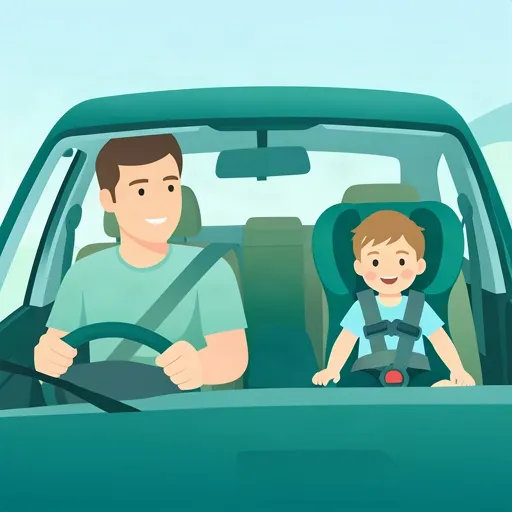
The driver is legally accountable for ensuring all passengers under the age of 15 are properly secured. If they are not using the required safety equipment, the driver receives the penalty, not the passenger.
A recurring theme in the Danish theory test involves questions about the transport of children. According to Færdselsloven § 80 a, children with a height of less than 135 cm must be secured using approved safety equipment that is appropriately sized for their height and weight. This equipment, such as a child seat (autostol) or a booster seat (selepude), must be approved under current ECE standards (such as i-Size or the ECE 44-04/03 regulations).
It is a common pitfall to assume that a child can simply use a regular adult seatbelt once they reach a certain age. However, the legislation focuses specifically on height. Until a child reaches the 135 cm threshold, they must use an approved restraint. Once they surpass this height, they may use the vehicle's standard seatbelt, provided it fits them correctly without causing injury.
The theory test often presents situational questions designed to test your knowledge of specific exemptions. For example, you might be asked about reversing a vehicle or driving in a private parking area. While the law contains very narrow exceptions—such as when a person is exempt due to medical documentation or during specific types of professional transport—you should be highly skeptical of any answer that suggests skipping seatbelts for general road travel.
| Scenario | Rule |
|---|---|
| Normal Driving | Seatbelt mandatory for all. |
| Reversing | Seatbelt may be removed. |
| Children < 135 cm | Approved safety seat mandatory. |
| Children < 15 years | Driver is responsible for compliance. |
| Medical Exception | Requires specific documentation. |
Always remember that if you are in doubt during an exam question, the safest legal action is to require the seatbelt. The "reversing" exemption is a classic trick, but it only applies strictly to the act of reversing, not to the entire journey.
The technical side of your theory test might touch upon the approval labels for child seats. Familiarizing yourself with the fact that ECE standards are the legal benchmark in Denmark will help you navigate questions regarding what constitutes "legal" safety equipment. Furthermore, ensure you understand that placing a rear-facing child seat in a seat with an active front airbag is strictly prohibited, as the deployment of the airbag can cause fatal injuries to the child.
Danish seatbelt law (Færdselsloven) mandates seatbelt use for all occupants in equipped seats, with the driver held legally responsible for passengers under 15. The critical 135 cm height rule determines when children must transition from approved child restraints to standard seatbelts, not their age. The theory exam frequently tests knowledge of the narrow reversing exemption and emphasizes that medical or other exceptions require documentation. Understanding driver accountability, ECE approval standards for child seats, and the mandatory airbag deactivation for rear-facing seats in front positions forms the core of exam-ready knowledge on this topic.
A short set of high-value points that capture the most important ideas from this article.
The driver bears full legal responsibility for ensuring all passengers under 15 are properly secured with seatbelts or approved child restraints
Children under 135 cm must use approved safety equipment regardless of age, until they reach that height threshold
Standard adult seatbelts are only permitted once a child exceeds 135 cm, not based on age alone
Child safety seats must meet current ECE standards such as i-Size (R129) or ECE 44-04/03
Placing a rear-facing child seat in the front seat requires deactivating the front passenger airbag to prevent fatal injury
The 135 cm height rule is the legal threshold for switching from child restraint to standard seatbelt
The reversing exemption only applies during the actual act of reversing, not throughout a journey
Driver penalties (fine, penalty point, Offerfonden fee) apply when passengers under 15 are unsecured, not to the passenger
Medical exemptions require specific documentation and are not assumed
ECE approval labels (R129, 44-04/03) are the legal benchmark for acceptable child safety equipment in Denmark
Assuming age determines when a child can use a standard seatbelt instead of the 135 cm height requirement
Overestimating the reversing exemption by thinking seatbelts can be removed for more than just reversing maneuvers
Forgetting to deactivate the front airbag when installing a rear-facing child seat in the front passenger seat
Believing short trips or low-speed driving permit seatbelt exceptions for passengers
Confusing which penalties apply to the driver versus the passenger when children are unsecured
Article content overview
A short set of high-value points that capture the most important ideas from this article.
The driver bears full legal responsibility for ensuring all passengers under 15 are properly secured with seatbelts or approved child restraints
Children under 135 cm must use approved safety equipment regardless of age, until they reach that height threshold
Standard adult seatbelts are only permitted once a child exceeds 135 cm, not based on age alone
Child safety seats must meet current ECE standards such as i-Size (R129) or ECE 44-04/03
Placing a rear-facing child seat in the front seat requires deactivating the front passenger airbag to prevent fatal injury
The 135 cm height rule is the legal threshold for switching from child restraint to standard seatbelt
The reversing exemption only applies during the actual act of reversing, not throughout a journey
Driver penalties (fine, penalty point, Offerfonden fee) apply when passengers under 15 are unsecured, not to the passenger
Medical exemptions require specific documentation and are not assumed
ECE approval labels (R129, 44-04/03) are the legal benchmark for acceptable child safety equipment in Denmark
Assuming age determines when a child can use a standard seatbelt instead of the 135 cm height requirement
Overestimating the reversing exemption by thinking seatbelts can be removed for more than just reversing maneuvers
Forgetting to deactivate the front airbag when installing a rear-facing child seat in the front passenger seat
Believing short trips or low-speed driving permit seatbelt exceptions for passengers
Confusing which penalties apply to the driver versus the passenger when children are unsecured
Explore related topics, search based questions, and concepts that learners often look up when studying Danish Seatbelt Laws and Rules. These themes reflect real search intent and help you understand how this topic connects to wider driving theory knowledge in Denmark.
Find clear and practical answers to common questions learners often have about Danish Seatbelt Laws and Rules. This section helps explain difficult points, remove confusion, and reinforce the key driving theory concepts that matter for learners in Denmark.
The driver is legally responsible for ensuring that all passengers under the age of 15 are properly secured in the vehicle.
Children under 135 cm in height must use an approved child restraint system, such as a car seat or booster seat, tailored to their height and weight.
Exemptions exist for specific situations like driving in reverse or in certain parking areas, as well as for individuals with documented medical reasons, though these are strictly defined by law.
Failing to secure a child under 15 correctly can result in a fine, a penalty point on the driver's license, and an additional fee to the Offerfonden.
Continue your learning journey by searching for additional articles or browsing our comprehensive topic categories. Deepen your knowledge of Danish road law, vehicle mechanics, and hazard perception to ensure complete preparation for your official theory exam.