
In a Legehede zone, drivers encounter unique traffic conditions that differ significantly from typical urban roads. This guide clarifies the legal requirements for navigating these areas, focusing on the mandatory walking-pace speed limit and the absolute right-of-way granted to pedestrians. Mastering these rules is crucial for both theoretical understanding and real-world hazard perception in residential Danish neighborhoods.
Article content overview
In Denmark, navigating residential areas requires more than just standard situational awareness; it demands an understanding of specific, protected zones where traffic legislation shifts in favor of vulnerable road users. A Legehede, or "play area," is a designated street or neighborhood where the normal hierarchy of road users is inverted. Understanding how these zones operate is a critical component of the Danish driving theory exam, as they represent a fundamental departure from the standard "Zone 30" urban traffic rules.
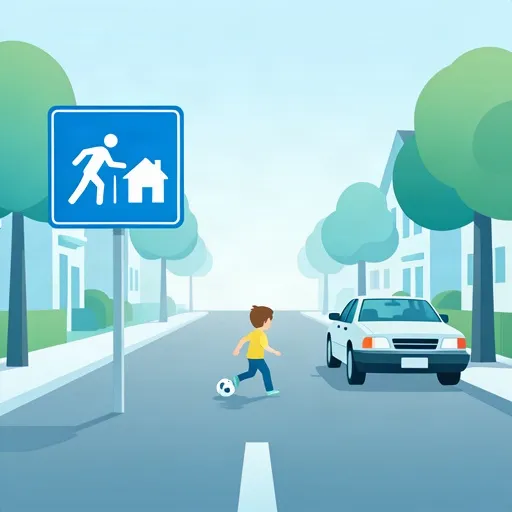
The Legehede is marked by a distinctive blue rectangular sign, which features a white pictogram of an adult and a child playing. This sign indicates that you are entering a space where the street is effectively shared and the safety of pedestrians is the absolute priority. When you see this sign, you must immediately transition your driving style, as the legal rules governing speed and priority change the moment you cross the threshold into the zone.
Inside a Legehede, the legal framework changes to prioritize human activity over vehicular movement. Under the Danish Færdselsloven, drivers must observe several strict requirements:
First, your speed must be limited to skridt tempo, which translates to a "walking pace." While there is no specific kilometer-per-hour figure mandated in the law, this is widely understood as approximately 15 km/h. This speed is not merely a suggestion; it is a legal requirement designed to ensure you can stop instantly if a child or pedestrian moves unexpectedly into your path.
Second, you must yield to everyone. Unlike on a standard street where pedestrians must wait for a safe gap, in a Legehede, pedestrians and cyclists have the right-of-way everywhere. You must be prepared to stop and wait for individuals to move, and they are not required to hurry for your convenience. Children are legally permitted to play across the entire width of the road, meaning you must be hyper-vigilant and prepared for sudden movements at all times.
Remember that in a Legehede, you must only park in marked, designated spaces. Parking outside of these areas is strictly prohibited to ensure the safety of playing children and the visibility of pedestrians.
One of the most frequent exam traps involves confusing a Legehede with a standard "Zone 30" or general residential street. In a Zone 30, the 30 km/h speed limit is the primary difference, but vehicles generally retain their priority over pedestrians on the road surface. In a Legehede, the priority shifts entirely to the pedestrian.
| Feature | Zone 30 (Residential) | Legehede (Play Area) |
|---|---|---|
| Max Speed | 30 km/h | Skridt tempo (~15 km/h) |
| Priority | Vehicle (mostly) | Pedestrian (absolute) |
| Pedestrian Space | Sidewalks | Full road width |
| Parking | Standard regulations | Marked spaces only |
In your theory exam, you will likely encounter scenarios involving hazard perception in residential areas. Examiners often present a picture of a street with children playing or a narrow road with a Legehede sign visible in the background. The core question usually tests your ability to recognize that, because you are in a Legehede, you cannot rely on the expectation that pedestrians will step aside.
The exam expects you to demonstrate "særlig agtpågivenhed" (special care) and "hensynsfuldhed" (consideration). This means if you see someone in the road, you do not just slow down; you must actively ensure they are aware of your presence and proceed only when it is safe to do so. Failing to demonstrate this level of caution—or failing to identify the sign—is a common reason for errors in the hazard perception section of the test.
A Legehede is a designated Danish play area where pedestrians hold absolute priority over vehicles, marked by a distinctive blue rectangular sign. Drivers must maintain skridt tempo (approximately 15 km/h) and yield to everyone on the road, including children playing across the full road width. The key distinction from a standard Zone 30 is that pedestrians never need to step aside for vehicles, and parking is restricted to marked spaces only. The Danish theory exam frequently tests recognition of Legehede zones and the correct speed and priority responses required.
A short set of high-value points that capture the most important ideas from this article.
A Legehede zone is marked by a blue rectangular sign showing an adult and child playing, signaling pedestrian absolute priority
Inside a Legehede, pedestrians have right-of-way across the entire road width, not just sidewalks
Speed must be at skridt tempo (walking pace), approximately 15 km/h, which is a legal requirement, not just a suggestion
Drivers must yield to everyone and be prepared to stop instantly for unexpected pedestrian movement
Children are legally permitted to play across the full width of the road in a Legehede
Skridt tempo means ~15 km/h, not the 30 km/h used in Zone 30 - these are different zones with different rules
Parking in a Legehede is only permitted in marked, designated spaces; random parking is prohibited
The Legehede sign is blue rectangular with a white pictogram of people playing
Priority shifts entirely to pedestrians in a Legehede, unlike Zone 30 where vehicles retain priority on the road
Legal terms: særlig agtpågivenhed (special care) and hensynsfuldhed (consideration) are required standards
Confusing a Legehede with a Zone 30 and assuming the 30 km/h speed limit applies
Thinking pedestrians must yield or step aside for vehicles in a Legehede - they do not
Failing to identify the Legehede sign when it appears in exam hazard perception scenarios
Assuming parking is allowed anywhere along the curb like in standard residential streets
Not demonstrating the required level of special attentiveness when pedestrians are present
Article content overview
A short set of high-value points that capture the most important ideas from this article.
A Legehede zone is marked by a blue rectangular sign showing an adult and child playing, signaling pedestrian absolute priority
Inside a Legehede, pedestrians have right-of-way across the entire road width, not just sidewalks
Speed must be at skridt tempo (walking pace), approximately 15 km/h, which is a legal requirement, not just a suggestion
Drivers must yield to everyone and be prepared to stop instantly for unexpected pedestrian movement
Children are legally permitted to play across the full width of the road in a Legehede
Skridt tempo means ~15 km/h, not the 30 km/h used in Zone 30 - these are different zones with different rules
Parking in a Legehede is only permitted in marked, designated spaces; random parking is prohibited
The Legehede sign is blue rectangular with a white pictogram of people playing
Priority shifts entirely to pedestrians in a Legehede, unlike Zone 30 where vehicles retain priority on the road
Legal terms: særlig agtpågivenhed (special care) and hensynsfuldhed (consideration) are required standards
Confusing a Legehede with a Zone 30 and assuming the 30 km/h speed limit applies
Thinking pedestrians must yield or step aside for vehicles in a Legehede - they do not
Failing to identify the Legehede sign when it appears in exam hazard perception scenarios
Assuming parking is allowed anywhere along the curb like in standard residential streets
Not demonstrating the required level of special attentiveness when pedestrians are present
Explore related topics, search based questions, and concepts that learners often look up when studying Danish Legehede Zone Rules. These themes reflect real search intent and help you understand how this topic connects to wider driving theory knowledge in Denmark.
Find clear and practical answers to common questions learners often have about Danish Legehede Zone Rules. This section helps explain difficult points, remove confusion, and reinforce the key driving theory concepts that matter for learners in Denmark.
The maximum speed allowed in a Legehede zone is 'skridt tempo', which refers to a walking pace, approximately 15 km/h.
Yes, pedestrians and children playing in a Legehede zone have absolute priority over motor vehicles at all times, and drivers must yield to them.
In a 30 km/h zone, vehicles generally retain priority over pedestrians on the road, whereas in a Legehede zone, pedestrians have priority and may use the entire width of the road for play.
Parking in a Legehede zone is only permitted in specially marked parking spaces.
Continue your learning journey by searching for additional articles or browsing our comprehensive topic categories. Deepen your knowledge of Danish road law, vehicle mechanics, and hazard perception to ensure complete preparation for your official theory exam.