Understanding how to safely interact with public buses is a fundamental requirement for every driver in Denmark. This guide details when you are legally required to yield to a departing bus, how to interpret bus priority signals, and the restrictions for driving in designated bus lanes to ensure you remain compliant with Danish traffic law and excel in your theory exam.
Article content overview
This article covers Denmark's specific rules for interacting with public buses under Færdselsloven §19, including the legal obligation to yield when a bus signals to pull out in built-up areas. It explains that dedicated bus lanes have paint markings and blue signs with time-based restrictions, and that unauthorized driving in them triggers automatic fines via ATK cameras. The article also clarifies how bus priority signals work at intersections and emphasizes that drivers must obey their own signals even when buses receive priority. Key Danish terminology such as *busbaner*, *rutebil*, and *ATK* are defined for theory exam preparation, making this essential study material for urban driving rules.
A short set of high-value points that capture the most important ideas from this article.
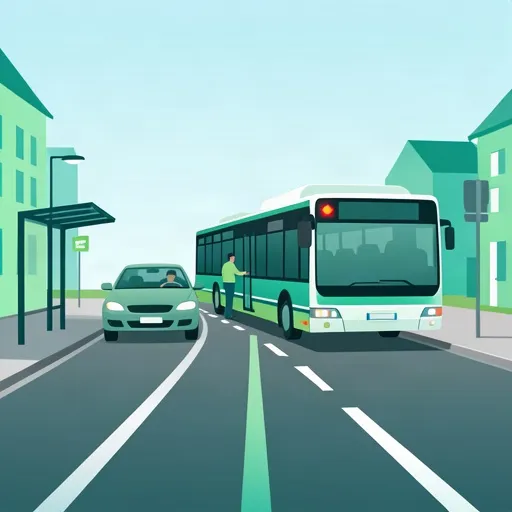
Under Færdselsloven §19, drivers in built-up areas must reduce speed or stop when a bus signals to pull out from a stop
Bus lanes (*busbaner*) are marked with paint and blue signs; driving in them without authorization results in automatic fines via ATK cameras
Bus lanes often have specific operating hours (typically 07:00–19:00 weekdays); outside these hours general traffic may be permitted with signs confirming
Bus priority signals give buses a dedicated green phase; you must still obey your own traffic signal and never enter on red
Bus priority applies only to service buses (*rutebiler*) in built-up areas, not to private coaches or tour buses
The yielding obligation only applies within built-up areas (*tættere bebygget område*) to service buses signaling departure
Bus lane time restrictions vary by location; always check supplementary signs for the specific hours at each lane
ATK cameras automatically issue fines for unauthorized bus lane use in cities like Copenhagen
When a bus priority signal is active, the intersection controller may extend green timing based on real-time bus scheduling data
Bus drivers retain their own duty of care and must not pull out if it creates immediate danger to other road users
Assuming bus lanes are always restricted without checking the time-based supplementary signs posted at each location
Entering a bus lane believing cyclists also use it means the lane is open to all vehicles (it is not)
Believing that if a bus is moving due to a priority signal, you may also proceed on a red light
Confusing private coaches or tour buses with *rutebiler* and applying bus priority rules to the wrong vehicles
Failing to reduce speed or prepare to stop when approaching a stationary bus at a stop, waiting for the signal to activate
Article content overview
A short set of high-value points that capture the most important ideas from this article.
Under Færdselsloven §19, drivers in built-up areas must reduce speed or stop when a bus signals to pull out from a stop
Bus lanes (*busbaner*) are marked with paint and blue signs; driving in them without authorization results in automatic fines via ATK cameras
Bus lanes often have specific operating hours (typically 07:00–19:00 weekdays); outside these hours general traffic may be permitted with signs confirming
Bus priority signals give buses a dedicated green phase; you must still obey your own traffic signal and never enter on red
Bus priority applies only to service buses (*rutebiler*) in built-up areas, not to private coaches or tour buses
The yielding obligation only applies within built-up areas (*tættere bebygget område*) to service buses signaling departure
Bus lane time restrictions vary by location; always check supplementary signs for the specific hours at each lane
ATK cameras automatically issue fines for unauthorized bus lane use in cities like Copenhagen
When a bus priority signal is active, the intersection controller may extend green timing based on real-time bus scheduling data
Bus drivers retain their own duty of care and must not pull out if it creates immediate danger to other road users
Assuming bus lanes are always restricted without checking the time-based supplementary signs posted at each location
Entering a bus lane believing cyclists also use it means the lane is open to all vehicles (it is not)
Believing that if a bus is moving due to a priority signal, you may also proceed on a red light
Confusing private coaches or tour buses with *rutebiler* and applying bus priority rules to the wrong vehicles
Failing to reduce speed or prepare to stop when approaching a stationary bus at a stop, waiting for the signal to activate
Explore related topics, search based questions, and concepts that learners often look up when studying Danish Bus Lane and Yielding Rules. These themes reflect real search intent and help you understand how this topic connects to wider driving theory knowledge in Denmark.
Find clear and practical answers to common questions learners often have about Danish Bus Lane and Yielding Rules. This section helps explain difficult points, remove confusion, and reinforce the key driving theory concepts that matter for learners in Denmark.
Under Færdselsloven §19, you are required to reduce speed and, if necessary, stop to allow a bus to pull out from a bus stop in a built-up area, provided the bus driver clearly indicates their intention to pull out with a turn signal.
Generally, bus lanes are restricted to buses, taxis, and cyclists. In Copenhagen, these lanes are strictly enforced, often by automatic cameras. Outside of operational hours, typically 07:00–19:00 on weekdays, some lanes may be open to general traffic, but you must always check local signage.
Some Danish intersections feature specific signals for public transport that allow buses to proceed before general traffic. You must observe these signals and ensure you do not enter an intersection during a bus-specific green phase if it obstructs the bus.
Continue your learning journey by searching for additional articles or browsing our comprehensive topic categories. Deepen your knowledge of Danish road law, vehicle mechanics, and hazard perception to ensure complete preparation for your official theory exam.