
This lesson is a critical part of your heavy vehicle training, focusing on the technical and legal requirements regarding vehicle mass. You will learn to distinguish between permissible total mass and actual mass, ensuring you can operate C1, C1E, C, and CE vehicles safely while avoiding dangerous overloading.

Lesson content overview
Operating heavy vehicles in Germany requires a thorough understanding of mass limitations, not only for legal compliance but critically for road safety. This lesson delves into the fundamental concepts of permissible total mass, actual mass, and payload, highlighting the severe risks and legal consequences associated with overloading. Mastering these principles is essential for every professional driver seeking a German heavy vehicle driving license in categories such as C1, C1E, C, and CE.
Effective mass management is a cornerstone of responsible heavy vehicle operation. It ensures that vehicles perform within their design capabilities, prevents damage to public infrastructure, and safeguards all road users. Without strict adherence to mass limits, the dynamics of a heavy vehicle change dramatically, introducing significant hazards.
Mass limits are not arbitrary figures; they are carefully calculated by vehicle manufacturers and regulatory bodies based on engineering specifications and infrastructure capacities. These limits ensure that components like brakes, tires, chassis, and suspension systems can safely manage the forces exerted by the vehicle's weight. Exceeding these limits compromises vehicle integrity and significantly increases accident risk.
Understanding the interplay between mass, inertia, and braking distance is vital. A heavier vehicle requires more force and distance to stop, and its handling characteristics are fundamentally altered. Professional drivers must internalize these physical principles alongside the legal requirements to ensure safe and compliant transport operations. This knowledge is interconnected with other critical areas, such as axle load distribution, braking system performance, and load securing principles, all of which contribute to overall vehicle stability and roadworthiness.
Before discussing the dangers of overloading, it is crucial to establish a clear understanding of the key terms that govern vehicle mass. These definitions form the basis for all load calculations and legal compliance checks.
The maximum mass for which a vehicle is legally approved, as specified in its registration documents. It combines the empty vehicle mass (tare weight) with the maximum admissible payload.
The Permissible Total Mass (PTM), known in German as the zulässige Gesamtmasse, represents the absolute upper limit of a vehicle's weight when fully loaded. This crucial figure is determined during the vehicle's type approval process and is documented in the vehicle's registration papers (e.g., Fahrzeugschein or Zulassungsbescheinigung Teil I). It dictates the maximum combined weight of the vehicle itself, its fuel, driver, passengers, and cargo.
The PTM is a non-negotiable limit designed to ensure safe operation, prevent undue wear on the vehicle, and protect road infrastructure like bridges and asphalt. Drivers must adhere to the PTM under all circumstances, irrespective of the journey length or road conditions. Any deviation can lead to serious legal penalties and significantly elevated safety risks. While some advanced vehicles may have load-sensing systems, the PTM remains the definitive legal boundary.
The real mass of the vehicle at any given moment, encompassing its empty weight, fuel, driver, any passengers, and the entire loaded cargo.
The Actual Mass, or tatsächliche Masse, refers to the precise weight of the vehicle as it stands at a particular time. This includes the vehicle's unladen weight (empty vehicle mass), the weight of all fuel, lubricants, the driver, any passengers, and the total weight of the cargo being transported. Calculating the actual mass requires summing all these components accurately.
This value is dynamic and changes with every kilogram added or removed from the vehicle. Its primary purpose is to provide a concrete, real-time measure against which the Permissible Total Mass (PTM) can be checked. If the actual mass exceeds the PTM, the vehicle is officially overloaded, triggering a range of safety concerns and legal repercussions. Precise measurement, typically using calibrated weigh scales at depots, loading facilities, or official inspection points, is critical for compliance.
The maximum allowable load of cargo and occupants a vehicle can legally carry, calculated as the Permissible Total Mass (PTM) minus the vehicle's empty mass.
The Payload, often referred to as Nutzlast in German, is the theoretical maximum weight of cargo, driver, and passengers that a vehicle can legally transport. It is derived by subtracting the vehicle's empty mass (unladen weight, including standard equipment and a full tank of fuel) from its Permissible Total Mass (PTM). This calculation provides drivers with a clear understanding of how much weight they can add to their vehicle without exceeding legal limits.
Formula: Payload = PTM - Empty Vehicle Mass
Understanding the payload is essential for effective load planning. Exceeding this figure, even if the total actual mass remains below the PTM, can still lead to problems. It means that the vehicle's components, designed for a certain stress level, are being pushed beyond their intended limits. This can accelerate wear and tear, compromise stability, and potentially lead to mechanical failures, even if a direct "overload" in terms of PTM is not registered.
Overloading a heavy vehicle is a critical safety violation with immediate and far-reaching consequences. It compromises virtually every aspect of vehicle performance and significantly escalates the risk of accidents. Professional drivers must fully comprehend these dangers to operate safely and responsibly.
An overload occurs when the actual mass of a vehicle, at any point during its journey, surpasses its legally defined Permissible Total Mass (PTM). This might happen due to miscalculation of cargo weight, underestimation of passenger and equipment weight, or simply by deliberately carrying too much. Even a seemingly small percentage of overload can have disproportionately large negative effects on vehicle dynamics and safety.
It is a common misunderstanding that slight overloads are negligible or can be compensated for by careful driving or short distances. This is fundamentally incorrect. Regulations are absolute, and any excess weight beyond the PTM is considered an overload, triggering potential penalties and, more importantly, immediate safety risks.
The most immediate and severe consequences of an overloaded heavy vehicle relate directly to safety:
Overloading fundamentally compromises the vehicle's design safety margins. What might be a minor inconvenience in a passenger car becomes a life-threatening hazard in a heavy vehicle.
Beyond immediate safety risks, persistent or severe overloading inflicts significant long-term damage and incurs considerable economic costs:
In Germany, the legal requirements for vehicle masses are primarily governed by the Straßenverkehrs-Zulassungs-Ordnung (StVZO), which translates to the Road Traffic Licensing Regulations. These regulations are strict and are designed to ensure road safety, prevent damage to infrastructure, and maintain fair competition within the transport industry.
Section 22 of the StVZO explicitly outlines the general principles for loading vehicles. It clearly states that the load, including its distribution, must not exceed the vehicle's permissible total mass (zulässige Gesamtmasse) and other specific weight limits, such as permissible axle loads (zulässige Achslasten). This regulation applies universally to all motor vehicles and their trailers, with particular emphasis on heavy vehicles (categories C1, C1E, C, CE) due to their potential impact.
The core principle here is mandatory compliance. There are no exceptions for short trips, specific cargo types, or urgent deliveries. The PTM specified in the vehicle's registration documents is an absolute limit that must be respected at all times. Failure to comply is a serious administrative offense (Ordnungswidrigkeit) and can result in significant penalties.
German law enforcement, including police and federal customs authorities (Bundespolizei and Zoll), regularly conduct roadside checks to ensure compliance with weight limits. These checks often involve directing heavy vehicles to designated weigh stations or using portable scales. If an overload is detected, immediate action is taken.
Overweight vehicles may be prohibited from continuing their journey until the excess load is removed or redistributed. This can lead to considerable delays, additional costs for offloading or transhipment, and substantial fines. The driver, vehicle owner, and potentially the dispatcher can all be held responsible, depending on the circumstances and the degree of fault. These stringent enforcement measures underscore the seriousness with which German authorities view mass compliance.
The legal consequences for overloading a heavy vehicle in Germany are severe and escalate significantly with the degree of overload. These penalties serve as a deterrent and reinforce the importance of strict adherence to weight regulations.
Drivers and vehicle owners face substantial fines (Bußgelder) for exceeding the permissible total mass. The amount of the fine typically increases progressively with the percentage of overload. For minor overloads, the fine might be a few hundred Euros, but for significant breaches, it can quickly escalate into thousands. Repeat offenses or severe overloads can lead to even higher penalties.
It is important to note that fines can be imposed not only on the driver but also on the vehicle owner, who is responsible for ensuring the vehicle is roadworthy and properly loaded. In some cases, the company employing the driver or the person who ordered the transport may also face penalties, reflecting a shared responsibility for safe and legal operations.
In cases of significant overloading, authorities have the power to immobilise the vehicle on the spot. This means the vehicle will be prevented from continuing its journey until the load is adjusted to comply with legal limits. This often necessitates arranging for another vehicle to take on the excess cargo, incurring additional time, cost, and logistical challenges.
Beyond immobilisation, overloaded vehicles might be required to undergo a comprehensive roadworthiness inspection (Hauptuntersuchung or safety check) to assess any potential damage caused by the overload. If damage is found, the vehicle may be declared unroadworthy until repairs are completed, leading to further delays and expenses.
For more severe or repeated overloading offenses, drivers may incur penalty points (Punkte in Flensburg) on their driving license. Accumulating too many points within a certain period can lead to a temporary or even permanent suspension of the driving license. For professional heavy vehicle drivers, a license suspension can have devastating effects on their career and livelihood.
The legal system in Germany takes a very dim view of offenses that compromise road safety, and overloading falls squarely into this category. Drivers must be aware that deliberate or negligent overloading can have long-lasting consequences far beyond a simple monetary fine.
Even experienced heavy vehicle drivers can fall victim to common pitfalls that lead to overloading. Recognizing these mistakes and implementing preventative measures is crucial for maintaining compliance and safety.
One of the most frequent causes of overloading is an inaccurate assessment of the cargo's weight. Drivers might rely on estimates rather than precise measurements, especially when dealing with bulk goods or diverse loads. Additionally, neglecting the weight of the driver, any co-drivers or passengers, and their personal effects can push a vehicle over its limit.
Correct Action: Always obtain accurate weight documentation for cargo. If precise weights are unavailable, use certified scales before commencing the journey. Always include the weight of all occupants and significant onboard equipment in your total mass calculations. Never assume slight variations are negligible; every kilogram counts.
It is possible for a vehicle to be within its Permissible Total Mass (PTM) but still be illegally overloaded on one or more individual axles. This occurs when the cargo is poorly distributed, concentrating too much weight over the front, rear, or intermediate axles. Uneven distribution severely compromises vehicle stability, steering, and braking effectiveness, and puts excessive stress on specific components.
Correct Action: Pay meticulous attention to load distribution. Use the vehicle's load plan, if available, and ensure cargo is spread evenly across the loading area, taking into account the permissible axle loads. Heavy items should generally be placed low and centred. Always aim for a balanced load to maintain stability and prevent axle overloads.
A dangerous misconception among some drivers is that a "small" overload (e.g., 1-5% over PTM) is tolerable or unlikely to be detected, or that it won't significantly impact safety. This belief is false and can lead to severe consequences. German regulations do not provide a grace period or tolerance for minor overloads; any excess is a violation.
Correct Action: Adhere strictly to the Permissible Total Mass (PTM) and permissible axle loads. There is no acceptable margin for error when it comes to vehicle weight limits. Always err on the side of caution and ensure your vehicle is comfortably within its limits.
Beyond the static regulations, various dynamic factors can interact with vehicle mass to further influence safety and operational efficiency. Professional drivers must consider these elements in their daily work.
Environmental conditions significantly exacerbate the risks associated with overloading:
To ensure continuous compliance and safety, regular and accurate verification of vehicle mass is indispensable. This means:
Understanding and strictly adhering to permissible masses is not merely a legal requirement; it is a fundamental pillar of safe and responsible heavy vehicle operation within Germany. For professional drivers aiming for a German heavy vehicle driving license, a deep comprehension of Permissible Total Mass, Actual Mass, and Payload is non-negotiable.
Overloading jeopardizes road safety for everyone, accelerates vehicle wear, and carries significant legal and financial penalties. By accurately calculating and verifying loads, ensuring proper distribution, and remaining vigilant against common mistakes, drivers can ensure their vehicles operate within legal limits and contribute to safer roads. Mastering mass management is an essential skill that underpins professional competence and compliance in the heavy transport sector.
This lesson covers the essential concepts of heavy vehicle mass management for German C-category licenses, distinguishing between Permissible Total Mass (the legal maximum weight), Actual Mass (real-time vehicle weight), and Payload (cargo capacity). It emphasises that overloading creates severe safety hazards including extended braking distances, reduced stability, and increased rollover risk, and is prosecuted under StVZO Section 22 with escalating fines, possible vehicle immobilisation, and penalty points. Professional drivers must master accurate load calculations, proper weight distribution across axles, and pre-trip weighing procedures to ensure legal compliance and road safety.
A short set of high-value points that capture the most important learning from this lesson.
Permissible Total Mass (PTM) is the absolute maximum weight specified in the vehicle's registration documents and must never be exceeded under any circumstances.
Overloading dramatically increases braking distances, reduces vehicle stability, and raises the risk of tire blowouts and component failure.
The Payload is calculated as PTM minus the empty vehicle mass, and represents the maximum cargo weight the vehicle can legally carry.
Environmental factors such as wet roads, strong winds, and steep inclines significantly amplify the dangers of operating an overloaded heavy vehicle.
Under StVZO Section 22, the PTM and permissible axle loads are mandatory limits with no exceptions, and enforcement can result in immediate vehicle immobilisation.
Explore all units and lessons included in this driving theory course.
PTM (zulässige Gesamtmasse) is fixed by vehicle type approval and documented in registration papers.
A vehicle can be legally loaded by total mass but still overload individual axles through poor cargo distribution.
German regulations provide zero tolerance for overloads—even small percentages violate the law.
Drivers, vehicle owners, and dispatchers may all share legal responsibility for overloading.
Weighing procedures should occur pre-trip and after any loading changes to verify compliance.
Relying on estimated cargo weights instead of using calibrated scales for precise measurements.
Ignoring the weight of driver, passengers, and onboard equipment when calculating actual mass.
Assuming that a small overload (1-5%) is negligible or unlikely to be detected.
Concentrating cargo unevenly, overloading one axle even when total mass is within PTM.
Failing to re-check axle loads during multi-drop journeys as cargo is progressively unloaded.
Lesson content overview
A short set of high-value points that capture the most important learning from this lesson.
Permissible Total Mass (PTM) is the absolute maximum weight specified in the vehicle's registration documents and must never be exceeded under any circumstances.
Overloading dramatically increases braking distances, reduces vehicle stability, and raises the risk of tire blowouts and component failure.
The Payload is calculated as PTM minus the empty vehicle mass, and represents the maximum cargo weight the vehicle can legally carry.
Environmental factors such as wet roads, strong winds, and steep inclines significantly amplify the dangers of operating an overloaded heavy vehicle.
Under StVZO Section 22, the PTM and permissible axle loads are mandatory limits with no exceptions, and enforcement can result in immediate vehicle immobilisation.
Explore all units and lessons included in this driving theory course.
PTM (zulässige Gesamtmasse) is fixed by vehicle type approval and documented in registration papers.
A vehicle can be legally loaded by total mass but still overload individual axles through poor cargo distribution.
German regulations provide zero tolerance for overloads—even small percentages violate the law.
Drivers, vehicle owners, and dispatchers may all share legal responsibility for overloading.
Weighing procedures should occur pre-trip and after any loading changes to verify compliance.
Relying on estimated cargo weights instead of using calibrated scales for precise measurements.
Ignoring the weight of driver, passengers, and onboard equipment when calculating actual mass.
Assuming that a small overload (1-5%) is negligible or unlikely to be detected.
Concentrating cargo unevenly, overloading one axle even when total mass is within PTM.
Failing to re-check axle loads during multi-drop journeys as cargo is progressively unloaded.
Explore search topics learners often look for when studying Permissible Masses and Overloading Risks. These topics reflect common questions about road rules, driving situations, safety guidance, and lesson level theory preparation for learners in Germany.
Browse additional driving theory lessons that cover connected traffic rules, road signs, and common driving situations related to this topic. Improve your understanding of how different rules interact across everyday traffic scenarios.
Understand the severe legal repercussions for exceeding permissible mass limits for heavy vehicles in Germany. This lesson covers fines, vehicle impoundment, and other penalties relevant to C1, C, and CE license holders preparing for their theory exam.

This lesson outlines the legal ramifications of operating a heavy vehicle while fatigued or overloaded. It covers potential fines, license suspension, and the negative impact on insurance coverage. The content also discusses the increased liability in the event of an accident caused by these violations.
This lesson explains the specific regulations for operating heavy vehicles on Autobahnen, including speed limits, lane discipline, and overtaking rules. It discusses the use of dedicated truck lanes and the importance of maintaining appropriate following distances. The content also covers procedures for merging and exiting high-speed roads safely.

This lesson explores the legal framework governing heavy vehicle operation in Germany, focusing on the Straßenverkehrs-Ordnung (StVO) and specific commercial transport regulations. It details the professional duty of care required from drivers, including responsibilities for vehicle inspection and documentation. You will understand the enforcement mechanisms and potential penalties for non-compliance.

This lesson covers the dimensional limits for heavy vehicles, focusing on height, width, and length restrictions. It explains how to interpret clearance signage for bridges, tunnels, and overhead obstacles, and discusses the implications for route planning. The content also addresses the importance of understanding turning radii and swept paths to avoid collisions.

This lesson explains the legal and safety requirements for transporting goods and cargo. It covers the importance of proper load distribution to maintain vehicle stability and the methods for securely fastening items to prevent them from shifting or falling. The regulations concerning maximum vehicle weight, roof loads, and the correct marking of loads that overhang the vehicle are also detailed.
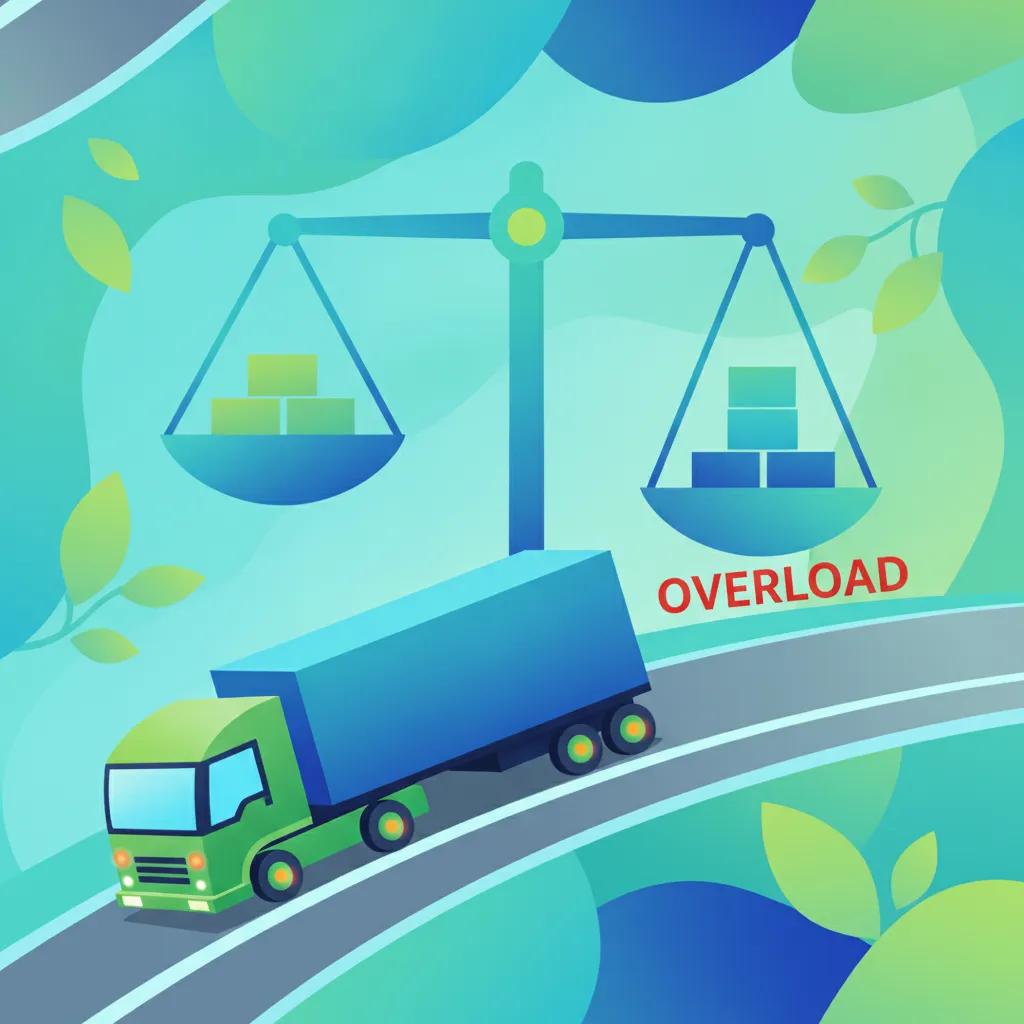
This lesson focuses on the distribution of loads across axle groups and the legal limits for axle loads. It explains the importance of correct weight distribution to avoid axle overloading, which can lead to road damage and safety hazards. The content also covers methods for measuring axle loads and the legal requirements for maintaining proper axle load limits.

This lesson examines the specific height, width, and length constraints that affect heavy vehicle operation, including bridge and tunnel clearances. It discusses how to interpret and comply with traffic signs indicating dimensional limits and the consequences of violating these restrictions. The content also covers practical strategies for route planning to avoid restricted areas.

This lesson focuses on the legal responsibilities and duties of a vehicle operator according to German traffic law, primarily the StVO. It covers the obligation to drive safely, the rules of conduct at an accident scene, and the legal consequences of traffic violations. Understanding these principles is crucial for maintaining road safety and avoiding penalties such as fines, points, or driving bans.
Explore the critical relationship between load distribution, centre of gravity, and vehicle stability for heavy vehicles. Learn how proper weight placement mitigates rollover risks and ensures safe driving, a key topic for C, CE license theory.
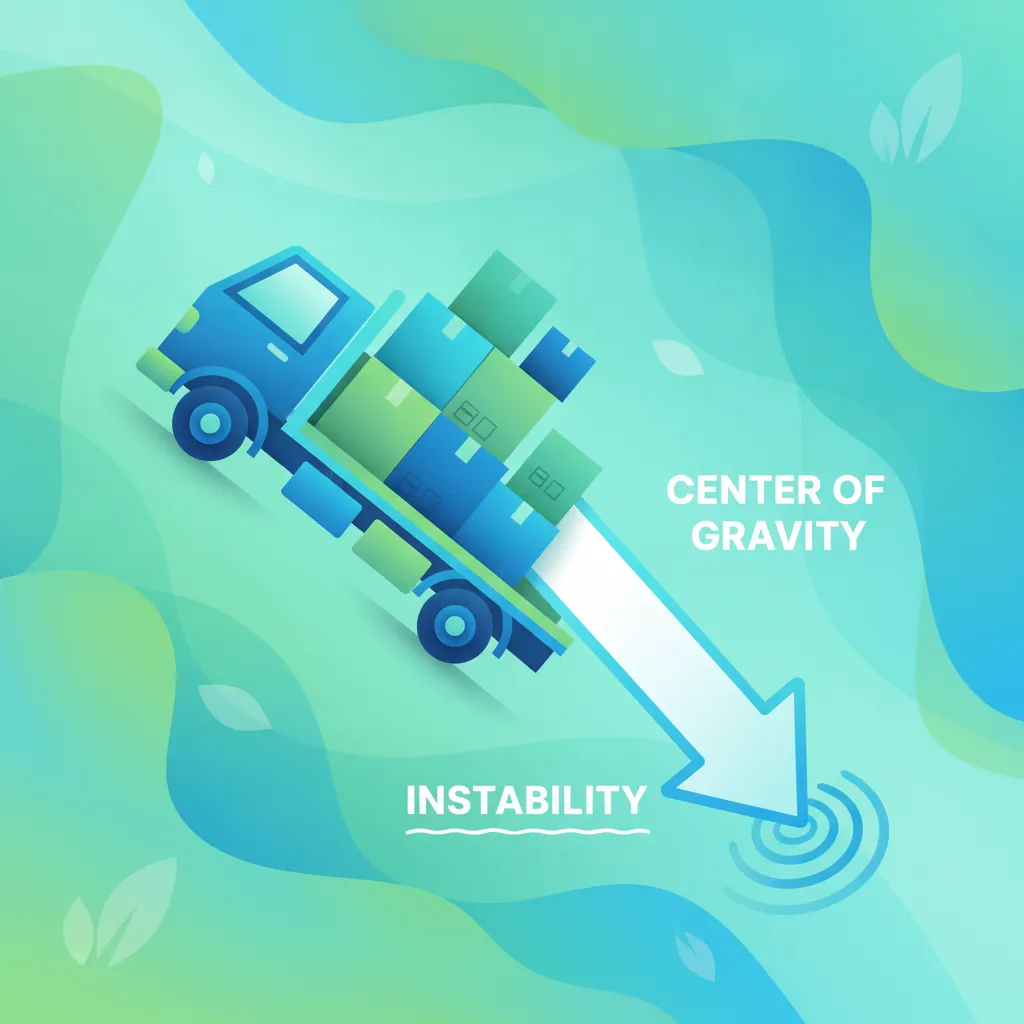
This lesson introduces the principles of load distribution and the impact of the centre of gravity on vehicle stability. It explains how cargo placement influences axle loads and the overall balance of the vehicle. The content emphasizes the importance of maintaining a low centre of gravity to reduce rollover risk.

This lesson focuses on the critical relationship between load distribution, the center of gravity, and vehicle stability. It explains how the placement of passengers and luggage can raise the center of gravity, increasing the risk of rollover during turns or sudden maneuvers. Learners will understand how to manage loading within legal weight limits to maintain optimal handling, braking performance, and overall safety.

This lesson examines the risks associated with load shifting during braking and cornering maneuvers. It explains how inertia and weight transfer can cause cargo to move, potentially leading to instability or loss of control. The content emphasizes the importance of proper load securing to mitigate these risks and maintain vehicle stability.

This lesson focuses on vehicle stability and the risks of rollover, particularly for vehicles with a high centre of gravity. It discusses how load placement, speed, and cornering affect rollover risk. The content outlines countermeasures such as speed reduction, load lowering, and the use of anti-roll devices.

This lesson examines the concepts of turning radius and swept path, explaining how a heavy vehicle's size influences the space required for a turn. It highlights the importance of maintaining proper lane positioning to accommodate the vehicle's dimensions. The content provides guidance on planning maneuvers and accounting for off-tracking during cornering.
This lesson focuses on the distribution of loads across axle groups and the legal limits for axle loads. It explains the importance of correct weight distribution to avoid axle overloading, which can lead to road damage and safety hazards. The content also covers methods for measuring axle loads and the legal requirements for maintaining proper axle load limits.

This lesson provides a method for calculating the braking distance of loaded vehicles, considering factors such as speed, load, and road conditions. It explains the formula for total stopping distance, including reaction time and braking distance components. The content highlights the importance of maintaining adequate safety margins for emergency braking.

This lesson focuses on the risks of jackknifing and trailer swing, particularly during braking and on downhill descents. It provides recommendations for safe speed management, proper braking techniques, and maintaining vehicle stability. The content also addresses safe reversing practices and the importance of monitoring blind spots during maneuvers.

This lesson contrasts the dynamic and operational characteristics of heavy vehicles with those of passenger cars. It explains how greater mass and inertia influence braking distance, turning radius, and vehicle stability. The content also addresses visibility challenges, the impact of load on handling, and the necessity for different driving strategies.
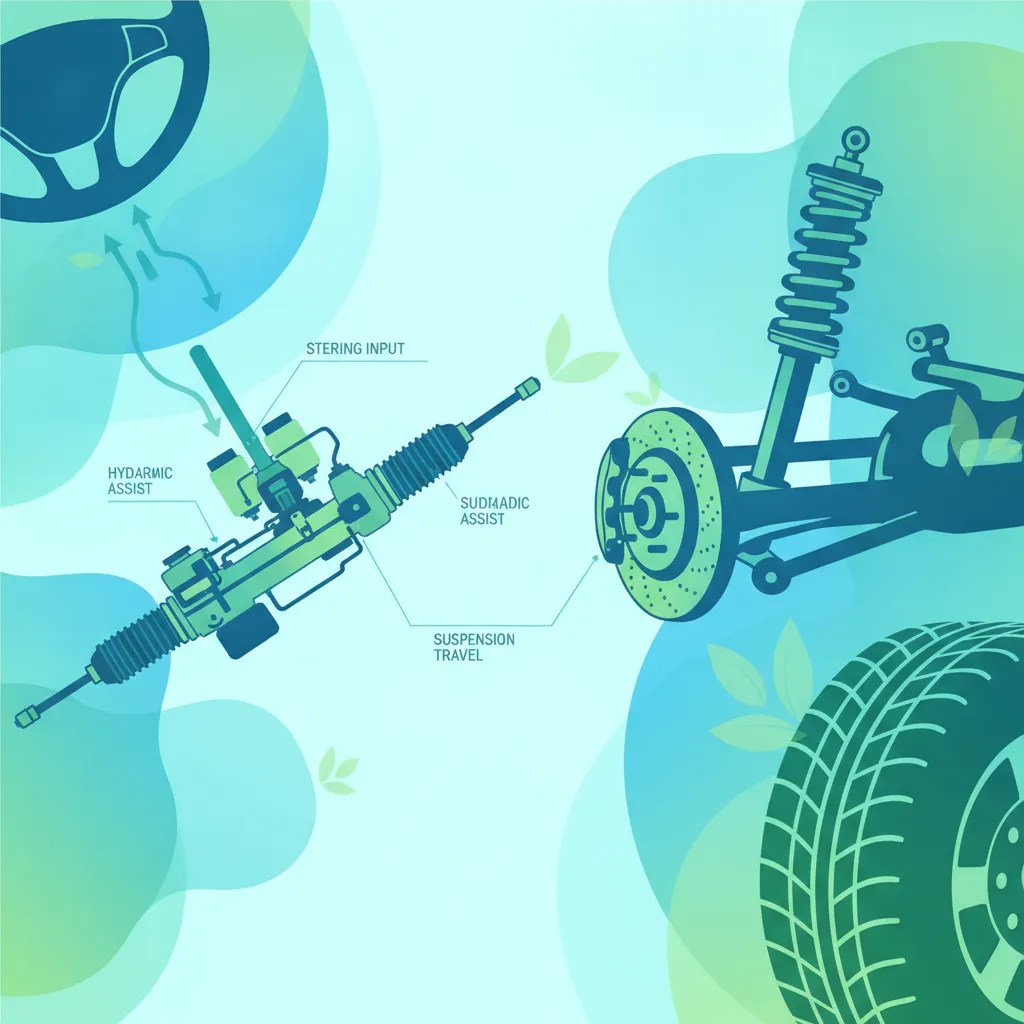
This lesson examines the steering mechanisms in heavy vehicles, including power-assisted systems, and their impact on handling. It also covers tyre technology, focusing on selection, pressure, load rating, and the importance of proper tyre maintenance. The content highlights how suspension components contribute to vehicle stability and control.
Find clear answers to common questions learners have about Permissible Masses and Overloading Risks. Learn how the lesson is structured, which driving theory objectives it supports, and how it fits into the overall learning path of units and curriculum progression in Germany. These explanations help you understand key concepts, lesson flow, and exam focused study goals.
Permissible total mass is the maximum weight the vehicle is legally allowed to weigh, including its own weight and load, as specified by the manufacturer. The actual mass is the weight of the vehicle and its load at any given moment, which must never exceed the permissible limit.
Overloading significantly increases stopping distances, as the braking system is designed for a specific weight. Additionally, it puts excessive stress on tyres and suspension, which can cause component failure and make the vehicle unstable during cornering.
Yes, for CE combinations, you must account for the gross combination mass. This includes the weight of the truck, the trailer, and the total load across all axles, which is strictly regulated to prevent road damage and ensure driver control.
Beyond immediate fines and potential loss of license points, frequent overloading causes premature wear on critical safety systems like brakes and steering. Employers and authorities in Germany track these issues, and it can impact your professional reputation and insurance validity.
Begin your targeted revision now. Use our practice search to quickly find specific German driving theory questions. Filter by StVO rules, road signs, or hazard perception to create your focused study plan. Master challenging areas and prepare confidently for your theoretical driving test.