
This lesson focuses on the essential skills of calculating following distance and performing safe overtaking maneuvers on your motorcycle. By mastering the two-second rule and strict observation protocols, you will meet the requirements of the Codice della Strada and enhance your safety on Italian roads. This knowledge is critical for your motorcycle theory exam and foundational for your future riding practice.

Lesson content overview
Riding a motorcycle safely on Italian roads requires a deep understanding of defensive riding techniques. Two critical components of this are maintaining an adequate following distance and executing safe overtaking maneuvers. These skills are fundamental to minimizing risks, preventing collisions, and ensuring smooth traffic flow for all road users, particularly within the context of the Italian Driving License Theory Course for Motorcycle Categories A1, A2, & A. This lesson will explore the principles, procedures, and legal considerations for both.
A safe following distance provides a crucial buffer, giving you sufficient time to perceive hazards, react, and take evasive action without colliding with the vehicle ahead. This buffer is your primary defense against sudden braking, road debris, or unexpected maneuvers from other drivers. Similarly, executing overtaking maneuvers safely is not merely about speed, but a systematic process designed to minimize exposure to risks like oncoming traffic or obstacles. Both concepts are deeply rooted in physics, accounting for factors like reaction time, braking distance, and kinetic energy, alongside the legal obligations outlined in the Codice della Strada (Italian Road Code). Mastering these elements contributes significantly to your overall safety and competence as a motorcyclist.
Following distance refers to the longitudinal gap maintained between your motorcycle and the vehicle directly in front of you. This distance is vital for safety, allowing you to stop safely without collision if the vehicle ahead suddenly decelerates or stops. While often intuitively judged, a structured, time-based approach offers a more reliable and adaptable method for determining a safe gap.
The two-second rule is a widely recommended minimum time gap for maintaining a safe following distance under normal driving conditions. This rule accounts for an average rider's perception-reaction time—the time it takes to recognize a hazard and initiate a response—and adds a safety margin.
A method where a rider ensures that at least two seconds elapse between the moment the vehicle ahead passes a fixed point on the road and when the rider's motorcycle passes the same point.
To apply this rule, simply choose a stationary object on the side of the road, such as a road sign, a bridge, or a tree. As the rear of the vehicle in front of you passes that object, begin counting "one thousand one, one thousand two." If your motorcycle reaches the same object before you finish counting, you are following too closely and need to increase your distance. This time-based measurement inherently adapts to your speed; at higher speeds, two seconds naturally cover a greater physical distance, which is necessary due to increased braking distances.
While the two-second rule serves as a fundamental baseline, it is crucial to understand that it represents a minimum. Many situations necessitate extending this gap to ensure adequate safety. These adjustments are vital for defensive riding and are often a determining factor in preventing collisions.
Adverse weather conditions significantly reduce road friction and visibility, directly impacting your ability to stop and react.
The type and condition of the road surface, as well as its geometry, play a critical role in determining safe following distances.
The characteristics of your motorcycle and what you are carrying directly affect its performance, especially braking capability.
Always err on the side of caution. If conditions are particularly challenging or you feel uncomfortable with the standard two-second gap, extend your following distance further. It's better to have too much space than not enough.
The Codice della Strada (Italian Road Code) emphasizes the importance of maintaining a safe distance. While it does not explicitly define a "two-second rule," the principle is embedded in its regulations concerning safe driving.
Article 142 of the Italian Road Code mandates that drivers must always maintain a safe distance from the vehicle ahead, sufficient to avoid collision in any traffic situation.
This legal framework means that even if you're adhering to the two-second rule, if an accident occurs because you couldn't stop in time, you could still be held responsible if the distance was deemed insufficient for the prevailing conditions. Therefore, understanding and applying the adjusted following distances for various scenarios is not just a safety recommendation but a legal imperative.
Overtaking, or passing another vehicle, is a common maneuver that, when executed correctly, enhances traffic flow. When done improperly, it is one of the riskiest actions a rider can take. For motorcyclists, the increased acceleration capabilities can sometimes lead to rushed decisions, making a structured, disciplined approach even more critical.
A safe overtaking maneuver is a multi-phase process requiring keen observation, clear communication, and precise vehicle control. Skipping any step significantly increases the risk of a collision.
Phase 1: Observation and Assessment Before even contemplating an overtake, perform a comprehensive visual check. Look well ahead to assess the road for oncoming traffic, curves, crests, intersections, or any hazards that might obstruct or endanger the maneuver. Check your mirrors for vehicles approaching rapidly from behind. Verify road markings: are they broken (indicating overtaking is permitted) or solid (prohibiting overtaking)? Assess the speed of the vehicle you intend to pass and determine if you have enough power and clear road to complete the overtake safely within the speed limit.
Phase 2: Signaling Intent Once you've determined it's safe to proceed, activate your left turn signal. This communicates your intention to other road users, allowing them time to react or adjust their position. Signal early enough to be noticed, but not so early that it could confuse other drivers about your immediate intentions. In some contexts, a brief flash of your headlamp may also be used to alert the vehicle ahead, though this should be used cautiously and legally.
Phase 3: Strategic Positioning and Speed Management Move into the appropriate lane for overtaking, ensuring you respect all lane markings. If you're on a multi-lane road, position your motorcycle in the leftmost available lane designated for overtaking. Begin to increase your speed to a level that allows you to overtake efficiently without exceeding the legal speed limit. You need sufficient kinetic energy to complete the maneuver swiftly and decisively.
Phase 4: Executing the Overtake with Lateral Clearance Smoothly accelerate and move past the slower vehicle. As you pass, maintain a lateral clearance—a safe horizontal distance—between your motorcycle and the overtaken vehicle. A minimum of 1.5 meters is generally recommended to provide a safety buffer for both vehicles, preventing side-swipes and allowing for unexpected movements.
Phase 5: Safe Re-entry and Confirmation Do not cut back into your original lane too early. Wait until you can see the entire front of the overtaken vehicle in your right-side mirror (or through a shoulder check if no mirror is present or sufficient). This ensures you have adequate clearance behind you. Signal your intention to move back into the right lane, check your mirrors and blind spot one final time, and smoothly merge back. Once back in your lane, turn off your signal and re-establish a safe following distance from any new vehicle ahead.
Road markings are crucial visual cues that dictate where and when overtaking is permitted or prohibited. Ignoring these markings is illegal and extremely dangerous.
The environment significantly influences the safety and legality of an overtaking maneuver.
In urban areas, overtaking is generally more complex and often unnecessary due to frequent stops, lower speeds, and increased traffic density.
These roads often present higher speeds but also more challenging geometry.
Motorways generally allow for higher-speed overtaking, but specific rules apply.
Failing to adhere to safe following distance and overtaking rules not only endangers yourself and others but also carries legal penalties under the Codice della Strada.
| Violation | Description | Correct Behavior | Consequence |
|---|---|---|---|
| Tailgating | Riding too close to the vehicle ahead, typically less than the recommended two-second rule under normal conditions. | Always maintain a safe following distance, using time-based rules (2-4 seconds) adjusted for conditions. | Increased risk of rear-end collision; fines and potential license points. |
| Overtaking on Solid Lines | Crossing a continuous white line to pass another vehicle. | Remain in your lane until markings permit overtaking (broken line). | Illegal maneuver; significant fines and license points. |
| Overtaking in Poor Visibility | Attempting to pass when fog, heavy rain, or darkness severely limits your sight distance. | Delay overtaking until visibility improves or is clearly safe; reduce speed and increase following distance. | High risk of head-on collision or misjudging hazards; severe penalties. |
| Insufficient Lateral Clearance | Passing too close (less than 1.5 meters) to the vehicle being overtaken. | Ensure a wide enough gap (minimum 1.5m) to safely pass without endangering the other vehicle or yourself. | Risk of side-impact, loss of control; fines. |
| Late or No Signaling | Failing to use your turn signals before initiating an overtaking maneuver or signaling too late for others to react. | Signal your intent early and clearly before changing lanes or starting the pass. | Other drivers are unaware of your actions, increasing collision risk; fines. |
| Overtaking on Curves or Crests | Attempting to pass on a blind curve or at the top of a hill where the opposite lane is not visible. | Wait until the road straightens and you have a clear, unobstructed view of the road ahead. | Extremely high risk of head-on collision; severe penalties. |
| Excessive Speed During Overtake | Exceeding the posted speed limit while performing an overtaking maneuver. | Accelerate only to a speed that allows for a swift overtake within legal limits. | Fines for speeding, potential loss of control, higher collision risk. |
The Codice della Strada contains specific articles governing safe driving practices, including following distance and overtaking. Adherence to these laws is mandatory for all riders.
Beyond the basic rules, a deeper understanding of the physics and human factors involved can further enhance your safety.
This lesson teaches motorcyclists how to maintain safe following distances using the two-second rule as a baseline, extending it to three or four seconds for adverse weather, night riding, heavy loads, or challenging road geometry. It provides a seven-phase systematic approach to safe overtaking: assess, signal, position, accelerate with adequate lateral clearance of at least 1.5 meters, then confirm safe re-entry using mirror visibility. The lesson also covers Italian traffic law requirements under the Codice della Strada, including Article 142 for following distance and Article 148 for overtaking rules, emphasizing that riders are legally responsible for maintaining conditions-appropriate gaps. Key physics principles—perception-reaction time, exponential braking distance, and kinetic energy—underpin why these techniques are essential for defensive riding.
A short set of high-value points that capture the most important learning from this lesson.
The two-second rule is the baseline minimum following distance under normal conditions, measured by counting from when the vehicle ahead passes a fixed object to when you reach it.
Adverse conditions require extended gaps: four seconds in rain, fog, or snow; three to four seconds for night riding; three to four seconds with a passenger or heavy load.
A safe overtaking maneuver follows seven phases: observe and assess, signal intent, position and accelerate, execute with lateral clearance of at least 1.5 meters, then safely re-enter the lane only when the overtaken vehicle is fully visible in your mirror.
Road markings dictate overtaking legality: broken lines permit it (if safe), while solid and double solid lines absolutely prohibit it.
The Codice della Strada holds riders legally responsible for following distance adequacy regardless of adhering to the two-second rule if conditions warranted a greater gap.
Explore all units and lessons included in this driving theory course.
Reaction time at 90 km/h means you travel 25 meters before even beginning to react, making extended following distance critical.
Braking distance increases exponentially with speed, so doubling speed roughly quadruples stopping distance.
Always perform a head check ('lifesaver look') before changing lanes, as mirrors have blind spots where vehicles can hide.
Overtake only on the left side in Italy; the right lane is for normal driving, left lanes are for passing.
Kinetic energy increases with the square of speed, meaning small speed increases create much larger energy demands during overtaking.
Tailgating by following closer than the two-second rule under normal conditions, which eliminates reaction time buffer.
Crossing solid white lines to overtake, which is prohibited and carries significant fines and license penalties.
Returning to the lane too early without confirming the overtaken vehicle is fully visible in the mirror, risking a side-swipe collision.
Attempting to overtake on blind curves or crests where oncoming traffic cannot be seen, creating high-risk head-on collision potential.
Passing other vehicles with insufficient lateral clearance of less than 1.5 meters, reducing safety margin for unexpected movements.
Lesson content overview
A short set of high-value points that capture the most important learning from this lesson.
The two-second rule is the baseline minimum following distance under normal conditions, measured by counting from when the vehicle ahead passes a fixed object to when you reach it.
Adverse conditions require extended gaps: four seconds in rain, fog, or snow; three to four seconds for night riding; three to four seconds with a passenger or heavy load.
A safe overtaking maneuver follows seven phases: observe and assess, signal intent, position and accelerate, execute with lateral clearance of at least 1.5 meters, then safely re-enter the lane only when the overtaken vehicle is fully visible in your mirror.
Road markings dictate overtaking legality: broken lines permit it (if safe), while solid and double solid lines absolutely prohibit it.
The Codice della Strada holds riders legally responsible for following distance adequacy regardless of adhering to the two-second rule if conditions warranted a greater gap.
Explore all units and lessons included in this driving theory course.
Reaction time at 90 km/h means you travel 25 meters before even beginning to react, making extended following distance critical.
Braking distance increases exponentially with speed, so doubling speed roughly quadruples stopping distance.
Always perform a head check ('lifesaver look') before changing lanes, as mirrors have blind spots where vehicles can hide.
Overtake only on the left side in Italy; the right lane is for normal driving, left lanes are for passing.
Kinetic energy increases with the square of speed, meaning small speed increases create much larger energy demands during overtaking.
Tailgating by following closer than the two-second rule under normal conditions, which eliminates reaction time buffer.
Crossing solid white lines to overtake, which is prohibited and carries significant fines and license penalties.
Returning to the lane too early without confirming the overtaken vehicle is fully visible in the mirror, risking a side-swipe collision.
Attempting to overtake on blind curves or crests where oncoming traffic cannot be seen, creating high-risk head-on collision potential.
Passing other vehicles with insufficient lateral clearance of less than 1.5 meters, reducing safety margin for unexpected movements.
Explore search topics learners often look for when studying Following Distance and Safe Overtaking Strategies. These topics reflect common questions about road rules, driving situations, safety guidance, and lesson level theory preparation for learners in Italy.
Browse additional driving theory lessons that cover connected traffic rules, road signs, and common driving situations related to this topic. Improve your understanding of how different rules interact across everyday traffic scenarios.
Learn the complete theoretical process for safe overtaking on Italian roads, from initial observation and signaling to safe execution and re-entry. Covers legal requirements and common errors to avoid.

This lesson addresses the increased complexity of overtaking in urban environments with dense traffic and frequent intersections. It stresses the importance of thorough observation, including mirror and blind spot checks, to ensure a safe gap is available. The content covers judging speed differentials and the necessity of clear signalling to execute the maneuver without causing conflict with other road users.

This lesson provides comprehensive guidance on the rules and best practices for safe overtaking. It explains how to assess whether it is legal and safe to pass, considering road markings, signs, and the distance of oncoming traffic. The content details the correct procedure, including signaling, accelerating, maintaining a safe distance during the maneuver, and returning to the original lane safely.
This lesson provides a comprehensive guide to riding on high-speed motorways, or autostrade. It details the correct procedures for safely merging into traffic from an entry ramp and exiting via a deceleration lane. The content reinforces strict lane discipline, rules for overtaking, and the importance of maintaining a significantly larger following distance to compensate for higher speeds and potential wind gusts.
This lesson focuses on the vital systems for visibility and communication: mirrors, lighting, and signals. It provides instruction on the proper adjustment of mirrors to minimize blind spots and the correct use of headlamps, indicators, and brake lights as per Italian regulations. The content underscores how maintaining these systems in full working order is crucial for being seen and signalling intentions clearly in traffic.
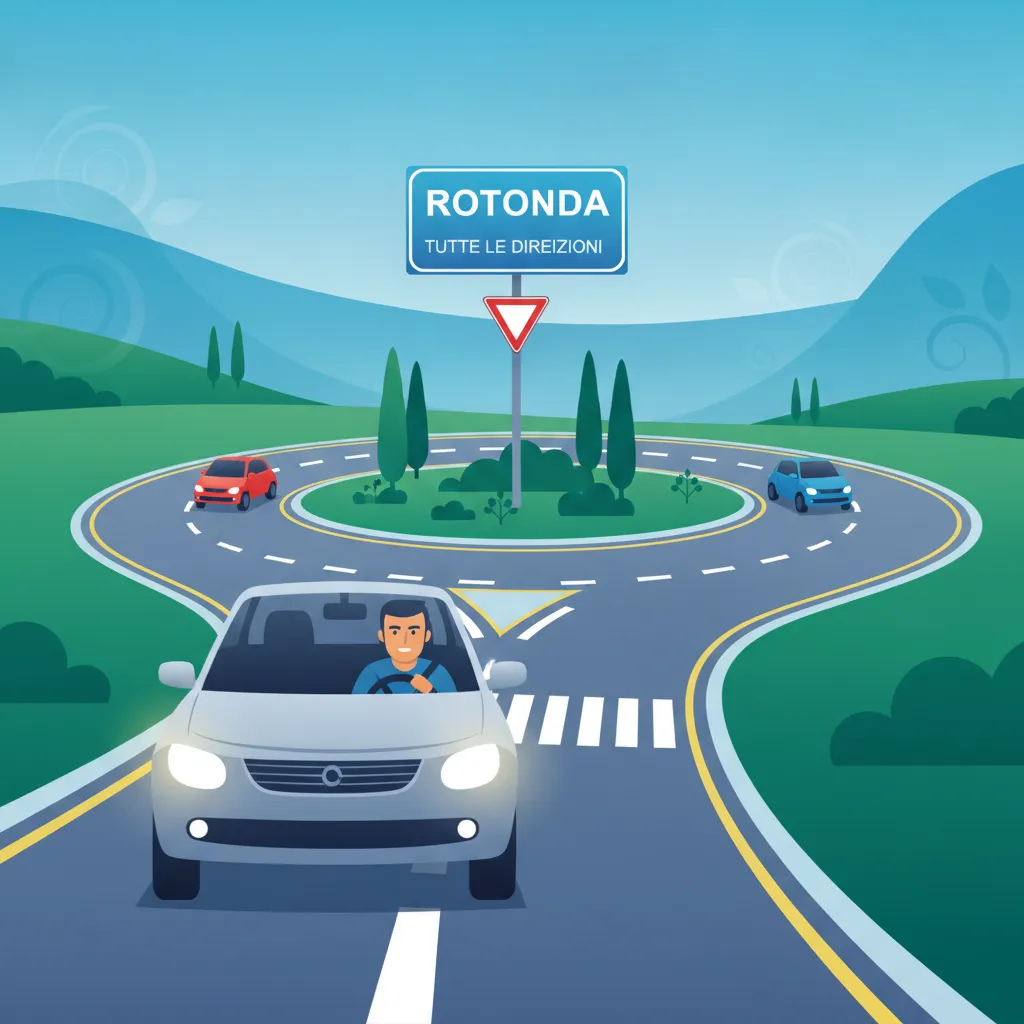
This lesson provides a step-by-step guide to safely navigating Italian roundabouts, known as rotatorie. It emphasizes the primary rule of yielding to traffic already circulating within the roundabout before entering. The content details correct lane positioning for different exits, the importance of signalling your intention to exit, and maintaining awareness of other vehicles.

This lesson delivers a comprehensive explanation of right-of-way regulations at Italian intersections. It covers the interpretation of traffic light signals, the absolute requirement to stop at stop signs, and yielding at give-way signs. Furthermore, it details the default priority rules for unmarked intersections and the specific obligations a rider has towards pedestrians on crossings.

This lesson explains how to execute left turns, right turns, and U-turns safely while maintaining correct lane discipline. It covers interpreting road markings and arrows, selecting the proper vehicle position, and using signals in a timely manner. Performing shoulder checks to monitor blind spots before and during a turn is a key focus for preventing collisions.

This lesson provides a thorough examination of the Italian motorcycle theory test's structure and content. It details the number of questions, the multiple-choice format, and the minimum score required to pass for the A1, A2, and A license categories. The content is designed to prepare learners for the specific knowledge areas and administrative procedures involved in taking the official exam.

This lesson teaches the fundamental observation techniques required for proactive and defensive riding. It details a systematic approach to scanning the road environment, using mirrors effectively, and performing shoulder checks to cover blind spots before any maneuver. Developing strong situational awareness is presented as a key skill for anticipating potential hazards and reacting to them in a timely manner.

This lesson addresses the specific challenges of sharing the road with two-wheeled motor vehicles like motorcycles and scooters. It highlights their reduced visibility and stability compared to cars, requiring drivers to double-check blind spots and maintain a greater following distance. The content also discusses common behaviors like lane filtering and the need for drivers to be predictable and signal intentions clearly.
Explore specific Italian traffic laws and safe riding techniques for overtaking and maintaining following distance on rural roads, mountain passes, and in adverse weather. Understand when overtaking is prohibited and how to adapt your distance.
This lesson provides comprehensive guidance on the rules and best practices for safe overtaking. It explains how to assess whether it is legal and safe to pass, considering road markings, signs, and the distance of oncoming traffic. The content details the correct procedure, including signaling, accelerating, maintaining a safe distance during the maneuver, and returning to the original lane safely.

This lesson is dedicated to the vital concept of 'distanza di sicurezza', the safe following distance required to avoid a rear-end collision. It explains how this distance is not fixed but varies with speed and conditions, covering practical methods like the 'two-second rule' to help judge it accurately. Maintaining this space cushion provides the necessary time to react and brake safely if the vehicle ahead stops suddenly.
This lesson addresses the increased complexity of overtaking in urban environments with dense traffic and frequent intersections. It stresses the importance of thorough observation, including mirror and blind spot checks, to ensure a safe gap is available. The content covers judging speed differentials and the necessity of clear signalling to execute the maneuver without causing conflict with other road users.

This lesson teaches riders how to maintain a safe following distance using the two-second rule, which accounts for reaction time and braking distance. It covers grip management, explaining how tire condition and road surfaces like wet asphalt affect traction. Mastering these concepts is essential for anticipating hazards and preventing rear-end collisions.
This lesson provides critical guidance on how to safely share the road with vulnerable users, including pedestrians, cyclists, motorcyclists, and children. It highlights the importance of increased awareness in specific areas like school zones and crosswalks. The content teaches techniques for maintaining a safe lateral distance when overtaking, checking blind spots thoroughly, and anticipating the often unpredictable movements of these users.

This lesson provides an in-depth focus on sharing the road with the most vulnerable users. It teaches drivers to be acutely aware of pedestrians at crossings, cyclists filtering through traffic, and motorcyclists who may be in blind spots. The lesson emphasizes the importance of leaving extra space, signaling intentions clearly, and exercising extreme caution at junctions, where the majority of serious incidents occur.
This lesson provides essential rules and techniques for driving on Italian motorways (autostrade) and major extra-urban roads. It explains how to safely merge onto the motorway from an entry ramp, the strict lane discipline required (drive right, overtake left), and how to exit correctly. The content also covers speed regulations, maintaining a safe following distance at high speed, and procedures for using service areas and handling emergencies.

This lesson teaches drivers how to adapt their technique for various adverse weather conditions. It explains the risks of reduced grip and visibility in rain, fog, snow, and ice, and the need to significantly increase following distances and reduce speed. The content covers how to avoid and correct skids, the proper use of lights in poor visibility, and the legal requirements for winter tyres or snow chains in certain areas.
This lesson teaches the crucial skill of selecting a safe and appropriate speed that may be lower than the legal limit, based on prevailing conditions. It explains how to assess factors such as traffic flow, weather, visibility, and road surface quality to make prudent speed choices. The goal is to always maintain full control of the vehicle and have sufficient time to react to unexpected hazards.

This lesson explains the rules for special urban traffic situations common in Italy. It provides a detailed explanation of Limited Traffic Zones (ZTL), including how to recognize the signage and understand the access restrictions to avoid fines. The content also offers guidance on navigating the narrow and complex streets of historic centers and safely maneuvering around frequently stopping delivery vehicles.
Find clear answers to common questions learners have about Following Distance and Safe Overtaking Strategies. Learn how the lesson is structured, which driving theory objectives it supports, and how it fits into the overall learning path of units and curriculum progression in Italy. These explanations help you understand key concepts, lesson flow, and exam focused study goals.
The two-second rule is a standard guideline to ensure a safe following distance. In the Italian theory test context, maintaining this gap is essential to provide enough time to react to sudden braking or hazards, and it is a key expectation for responsible riding.
Generally, you must overtake on the left. Overtaking on the right is only permitted in very specific conditions, such as when a vehicle ahead is turning left or in congested traffic with clearly marked lanes, but these rules are strict and appear frequently in the exam.
You must verify that the road ahead is clear for a sufficient distance, check your mirrors and blind spot, and ensure that no vehicle behind you has already begun to overtake your motorcycle. Signalling your intention early is also a mandatory legal requirement.
Understanding your bike's power is crucial for safe overtaking because it dictates how quickly you can safely complete the pass. In the exam, you may be tested on selecting appropriate opportunities based on your motorcycle's capability to accelerate and return to your lane.
Start searching now to pinpoint exactly which Italian driving theory topics, road signs, or traffic rules you need to master. Use our advanced filters to build a custom practice session and ensure you're fully prepared for every aspect of your official driving licence exam.