
This lesson provides an in-depth look at auxiliary braking systems, which are essential for maintaining speed control on steep descents. You will learn the mechanical differences between engine brakes, exhaust brakes, and retarders to ensure you can operate heavy vehicles safely and professionally.

Lesson content overview
Driving heavy goods vehicles, especially those operating under an Italian Goods Vehicle License (C, C1, C1E, CE), demands a comprehensive understanding of advanced braking techniques. Unlike passenger cars, heavy vehicles possess immense kinetic energy, which becomes particularly challenging to manage on long downhill grades. The conventional service brakes, while powerful, are not designed for continuous deceleration over extended periods. This lesson delves into the crucial auxiliary or "endurance" braking systems: the engine brake, hydrodynamic retarder, and exhaust brake, which are indispensable tools for maintaining safety and control.
These systems are specifically engineered to provide continuous speed management without relying on the primary service brakes. By understanding their principles and correct application, professional drivers can prevent dangerous brake overheating, preserve brake effectiveness for emergencies, and comply with safety regulations like those outlined in the Italian Codice della Strada. This knowledge is not just about vehicle mechanics; it is fundamentally about ensuring road safety for yourself and other road users.
Auxiliary braking systems are a cornerstone of heavy vehicle operation, designed to supplement the service brakes by converting the vehicle's kinetic energy into other forms, typically heat, without generating friction on the wheel-end components. This approach ensures that the service brakes remain cool and fully effective for emergency stops or when coming to a complete halt. For drivers holding a C, C1, C1E, or CE license, mastering these systems is a core competency.
The primary function of these systems is to provide a controlled, continuous deceleration, particularly vital on prolonged descents or when carrying heavy loads. Without them, drivers would be forced to repeatedly apply and release the service brakes, leading to a rapid buildup of heat, which can severely compromise braking performance. This lesson will explore the specific types of auxiliary brakes, their operational nuances, and their strategic use in various driving conditions.
At the heart of auxiliary braking lies the principle of preventing brake fade. Brake fade is a dangerous phenomenon where the effectiveness of conventional friction brakes significantly diminishes due to excessive heat buildup. When brake components—discs, drums, and pads—become too hot, their ability to generate friction is reduced, leading to longer stopping distances and, in severe cases, complete loss of braking power. This is a critical risk for heavy vehicles descending steep grades.
Endurance brakes act as a thermal management solution. By absorbing kinetic energy through alternative mechanisms (engine resistance, fluid dynamics, or exhaust back pressure), they keep the service brakes cool. This ensures that the friction brakes are always available with their full designed capacity when needed for actual stopping, emergency maneuvers, or final vehicle halts. Using endurance brakes proactively is a hallmark of safe and professional heavy vehicle driving.
Heavy goods vehicles employ several distinct types of auxiliary braking systems, each with its unique operating principle and ideal application. While they all serve the common goal of continuous speed control, their mechanisms differ significantly. The main categories include the engine brake (often a compression release brake), the hydrodynamic retarder, and the exhaust brake. Understanding the characteristics of each allows drivers to select the most appropriate system for current road and load conditions.
These systems are typically engaged manually by the driver via a dedicated lever or foot control, though some modern vehicles integrate them into automatic speed control systems. Their effective use requires careful judgment, anticipation, and a solid grasp of how they interact with the vehicle's drivetrain and the service brakes.
The engine brake, widely known as a "Jake brake" in many regions, is a sophisticated auxiliary braking system predominantly found in diesel engines. It converts the engine itself into an air compressor, absorbing kinetic energy from the vehicle to slow it down. This system is highly effective, particularly at higher engine RPMs, and offers substantial braking power.
When an engine brake is activated, specific valves in the engine's cylinders are manipulated during the compression stroke. Instead of allowing the compressed air to expand and push the piston down, which would generate power, the exhaust valve is briefly opened near the top of the compression stroke. This releases the compressed air into the exhaust system, preventing the engine from recovering the energy of compression. The engine must then work against this resistance during the next compression cycle, effectively absorbing energy from the vehicle's motion and slowing it down. This cycle creates the characteristic loud noise often associated with engine brakes, although modern designs are significantly quieter.
The engine brake is most effective when engaged at higher engine RPMs and in lower gears. This maximizes the engine's pumping losses and provides the greatest braking effect. Drivers should engage the engine brake before commencing a long descent, ideally while selecting a gear that allows the engine to rev sufficiently high without over-revving. It should be used to maintain a constant, safe speed, rather than to repeatedly slow down from a higher speed. The engine brake should generally be disengaged when the vehicle is stationary or when applying the service brakes for a final stop, to prevent stalling or unnecessary engine strain.
While powerful, engine brakes must be used judiciously. On wet, icy, or low-traction surfaces, aggressive engine braking, especially in lower gears, can potentially cause the drive wheels to lose traction and skid. In such conditions, it is crucial to use the engine brake gently and in combination with other braking systems, or to rely more heavily on systems like retarders that offer smoother deceleration. Additionally, many communities have noise ordinances that restrict the use of engine brakes in certain areas due to the noise they generate, particularly older models.
The hydrodynamic retarder is a highly effective and smooth auxiliary braking system, particularly well-suited for heavy goods vehicles that frequently navigate mountainous terrain or long gradients. Unlike the engine brake, which uses engine resistance, the retarder uses fluid dynamics to absorb kinetic energy. It provides a continuous, powerful, and wear-free braking force that is independent of the engine's RPM, making it an excellent choice for maintaining a steady speed on descents.
A hydrodynamic retarder, often integrated into the vehicle's transmission or mounted separately on the driveline, consists of a stator (stationary housing) and a rotor (rotating element) enclosed within a fluid-filled chamber. As the vehicle moves, the rotor, connected to the driveline, spins rapidly. When the retarder is activated, fluid (usually transmission oil or a dedicated water/glycol mix) is pumped into the chamber. The spinning rotor agitates this fluid, creating turbulence and resistance against the stationary stator blades. This resistance opposes the rotation of the driveline, effectively slowing the vehicle. The kinetic energy is converted into heat within the fluid, which is then dissipated by a dedicated cooling system, often integrated with the engine's cooling system.
Retarders typically offer multiple stages of braking power, controlled by a lever on the steering column or dashboard. Drivers can select the desired level of retardation, allowing for very fine control over vehicle speed. This smooth engagement makes retarders ideal for maintaining a consistent speed on long downgrades without causing abrupt deceleration or discomfort to passengers or cargo. It is crucial to engage the retarder before speed builds up and to use enough braking power to keep the vehicle at a safe and controlled speed. Like the engine brake, the retarder is a speed-management tool, not a stopping brake, and should be disengaged before the final stop.
There are two primary types of hydrodynamic retarders:
The exhaust brake is a simpler, yet effective, auxiliary braking system, particularly prevalent in older heavy goods vehicles or those where a full engine brake or retarder is not installed. It works by creating back pressure in the engine's exhaust system, thereby increasing the engine's resistance to rotation and providing a braking effect.
When the exhaust brake is activated, a valve (often a butterfly valve) closes within the exhaust pipe, typically near the engine. This closure restricts the escape of exhaust gases, causing a buildup of pressure in the exhaust manifold and cylinders. This increased back pressure makes it harder for the engine to complete its exhaust stroke, effectively turning the engine into a partial air compressor. The energy required to push against this back pressure is drawn from the vehicle's kinetic energy, resulting in a retarding force.
The exhaust brake is most effective when the engine is operating at moderate to high RPMs, similar to an engine brake. It provides a useful level of continuous deceleration, but generally offers less braking power than a full engine brake or a hydrodynamic retarder. Drivers should engage the exhaust brake when approaching a descent or when needing to shed speed gradually. It should always be used in conjunction with appropriate gear selection to maximize its effectiveness. Like other auxiliary brakes, it is not intended for bringing the vehicle to a complete stop and should be disengaged when final stopping is required using the service brakes.
Understanding the fundamental differences between service brakes and auxiliary (endurance) brakes is paramount for safe and efficient heavy vehicle operation. While both systems contribute to slowing or stopping the vehicle, their primary roles, operating principles, and ideal applications are distinctly different.
Service brakes are friction-based systems that utilize brake pads or linings to create friction against rotating discs or drums at the wheels. This friction converts kinetic energy directly into heat, which must then be dissipated into the atmosphere. They are designed for high-power, short-duration applications: bringing the vehicle to a stop, making quick speed adjustments, or executing emergency braking maneuvers. Their effectiveness is immediate but their capacity for continuous heat absorption is limited.
Auxiliary or endurance brakes, conversely, are designed for continuous, long-duration deceleration. They absorb kinetic energy through non-friction mechanisms within the engine or drivetrain, converting it into heat that is then dissipated through the engine's or retarder's cooling system. Their primary purpose is to maintain a controlled speed on long descents, thereby preserving the service brakes for when they are truly needed. By reducing reliance on the service brakes, endurance systems prevent brake fade and extend the lifespan of friction components.
The key takeaway is that these systems are complementary, not interchangeable. Professional drivers learn to use them in combination, leveraging the continuous power of auxiliary brakes for speed management and reserving the immediate, high-friction power of service brakes for definitive stopping actions.
Brake fade is one of the most serious hazards facing heavy goods vehicle drivers, particularly on prolonged downhill grades. It refers to the reduction in braking effectiveness due to the overheating of the vehicle's friction brake components.
When service brakes are applied continuously or too frequently on a long descent, the friction between the pads/linings and discs/drums generates immense heat. If this heat cannot dissipate quickly enough, the temperature of the brake components rises beyond their optimal operating range. This can lead to several dangerous conditions:
The implication of brake fade is a dangerous increase in stopping distance and a potential complete loss of braking capability, which can be catastrophic for a heavily loaded vehicle on a steep incline. This is precisely why auxiliary braking systems are not merely a convenience but a critical safety requirement for goods vehicle operations.
Effective downhill speed management is a cornerstone of safe heavy goods vehicle operation, especially in regions with challenging topography like parts of Italy. It involves a strategic combination of gear selection and the judicious use of auxiliary braking systems to control the vehicle's speed without overworking the service brakes.
Anticipate: Look ahead for upcoming descents and road signs indicating steep grades.
Select Appropriate Gear: Before entering the descent, shift to a lower gear that will allow the engine to maintain a safe, controlled speed without excessive acceleration. This gear should be low enough to provide significant engine braking.
Engage Auxiliary Brakes: Activate the engine brake, exhaust brake, or hydrodynamic retarder as soon as you begin the descent. Use these systems to primarily control your speed, aiming to maintain a constant speed that is safe for the conditions.
Monitor Speed: Regularly check your speedometer. If speed starts to increase beyond the desired limit, apply additional auxiliary braking or, if necessary, make a brief and firm application of the service brakes to bring the speed back into control, then release them promptly to allow them to cool.
Increase Safety Distances: Always maintain a significantly greater following distance on downhill grades. Due to the effects of gravity, heavier loads, and the potential for brake lag and fade, stopping distances will be longer. A good rule of thumb is to increase your normal following distance by at least double, or even more, depending on the steepness of the grade and your vehicle's load.
Brake Lag: Heavy vehicles, particularly those with air brake systems, experience a phenomenon known as brake lag. This is the delay between the driver's application of the brake pedal and the actual braking force being applied at the wheels. On a downhill grade, this lag combined with gravity can cause the vehicle to gain significant speed before the brakes fully engage. Proactive use of auxiliary brakes helps mitigate the impact of brake lag by continuously managing speed.
By diligently following these practices, drivers can safely navigate challenging descents, prevent brake overheating, and ensure the long-term reliability of their vehicle's braking systems.
The Italian Codice della Strada (Highway Code) places significant emphasis on the safe operation of heavy goods vehicles, especially concerning braking systems on challenging terrains. While general principles of safe driving apply universally, specific regulations exist to mandate the use of auxiliary brakes under certain conditions to ensure road safety and prevent accidents caused by brake failure.
Italian regulations, particularly concerning mountain roads and steep gradients, often make the use of auxiliary brakes mandatory for heavy goods vehicles. These mandates are typically indicated by specific road signage.
This sign, often accompanied by supplementary panels indicating the length or percentage of the grade, explicitly instructs drivers of heavy vehicles to engage their engine brake or retarder. The rationale is to prevent service brake overheating and ensure controlled descent. While the specific grade thresholds for mandatory use can vary, a general guideline is that auxiliary brakes should always be employed on grades exceeding 5-7%, especially with heavy loads.
Failure to comply with these mandatory requirements can result in fines and penalties, but more importantly, it significantly increases the risk of a dangerous loss of vehicle control due to brake fade. The law underscores that drivers are responsible for understanding and utilizing all available braking systems appropriately.
Improper use or neglect of auxiliary braking systems on Italian roads can lead to severe consequences, both legal and safety-related.
The Italian Codice della Strada, like similar regulations across Europe, aims to instill a culture of proactive safety in professional driving. Utilizing auxiliary brakes is not just a best practice; it is a legally enforced measure to safeguard all road users.
Even experienced drivers can sometimes make errors in the application of auxiliary braking systems. Understanding these common pitfalls and adhering to best practices is essential for optimal safety and vehicle longevity.
The effective use of auxiliary braking systems is not a one-size-fits-all approach; it requires constant adaptation to varying driving conditions. Professional drivers must assess the environment and adjust their braking strategy accordingly to ensure maximum safety and efficiency.
The systematic and correct use of auxiliary braking systems extends far beyond immediate speed control; it fundamentally impacts driver safety, operational efficiency, and the long-term health of the vehicle.
In summary, auxiliary braking systems are sophisticated engineering solutions that empower professional drivers to operate heavy goods vehicles safely, economically, and efficiently, particularly when confronting the challenges of topography and heavy loads.
Understanding auxiliary braking concepts is best solidified through practical application. Here are several scenarios illustrating correct and incorrect actions when operating heavy goods vehicles.
Auxiliary braking systems – the engine brake, hydrodynamic retarder, and exhaust brake – are fundamental safety and operational tools for professional heavy goods vehicle drivers in Italy and across the globe. This lesson has underscored their vital role in managing vehicle speed on long downgrades, preventing the dangerous phenomenon of brake fade, and thereby preserving the effectiveness of the service brakes for critical stopping situations.
Drivers of vehicles requiring C, C1, C1E, or CE licenses must not only understand the principles behind these systems but also develop the practical skills to engage them proactively, adjust their use according to load, road, and weather conditions, and adhere to regulatory mandates such as those found in the Italian Codice della Strada. By doing so, they ensure enhanced safety, contribute to greater fuel efficiency, prolong vehicle component life, and ultimately uphold the highest standards of professional driving. Mastering endurance braking is a commitment to responsible and secure road transport.
This lesson covers three essential auxiliary braking systems for heavy goods vehicles: the engine brake (compression release brake), hydrodynamic retarder, and exhaust brake, each using different mechanisms to convert kinetic energy into heat without using wheel-end friction brakes. The critical distinction is that service brakes provide immediate stopping power for emergencies and final halts, while endurance brakes maintain controlled speed on long descents to prevent brake fade. Italian regulations mandate auxiliary brake use on steep grades indicated by road signs, and drivers must adapt their technique based on load, weather, and road conditions. Proper procedure involves selecting an appropriate gear before descent, engaging auxiliary brakes proactively, using gentle continuous deceleration, and reserving service brakes for brief corrections and final stops.
A short set of high-value points that capture the most important learning from this lesson.
Auxiliary braking systems (engine brake, hydrodynamic retarder, exhaust brake) provide continuous speed control on long descents to prevent dangerous brake fade in service brakes
Each auxiliary system uses a different mechanism: engine brake manipulates valve timing, retarder uses fluid dynamics, exhaust brake creates back pressure
Service brakes are designed for immediate stopping and emergency use; auxiliary brakes maintain controlled speed on descents
Italian Codice della Strada mandates auxiliary brake use on steep grades, typically indicated by sign D6 requiring heavy vehicles to engage endurance braking
Effective downhill speed management requires proactive engagement before the descent, appropriate gear selection matching the grade, and continuous monitoring
Explore all units and lessons included in this driving theory course.
Engine brake effectiveness is maximised at higher RPMs and in lower gears; engage before starting descent
Hydrodynamic retarders offer the smoothest deceleration and are ideal on slippery surfaces where wheel traction must be maintained
Brake fade occurs when friction brake components overheat, reducing stopping power and potentially causing complete brake failure
The recommended gear for descending is the same gear used to climb the same grade
Auxiliary brakes should be disengaged before final stopping, allowing service brakes to bring the vehicle to a complete halt
Relying exclusively on service brakes for long downhill descents, which leads inevitably to brake fade and loss of braking power
Engaging auxiliary brakes too late, after speed has already built up, reducing their effectiveness and increasing system strain
Using aggressive engine braking on wet or icy surfaces, which can cause drive wheels to lose traction and skid
Selecting too high a gear for engine or exhaust brake use, resulting in low RPM and minimal braking effect
Failing to disengage the retarder before final stopping, which can cause abrupt jolts or drivetrain stress
Lesson content overview
A short set of high-value points that capture the most important learning from this lesson.
Auxiliary braking systems (engine brake, hydrodynamic retarder, exhaust brake) provide continuous speed control on long descents to prevent dangerous brake fade in service brakes
Each auxiliary system uses a different mechanism: engine brake manipulates valve timing, retarder uses fluid dynamics, exhaust brake creates back pressure
Service brakes are designed for immediate stopping and emergency use; auxiliary brakes maintain controlled speed on descents
Italian Codice della Strada mandates auxiliary brake use on steep grades, typically indicated by sign D6 requiring heavy vehicles to engage endurance braking
Effective downhill speed management requires proactive engagement before the descent, appropriate gear selection matching the grade, and continuous monitoring
Explore all units and lessons included in this driving theory course.
Engine brake effectiveness is maximised at higher RPMs and in lower gears; engage before starting descent
Hydrodynamic retarders offer the smoothest deceleration and are ideal on slippery surfaces where wheel traction must be maintained
Brake fade occurs when friction brake components overheat, reducing stopping power and potentially causing complete brake failure
The recommended gear for descending is the same gear used to climb the same grade
Auxiliary brakes should be disengaged before final stopping, allowing service brakes to bring the vehicle to a complete halt
Relying exclusively on service brakes for long downhill descents, which leads inevitably to brake fade and loss of braking power
Engaging auxiliary brakes too late, after speed has already built up, reducing their effectiveness and increasing system strain
Using aggressive engine braking on wet or icy surfaces, which can cause drive wheels to lose traction and skid
Selecting too high a gear for engine or exhaust brake use, resulting in low RPM and minimal braking effect
Failing to disengage the retarder before final stopping, which can cause abrupt jolts or drivetrain stress
Explore search topics learners often look for when studying Engine Brake, Retarder, and Exhaust Braking. These topics reflect common questions about road rules, driving situations, safety guidance, and lesson level theory preparation for learners in Italy.
Browse additional driving theory lessons that cover connected traffic rules, road signs, and common driving situations related to this topic. Improve your understanding of how different rules interact across everyday traffic scenarios.
Understand the fundamental principles and operational differences between engine brakes, retarders, and exhaust brakes for heavy goods vehicles. Learn their critical role in preventing brake fade and managing speed on long descents according to Italian driving theory.

This lesson introduces the three distinct categories of braking systems on a heavy vehicle. It explains the role of the service brake for normal stopping, the parking brake for securing the vehicle when stationary, and endurance brakes for sustained speed control. Understanding the purpose and correct application of each system is fundamental to safe and efficient vehicle operation, as well as minimizing wear on the primary service brakes.

This lesson covers three critical risks associated with heavy vehicle braking systems. It explains 'brake lag' in air brake systems, the delay between pedal application and brake activation, and 'brake fade', the loss of braking efficiency due to overheating. Learners will be taught to recognize the warning signs and, more importantly, to use correct driving techniques, such as utilizing endurance brakes, to prevent these potentially catastrophic failures.

This lesson provides an in-depth analysis of motorcycle braking systems, clearly defining the distinct roles of the front and rear brakes. It covers the mechanics of hydraulic disc brakes and explains the function and benefits of an Anti-lock Braking System (ABS). Learners will understand the principles of brake balance for achieving maximum stopping power and the importance of routine maintenance on pads, discs, and fluid.

This lesson covers the techniques for executing a controlled emergency stop in a heavy goods vehicle. It explains the function of Anti-lock Braking Systems (ABS) in preventing wheel lock-up and maintaining steering control during maximum braking effort. Learners will understand how to brace for the effects of rapid deceleration and anticipate potential load shifts, focusing on bringing the vehicle to a stop as quickly and safely as possible.
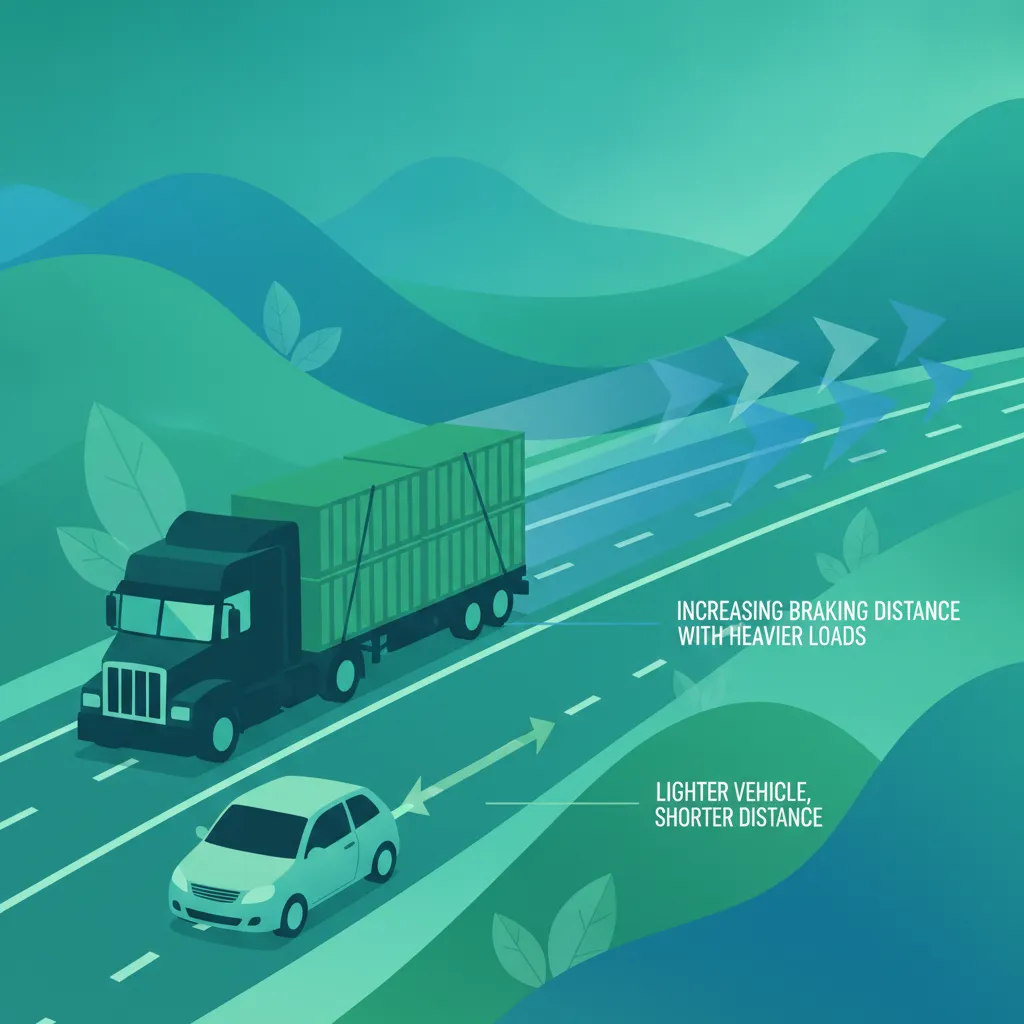
This lesson explores the critical physics behind stopping a heavy vehicle. It breaks down the components of total stopping distance—thinking distance and braking distance—and explains how this is significantly increased by vehicle mass and speed. Learners will understand the necessity of maintaining a much greater following distance than a car to allow enough space to stop safely in all conditions.

This lesson explains how the braking, lighting, and ABS systems of a trailer are powered and controlled by the tractor unit. It details the purpose of the red (emergency) and yellow (service) air lines and the multi-pin electrical connector, providing a clear procedure for connecting them in the correct sequence. Learners will understand the importance of these connections for safe braking and legal lighting operation.

This lesson provides essential strategies for safely navigating long, steep downgrades. It teaches the principle of selecting a low gear before starting the descent, allowing the engine's natural resistance to help control the vehicle's speed. Learners will understand how to combine correct gear selection with the judicious use of engine brakes and retarders to maintain a steady, safe speed and keep the service brakes cool and ready for emergency use.

This lesson explains the function of the vehicle's braking system and key active safety technologies. It details how the Anti-lock Braking System (ABS) prevents wheels from locking during hard braking, allowing the driver to maintain steering control. The content also covers Electronic Stability Control (ESC), which helps prevent skidding by automatically applying brakes to individual wheels to stabilize the vehicle.

This lesson covers the complete set of lighting, reflective equipment, and protective guards mandated for heavy vehicles. It explains the function of each light, from headlights to side markers, and the importance of keeping them clean and operational to ensure the vehicle is visible to others. The lesson also details the legal requirements and safety purpose of side guards and rear underrun protection, which are designed to protect vulnerable road users in a collision.

This lesson focuses on the steering mechanisms that enable drivers to control heavy vehicles, with a particular emphasis on power-assisted hydraulic systems. It covers the key components, from the steering wheel to the linkages connected to the wheels, and explains how to perform basic checks for responsiveness and fluid levels. Learners will understand how proper steering function is critical for maintaining directional control and overall vehicle safety.
Master safe downhill speed management techniques for heavy vehicles. Explore Italian Codice della Strada regulations regarding mandatory auxiliary brake use, understanding common mistakes and best practices to prevent brake fade and ensure safety.
This lesson provides essential strategies for safely navigating long, steep downgrades. It teaches the principle of selecting a low gear before starting the descent, allowing the engine's natural resistance to help control the vehicle's speed. Learners will understand how to combine correct gear selection with the judicious use of engine brakes and retarders to maintain a steady, safe speed and keep the service brakes cool and ready for emergency use.
This lesson covers three critical risks associated with heavy vehicle braking systems. It explains 'brake lag' in air brake systems, the delay between pedal application and brake activation, and 'brake fade', the loss of braking efficiency due to overheating. Learners will be taught to recognize the warning signs and, more importantly, to use correct driving techniques, such as utilizing endurance brakes, to prevent these potentially catastrophic failures.
This lesson provides specialized instruction for driving in mountainous terrain. It teaches drivers how to select the correct gear for both climbing steep inclines to prevent engine strain and descending to maintain control without overheating the brakes. Techniques for navigating sharp hairpin bends, using passing places on narrow roads, and anticipating the effects of altitude on vehicle performance are also covered.
This lesson explores the critical physics behind stopping a heavy vehicle. It breaks down the components of total stopping distance—thinking distance and braking distance—and explains how this is significantly increased by vehicle mass and speed. Learners will understand the necessity of maintaining a much greater following distance than a car to allow enough space to stop safely in all conditions.
This lesson introduces the three distinct categories of braking systems on a heavy vehicle. It explains the role of the service brake for normal stopping, the parking brake for securing the vehicle when stationary, and endurance brakes for sustained speed control. Understanding the purpose and correct application of each system is fundamental to safe and efficient vehicle operation, as well as minimizing wear on the primary service brakes.

This lesson provides essential guidance on how to adjust driving techniques for a range of hazardous weather conditions. It covers reducing speed and increasing following distances in rain to prevent aquaplaning, using lights correctly in fog, and understanding the vehicle's reduced traction on snow and ice. It also explains how to anticipate and counteract the effects of strong crosswinds on high-sided vehicles.

This lesson provides a step-by-step guide for managing a vehicle breakdown safely. It reinforces the procedure for stopping on the hard shoulder, activating hazard lights, and placing a warning triangle at the correct distance. The lesson emphasizes the importance of wearing high-visibility clothing, exiting the vehicle from the side away from traffic, and waiting in a safe location before contacting a roadside assistance service.

This lesson focuses on the specific regulations and techniques for operating a heavy vehicle on high-speed motorways. It covers mandatory lane discipline for trucks, the rules governing overtaking other heavy vehicles, and the specific speed limits that apply. Best practices for merging onto and exiting the motorway, maintaining safe following distances, and using the hard shoulder only in genuine emergencies are also detailed.
This lesson covers the techniques for executing a controlled emergency stop in a heavy goods vehicle. It explains the function of Anti-lock Braking Systems (ABS) in preventing wheel lock-up and maintaining steering control during maximum braking effort. Learners will understand how to brace for the effects of rapid deceleration and anticipate potential load shifts, focusing on bringing the vehicle to a stop as quickly and safely as possible.

This lesson focuses on the principle of 'appropriate speed' in urban environments, which often means driving slower than the legal maximum. It explains how to assess the environment for potential hazards—such as schools, parked cars, and busy intersections—and adjust speed accordingly to allow for adequate reaction time. Maintaining a safe, consistent speed reduces the need for harsh braking and contributes to a safer environment for everyone.
Find clear answers to common questions learners have about Engine Brake, Retarder, and Exhaust Braking. Learn how the lesson is structured, which driving theory objectives it supports, and how it fits into the overall learning path of units and curriculum progression in Italy. These explanations help you understand key concepts, lesson flow, and exam focused study goals.
Heavy vehicles have massive kinetic energy on descents. If you only use service brakes, they can overheat and suffer from 'brake fade', leading to a loss of stopping power. Auxiliary brakes dissipate energy without overheating the friction linings.
An engine brake uses the engine's compression to slow the vehicle, while a hydrodynamic retarder uses fluid dynamics within a housing to create resistance. Both are endurance systems that help preserve the main service brakes.
You should use the exhaust brake as an initial measure to maintain a steady speed on moderate descents. It should be activated early, before the vehicle gains too much speed, to assist in keeping your vehicle within a safe speed limit.
No. Auxiliary brakes are designed for speed management and endurance, not for rapid, full-stop emergency braking. Always be ready to engage the main service brake system if a rapid reduction in speed is required.
Start searching now to pinpoint exactly which Italian driving theory topics, road signs, or traffic rules you need to master. Use our advanced filters to build a custom practice session and ensure you're fully prepared for every aspect of your official driving licence exam.