
Achieving your driving license in Switzerland requires a deep understanding of federal traffic ordinances, particularly regarding priority and signage. This article guides you through the crucial distinctions between warning and prohibition signs while clarifying the specific rules governing roundabouts and unmarked intersections. You will learn how to accurately interpret official Swiss road signals and prioritize effectively, ensuring you are fully prepared for the theoretical requirements of the category B exam.
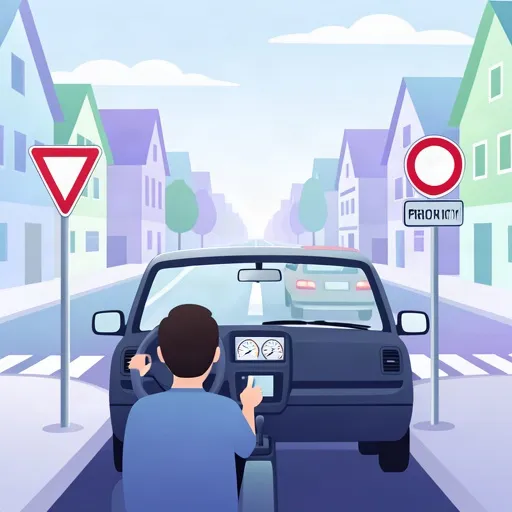
Article content overview
Passing the Swiss driving theory exam requires more than just memorizing images; it demands a thorough understanding of the federal traffic ordinances that govern our roads. Whether you are aiming for your category B license or another class, the Swiss Federal Roads Office (ASTRA) places significant emphasis on your ability to correctly interpret signals and apply priority rules in diverse traffic scenarios. By mastering these foundational concepts, you not only improve your chances of passing the exam on the first attempt but also contribute to the "Via Sicura" vision of safer roads for all.
One of the most frequent sources of confusion for learners is determining who has the right of way at intersections. In Switzerland, the default rule at unmarked intersections is "right-hand priority," meaning traffic coming from the right has the right of way unless otherwise indicated by road signs or markings. However, this is frequently superseded by signage, such as the "Main Road" sign or specific "Stop" or "Give Way" signals.
When you approach an intersection, you must actively scan for these indicators. A common exam trap involves failing to recognize when a main road changes direction. Even if you are on a wider or busier street, if a sign indicates the main road turns, you must yield to those following that priority path.
The yellow diamond sign is the most important indicator of a main road in Switzerland. When you see this sign, it confirms that you have priority over traffic entering from secondary roads. However, this does not grant you absolute immunity from caution. You must still remain alert for public transport, such as trams, which often have their own specific priority rules, and emergency vehicles with flashing blue lights and sirens.
It is essential to distinguish between the "Stop" sign and the "Give Way" sign. A "Stop" sign requires a complete halt of the vehicle, even if the road appears empty. Your wheels must come to a total standstill before the stop line. In contrast, the "Give Way" sign requires you to slow down and prepare to stop only if there is conflicting traffic.
| Sign | Action Required |
|---|---|
| Stop (3.01) | Complete standstill mandatory; check for traffic before proceeding. |
| Give Way (3.02) | Yield to cross-traffic; stop only if necessary. |
| Main Road (3.05) | Maintain speed (within limits); priority over side roads. |
A common mistake in the theory exam is forgetting that "right-hand priority" still applies at unmarked intersections even in 30 km/h zones. Always assume the rule is active unless a sign explicitly states otherwise.
Roundabouts are prevalent in Swiss urban planning and require a specific approach. When entering a roundabout, you must yield to vehicles already inside the circle, which are coming from your left. Once you are inside, maintain your lane and use your indicator to signal your exit, ensuring you do not cut off cyclists who may be traveling along the edge of the roundabout.
In alpine regions, mountain roads present unique challenges. If you are traveling uphill on a narrow road and meet a vehicle coming down, the general rule is that the ascending vehicle has priority. This is because it is much more difficult to restart a climb from a standstill than it is to maneuver downhill.
The theory exam is designed to test your real-world application of these rules. You will encounter various scenarios involving complex intersections, cyclist interactions, and speed limit changes. Remember that standard speed limits (50 km/h in urban areas, 80 km/h on rural roads, 100 km/h on expressways, and 120 km/h on motorways) are defaults; always look for signs that may lower these limits for safety reasons, such as near schools or construction zones.
This article covers the foundational priority rules essential for the Swiss theory exam, including the right-hand priority rule (Rechtsvortritt) that applies at unmarked intersections, the distinction between Stop and Give Way signs, and the significance of yellow diamond main road signs. It explains how to navigate roundabouts by yielding to left-side traffic and proper use of indicators, and introduces the mountain road priority rule giving ascending vehicles priority on narrow alpine roads. Understanding these rules and their specific Swiss legal definitions will help candidates apply priority concepts correctly in diverse traffic scenarios encountered on the exam.
A short set of high-value points that capture the most important ideas from this article.
Right-hand priority (Rechtsvortritt) is the default rule at unmarked intersections in Switzerland, meaning traffic from the right always has priority unless signs indicate otherwise
Yellow diamond signs mark main roads where you have priority over vehicles entering from side roads
A Stop sign requires a complete standstill before proceeding, while a Give Way sign only requires slowing and yielding when necessary
Roundabouts require yielding to vehicles already inside the circle coming from your left, and using indicators when exiting
On narrow mountain roads, vehicles traveling uphill have priority over those going downhill
Right-hand priority applies at unmarked intersections even in 30 km/h zones unless explicitly overridden by signage
Main road priority can change direction at intersections; follow the signed priority path, not just road width
Public transport (trams) and emergency vehicles have their own specific priority rules that override standard signage
The stop line is the white transverse line where your vehicle must come to a complete halt for Stop signs
Standard speed limits (50/80/100/120 km/h) are defaults that can be lowered by signs near schools, construction zones, or other hazard areas
Assuming wider or busier roads always have priority over smaller side roads regardless of signage
Confusing Stop and Give Way signs, particularly thinking a Give Way sign requires a full stop
Failing to scan for vehicles approaching from the right at unmarked intersections
Not signaling when exiting a roundabout, which can confuse other road users especially cyclists
Forgetting that right-hand priority still applies at unmarked intersections in low-speed zones
Article content overview
A short set of high-value points that capture the most important ideas from this article.
Right-hand priority (Rechtsvortritt) is the default rule at unmarked intersections in Switzerland, meaning traffic from the right always has priority unless signs indicate otherwise
Yellow diamond signs mark main roads where you have priority over vehicles entering from side roads
A Stop sign requires a complete standstill before proceeding, while a Give Way sign only requires slowing and yielding when necessary
Roundabouts require yielding to vehicles already inside the circle coming from your left, and using indicators when exiting
On narrow mountain roads, vehicles traveling uphill have priority over those going downhill
Right-hand priority applies at unmarked intersections even in 30 km/h zones unless explicitly overridden by signage
Main road priority can change direction at intersections; follow the signed priority path, not just road width
Public transport (trams) and emergency vehicles have their own specific priority rules that override standard signage
The stop line is the white transverse line where your vehicle must come to a complete halt for Stop signs
Standard speed limits (50/80/100/120 km/h) are defaults that can be lowered by signs near schools, construction zones, or other hazard areas
Assuming wider or busier roads always have priority over smaller side roads regardless of signage
Confusing Stop and Give Way signs, particularly thinking a Give Way sign requires a full stop
Failing to scan for vehicles approaching from the right at unmarked intersections
Not signaling when exiting a roundabout, which can confuse other road users especially cyclists
Forgetting that right-hand priority still applies at unmarked intersections in low-speed zones
Explore related topics, search based questions, and concepts that learners often look up when studying Swiss Priority Rules and Signs. These themes reflect real search intent and help you understand how this topic connects to wider driving theory knowledge in Switzerland.
Find clear and practical answers to common questions learners often have about Swiss Priority Rules and Signs. This section helps explain difficult points, remove confusion, and reinforce the key driving theory concepts that matter for learners in Switzerland.
A 'Stop' sign (3.01) requires a complete standstill for at least one second at the marked line, whereas a 'Give Way' sign (3.02) requires you to slow down and stop only if there is traffic approaching that has priority.
Right-hand priority (Rechtsvortritt) applies at all road intersections unless priority is otherwise regulated by traffic signs, road markings, or the presence of a main road sign.
Yes, vehicles entering a roundabout must yield to those already circulating within the roundabout, unless official signage indicates a specific exception.
The yellow diamond sign identifies the road as a 'main road,' which grants priority over vehicles approaching from secondary roads, regardless of the right-hand priority rule.
Continue your learning journey by searching our extensive library of Swiss driving theory articles. Explore additional topics, review specific road rules, or deepen your understanding of official traffic procedures to excel in your exam and drive safely in Switzerland.