
Learning the Swiss traffic rules involves more than just memorizing speed limits; it requires understanding the legal system that governs enforcement. This guide clarifies how authorities calculate speed, the role of safety deductions, and the difference between administrative fines and more serious judicial proceedings. Mastering these concepts is crucial for both passing your theory test and maintaining a clean driving record.
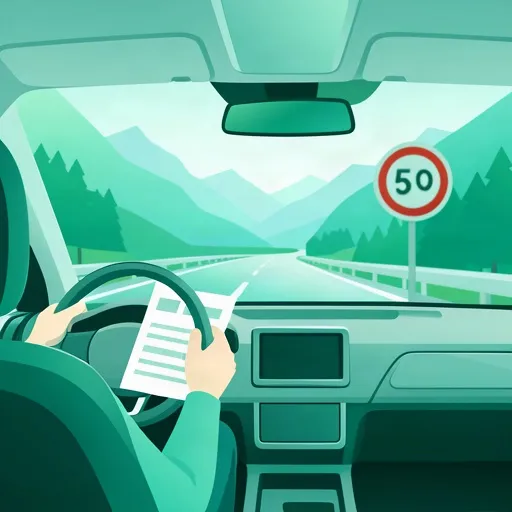
Article content overview
Navigating the roads in Switzerland requires a strict adherence to traffic regulations, as the Swiss enforcement system is both precise and unforgiving. Whether you are preparing for your theory exam or driving on Swiss motorways, understanding the legal framework behind speed limits is essential. Switzerland employs a standardized approach to traffic law, governed by the Road Traffic Act (SVG) and the Traffic Rules Ordinance (VRV), ensuring that drivers remain accountable for their speed regardless of the canton they are in.
The foundation of safe driving in Switzerland is knowing the maximum permissible speeds for different road categories. These limits are designed to balance traffic flow with public safety, particularly in areas with pedestrians, cyclists, and public transport.
| Road Type | Speed Limit |
|---|---|
| Motorways (Autobahn) | 120 km/h |
| Semi-motorways (Autostrasse) | 100 km/h |
| Rural roads (outside built-up areas) | 80 km/h |
| Built-up areas (within towns/villages) | 50 km/h |
| Residential zones (Tempo-30 zones) | 30 km/h |
It is important to note that the 50 km/h limit in built-up areas begins as soon as you pass the village entry sign. Conversely, the 80 km/h limit on rural roads applies from the moment you pass the village exit sign, which features the location name with a diagonal red line.
A common point of confusion for new drivers is how the police determine if you have exceeded the speed limit. Swiss authorities apply a "safety deduction" (Sicherheitsabzug) to the speed recorded by any measuring device. This deduction is intended to account for potential technical inaccuracies in both the radar or laser equipment and your vehicle’s speedometer.
For example, if a laser device records your speed at 87 km/h, the police will subtract a specific margin—often 3 km/h depending on the device and the speed range—and base the penalty on the remaining figure. This means that the fine is calculated based on your adjusted speed, not the absolute raw reading of the device.
When you are caught exceeding the speed limit, the consequence depends on the severity of the infraction. For minor infringements, you will typically receive a fixed penalty (Geldbusse), which is a straightforward administrative fine. However, if you are caught driving significantly above the allowed limit, the situation changes from a simple fine to a formal judicial process.
In such cases, you will receive a court summons (Anzeige). A summons implies a more serious breach of road traffic laws, and the resulting financial penalty will likely be at least 400 CHF. More importantly, the amount of the fine for severe speeding can be adjusted based on your personal financial circumstances, and you may also be required to pay additional procedural costs and legal fees.
In Switzerland, the authorities take a "graduated" approach to traffic violations. Repeatedly receiving fixed penalties for minor speeding can lead to administrative measures, such as a warning or the eventual suspension of your learner’s or probationary driving license. The theory exam frequently tests this concept to ensure that candidates understand that speeding is not just a financial cost, but a risk to their legal right to drive.
This article covers the Swiss enforcement framework for speeding, including standardized speed limits across road types from 120 km/h on motorways to 30 km/h in residential zones. A key concept is the safety deduction (Sicherheitsabzug), where police subtract a margin from measured speed to account for technical inaccuracies before calculating fines. Minor infringements result in fixed penalties (Geldbusse), while significant speeding triggers court summons (Anzeige) with much higher financial consequences and possible licence suspension. Switzerland applies a graduated approach where repeated minor violations can ultimately threaten your driving licence status, making compliance essential for both road safety and exam success.
A short set of high-value points that capture the most important ideas from this article.
Switzerland uses standardized speed limits: 120 km/h motorways, 100 km/h semi-motorways, 80 km/h rural roads, 50 km/h built-up areas, and 30 km/h residential zones.
Police always apply a safety deduction (Sicherheitsabzug) to measured speed before calculating penalties, accounting for device and speedometer inaccuracies.
Fixed penalties (Geldbusse) are for minor infringements, while court summons (Anzeige) lead to judicial proceedings with fines starting at 400 CHF for serious speeding.
The 50 km/h limit in built-up areas begins immediately after passing the village entry sign, not at the sign itself.
Switzerland uses a graduated approach where repeated minor speeding violations can lead to licence warnings or suspension.
Speed limits change at the village entry sign (50 km/h) and village exit sign (returning to 80 km/h on rural roads).
The safety deduction means your actual speed is lower than measured speed, so you cannot rely on a buffer.
Court summons (Anzeige) fines can be adjusted based on personal financial circumstances and include procedural costs.
Tempo-30 zones apply in residential and school areas for enhanced pedestrian safety.
Temporary speed limits shown on motorway gantries are legally binding and must be obeyed.
Assuming the speedometer shows exact speed—vehicles typically read slightly higher than actual velocity.
Confusing when the 50 km/h built-up limit starts, thinking it applies after the sign rather than from it.
Believing that a small amount over the limit results in only a minor fine without licence consequences.
Overlooking special speed limits for vehicles towing trailers or heavy goods over 3.5 tonnes.
Assuming raw radar or laser readings are used for penalties instead of adjusted readings after safety deduction.
Article content overview
A short set of high-value points that capture the most important ideas from this article.
Switzerland uses standardized speed limits: 120 km/h motorways, 100 km/h semi-motorways, 80 km/h rural roads, 50 km/h built-up areas, and 30 km/h residential zones.
Police always apply a safety deduction (Sicherheitsabzug) to measured speed before calculating penalties, accounting for device and speedometer inaccuracies.
Fixed penalties (Geldbusse) are for minor infringements, while court summons (Anzeige) lead to judicial proceedings with fines starting at 400 CHF for serious speeding.
The 50 km/h limit in built-up areas begins immediately after passing the village entry sign, not at the sign itself.
Switzerland uses a graduated approach where repeated minor speeding violations can lead to licence warnings or suspension.
Speed limits change at the village entry sign (50 km/h) and village exit sign (returning to 80 km/h on rural roads).
The safety deduction means your actual speed is lower than measured speed, so you cannot rely on a buffer.
Court summons (Anzeige) fines can be adjusted based on personal financial circumstances and include procedural costs.
Tempo-30 zones apply in residential and school areas for enhanced pedestrian safety.
Temporary speed limits shown on motorway gantries are legally binding and must be obeyed.
Assuming the speedometer shows exact speed—vehicles typically read slightly higher than actual velocity.
Confusing when the 50 km/h built-up limit starts, thinking it applies after the sign rather than from it.
Believing that a small amount over the limit results in only a minor fine without licence consequences.
Overlooking special speed limits for vehicles towing trailers or heavy goods over 3.5 tonnes.
Assuming raw radar or laser readings are used for penalties instead of adjusted readings after safety deduction.
Explore related topics, search based questions, and concepts that learners often look up when studying Swiss Speeding Penalties Explained. These themes reflect real search intent and help you understand how this topic connects to wider driving theory knowledge in Switzerland.
Find clear and practical answers to common questions learners often have about Swiss Speeding Penalties Explained. This section helps explain difficult points, remove confusion, and reinforce the key driving theory concepts that matter for learners in Switzerland.
A safety deduction is a mandatory reduction from the measured speed to account for potential inaccuracies in speedometers and measurement devices, ensuring fairness in penalty application.
A fixed penalty (Geldbusse) is a standard fine for minor infractions. A court summons (Anzeige) is issued for more severe speed violations, often leading to higher fines based on financial circumstances and potential administrative measures against your licence.
Yes, penalties are generally linked to the severity of the violation relative to the speed limit. Exceeding limits in sensitive areas like Tempo-30 zones is treated with high seriousness by Swiss authorities.
Continue your learning journey by searching our extensive library of Swiss driving theory articles. Explore additional topics, review specific road rules, or deepen your understanding of official traffic procedures to excel in your exam and drive safely in Switzerland.