
Forming an emergency corridor is a critical responsibility for every driver on Swiss motorways, mandated by law since 2021. You will learn the exact vehicle positioning required to clear a path for emergency services, whether you are on a two-lane or multi-lane road. This knowledge is not only vital for passing your theory exam but also for ensuring the safety of others and avoiding strict regulatory penalties.
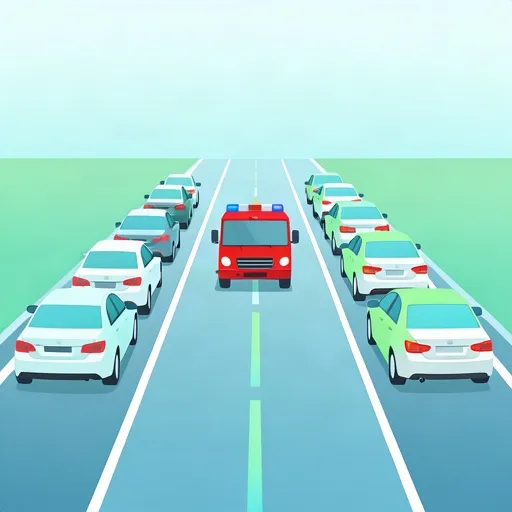
Article content overview
Navigating Swiss motorways requires not only technical driving skills but also a disciplined approach to traffic flow and emergency preparedness. Since January 1, 2021, Switzerland has implemented a mandatory regulation regarding the Rettungsgasse, or emergency corridor. This rule is designed to ensure that emergency vehicles, such as ambulances, fire trucks, and police cars, can reach the scene of an accident without dangerous delays. Understanding this regulation is essential, as failing to comply is not only a safety risk but also a punishable offense under Swiss traffic law.
The requirement to form an emergency corridor is codified in Article 36a of the Swiss Traffic Rules Ordinance (VRV). The law dictates that whenever traffic on a motorway or a semi-motorway slows to a walking pace or comes to a complete standstill, drivers must proactively clear a path. This obligation exists regardless of whether an emergency vehicle with blue lights or a siren is currently visible or audible. By acting early, you ensure that the corridor is fully established by the time emergency services reach your location.
The positioning of your vehicle depends entirely on the number of lanes available on your side of the motorway. Precision is vital, as confusion during a traffic jam can lead to unnecessary congestion or, worse, block the path of responders.
While the Rettungsgasse is distinct from the hard shoulder, it is often confused with other motorway traffic management strategies. The "zipper principle" (Reissverschlusssystem) is now mandatory when lanes end due to construction or accidents; you should continue in your lane until the obstacle and then merge alternately. It is important to remember that these rules are separate from the emergency corridor requirement. You must never block the rescue path while attempting to merge or change lanes during a traffic jam.
In Switzerland, the authorities take the obstruction of emergency vehicles very seriously. Under the Swiss Ordnungsbussenkatalog, failing to form a Rettungsgasse or blocking the corridor can result in a fine of CHF 100. Furthermore, if investigators determine that your failure to move aside contributed to a significant delay in the arrival of life-saving services, the consequences may extend far beyond a standard fine, potentially leading to criminal proceedings.
| Scenario | Lane Positioning Requirement |
|---|---|
| 2-Lane Motorway | Between Lane 1 (Left) and Lane 2 (Right) |
| 3-Lane Motorway | Between Lane 1 (Left) and Lane 2 (Middle) |
| 4-Lane Motorway | Between Lane 1 (Left) and Lane 2 (Middle-Left) |
In your theory exam, you may encounter situational questions regarding motorway behavior. Remember: the Rettungsgasse is not an option—it is a legal mandate. If you see an image of a stationary traffic jam, the correct answer will always emphasize moving to the side to create that gap, regardless of the absence of sirens. Stay alert, keep your distance from the vehicle in front, and always stay informed on current Swiss traffic legislation.
Switzerland's Rettungsgasse (emergency corridor) is a mandatory safety measure established under Article 36a VRV since January 2021. Drivers must proactively form the corridor between the leftmost lane and the lane immediately to its right whenever traffic slows to walking pace or stops, regardless of whether emergency vehicles are visible. On two-lane roads, vehicles move left and right to create a central path; on multi-lane roads, only the far-left lane moves left while all other lanes move right. Failing to comply can result in a CHF 100 fine and potentially criminal liability if emergency services are delayed, and drivers must never use the corridor themselves.
A short set of high-value points that capture the most important ideas from this article.
Form the emergency corridor as soon as traffic slows to walking pace, not just when you see emergency vehicles approaching.
On a two-lane motorway, the left lane moves left and the right lane moves right, creating the corridor in the middle.
On a three-lane motorway, only the leftmost lane moves left; all other lanes move right, placing the corridor between lanes 1 and 2.
The emergency corridor is reserved exclusively for official emergency response vehicles; driving through it yourself carries heavy penalties.
The Rettungsgasse requirement is mandatory law under Article 36a VRV, not optional or situational.
The corridor is always established between the leftmost lane and the lane directly to its right, regardless of total lane count.
The obligation to form the corridor activates at walking pace or complete stoppage, before any emergency vehicle is visible.
The zipper principle (Reissverschlusssystem) is a separate rule for lane merging during construction or obstacles, not the same as the emergency corridor.
Non-compliance can result in CHF 100 fine and potentially criminal proceedings if delays to emergency services are proven.
Never use the emergency corridor yourself; it is exclusively for ambulances, fire trucks, and police vehicles.
Assuming the corridor only needs to be formed after seeing flashing lights or hearing sirens, rather than proactively at the first sign of congestion.
Confusing the Rettungsgasse with the hard shoulder or believing they serve the same purpose.
On three-lane roads, incorrectly moving the middle lane left instead of right, creating the corridor in the wrong position.
Forgetting that the zipper principle and emergency corridor are separate rules that require different responses.
Believing the rule applies only on motorways, not recognizing that semi-motorways also require the same corridor formation.
Article content overview
A short set of high-value points that capture the most important ideas from this article.
Form the emergency corridor as soon as traffic slows to walking pace, not just when you see emergency vehicles approaching.
On a two-lane motorway, the left lane moves left and the right lane moves right, creating the corridor in the middle.
On a three-lane motorway, only the leftmost lane moves left; all other lanes move right, placing the corridor between lanes 1 and 2.
The emergency corridor is reserved exclusively for official emergency response vehicles; driving through it yourself carries heavy penalties.
The Rettungsgasse requirement is mandatory law under Article 36a VRV, not optional or situational.
The corridor is always established between the leftmost lane and the lane directly to its right, regardless of total lane count.
The obligation to form the corridor activates at walking pace or complete stoppage, before any emergency vehicle is visible.
The zipper principle (Reissverschlusssystem) is a separate rule for lane merging during construction or obstacles, not the same as the emergency corridor.
Non-compliance can result in CHF 100 fine and potentially criminal proceedings if delays to emergency services are proven.
Never use the emergency corridor yourself; it is exclusively for ambulances, fire trucks, and police vehicles.
Assuming the corridor only needs to be formed after seeing flashing lights or hearing sirens, rather than proactively at the first sign of congestion.
Confusing the Rettungsgasse with the hard shoulder or believing they serve the same purpose.
On three-lane roads, incorrectly moving the middle lane left instead of right, creating the corridor in the wrong position.
Forgetting that the zipper principle and emergency corridor are separate rules that require different responses.
Believing the rule applies only on motorways, not recognizing that semi-motorways also require the same corridor formation.
Explore related topics, search based questions, and concepts that learners often look up when studying Swiss Emergency Corridor Rules. These themes reflect real search intent and help you understand how this topic connects to wider driving theory knowledge in Switzerland.
Find clear and practical answers to common questions learners often have about Swiss Emergency Corridor Rules. This section helps explain difficult points, remove confusion, and reinforce the key driving theory concepts that matter for learners in Switzerland.
The Rettungsgasse is an emergency corridor that allows police, fire, and ambulance services to reach incident sites quickly during traffic congestion. It is legally mandatory under Article 36a of the Swiss traffic regulations (VRV) for all drivers on motorways when traffic slows to walking speed or comes to a stop.
On a two-lane road, vehicles in the left lane must move as far to the left as possible, while vehicles in the right lane must move as far to the right as possible, creating a clear space in the center for emergency vehicles.
On a three-lane motorway, vehicles in the far-left lane move to the left, while all other lanes (middle and right) must move to the right. The emergency corridor is always formed between the leftmost lane and the lane immediately to its right.
Yes. The Rettungsgasse must be formed proactively as soon as traffic slows to walking speed, regardless of whether an emergency vehicle is currently visible or audible. This ensures the path is already clear when help arrives.
Failure to form or keep the emergency corridor open can result in an official fine of CHF 100 as per the Swiss fine catalogue. More severe penalties may apply if it is proven that the failure to act caused a significant delay to emergency response services.
Continue your learning journey by searching our extensive library of Swiss driving theory articles. Explore additional topics, review specific road rules, or deepen your understanding of official traffic procedures to excel in your exam and drive safely in Switzerland.