Driving on narrow Alpine routes requires a precise understanding of the Swiss Begegnungsregeln, or meeting rules, as defined by Art. 37 VRV. You will learn the legal hierarchy of priority between ascending and descending vehicles, the crucial exceptions for Postauto services, and the practical etiquette of using passing places. This knowledge is vital for navigating mountain passes confidently and correctly answering related questions in your Swiss theory exam.
Article content overview
Navigating Switzerland’s spectacular mountain regions often involves driving on narrow, winding roads where two vehicles cannot safely pass side-by-side. For drivers, understanding the specific "meeting rules" (Begegnungsregeln) is not only essential for safety on Alpine routes but is also a frequent subject of the Swiss theory test. These regulations are primarily governed by Art. 37 of the Traffic Rules Ordinance (VRV), which establishes a clear hierarchy to ensure traffic flows smoothly despite the topographical limitations of the terrain.
When you encounter oncoming traffic on a narrow road where passing is impossible, the legal responsibility to yield is determined by specific criteria. The fundamental principle is that the vehicle best positioned to reverse to a passing place (Ausweichstelle) must do so. However, when no clear advantage exists, the rule of thumb is that the descending vehicle should yield to the ascending vehicle. This is because restarting a vehicle on a steep incline can be mechanically difficult, and drivers going uphill often have less visibility into the space behind them than those descending.
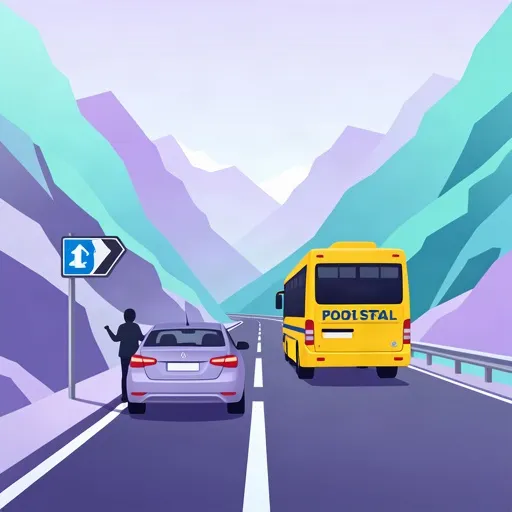
In the Swiss driving theory, a critical exception exists regarding public transport. The Postauto (postal bus) serves as a vital lifeline in the Swiss mountains and is granted absolute priority on narrow mountain roads. If you are driving a private car and encounter an oncoming Postauto on a narrow section, you must yield and reverse, regardless of whether you are ascending or descending, or whether you have already entered the narrow passage.
Never assume your position on the road gives you the right of way over a Postauto. On designated postal routes, the bus has the legal right of way at narrow passages. If you hear the distinct three-tone horn of a Postauto, be prepared to slow down or pull into a passing place immediately.
Safety on Swiss mountain passes requires more than just knowing the law; it requires proactive driving habits. Because many mountain roads feature blind hairpin bends, you should always adjust your speed so that you can come to a complete stop within the visible distance. In areas where sightlines are heavily obstructed, the law allows for the use of the horn to announce your presence to unseen oncoming traffic.
| Scenario | Priority Rule | Action Required |
|---|---|---|
| Two cars (equidistant) | Ascending has priority | Descending must reverse |
| Car vs. Postauto | Postauto has absolute priority | Car must reverse |
| Passing places nearby | Vehicle closest to space | Vehicle closest must reverse |
| Heavy vehicle vs. Car | Heavy vehicle often has priority | Use caution and yield early |
The Swiss theory exam often tests your ability to interpret these scenarios through illustrative examples. You may be shown a situation where two vehicles are approaching each other on a narrow path and asked to identify which vehicle has the legal obligation to reverse. Remember that questions involving a Postauto are specifically designed to test your knowledge of its special legal status. Always read the question carefully to determine the gradient direction and the distance to the nearest passing place.
Before starting a journey on a mountain pass, check the official road status reports. Some high-altitude passes may be closed, have weight restrictions, or require specific equipment like snow chains during certain times of the year.
Swiss narrow mountain road priority is governed by Art. 37 VRV, which establishes that the vehicle closest to a passing place must reverse, and when equidistant, the descending vehicle yields to the ascending vehicle. However, Postauto buses hold absolute priority regardless of direction or position. These rules are frequently tested in the Swiss theory exam, so learners should memorize both the hierarchy and the specific Postauto exception, and always check road status reports before mountain journeys.
A short set of high-value points that capture the most important ideas from this article.
The fundamental rule on narrow mountain roads is that the vehicle best positioned to reverse to a passing place (Ausweichstelle) must yield
When both vehicles are equidistant from passing places, the descending (downhill) vehicle must yield to the ascending (uphill) vehicle
Postauto buses hold absolute priority on narrow mountain roads, regardless of direction or your position in the passage
Distance to the nearest passing place takes priority over the ascending/descending rule when determining who should reverse
Always adjust speed on mountain roads so you can stop within your visible distance, especially before blind hairpin bends
Art. 37 VRV is the specific article of Swiss law governing meeting and passing rules on narrow roads
Postauto has absolute priority—no exceptions, even if you are already in the narrow passage
Ausweichstelle is the German term for a designated passing place where vehicles can pull over
Ascending vehicles have priority because restarting on a steep incline is mechanically difficult and uphill drivers have less rear visibility
The horn may be used to announce your presence on blind bends where sightlines are obstructed
Assuming your position in a narrow passage gives you right of way over an approaching Postauto—never true
Forgetting that the Postauto exception overrides the ascending-vehicle-priority rule entirely
Reversing when you are actually closer to a passing place than the oncoming vehicle, even if you are ascending
Confusing descending (downhill) with ascending (uphill) when applying the priority rule
Not checking for passing places before assuming the standard ascending-vehicle rule applies
Article content overview
A short set of high-value points that capture the most important ideas from this article.
The fundamental rule on narrow mountain roads is that the vehicle best positioned to reverse to a passing place (Ausweichstelle) must yield
When both vehicles are equidistant from passing places, the descending (downhill) vehicle must yield to the ascending (uphill) vehicle
Postauto buses hold absolute priority on narrow mountain roads, regardless of direction or your position in the passage
Distance to the nearest passing place takes priority over the ascending/descending rule when determining who should reverse
Always adjust speed on mountain roads so you can stop within your visible distance, especially before blind hairpin bends
Art. 37 VRV is the specific article of Swiss law governing meeting and passing rules on narrow roads
Postauto has absolute priority—no exceptions, even if you are already in the narrow passage
Ausweichstelle is the German term for a designated passing place where vehicles can pull over
Ascending vehicles have priority because restarting on a steep incline is mechanically difficult and uphill drivers have less rear visibility
The horn may be used to announce your presence on blind bends where sightlines are obstructed
Assuming your position in a narrow passage gives you right of way over an approaching Postauto—never true
Forgetting that the Postauto exception overrides the ascending-vehicle-priority rule entirely
Reversing when you are actually closer to a passing place than the oncoming vehicle, even if you are ascending
Confusing descending (downhill) with ascending (uphill) when applying the priority rule
Not checking for passing places before assuming the standard ascending-vehicle rule applies
Explore related topics, search based questions, and concepts that learners often look up when studying Swiss Mountain Road Priority Rules. These themes reflect real search intent and help you understand how this topic connects to wider driving theory knowledge in Switzerland.
Find clear and practical answers to common questions learners often have about Swiss Mountain Road Priority Rules. This section helps explain difficult points, remove confusion, and reinforce the key driving theory concepts that matter for learners in Switzerland.
The ascending vehicle generally has priority over the descending vehicle because it is more difficult to restart a vehicle on a steep incline.
The Postauto has absolute priority. All other vehicles must give way and reverse to a passing place if necessary to allow the bus to pass.
If you are the descending vehicle and there is no passing place immediately behind you, you are generally required to reverse to the nearest passing place to allow the ascending vehicle to pass.
The rule is that the vehicle that can more easily reach a passing place or reverse to one should do so. If both are equally positioned, the descending vehicle typically bears the responsibility to reverse.
Continue your learning journey by searching our extensive library of Swiss driving theory articles. Explore additional topics, review specific road rules, or deepen your understanding of official traffic procedures to excel in your exam and drive safely in Switzerland.