Understanding the specific rules for overtaking and passing is vital for both safe motorway driving and achieving a passing grade on your Swiss theory test. This guide breaks down the legal definitions from the SVG and VRV ordinances, focusing on when right-side maneuvers are allowed and why intentional overtaking on the right is strictly prohibited. You will learn to identify key exam scenarios and the importance of situational awareness regarding safety lines and traffic density.
Article content overview
Mastering the distinction between overtaking and passing is a foundational requirement for any student preparing for the Swiss driving theory exam. While these terms are often used interchangeably in casual conversation, the Swiss Road Traffic Act (SVG) and the Traffic Rules Ordinance (VRV) maintain precise legal boundaries between them. Understanding these distinctions is not just a matter of avoiding penalty points during your test; it is a critical skill for navigating motorways and urban environments safely and legally.
In Swiss traffic law, the primary rule is that you must always overtake on the left. Overtaking is defined as moving into a different lane to bypass a vehicle traveling in the same direction and subsequently returning to your original lane. Because this maneuver involves a double lane change, it is strictly regulated to prevent collisions and maintain traffic flow.
Overtaking (überholen) involves changing lanes to pass a slower vehicle and returning to the original lane. Passing (vorbeifahren) occurs when traffic on a parallel lane is moving at a different speed, such as in heavy traffic or on marked lanes, without the need to switch lanes to circumvent a specific vehicle.
Passing on the right, conversely, is permitted only in very specific, legally defined scenarios. Attempting to "overtake" by swerving right and then cutting back in front of another driver is an illegal maneuver that carries significant consequences and is a common trap in theory exam scenarios.
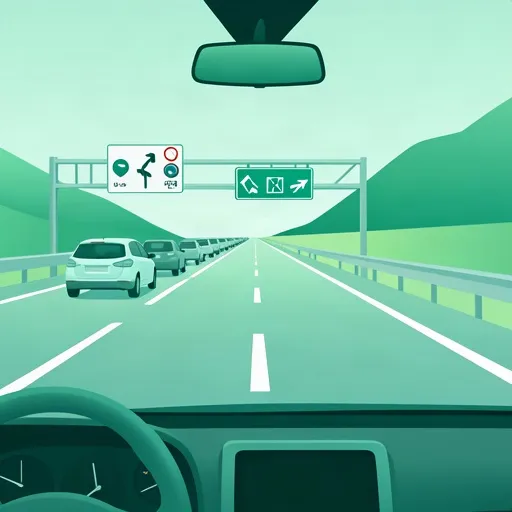
The Swiss authorities, specifically through ASTRA regulations, recognize that rigid adherence to "no passing on the right" can lead to congestion. Therefore, you are permitted to pass on the right with the necessary degree of caution in the following situations:
Do not confuse the "zipping principle" (Reissverschluss) with overtaking. When a motorway lane terminates, you are required to use both lanes until the point of obstruction and merge alternately. This is a mandatory safety procedure, not a maneuver to bypass other drivers.
The Swiss theory exam often presents complex traffic pictures to test your situational awareness. A recurring trap involves asking whether a driver may overtake when a solid line is present or visibility is restricted. You must remember that safety lines (Sicherheitslinie) are absolute boundaries.
When evaluating a scenario in your exam, always prioritize the visual cues provided by road markings. If you see a safety line, a crest in the road, or an unclear curve, the correct answer will always be to refrain from overtaking, regardless of the speed of the vehicle in front of you.
Your theory exam preparation should emphasize that driving is about proactive decision-making. You are expected to demonstrate patience, particularly when dealing with heavy vehicles or public transport. For example, if a bus is stopped at a designated stop, you may pass, but you must remain vigilant for passengers exiting the vehicle.
Swiss traffic law strictly differentiates between overtaking (always left, requires lane change) and passing (right-side allowed only in specific dense-traffic situations). The three permitted right-side passing scenarios are column traffic, signposted destination lanes, and motorway merging. Safety lines are absolute prohibitions. Your exam preparation should focus on recognizing when each rule applies, particularly distinguishing the mandatory zipping principle from illegal overtaking maneuvers, and always prioritizing road markings and visibility over vehicle speed when making overtaking decisions.
A short set of high-value points that capture the most important ideas from this article.
Overtaking (Überholen) always requires a double lane change and must be done on the left; passing (Vorbeifahren) occurs when lanes move at different speeds without changing lanes to bypass.
Right-side passing is permitted only in column traffic, when lanes are signposted for specific destinations, or during motorway merging situations.
Safety lines (Sicherheitslinie) are absolute boundaries that must never be crossed, regardless of traffic conditions or vehicle speed ahead.
The zipping principle (Reissverschluss) is mandatory lane merging, not an overtaking maneuver; it applies when a lane terminates, not to bypass slower vehicles.
Evaluate visibility, road markings, and vehicle signals before attempting any overtaking maneuver.
The legal distinction: overtaking involves changing lanes to bypass and return; passing is driving alongside slower or stationary traffic without lane change.
Three permitted right-side passing scenarios: Kolonnenverkehr, signposted lane targets, and motorway merging up to lane closures.
A solid white Sicherheitslinie prohibits any crossing; a broken Leitlinie may be crossed with caution.
Never overtake if sight is limited by hills, curves, crests, or stationary vehicles.
ASTRA regulations govern these rules and violations carry penalty points on your license application.
Confusing the zipping principle with right-side overtaking; Reissverschluss is mandatory merging, not a passing maneuver.
Believing right-side passing is always illegal; it is permitted in dense column traffic when lanes are fully occupied.
Attempting to overtake on a solid safety line because the vehicle ahead is slow, which is strictly prohibited.
Misinterpreting passing scenarios as overtaking, leading to incorrect answers about lane change requirements.
Ignoring visual cues like road markings when deciding whether to overtake, focusing only on vehicle behavior.
Article content overview
A short set of high-value points that capture the most important ideas from this article.
Overtaking (Überholen) always requires a double lane change and must be done on the left; passing (Vorbeifahren) occurs when lanes move at different speeds without changing lanes to bypass.
Right-side passing is permitted only in column traffic, when lanes are signposted for specific destinations, or during motorway merging situations.
Safety lines (Sicherheitslinie) are absolute boundaries that must never be crossed, regardless of traffic conditions or vehicle speed ahead.
The zipping principle (Reissverschluss) is mandatory lane merging, not an overtaking maneuver; it applies when a lane terminates, not to bypass slower vehicles.
Evaluate visibility, road markings, and vehicle signals before attempting any overtaking maneuver.
The legal distinction: overtaking involves changing lanes to bypass and return; passing is driving alongside slower or stationary traffic without lane change.
Three permitted right-side passing scenarios: Kolonnenverkehr, signposted lane targets, and motorway merging up to lane closures.
A solid white Sicherheitslinie prohibits any crossing; a broken Leitlinie may be crossed with caution.
Never overtake if sight is limited by hills, curves, crests, or stationary vehicles.
ASTRA regulations govern these rules and violations carry penalty points on your license application.
Confusing the zipping principle with right-side overtaking; Reissverschluss is mandatory merging, not a passing maneuver.
Believing right-side passing is always illegal; it is permitted in dense column traffic when lanes are fully occupied.
Attempting to overtake on a solid safety line because the vehicle ahead is slow, which is strictly prohibited.
Misinterpreting passing scenarios as overtaking, leading to incorrect answers about lane change requirements.
Ignoring visual cues like road markings when deciding whether to overtake, focusing only on vehicle behavior.
Explore related topics, search based questions, and concepts that learners often look up when studying Swiss Overtaking and Passing Rules. These themes reflect real search intent and help you understand how this topic connects to wider driving theory knowledge in Switzerland.
Find clear and practical answers to common questions learners often have about Swiss Overtaking and Passing Rules. This section helps explain difficult points, remove confusion, and reinforce the key driving theory concepts that matter for learners in Switzerland.
Overtaking involves changing lanes to bypass a vehicle and then returning to the original lane, which is generally prohibited on the right. Passing on the right is permitted only under specific conditions, such as driving in parallel traffic columns on motorways, without changing lanes for the purpose of overtaking.
You may pass on the right if a queue of traffic has formed on the left or middle lanes. You must do so with caution and without intentionally changing lanes to bypass the flow of traffic.
Yes, overtaking is strictly forbidden when sight is limited, such as in sharp curves, at hill crests, or at unmarked railway crossings. Additionally, you must never cross a solid safety line to initiate an overtaking maneuver.
The zipping principle (Reissverschluss) is mandatory when a motorway lane ends. Drivers in both lanes should continue to the point of closure and merge alternatively, ensuring a smooth transition during heavy traffic.
Continue your learning journey by searching our extensive library of Swiss driving theory articles. Explore additional topics, review specific road rules, or deepen your understanding of official traffic procedures to excel in your exam and drive safely in Switzerland.