Navigating public transport infrastructure is a critical part of the Swiss driving theory. This guide clarifies the distinction between restricted bus lanes and areas where specific traffic, such as taxis or cyclists, may be permitted. You will learn the exact conditions for legal lane entry and the potential consequences of unauthorised use.
Article content overview
Navigating urban traffic in Switzerland requires a precise understanding of specialized road markings and signs. Among the most critical, yet frequently misunderstood, infrastructure elements are bus lanes, known as "Busspuren." These lanes are designed to ensure the reliability of public transport, allowing buses to bypass congestion. For learner drivers, mastering the rules surrounding these lanes is essential, not only for the practical driving test but for maintaining safety and avoiding costly fines in the Swiss theory exam.
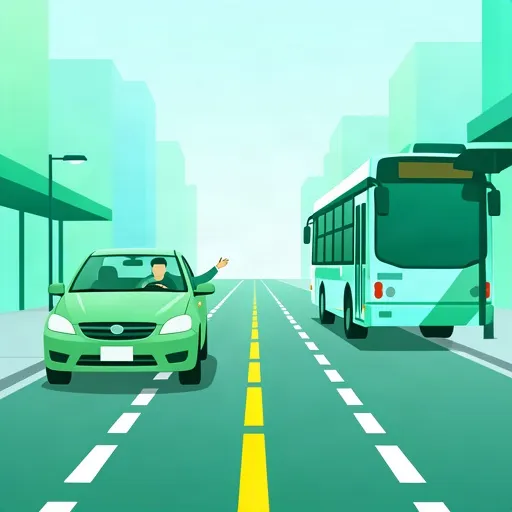
A bus lane is a section of the carriageway specifically reserved for public transport vehicles. In Switzerland, you can typically identify these lanes by the word "BUS" painted in large white letters directly onto the road surface. Additionally, overhead or roadside blue rectangular signs are used to indicate the beginning and end of these reserved areas.
It is important to remember that bus lanes are not universal; they are restrictive zones. If you are operating a private passenger car, you are generally prohibited from entering these lanes. This prohibition is strictly enforced to prevent delays for scheduled public transport, including city buses and the iconic Postauto vehicles.
While bus lanes are primarily for scheduled public transport, there are exceptions that depend on local signage. You might see supplementary signs (Zusatztafeln) attached beneath the main bus lane sign. These small white plates specify which additional vehicles may use the lane. Common exceptions often include:
Always look for the specific icons on the supplementary signs. If a sign displays a bicycle symbol, only cyclists—and not private cars—are granted the exception. Misinterpreting these supplementary signs is a common mistake that leads to unnecessary errors during the theory exam.
A frequent exam-related question concerns whether you are allowed to enter a bus lane to turn right. Under Swiss traffic law, you may only cross or enter a bus lane for the specific purpose of executing a right-hand turn at an upcoming junction, provided that a specific supplementary sign indicating "Einbiegen gestattet" (turning permitted) is displayed.
If such a sign is present, you may enter the lane at the latest possible moment to complete your turn, ensuring you do not impede any oncoming buses. However, if no such sign exists, you must remain in your lane until you reach the point where the bus lane marking is broken or ends, or simply wait for the junction. Crossing a solid line into a bus lane without legal authorization is considered a traffic violation.
The misuse of bus lanes carries a standard fine of CHF 100, which falls under the category of an "Ordnungsbusse." In the context of your theory exam, you will likely encounter questions that test your ability to distinguish between lanes that allow turning and those that are strictly off-limits.
Never drive in a bus lane simply to overtake slower traffic or to avoid a queue. This is a common exam trap; even if the lane appears empty, occupying it with a private vehicle is illegal and leads to immediate points deductions in a practical test or incorrect answers in the theory exam.
To ensure you stay compliant and safe, follow these fundamental principles regarding Swiss bus lanes:
Article content overview
Explore related topics, search based questions, and concepts that learners often look up when studying Swiss Bus Lane Rules. These themes reflect real search intent and help you understand how this topic connects to wider driving theory knowledge in Switzerland.
Find clear and practical answers to common questions learners often have about Swiss Bus Lane Rules. This section helps explain difficult points, remove confusion, and reinforce the key driving theory concepts that matter for learners in Switzerland.
Only scheduled public transport buses are generally allowed. Taxis and cyclists may use the lane only if a specific supplementary sign explicitly permits them.
You may enter the bus lane only for the distance required to complete your turn, and only if a specific 'Einbiegen gestattet' (turning permitted) supplementary sign is posted.
Unauthorised use of a bus lane is subject to a fixed fine (Ordnungsbusse) of CHF 100.
No, tram tracks embedded in the road carriageway are distinct from bus lanes and are governed by different traffic rules.
Continue your learning journey by searching our extensive library of Swiss driving theory articles. Explore additional topics, review specific road rules, or deepen your understanding of official traffic procedures to excel in your exam and drive safely in Switzerland.