
Learners often mistakenly assume that lower speed limits near schools are only active during school hours. This guide clarifies the legal framework for Tempo-20 and Tempo-30 zones, ensuring you understand that these limits are permanent fixtures unless indicated otherwise. Mastering these rules is critical for safe driving and passing the Swiss theory exam.
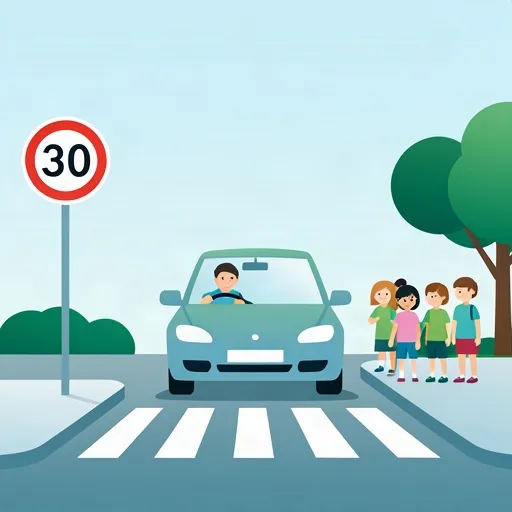
Article content overview
Driving through Switzerland, you will frequently encounter areas designed to prioritize pedestrian safety, particularly near schools, kindergartens, and residential hubs. Understanding the legal difference between a standard 50 km/h urban limit, a Tempo-30 zone, and a Tempo-20 Begegnungszone (meeting zone) is a core requirement for both passing your theory exam and becoming a responsible driver. Many learners mistakenly believe that school-related speed limits are only active during specific hours or school days; however, in Switzerland, the law is generally much stricter and more permanent.
In Switzerland, municipalities are responsible for implementing traffic calming measures to ensure a safe route to school for children. When you see signs indicating a zone-wide speed limit, that limit is a permanent fixture of the road network. Unless a white supplementary sign—such as "Mo–Fr 07:00–19:00"—is mounted directly beneath the speed limit sign, the restriction applies 24 hours a day, seven days a week.
Common Exam Trap: Never assume that a Tempo-30 zone near a school is only active during the week or while school is in session. If the sign does not have a time-restrictive plate, the speed limit is legally binding at all times, including Sundays and school holidays.
Tempo-30 zones are designed to balance traffic flow with safety. Within these zones, the speed limit is reduced to 30 km/h to decrease the braking distance and the severity of potential impacts. Conversely, a Begegnungszone (Meeting Zone) is often found in immediate school vicinities or town centers and is marked with a 20 km/h limit. In these zones, pedestrians are permitted to use the entire width of the road and have priority over vehicles, though they must not unnecessarily obstruct traffic.
The following table summarizes the operational differences between these common Swiss traffic zones that you will encounter during your driving theory practice.
| Feature | Tempo-30 Zone | Begegnungszone (Tempo-20) |
|---|---|---|
| Speed Limit | 30 km/h | 20 km/h |
| Pedestrian Priority | Standard rules apply | Pedestrians have priority |
| Road Usage | Vehicles only | Pedestrians may use full road |
| Signage | 2.59.1 | 2.59.3 |
The safety logic behind these zones is rooted in physics and accident research. Statistics from the Swiss Council for Accident Prevention (BFU) highlight that a large percentage of serious accidents involving children occur in urban areas. By maintaining a constant, lower speed limit, municipalities ensure that drivers remain in a state of high awareness. If the limit were to fluctuate based on the time of day, it would create confusion and increase the likelihood of speeding, which directly correlates to more severe accident outcomes.
Swiss traffic planning often integrates physical infrastructure with legal signs to encourage compliance. You might notice speed humps, raised pedestrian crossings, or narrowed lanes near schools. Additionally, radar feedback displays are common; these are educational tools that provide immediate visual feedback on your current speed. While these displays are not police enforcement cameras, they serve as a reminder that you are in a sensitive zone where children are likely to be present.
Swiss school zones feature two distinct speed-limited areas: Tempo-30 zones (sign 2.59.1) with a 30 km/h limit and standard traffic rules, and Begegnungszonen (sign 2.59.3) with a 20 km/h limit where pedestrians have priority. Crucially, these limits are permanent legal requirements unless a supplementary sign explicitly specifies otherwise, applying at all times including weekends and holidays. The safety rationale stems from accident statistics showing that constant lower speeds reduce both the likelihood and severity of collisions involving children. Drivers must read signs carefully for any time restrictions and maintain reduced speeds regardless of whether children are visibly present.
A short set of high-value points that capture the most important ideas from this article.
Tempo-30 and Tempo-20 limits near schools apply 24/7 unless a white supplementary sign specifies otherwise
A Begegnungszone is marked by sign 2.59.3 and sets a 20 km/h limit where pedestrians have priority over vehicles
In the absence of a time-restrictive plate, school zone speed limits are legally binding including Sundays and school holidays
Speed limits in these zones are permanent fixtures of the road network, not conditional on school hours
Physical infrastructure like speed humps and radar displays complement but do not replace legal sign requirements
Tempo-30 zones use sign 2.59.1; Begegnungszonen use sign 2.59.3
Pedestrian priority in Begegnungszonen allows pedestrians to use the full road width
Time-restrictive supplementary signs like 'Mo–Fr 07:00–19:00' must be physically mounted beneath the speed limit sign to apply
The Swiss Council for Accident Prevention (BFU) data supports permanent speed limits to reduce serious child pedestrian accidents
'Right before left' priority rules generally apply inside Tempo-30 zones unless otherwise indicated
Assuming a Tempo-30 zone near a school only applies during school hours or weekdays
Overlooking the supplementary sign beneath a speed limit sign that indicates time restrictions
Confusing Begegnungszonen with standard crosswalks where pedestrians must yield to traffic
Believing that visible infrastructure like speed bumps replaces the need to obey posted speed limits
Failing to recognize that even during holidays, school zone speed limits remain in effect if no time restriction is shown
Article content overview
A short set of high-value points that capture the most important ideas from this article.
Tempo-30 and Tempo-20 limits near schools apply 24/7 unless a white supplementary sign specifies otherwise
A Begegnungszone is marked by sign 2.59.3 and sets a 20 km/h limit where pedestrians have priority over vehicles
In the absence of a time-restrictive plate, school zone speed limits are legally binding including Sundays and school holidays
Speed limits in these zones are permanent fixtures of the road network, not conditional on school hours
Physical infrastructure like speed humps and radar displays complement but do not replace legal sign requirements
Tempo-30 zones use sign 2.59.1; Begegnungszonen use sign 2.59.3
Pedestrian priority in Begegnungszonen allows pedestrians to use the full road width
Time-restrictive supplementary signs like 'Mo–Fr 07:00–19:00' must be physically mounted beneath the speed limit sign to apply
The Swiss Council for Accident Prevention (BFU) data supports permanent speed limits to reduce serious child pedestrian accidents
'Right before left' priority rules generally apply inside Tempo-30 zones unless otherwise indicated
Assuming a Tempo-30 zone near a school only applies during school hours or weekdays
Overlooking the supplementary sign beneath a speed limit sign that indicates time restrictions
Confusing Begegnungszonen with standard crosswalks where pedestrians must yield to traffic
Believing that visible infrastructure like speed bumps replaces the need to obey posted speed limits
Failing to recognize that even during holidays, school zone speed limits remain in effect if no time restriction is shown
Explore related topics, search based questions, and concepts that learners often look up when studying Swiss School Speed Zones. These themes reflect real search intent and help you understand how this topic connects to wider driving theory knowledge in Switzerland.
Find clear and practical answers to common questions learners often have about Swiss School Speed Zones. This section helps explain difficult points, remove confusion, and reinforce the key driving theory concepts that matter for learners in Switzerland.
No, in Switzerland, a Tempo-30 zone sign applies 24/7 unless there is a specific supplementary sign underneath indicating a limited timeframe.
A Tempo-30 zone is a traffic-calmed area where the speed limit is 30 km/h, while a Tempo-20 zone is a 'Begegnungszone' where pedestrians have priority and may use the entire road, requiring a maximum speed of 20 km/h.
No, common solar-powered radar displays showing your current speed are educational tools intended to encourage safe driving, not official police enforcement cameras.
Check for a rectangular white supplementary sign mounted directly below the speed limit sign. If no such sign is present, the speed limit is effective at all times.
Continue your learning journey by searching our extensive library of Swiss driving theory articles. Explore additional topics, review specific road rules, or deepen your understanding of official traffic procedures to excel in your exam and drive safely in Switzerland.