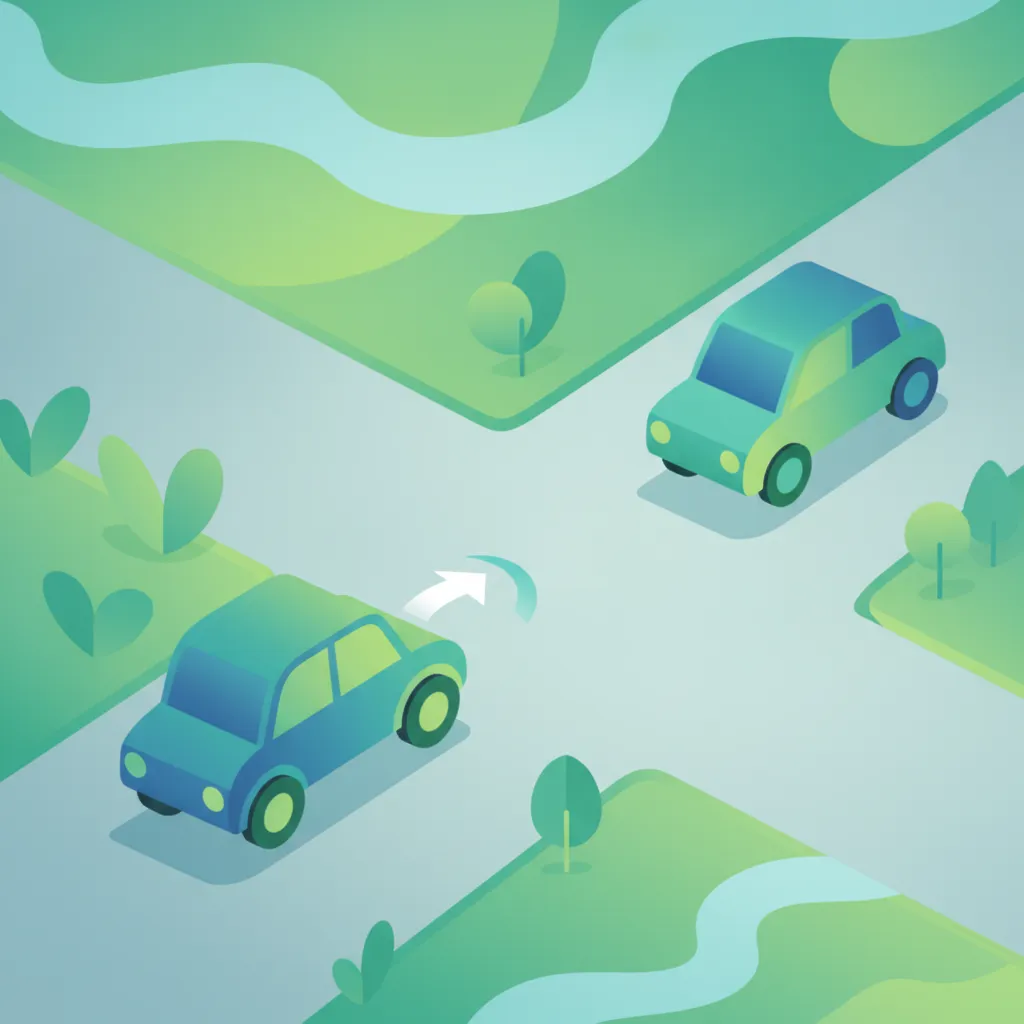
In Belgium, not all intersections are regulated by traffic lights, signs, or road markings. These are known as uncontrolled intersections, and they require drivers to apply general right-of-way rules. The most important principle is 'priority to the right' (priorité de droite), which means you must yield to any vehicle approaching from your right side. Always be vigilant and prepared to adapt to real-world conditions.
Theory topic content overview
Read the full theory topic guide for Uncontrolled Intersections Priority with structured, easy-to-scan content built for learners in Belgium. This detailed section explains the exact rule, meaning, traffic context, comparison points, and exam logic behind this Belgian driving theory topic so you can study faster, understand the concept more clearly, and avoid common interpretation mistakes on the theory test.
An uncontrolled intersection (in French, carrefour sans signalisation; in Dutch, ongeregelde kruising) is any junction in Belgium where the right of way is not regulated by traffic lights, "give way" (B1) signs, "stop" (B5) signs, "priority road" (B9) signs, or specific road markings. In these situations, drivers must fall back on fundamental general rules to determine who has the right of way.
The core principle at these intersections in Belgium is "priority to the right" (priorité de droite / voorrang van rechts). This means that you, as the driver, must yield to any vehicle approaching the intersection from your right-hand side. This rule is designed to ensure predictable behaviour when no other guidance is present.
Mastering the rules for uncontrolled intersections is not just an academic exercise; it's a critical safety skill and a frequent subject in the Belgian driving theory exam. Belgium has many older towns and residential areas with a high number of unmarked crossroads. Misinterpreting priority here can lead directly to collisions.
Before applying "priority to the right," it's crucial to understand the overall hierarchy of priority rules in Belgian traffic law. You only apply the general rules, including "priority to the right," if higher-ranking signals or instructions are absent:
Therefore, when approaching any intersection, your first task is to quickly scan for an officer, traffic lights, and priority signs. If you find none, then and only then do you activate the "priority to the right" rule.
When you approach an uncontrolled intersection in Belgium:
This applies even if you are turning left or right, and even if the road you are on seems "main." Without signs, "priority to the right" dictates.
While "priority to the right" is the default, Belgian traffic law includes crucial exceptions that drivers must know. These exceptions override the general rule:
You might occasionally see a diamond-shaped sign with a yellow square inside a white border (the old "priority road" sign). In Belgium, this sign is B17. Crucially, the B17 sign does not grant priority. Instead, it serves as a reminder that "priority to the right" still applies at the upcoming intersection.
It's typically used in areas where "priority to the right" might not be immediately obvious, perhaps after a section of road that had priority signs. This sign highlights the importance of re-establishing your understanding of priority. Seeing a B17 sign means you must be extra vigilant and prepared to yield to vehicles from your right.
Consider these Belgian scenarios:
Effective hazard perception at uncontrolled intersections involves:
Learners often make specific errors when dealing with uncontrolled intersections, especially in the Belgian context:
At uncontrolled intersections in Belgium, your approach should always be proactive and cautious. Don't wait to react; anticipate. Always slow down, scan thoroughly, and prioritize safety over asserting your right of way. Remember the hierarchy: no signs means priority to the right, unless one of the specific exceptions applies (like exiting an unpaved road). This disciplined approach is vital for both passing your Belgian driving theory exam and for safe, confident driving on the road.
Start with a short, direct summary of Uncontrolled Intersections Priority before reading the full explanation below.
At uncontrolled intersections in Belgium, where there are no traffic lights, signs (like 'give way' or 'stop'), or road markings indicating priority, the general rule is to give way to traffic coming from your right. This 'priority to the right' principle is a foundational rule, ensuring predictable decision-making. However, drivers must always maintain caution, especially when visibility is limited or when approaching from unpaved roads or paths.
Review the most important terms, rule signals, and traffic concepts linked to Uncontrolled Intersections Priority.
Explore related theory topic pages connected to Uncontrolled Intersections Priority and continue with the next useful rule explanation.
See the common search queries learners use when trying to understand Uncontrolled Intersections Priority in Belgium.

Start your comprehensive preparation for the Belgian driving licence theory exam. Dive into our expertly curated topics, master the road rules and concepts, and build the confidence you need to pass your test and drive safely on Belgian roads. Begin mastering theory today.
Explore Belgian Theory TopicsTheory topic content overview
Start with a short, direct summary of Uncontrolled Intersections Priority before reading the full explanation below.
At uncontrolled intersections in Belgium, where there are no traffic lights, signs (like 'give way' or 'stop'), or road markings indicating priority, the general rule is to give way to traffic coming from your right. This 'priority to the right' principle is a foundational rule, ensuring predictable decision-making. However, drivers must always maintain caution, especially when visibility is limited or when approaching from unpaved roads or paths.
Review the most important terms, rule signals, and traffic concepts linked to Uncontrolled Intersections Priority.
Explore related theory topic pages connected to Uncontrolled Intersections Priority and continue with the next useful rule explanation.
See the common search queries learners use when trying to understand Uncontrolled Intersections Priority in Belgium.
Start your comprehensive preparation for the Belgian driving licence theory exam. Dive into our expertly curated topics, master the road rules and concepts, and build the confidence you need to pass your test and drive safely on Belgian roads. Begin mastering theory today.
Explore Belgian Theory TopicsUse this exam-focused revision tip to understand how Uncontrolled Intersections Priority is likely to appear in theory questions for learners in Belgium. This section helps you identify the most testable part of the rule, avoid common traps, and remember the concept more effectively during Belgian driving theory exam preparation.
In the Belgian theory exam, be vigilant for diagrams showing unmarked intersections. A common trick is to include a seemingly 'main' road where priority to the right still applies. Always check for priority signs first, and if none are present, automatically apply the 'priority to the right' rule, considering any exceptions like unpaved roads.
Read direct answers to the most common learner questions about Uncontrolled Intersections Priority in Belgium. This FAQ focuses on rule confusion, practical meaning, comparison with similar concepts, and the exact uncertainties that appear most often in Belgian driving theory revision and exam preparation.
An uncontrolled intersection in Belgium is a crossroads where there are no traffic lights, 'give way' (B1) or 'stop' (B5) signs, priority road signs (B9 or B15), or traffic officers directing who should go first. Drivers must then apply the general traffic rules.
In Belgium, the primary rule at an uncontrolled intersection is 'priority to the right' (priorité de droite). This means that any driver approaching such an intersection must yield to vehicles coming from their immediate right.
Yes, there are key exceptions. You must yield even if a vehicle is on your left if they are: emerging from an unpaved road or path onto a public road, accessing a motorway's main carriageway, or entering a roundabout (where traffic already on the roundabout has priority).
No, in Belgium, the size or apparent importance of a road does not automatically grant priority at an uncontrolled intersection. Without specific signage or signals, the default 'priority to the right' rule applies, regardless of how wide or busy a road seems.
The B17 sign (a white diamond with a yellow center, crossed by a black bar) indicates the end of a priority road. When you see this sign, it often means that at the upcoming intersection, the general rule of 'priority to the right' will apply again, as any previous priority status has ended.
If visibility is limited due to buildings, parked cars, or weather conditions, you must approach the uncontrolled intersection very slowly and be prepared to stop. Even if you believe you have priority, it's crucial to ensure the intersection is clear and that other road users have seen you and are reacting appropriately.
While less common, if two vehicles arrive from 'the right' of each other at exactly the same time, neither can proceed safely. In such rare stand-offs, both drivers must exercise extreme caution, make eye contact, and use hand signals to agree on who will proceed first, prioritizing safety above all else.
Ready to focus your Belgian driving theory revision? Utilize our powerful search tool to pinpoint exact topics, road signs, or difficulty levels. Engage with practice questions that directly address your learning needs and solidify your understanding of Belgian traffic laws for your upcoming exam.