
A priority road is designated to ensure a continuous flow of traffic, giving vehicles on it precedence over those entering from side roads. In Belgium, understanding these rules, recognizing the specific 'priority road' (B9) sign, and knowing when to yield or proceed is fundamental for passing your driving theory test and driving safely.
Theory topic content overview
Read the full theory topic guide for Priority Road Rules (Belgium) with structured, easy-to-scan content built for learners in Belgium. This detailed section explains the exact rule, meaning, traffic context, comparison points, and exam logic behind this Belgian driving theory topic so you can study faster, understand the concept more clearly, and avoid common interpretation mistakes on the theory test.
A priority road (or voie prioritaire in French, voorrangsweg in Dutch) in Belgium is a designated road where traffic generally has the right of way over vehicles approaching from intersecting roads. The primary purpose of establishing priority roads is to ensure a smoother, more efficient, and safer flow of traffic on key routes, especially within and between built-up areas.
Understanding priority road rules is fundamental for safe driving and passing the Belgian driving theory test. It dictates a clear hierarchy at intersections, reducing uncertainty and potential collisions.
In Belgium, priority roads are clearly marked using specific traffic signs that drivers must recognise instantly.
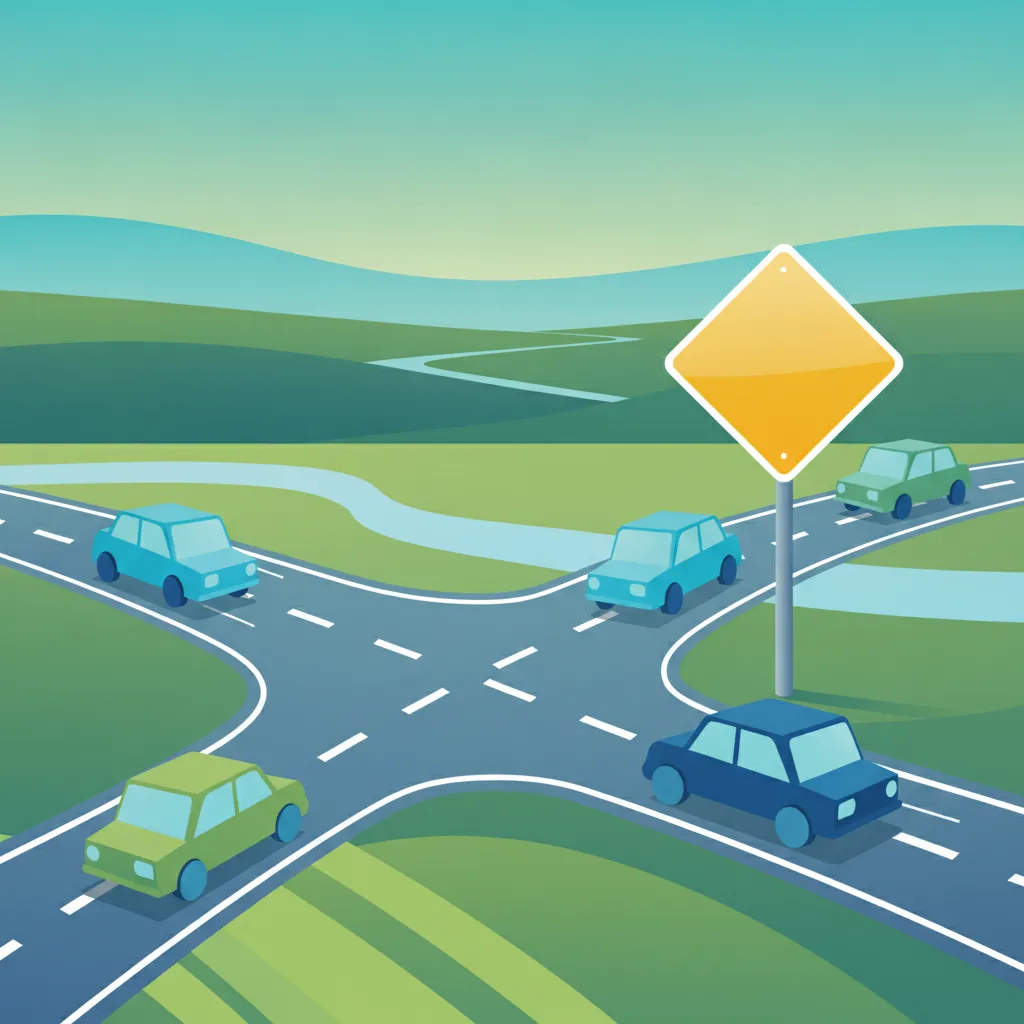
This is the most crucial sign: a yellow diamond shape with a white border.
This sign is a white diamond with a black diagonal stripe, indicating the end of a priority road.
Often, the B9 sign may be accompanied by a small supplementary panel. These panels visually depict the layout of the intersection ahead, showing which road (or roads) form the priority route. The thick line on the panel indicates the priority road, while thinner lines represent roads where drivers must yield.
If you are driving on a road marked with a B9 sign, you generally have precedence.
If you are approaching a priority road from an intersecting side road, you do not have priority.
One of the most important concepts for Belgian learner drivers is the interaction between priority roads and the default rule of priority from the right (priorité de droite / voorrang van rechts).
Consider these common situations:
Mastering priority road rules in Belgium means more than just recognizing signs. It involves anticipating traffic flow, understanding the hierarchy of rules, and driving defensively. Always be aware of whether you are on a priority road, entering one, or where a priority road ends, and adjust your behavior accordingly. Prioritising safety and correct observation will ensure compliance with Belgian traffic law and contribute to smoother, safer journeys for everyone.
In Belgium, priority roads are designated thoroughfares marked by the yellow diamond B9 sign, giving traffic on them precedence over vehicles from intersecting side roads. This priority specifically overrides the default Belgian rule of priority from the right. Drivers entering a priority road must yield using B1 or B5 signs, while the white B11 sign with a black diagonal stripe marks where priority ends and normal rules resume. The B17 sign serves as a reminder that priority from the right applies at a specific intersection. Regardless of priority status, defensive driving is essential as other drivers may not always respect the rules.
A short set of high-value points that capture the most important ideas from this theory explanation.
Priority roads in Belgium are marked by the yellow diamond B9 sign and give traffic the right of way over vehicles entering from side roads
A priority road explicitly overrides the default 'priority from the right' rule at intersections where the priority road continues
Vehicles entering a priority road from a side road must always yield, indicated by B1 (Give Way) or B5 (Stop) signs
The B11 sign (white diamond with black diagonal stripe) marks the end of a priority road, restoring normal priority rules
Supplementary panels under B9 signs show which roads have priority at complex intersections through line thickness
B9 = yellow diamond = you are on a priority road and have right of way
B11 = white diamond with black stripe = end of priority road, normal rules apply
Side roads joining a priority road will always show B1 or B5 signs requiring you to yield
B17 sign explicitly reminds drivers that priority from the right applies at an upcoming intersection
Priority roads take precedence over the default priority-from-the-right rule for cross-traffic
Assuming absolute priority on a B9 road without watching for drivers who may not yield
Confusing priority from the right with priority road rules, forgetting that B9 overrides the right-hand rule
Failing to notice the B11 sign and incorrectly assuming continued priority at the next intersection
Misinterpreting supplementary panel layouts, especially at intersections where the priority road curves
Not stopping fully at B5 (Stop) signs when entering a priority road from a side road
Start with a short, direct summary of Priority Road Rules (Belgium) before reading the full explanation below.
In Belgium, a priority road is a main thoroughfare where traffic generally has the right of way over vehicles approaching from intersecting roads. You identify a priority road primarily by the yellow diamond-shaped B9 sign. When driving on such a road, other drivers are expected to yield to you, but vigilance is always required. Conversely, when entering a priority road, you must always give way to existing traffic unless specific signals indicate otherwise.
Review the most important terms, rule signals, and traffic concepts linked to Priority Road Rules (Belgium).
Explore related theory topic pages connected to Priority Road Rules (Belgium) and continue with the next useful rule explanation.
See the common search queries learners use when trying to understand Priority Road Rules (Belgium) in Belgium.

Start your comprehensive preparation for the Belgian driving licence theory exam. Dive into our expertly curated topics, master the road rules and concepts, and build the confidence you need to pass your test and drive safely on Belgian roads. Begin mastering theory today.
Explore Belgian Theory TopicsTheory topic content overview
A short set of high-value points that capture the most important ideas from this theory explanation.
Priority roads in Belgium are marked by the yellow diamond B9 sign and give traffic the right of way over vehicles entering from side roads
A priority road explicitly overrides the default 'priority from the right' rule at intersections where the priority road continues
Vehicles entering a priority road from a side road must always yield, indicated by B1 (Give Way) or B5 (Stop) signs
The B11 sign (white diamond with black diagonal stripe) marks the end of a priority road, restoring normal priority rules
Supplementary panels under B9 signs show which roads have priority at complex intersections through line thickness
B9 = yellow diamond = you are on a priority road and have right of way
B11 = white diamond with black stripe = end of priority road, normal rules apply
Side roads joining a priority road will always show B1 or B5 signs requiring you to yield
B17 sign explicitly reminds drivers that priority from the right applies at an upcoming intersection
Priority roads take precedence over the default priority-from-the-right rule for cross-traffic
Assuming absolute priority on a B9 road without watching for drivers who may not yield
Confusing priority from the right with priority road rules, forgetting that B9 overrides the right-hand rule
Failing to notice the B11 sign and incorrectly assuming continued priority at the next intersection
Misinterpreting supplementary panel layouts, especially at intersections where the priority road curves
Not stopping fully at B5 (Stop) signs when entering a priority road from a side road
Start with a short, direct summary of Priority Road Rules (Belgium) before reading the full explanation below.
In Belgium, a priority road is a main thoroughfare where traffic generally has the right of way over vehicles approaching from intersecting roads. You identify a priority road primarily by the yellow diamond-shaped B9 sign. When driving on such a road, other drivers are expected to yield to you, but vigilance is always required. Conversely, when entering a priority road, you must always give way to existing traffic unless specific signals indicate otherwise.
Review the most important terms, rule signals, and traffic concepts linked to Priority Road Rules (Belgium).
Explore related theory topic pages connected to Priority Road Rules (Belgium) and continue with the next useful rule explanation.
See the common search queries learners use when trying to understand Priority Road Rules (Belgium) in Belgium.
Start your comprehensive preparation for the Belgian driving licence theory exam. Dive into our expertly curated topics, master the road rules and concepts, and build the confidence you need to pass your test and drive safely on Belgian roads. Begin mastering theory today.
Explore Belgian Theory TopicsUse this exam-focused revision tip to understand how Priority Road Rules (Belgium) is likely to appear in theory questions for learners in Belgium. This section helps you identify the most testable part of the rule, avoid common traps, and remember the concept more effectively during Belgian driving theory exam preparation.
Pay close attention to priority road signs (B9, B11) and their associated supplementary panels in the Belgian theory exam. Remember that a priority road specifically overrides priority from the right for vehicles entering it, which is a common confusion point. Always anticipate that side roads will have B1 or B5 signs, but confirm by observation.
Read direct answers to the most common learner questions about Priority Road Rules (Belgium) in Belgium. This FAQ focuses on rule confusion, practical meaning, comparison with similar concepts, and the exact uncertainties that appear most often in Belgian driving theory revision and exam preparation.
A priority road in Belgium is a designated road where drivers have the right of way over vehicles joining from side roads or intersecting paths, ensuring smoother traffic flow.
Priority roads are typically indicated by the B9 sign: a yellow diamond with a white border. This sign is placed at the beginning of a priority road and after each intersection.
The B9 sign is the official Belgian traffic sign for a priority road. It's a yellow diamond with a white border, signaling that you are on a road where you generally have precedence.
While you generally have priority, you must still be attentive and ready to react. Priority can be overridden by traffic lights, police signals, or specific 'stop' (B5) or 'give way' (B1) signs on your path.
Priority from the right applies at unmarked intersections. A priority road, indicated by the B9 sign, establishes precedence for traffic on that specific road, overriding the 'priority from the right' rule for those entering it.
A priority road ends when indicated by the B11 sign, which is the yellow diamond B9 sign with a black diagonal stripe through it. At this point, new priority rules (like priority from the right) will apply unless otherwise signed.
Yes, drivers entering or crossing a priority road must yield to traffic already on that road, usually indicated by a B1 (give way triangle) or B5 (stop) sign on the side road.
Ready to focus your Belgian driving theory revision? Utilize our powerful search tool to pinpoint exact topics, road signs, or difficulty levels. Engage with practice questions that directly address your learning needs and solidify your understanding of Belgian traffic laws for your upcoming exam.