
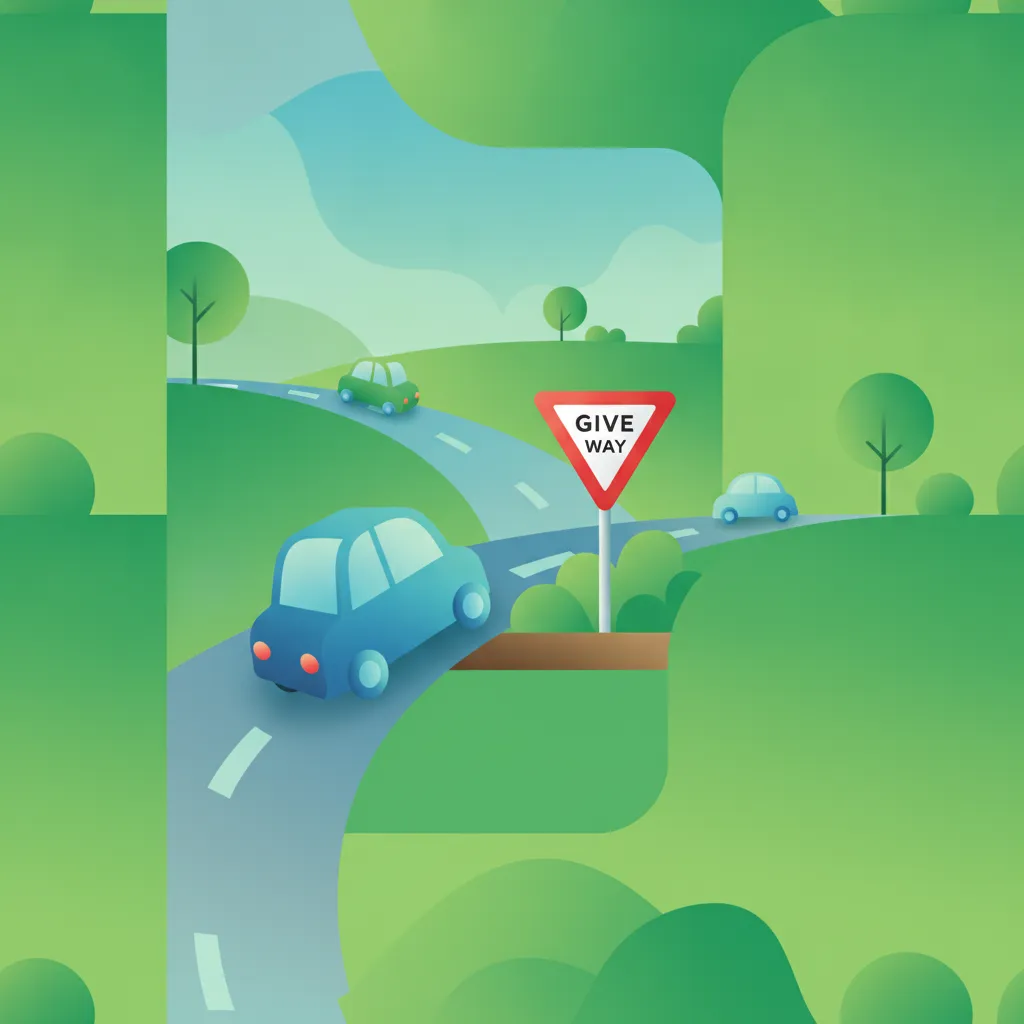
The Give Way sign, officially known as B1 in Belgium, instructs drivers to yield priority to other road users before proceeding. This means you must slow down, carefully observe approaching traffic, and only continue when it is safe to do so without forcing others to brake or swerve. It's crucial to understand that, unlike a Stop sign, a complete stop is not always mandatory if the road is clear.
Theory topic content overview
Read the full theory topic guide for Give Way Sign (B1) Rules with structured, easy-to-scan content built for learners in Belgium. This detailed section explains the exact rule, meaning, traffic context, comparison points, and exam logic behind this Belgian driving theory topic so you can study faster, understand the concept more clearly, and avoid common interpretation mistakes on the theory test.
The Give Way sign, officially designated as B1 in Belgium (Dutch: verkeersteken B1, French: signal B1), is a triangular road sign with a red border and a white background, pointing downwards. Its fundamental instruction to drivers is to yield priority to all traffic on the intersecting road before entering or crossing it. This means you must grant precedence to other road users who are already on, or about to enter, the priority road you are approaching.
Understanding the B1 sign is crucial for safe navigation and is a cornerstone of Belgian driving theory, frequently appearing in the official driving exam. It's a key component of the overall Belgian priority rules system.
Properly interpreting and reacting to the Give Way sign is vital for several reasons:
priority from the right (voorrang van rechts / priorité de droite) for the driver facing the sign. The road ahead is the priority road.When you approach a Give Way sign (B1), your actions must follow a clear sequence:
The B1 sign is often accompanied by a broken white line painted across the width of your lane at the intersection. This line indicates where you should yield. If you need to stop, halt before this line.
A common source of confusion for Belgian learners is differentiating the B1 Give Way sign from other priority rules and signs:
This is the most critical distinction in Belgian traffic law and for your theory exam:
Memory Aid:
In Belgium, the general rule at unmarked intersections is priority from the right (priorité de droite). However, the presence of a B1 Give Way sign overrides this general rule for the driver facing the sign.
Let's look at how these rules apply in typical Belgian traffic situations:
Belgian learners often make these errors related to the B1 sign:
priority from the right when a B1 sign is present, assuming the vehicle to your right still has priority even if you are facing the Give Way sign. Remember, the B1 sign makes the intersecting road the priority road.The Give Way sign (B1) is about intelligent yielding. It demands active assessment, not just blind action. In Belgium, always remember:
Mastering this concept is fundamental to safe driving in Belgium and will ensure you pass your theory exam with confidence.
The Give Way sign (B1) is a red-bordered white triangle instructing drivers to yield priority to all traffic on the intersecting road without necessarily stopping, unless traffic conditions require it. This sign overrides Belgium's default 'priority from the right' rule, making the intersecting road the priority route. The critical distinction is between B1 (yield, stop only if needed) and B5 Stop sign (full mandatory stop always required). Safe reaction involves slowing down, observing all directions for vehicles and vulnerable road users, assessing speed and distance of approaching traffic, and only proceeding when entry will not force others to brake or swerve.
A short set of high-value points that capture the most important ideas from this theory explanation.
The B1 Give Way sign requires you to yield priority to ALL traffic on the intersecting road before entering or crossing it
Unlike a Stop sign, you do NOT need to come to a complete halt if the priority road is clear and traffic is not affected
The B1 sign overrides Belgium's general 'priority from the right' rule for the driver facing the sign
You must observe traffic from all directions including vulnerable road users like cyclists and pedestrians on the priority path
Your decision to proceed depends on assessing both the speed and distance of approaching vehicles on the intersecting road
B1 Give Way: 'Be prepared to stop, but only stop if needed' - proceed at reduced speed when safe
B5 Stop Sign: 'Stop always, then proceed if clear' - full stop is mandatory regardless of traffic
The B1 sign makes the intersecting road the priority road, so yield to traffic from both left and right
When visibility is limited, slow down significantly and inch forward cautiously to assess before proceeding
The broken white line at the intersection marks where you should yield or stop if stopping is necessary
Stopping completely when the priority road is clearly empty, treating B1 like a B5 Stop sign unnecessarily
Failing to stop when approaching traffic is too close or moving too fast, forcing other road users to brake
Only checking one direction (typically left) and missing traffic or cyclists approaching from other angles
Misjudging the speed of vehicles on the priority road, leading to hasty or unsafe entry into the intersection
Ignoring cyclists on dedicated cycle paths that cross the intersection, as they are part of the priority road traffic
Start with a short, direct summary of Give Way Sign (B1) Rules before reading the full explanation below.
The Give Way sign (B1) in Belgium means you must grant priority to all traffic on the intersecting road before entering or crossing. You must slow down and be prepared to stop, but you only need to come to a complete halt if necessary to safely yield to other road users. Proceed only when you can do so without hindering or endangering others.
Review the most important terms, rule signals, and traffic concepts linked to Give Way Sign (B1) Rules.
Explore related theory topic pages connected to Give Way Sign (B1) Rules and continue with the next useful rule explanation.
See the common search queries learners use when trying to understand Give Way Sign (B1) Rules in Belgium.

Start your comprehensive preparation for the Belgian driving licence theory exam. Dive into our expertly curated topics, master the road rules and concepts, and build the confidence you need to pass your test and drive safely on Belgian roads. Begin mastering theory today.
Explore Belgian Theory TopicsTheory topic content overview
A short set of high-value points that capture the most important ideas from this theory explanation.
The B1 Give Way sign requires you to yield priority to ALL traffic on the intersecting road before entering or crossing it
Unlike a Stop sign, you do NOT need to come to a complete halt if the priority road is clear and traffic is not affected
The B1 sign overrides Belgium's general 'priority from the right' rule for the driver facing the sign
You must observe traffic from all directions including vulnerable road users like cyclists and pedestrians on the priority path
Your decision to proceed depends on assessing both the speed and distance of approaching vehicles on the intersecting road
B1 Give Way: 'Be prepared to stop, but only stop if needed' - proceed at reduced speed when safe
B5 Stop Sign: 'Stop always, then proceed if clear' - full stop is mandatory regardless of traffic
The B1 sign makes the intersecting road the priority road, so yield to traffic from both left and right
When visibility is limited, slow down significantly and inch forward cautiously to assess before proceeding
The broken white line at the intersection marks where you should yield or stop if stopping is necessary
Stopping completely when the priority road is clearly empty, treating B1 like a B5 Stop sign unnecessarily
Failing to stop when approaching traffic is too close or moving too fast, forcing other road users to brake
Only checking one direction (typically left) and missing traffic or cyclists approaching from other angles
Misjudging the speed of vehicles on the priority road, leading to hasty or unsafe entry into the intersection
Ignoring cyclists on dedicated cycle paths that cross the intersection, as they are part of the priority road traffic
Start with a short, direct summary of Give Way Sign (B1) Rules before reading the full explanation below.
The Give Way sign (B1) in Belgium means you must grant priority to all traffic on the intersecting road before entering or crossing. You must slow down and be prepared to stop, but you only need to come to a complete halt if necessary to safely yield to other road users. Proceed only when you can do so without hindering or endangering others.
Review the most important terms, rule signals, and traffic concepts linked to Give Way Sign (B1) Rules.
Explore related theory topic pages connected to Give Way Sign (B1) Rules and continue with the next useful rule explanation.
See the common search queries learners use when trying to understand Give Way Sign (B1) Rules in Belgium.
Start your comprehensive preparation for the Belgian driving licence theory exam. Dive into our expertly curated topics, master the road rules and concepts, and build the confidence you need to pass your test and drive safely on Belgian roads. Begin mastering theory today.
Explore Belgian Theory TopicsUse this exam-focused revision tip to understand how Give Way Sign (B1) Rules is likely to appear in theory questions for learners in Belgium. This section helps you identify the most testable part of the rule, avoid common traps, and remember the concept more effectively during Belgian driving theory exam preparation.
A common exam trap is confusing the Give Way sign with the Stop sign. Remember, 'Give Way' means 'be prepared to stop if needed, but not always'. Always assess the speed and distance of approaching vehicles to decide if you need to stop completely or can safely merge/cross by slowing down and yielding.
Read direct answers to the most common learner questions about Give Way Sign (B1) Rules in Belgium. This FAQ focuses on rule confusion, practical meaning, comparison with similar concepts, and the exact uncertainties that appear most often in Belgian driving theory revision and exam preparation.
The B1 Give Way sign means you must yield priority to all traffic on the intersecting road. You must not enter the intersection if doing so would force other road users to slow down or change direction.
No, unlike a Stop sign (B5), a complete stop is not always required. You must slow down significantly and be prepared to stop, only coming to a halt if necessary to safely yield to approaching traffic.
The key difference is the mandatory stop. A Stop sign (B5) requires you to come to a complete halt before the stop line, regardless of traffic. A Give Way sign (B1) only requires you to stop if yielding to traffic necessitates it; if the way is clear, you can proceed without stopping.
Reduce your speed, look left and right for approaching traffic, and assess the situation. If there are vehicles on the priority road that you would impede, stop and wait for a safe gap. If the road is clear, you may proceed cautiously without stopping.
Yes, when a Give Way sign is present, you must yield to all other road users on the priority road, which includes pedestrians and cyclists if they are already on or about to enter your path on that priority road.
Yes, failing to respect a Give Way sign by not yielding priority can result in a fine and potentially points or a driving ban, as it is a serious traffic violation in Belgium.
The Belgian B1 Give Way sign is an inverted equilateral triangle with a red border and a white center.
Ready to focus your Belgian driving theory revision? Utilize our powerful search tool to pinpoint exact topics, road signs, or difficulty levels. Engage with practice questions that directly address your learning needs and solidify your understanding of Belgian traffic laws for your upcoming exam.