
This lesson introduces the proactive mindset of defensive driving, teaching you to anticipate hazards rather than merely reacting to them. You will learn systematic risk assessment techniques, such as proper road scanning and mirror usage, to build a buffer of safety around your vehicle as a Category B driver in Austria.

Lesson content overview
Navigating the diverse road network of Austria safely requires more than just knowing traffic laws and how to operate your vehicle. It demands a proactive mindset, a constant awareness of your surroundings, and the ability to anticipate potential dangers before they become immediate threats. This lesson, part of the Austrian Driving License B Theory Course, introduces you to the essential principles of defensive driving and systematic risk assessment, fundamental skills for any responsible driver.
Defensive driving is a philosophy and a set of techniques that empowers drivers to protect themselves and others from accidents, regardless of the conditions or the actions of other road users. It's about taking responsibility for your safety and actively working to minimize risks.
At its heart, defensive driving is a proactive safety strategy. Instead of merely reacting to events as they unfold, a defensive driver actively anticipates potential hazards, maintains sufficient safe following distances, and creates buffer zones around their vehicle. This foresight provides the crucial time needed to react safely to unexpected situations. By predicting the likely behavior of other road users and environmental factors, you can make informed decisions that significantly reduce the risk of collisions. This approach complements and reinforces the intent of Austrian traffic laws, which aim to ensure the safety of all road users through predictable behavior.
The core principles that underpin defensive driving include:
Austria's roads present a variety of driving conditions, from bustling city streets and fast-paced motorways to winding alpine passes and rural routes. Each environment carries unique challenges and risks. Defensive driving equips you with the tools to navigate these conditions safely, minimizing the likelihood of being involved in an accident. It's not just about obeying the law; it's about making conscious choices to ensure your safety and the safety of others, making it a cornerstone of safe road behavior in the Austrian context.
A key element of defensive driving is the ability to perceive and correctly assess hazards. This involves constantly observing your surroundings and understanding how different elements could become risks.
Hazard perception is the ability to detect, evaluate, and anticipate risks within the traffic environment. This skill involves looking beyond the immediate front of your vehicle to identify both:
Effective hazard perception means continuously scanning for these cues and understanding their implications. For instance, seeing a cyclist signaling a left turn ahead requires you to adjust your speed and positioning proactively, well before the cyclist begins their maneuver.
Scanning technique, also known as "scanning ahead," is the systematic observation of the road ahead, to the sides, and to the rear. This continuous, active visual search helps you detect hazards early, providing more time to react. The appropriate scanning range varies with your speed and road type:
Far Scanning: Look at least 150 meters ahead, especially on high-speed roads like motorways (Autobahnen). This helps detect distant traffic changes, upcoming exits, or slow-moving vehicles.
Mid-Range Scanning: Focus 50-150 meters ahead for moderate speeds, typical on urban roads or country roads (Bundesstraßen). This range is crucial for identifying traffic flow, upcoming intersections, and changes in lane usage.
Near Scanning: Pay attention to the area less than 50 meters in front of your vehicle, focusing on immediate surroundings. This is essential for navigating slow traffic, pedestrian zones, or executing maneuvers like parking.
A common misunderstanding is to over-focus on the vehicle directly ahead, neglecting peripheral areas and the broader traffic picture. By systematically scanning across all three ranges, you gain a comprehensive view, allowing for earlier detection of hazards and more informed decision-making.
Mirror checks involve frequent visual checks using your interior and exterior mirrors to monitor traffic behind and to your sides. This practice is critical for maintaining awareness of vehicles that may be approaching, overtaking, or positioned in adjacent lanes.
Regular mirror checks are crucial before any lane change, overtaking maneuver, or even when slowing down, to understand the intentions and positions of other drivers. However, relying solely on mirrors is insufficient; you must also be aware of blind spots—areas around your vehicle that mirrors cannot show. Therefore, a physical shoulder check (a quick glance over your shoulder) is mandatory before changing lanes or merging to ensure no vehicle is hidden in these blind spots. Neglecting this crucial step can lead to side-impact accidents.
A fundamental aspect of defensive driving is the creation and maintenance of safety buffers—the purposeful space kept around your vehicle. These buffers provide the essential time and distance needed to react to unexpected events.
Following distance refers to the longitudinal space between your vehicle and the vehicle directly ahead, typically expressed in seconds. Under ideal conditions (dry roads, good visibility, light traffic), the two-second rule serves as a minimum safe following distance.
To apply the two-second rule, choose a fixed object ahead (e.g., a road sign, tree). When the vehicle in front passes that object, you should count "one-thousand-one, one-thousand-two." If you reach the object before finishing your count, you are following too closely.
This rule provides adequate time for perception, reaction, and initial braking, significantly reducing the risk of a rear-end collision.
The two-second rule is a minimum. In less than ideal conditions, you must increase your following distance.
Under adverse weather (rain, snow, ice), heavy loads, higher speeds, or reduced visibility, extend your following distance to three, four, or even more seconds. For example, maintaining a three-second gap during rain compensates for reduced tire grip and longer braking distances.
Heavier vehicles, especially those towing trailers or carrying significant loads, require substantially longer stopping distances due to increased mass. Therefore, drivers of such vehicles must maintain much larger safety buffers, particularly on inclines or at higher speeds.
Beyond the distance to the vehicle ahead, maintaining lateral buffer zones—space to the side of your vehicle—is equally critical. This provides room for evasive maneuvers, accounts for wind gusts, or allows space for other road users to operate safely.
This is particularly important when:
When interacting with vulnerable road users such as cyclists and pedestrians, lateral buffer zones become critically important and are often legally mandated. In Austria, when overtaking cyclists, you must maintain a minimum lateral distance to ensure their safety.
You must maintain at least 1.5 meters lateral distance when passing a cyclist, especially on roads with a bike lane or when they are on the roadside. This distance provides a crucial safety margin for sudden movements, wind effects, or unexpected obstacles that the cyclist might encounter.
Similarly, when approaching pedestrians, especially near crossings or on shared paths, ensure sufficient lateral and longitudinal distance, anticipating that they might suddenly move or change direction.
Appropriate speed management is a cornerstone of defensive driving, intertwined with visibility and road conditions. It's not just about obeying speed limits, but about choosing a speed that is safe for the prevailing circumstances.
Speed management involves adjusting your vehicle's speed based on assessed risks, including traffic density, road geometry, and environmental conditions. While legal speed limits define the maximum permissible speed, a safe speed is one that allows you to stop your vehicle safely within the visible distance ahead.
Always remember: the legal speed limit is the maximum allowed under ideal conditions. A truly safe speed is often lower, especially when conditions are less than perfect. For instance, reducing speed on a winding mountain road (Bergstraße) is necessary even if the general speed limit is higher, to match the curve radius and maintain control.
Reducing your speed significantly lowers the kinetic energy of your vehicle, allowing for faster deceleration and shorter stopping distances.
Defensive drivers constantly adapt their speed based on external factors:
Visibility management is about ensuring optimal sight lines by adjusting speed, using mirrors, and positioning your vehicle appropriately. It allows for early hazard detection and provides crucial response time.
Defensive driving isn't just about reacting quickly; it's about anticipating what might happen next. This forward-thinking approach is called predictive driving.
A key skill in predictive driving is the ability to anticipate the actions of other road users. This involves:
This proactive mindset reduces surprise and improves your decision speed and accuracy, allowing you to prepare for potential actions rather than being caught off guard.
Anticipatory positioning, often related to the car-following model, means adjusting your vehicle's position and speed based on the predicted behavior of the vehicle ahead.
Active following reduces the need for sudden, harsh braking, which not only improves safety but also promotes smoother traffic flow, conserves fuel, and reduces wear and tear on your vehicle.
Defensive driving principles are deeply embedded in Austrian traffic regulations (Straßenverkehrsordnung - StVO). Adherence to these laws is not just a legal obligation but a practical application of defensive driving.
Austrian law mandates that drivers maintain a safe following distance, generally not less than the time required to stop at the current speed. This distance must increase in adverse conditions. Furthermore, drivers must adjust their speed to visibility conditions, reducing it significantly during night, fog, heavy rain, or snow to ensure they can stop within their line of sight. Failure to do so is a common violation with severe consequences.
The StVO explicitly requires drivers to perform regular mirror checks before any lane change, overtaking maneuver, or at intersections. This is crucial to prevent collisions with vehicles in blind spots. Additionally, a driver must keep a safe lateral distance when passing vulnerable road users, with the 1.5-meter rule for cyclists being a critical legal requirement.
Proper use of vehicle lighting is also regulated. Drivers must use appropriate headlight settings (low beam vs. high beam) based on oncoming traffic and visibility to prevent glare and ensure their own visibility. For instance, switching to low beam when approaching oncoming traffic is mandatory, as is using dipped beams during dusk, dawn, and adverse weather conditions.
Understanding common violations helps reinforce correct defensive driving behaviors and highlights the risks associated with negligence.
Defensive driving is not a one-size-fits-all approach; its application must adapt to varying conditions and interactions.
The principles of defensive driving are firmly rooted in physics and human psychology.
Defensive driving is a foundational skill for obtaining an Austrian driving license and ensuring lifelong road safety. It's a proactive approach centered on anticipating hazards, continuously assessing risks, and creating safety buffers around your vehicle.
Key practices include systematic scanning of the road (far, mid-range, and near), frequent mirror checks combined with blind spot awareness, maintaining adequate following distances (minimum two-second rule, increased in adverse conditions), and dynamic speed management based on visibility, road conditions, and traffic. Safety buffers encompass both longitudinal space (following distance) and lateral space, which is especially critical when interacting with vulnerable road users like cyclists (requiring at least 1.5 meters). Adherence to mandatory rules, such as adjusting speed to visibility, proper headlight use, and diligent mirror checks, is not just legal but forms the practical backbone of defensive driving. Contextual variations—like adverse weather, specific road types, or the presence of heavy vehicles and vulnerable users—demand flexible application of these principles. Ultimately, defensive driving is a data-backed strategy rooted in the physics of vehicle dynamics and human perception, empowering you to navigate Austria's roads with confidence and safety.
This lesson establishes defensive driving as a proactive safety philosophy centered on anticipation, observation, and buffer creation rather than reaction. Key techniques include systematic far-mid-near scanning, regular mirror checks with mandatory shoulder verification, and the two-second following distance rule adjusted for conditions. Austrian-specific requirements such as the 1.5-meter minimum lateral distance when overtaking cyclists and speed-visibility proportionality are emphasized. The content covers contextual adaptations for weather, road type, and vulnerable road users, grounded in the physics of stopping distances and human reaction times, all reinforcing StVO compliance as practical defensive practice.
A short set of high-value points that capture the most important learning from this lesson.
Defensive driving is a proactive mindset focused on anticipating hazards before they become immediate threats, not merely reacting to events.
Systematic scanning across three ranges (far 150m+, mid 50-150m, near <50m) provides comprehensive hazard awareness at different speeds.
Maintain a minimum two-second following distance under ideal conditions, increasing to three or more seconds in rain, snow, fog, or heavy traffic.
Lateral buffer zones are critical when passing cyclists—Austrian law mandates at least 1.5 meters of clearance.
Speed should always match visibility distance; if you can only see 30 meters, your speed must not exceed 30 km/h.
Explore all units and lessons included in this driving theory course.
Mirrors alone are insufficient—physical shoulder checks are mandatory to cover blind spots before any lane change or merge.
Heavier vehicles and those towing trailers require substantially longer stopping distances, demanding greater safety buffers.
The two-second rule is a minimum baseline; conditions like wet roads, reduced visibility, or higher speeds all require proportional increases.
Headlight use is regulated: switch to low beam within 150 meters of oncoming traffic, when following closely, or in poor visibility.
Predictive driving means observing subtle cues (brake lights ahead, head turns of motorcyclists) to anticipate actions before they occur.
Over-focusing only on the vehicle directly ahead while neglecting peripheral scanning and the broader traffic picture.
Assuming mirrors alone provide complete awareness and skipping the mandatory shoulder check for blind spots.
Failing to increase following distance in adverse weather, which dramatically lengthens braking distances on wet or icy surfaces.
Treating the legal speed limit as a safe speed regardless of current conditions like fog, curves, or reduced visibility.
Passing cyclists too closely without maintaining the legally required 1.5-meter lateral distance, especially near bike lanes.
Lesson content overview
A short set of high-value points that capture the most important learning from this lesson.
Defensive driving is a proactive mindset focused on anticipating hazards before they become immediate threats, not merely reacting to events.
Systematic scanning across three ranges (far 150m+, mid 50-150m, near <50m) provides comprehensive hazard awareness at different speeds.
Maintain a minimum two-second following distance under ideal conditions, increasing to three or more seconds in rain, snow, fog, or heavy traffic.
Lateral buffer zones are critical when passing cyclists—Austrian law mandates at least 1.5 meters of clearance.
Speed should always match visibility distance; if you can only see 30 meters, your speed must not exceed 30 km/h.
Explore all units and lessons included in this driving theory course.
Mirrors alone are insufficient—physical shoulder checks are mandatory to cover blind spots before any lane change or merge.
Heavier vehicles and those towing trailers require substantially longer stopping distances, demanding greater safety buffers.
The two-second rule is a minimum baseline; conditions like wet roads, reduced visibility, or higher speeds all require proportional increases.
Headlight use is regulated: switch to low beam within 150 meters of oncoming traffic, when following closely, or in poor visibility.
Predictive driving means observing subtle cues (brake lights ahead, head turns of motorcyclists) to anticipate actions before they occur.
Over-focusing only on the vehicle directly ahead while neglecting peripheral scanning and the broader traffic picture.
Assuming mirrors alone provide complete awareness and skipping the mandatory shoulder check for blind spots.
Failing to increase following distance in adverse weather, which dramatically lengthens braking distances on wet or icy surfaces.
Treating the legal speed limit as a safe speed regardless of current conditions like fog, curves, or reduced visibility.
Passing cyclists too closely without maintaining the legally required 1.5-meter lateral distance, especially near bike lanes.
Explore search topics learners often look for when studying Defensive Driving Techniques and Risk Assessment. These topics reflect common questions about road rules, driving situations, safety guidance, and lesson level theory preparation for learners in Austria.
Browse additional driving theory lessons that cover connected traffic rules, road signs, and common driving situations related to this topic. Improve your understanding of how different rules interact across everyday traffic scenarios.
Explore realistic driving scenarios to understand how to apply defensive driving techniques and assess risks effectively. Learn to anticipate hazards and react safely in complex traffic situations on Austrian roads.

This lesson consolidates knowledge by applying it to common everyday driving situations. It offers practical tips on topics like smooth driving for fuel efficiency, managing distractions in the cabin, and maintaining courtesy in frustrating traffic. The content reinforces defensive driving principles as a constant habit, helping learners transition from theoretical knowledge to confident, safe, and responsible real-world driving.

This lesson provides advanced strategies for proactively managing interactions with vulnerable road users to prevent conflicts before they arise. It teaches drivers to predict the likely behavior of pedestrians, cyclists, and e-scooter riders, especially at intersections and in congested areas. Key techniques include maintaining larger safety distances, covering the brake, and making eye contact to ensure mutual awareness and avoid accidents.
This lesson explores the key psychological factors that influence a driver's performance and safety on the road. It covers topics such as risk perception, attention allocation, and the process of making sound decisions, especially when under stress or facing unexpected hazards. By understanding concepts like cognitive load and the importance of maintaining a defensive mindset, drivers can better anticipate dangers and avoid common mental errors that lead to collisions.

Driving a bus in a busy city like Vienna or Salzburg requires constant forward planning and anticipation. This lesson teaches techniques for maintaining adequate space around the vehicle, positioning correctly for upcoming junctions, and reading the flow of traffic. Adopting a defensive mindset is key to navigating complex urban environments without incident.

Driving in tourist hotspots in cities like Salzburg or alpine resorts requires extra patience and vigilance. This lesson explores common unpredictable behaviours, such as pedestrians stepping into the road to take photos or groups of tourists being unaware of traffic. It teaches drivers to slow down, be prepared for anything, and use communication tools like the horn sparingly and appropriately.
This lesson examines the specific risk factors that are statistically higher for novice drivers, including issues like inaccurate risk perception, overconfidence, and susceptibility to peer pressure and distractions. It aims to build self-awareness about these behavioural tendencies. By understanding these common pitfalls, new drivers can consciously adopt strategies to manage them, leading to safer driving habits from the very beginning of their driving career.

This lesson explores the specific characteristics and hazards of rural roads (Landstraßen). It emphasizes the need for careful speed adjustment due to factors like narrow lanes, poor road surfaces, and hidden entrances. Learners will understand how to safely navigate blind curves, use passing places, and anticipate the presence of slow-moving agricultural vehicles or livestock on the road.

This lesson explores the distinct challenges of urban driving, focusing on managing the vehicle in dense, slow-moving, or stop-and-go traffic. It covers strategies for effective lane management, anticipating traffic signal changes, and navigating common city road features like one-way streets and traffic calming measures. Understanding these dynamics helps reduce stress and improve safety in congested environments.

This lesson introduces the foundational elements of Austrian traffic culture, placing a strong emphasis on cooperation, courtesy, and effective non-verbal communication between road users. It delves into the societal expectations for driver behavior, highlighting how mutual respect and clear signaling enhance safety for everyone. By understanding and applying these norms, drivers can contribute to a more harmonious and predictable traffic environment, reducing conflicts and potential accidents.

This lesson provides advice for navigating popular scenic routes, which often feature heavy traffic, cyclists, and distracted drivers. It emphasizes maintaining focus on the road despite beautiful scenery and anticipating unpredictable actions from other tourists who may stop suddenly. Adopting a patient and defensive mindset is key to safely enjoying these remarkable roads.
Understand the physics behind driving, including reaction times, braking distances, and the impact of speed. Learn how these factors influence safe driving and defensive strategies on Austrian roads.

This lesson breaks down the concept of total stopping distance into its two key components: reaction distance and braking distance. Learners will understand how factors like vehicle speed, driver perception-reaction time, and road surface conditions (e.g., wet or icy) dramatically influence how long it takes to bring a vehicle to a complete stop. This knowledge is crucial for making safe speed choices and maintaining an adequate buffer for hazard avoidance.

This lesson explains the various factors that determine the total stopping distance of a heavy vehicle. It covers the effects of speed, vehicle weight, road conditions, and driver reaction time. Understanding these variables helps drivers to maintain a safe following distance and anticipate how much space is needed to stop.

This lesson explains the importance of maintaining a safe following distance to prevent rear-end collisions. It introduces practical methods for judging a safe gap, such as the widely-used 'two-second rule,' and clarifies how this distance needs to be increased in adverse weather or poor visibility. The content emphasizes that an adequate buffer zone provides the necessary time and space to react and brake safely if the vehicle in front stops suddenly.

This lesson teaches correct braking techniques, including the coordinated use of front and rear brakes for maximum efficiency. It explains how to calculate total stopping distance based on speed, perception time, and reaction time. The content also covers adjustments needed for braking on wet or slippery surfaces to avoid loss of control.
This lesson explores the key psychological factors that influence a driver's performance and safety on the road. It covers topics such as risk perception, attention allocation, and the process of making sound decisions, especially when under stress or facing unexpected hazards. By understanding concepts like cognitive load and the importance of maintaining a defensive mindset, drivers can better anticipate dangers and avoid common mental errors that lead to collisions.

This lesson details the specific regulations and best practices for driving in areas with high pedestrian activity, such as bus stops and school zones. It explains the driver's obligation to stop for school buses with flashing lights and to yield to public buses pulling out from a stop. The content emphasizes the requirement to significantly reduce speed in marked school zones to ensure the safety of children.

This lesson explains how fatigue, alcohol, and drugs dangerously impair a rider's judgment, coordination, and reaction time. It specifies the legal blood alcohol concentration (BAC) limit for vehicle operators in Austria and describes the severe penalties for driving under the influence (DUI). The importance of being well-rested and completely sober before every ride is strongly emphasized.

This lesson addresses the critical skill of adapting driving behavior to conditions of reduced visibility, such as fog, heavy rain, snow, or darkness. It explains the principle of driving only as fast as you can see, ensuring your stopping distance is within your visibility range. The content covers the correct use of headlights and fog lights and emphasizes why speed reduction is essential for maintaining safety when your ability to perceive hazards is compromised.
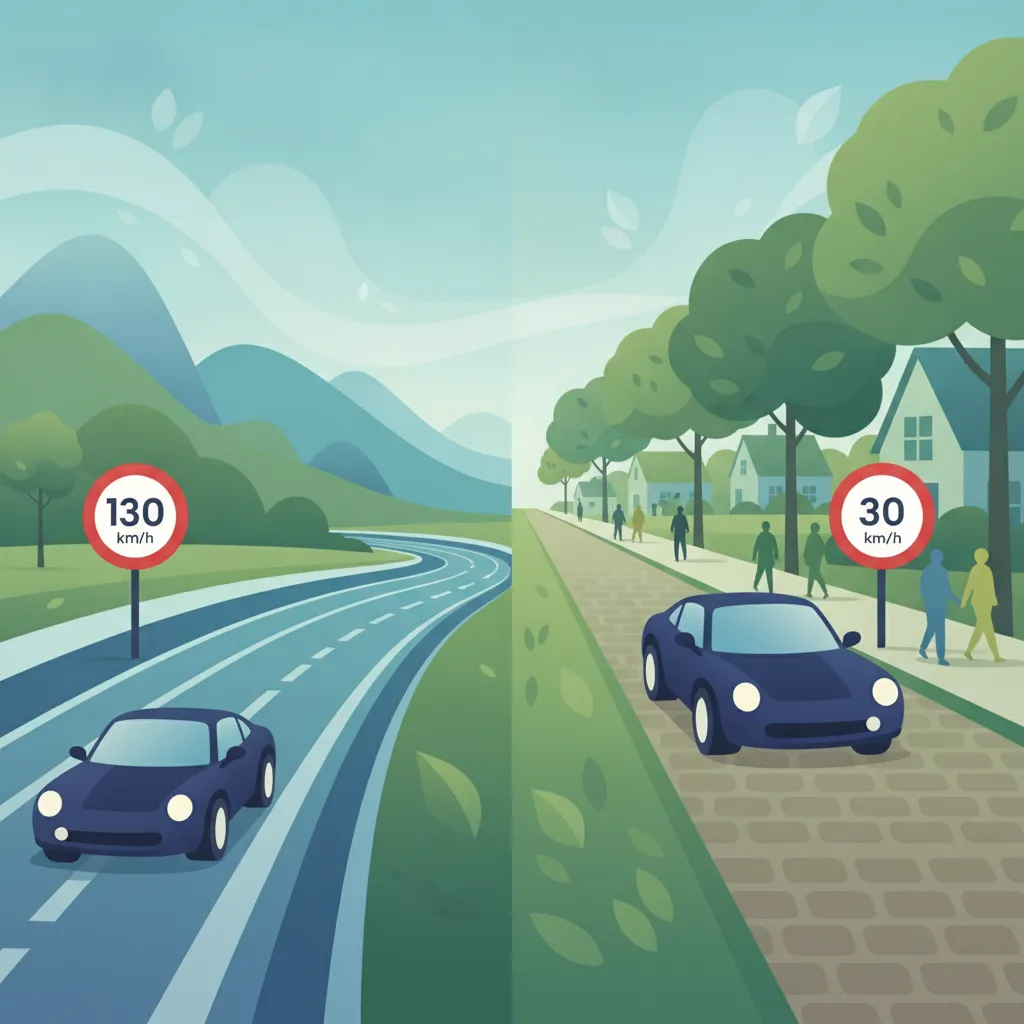
This lesson details the legally prescribed speed limits across Austria's road network, including the specific limits for urban areas (Ortsgebiet), rural roads (Landstraßen), motorways (Autobahnen), and expressways (Schnellstraßen). Learners will understand how to interpret speed limit signs, including those with supplementary conditions. Adherence to these legal requirements is a fundamental aspect of road safety and compliance with the Austrian road traffic act (StVO).
Driving in tourist hotspots in cities like Salzburg or alpine resorts requires extra patience and vigilance. This lesson explores common unpredictable behaviours, such as pedestrians stepping into the road to take photos or groups of tourists being unaware of traffic. It teaches drivers to slow down, be prepared for anything, and use communication tools like the horn sparingly and appropriately.
Find clear answers to common questions learners have about Defensive Driving Techniques and Risk Assessment. Learn how the lesson is structured, which driving theory objectives it supports, and how it fits into the overall learning path of units and curriculum progression in Austria. These explanations help you understand key concepts, lesson flow, and exam focused study goals.
The Austrian exam requires you to demonstrate that you can identify hazards and react appropriately. Defensive driving is the foundation for safe decision-making in these test scenarios.
Adopting a defensive mindset helps you avoid traffic violations and accidents, which is critical for new drivers during the probationary phase (Mehrphasenausbildung) to avoid penalties.
Traffic rules define what you must do, while defensive driving is the mindset of anticipating risks beyond what the law explicitly dictates to ensure maximum safety.
Effective scanning involves constant eye movement, checking your mirrors every few seconds, and looking far ahead into the distance to spot potential conflicts before they reach your path.
Refine your study plan by searching for specific Austrian driving theory practice sets. Pinpoint questions related to particular road rules, signs, or challenge levels, and begin practicing immediately to reinforce your knowledge and excel in your official exam with confidence. Get started with focused revision today.