
This lesson provides a comprehensive overview of passenger safety and legal requirements for Category B drivers in Austria. You will learn the mandatory use of seatbelts, the correct selection of child restraints, and how to safely secure loads, which are critical components for both your theory exam and real-world driving.

Lesson content overview
Driving a vehicle in Austria comes with a profound responsibility, not only for your own safety but also for the well-being of every passenger you transport. This principle is deeply embedded in Austrian traffic law (StVO) and forms a cornerstone of safe driving practices within the Austrian Driving License B Theory Course curriculum. Ensuring that all occupants are correctly restrained and that any external loads, such as those on a roof rack, are safely secured, is a fundamental duty of every driver.
This lesson explores the legal and practical requirements for safeguarding passengers and cargo. We will delve into the mandatory use of seatbelts for all vehicle occupants, the specific regulations governing child restraint systems (CRS) tailored to a child's age, weight, and height, and the critical guidelines for safely loading items onto a vehicle's roof. Adherence to these rules dramatically reduces the risk and severity of injuries in the event of a collision and prevents dangerous situations caused by unstable loads.
The proper restraint of occupants is not merely a legal formality; it is a life-saving measure. In a collision, the forces generated can be immense, and without adequate restraint, occupants are violently propelled within the vehicle, risking severe or fatal injuries from impact with the interior, other passengers, or even ejection from the vehicle. Seatbelts and child restraint systems are engineered to absorb and distribute these forces, significantly mitigating harm.
Similarly, an improperly secured roof load can drastically alter a vehicle's handling characteristics, increase braking distances, and pose a severe hazard to other road users if it detaches. Understanding and implementing these safety measures are crucial for responsible driving in Austria.
Seatbelts are the most fundamental safety device in a vehicle, designed to keep occupants securely in their seats during sudden stops, swerves, or collisions. Austrian traffic law makes their use compulsory for everyone in a moving vehicle.
According to Austrian traffic regulations (StVO § 23a), it is a legal requirement for all vehicle occupants to use an approved seatbelt system while the vehicle is in motion. This applies to the driver, the front-seat passenger, and all passengers in the rear seats, regardless of their age. The seatbelt must be fastened before the vehicle begins to move and must remain fastened throughout the journey. Failure to comply is a direct violation of traffic law, carrying fines and potentially penalty points on a driver's license.
The purpose of this mandatory rule is clear: seatbelts are proven to reduce the risk of fatality in a crash by up to 50% and the risk of serious injury by up to 75%. They prevent occupants from hitting the vehicle's interior or being ejected, distributing the impact forces across stronger parts of the body.
For a seatbelt to offer its maximum protective effect, it must be worn correctly. An improperly worn seatbelt can itself cause injury or be ineffective in a crash.
Lap Belt Position: The lap portion of the belt should sit low across the pelvis, over the hip bones, not across the stomach. This ensures that impact forces are distributed to the strongest part of your body.
Shoulder Strap Position: The shoulder strap should lie across the middle of your chest and collarbone, not resting on your neck or sliding off your shoulder. Adjust the height of the shoulder strap if your vehicle allows it, to achieve this optimal position.
Snug Fit: The belt should be snug against your body, with no slack. It should not be twisted. Remove any bulky clothing that might prevent a close fit.
No Objects Under the Belt: Do not place objects (like wallets, phones, or cushions) under the seatbelt, as this can reduce its effectiveness and even increase injury risk by concentrating forces.
Modern seatbelts often include technologies like pretensioners and load limiters. Pretensioners automatically tighten the belt in the initial moments of a collision to remove slack, while load limiters then allow a small amount of belt payout to reduce the peak force exerted on the occupant's chest, preventing excessive pressure. These systems work together to optimize protection.
Historically, and still in some older vehicles or specific rear-seat configurations, you might encounter different types of seatbelts:
Children, due to their developing physiology, require specialized restraint systems that go beyond standard adult seatbelts. Their smaller size, weaker bones, and disproportionately large heads make them particularly vulnerable in a collision. Austrian law has specific, strict requirements for child restraint systems (CRS).
Under Austrian law (StVO § 23b), children up to 12 years of age or under 150 cm in height must be secured in an approved child restraint system appropriate for their age, weight, and height. This means that even if a child is 12 years old but still under 150 cm, they must continue to use a child restraint. Conversely, a child who is, for example, 10 years old but already 150 cm tall can use a standard adult seatbelt.
The driver is legally responsible for ensuring that all child passengers are correctly restrained before the vehicle moves and throughout the journey.
Choosing the correct child restraint system is paramount. Child seats are designed based on specific physiological parameters to provide optimal protection. Using an inappropriate seat can be as dangerous as using no seat at all. Modern child seats are classified according to European standards (ECE R44 or ECE R129, also known as i-Size).
Always consult the child seat manufacturer's manual and your vehicle's owner's manual for specific instructions and compatibility checks.
For infants and very young children, rear-facing child seats are mandatory (StVO § 23c) until they exceed the manufacturer's specified weight or height limit, typically up to at least 15 kg. Some modern seats allow rear-facing travel up to 18 kg or even 25 kg.
A child restraint system installed so that the child faces the rear of the vehicle. This position provides superior protection for an infant's head, neck, and spine by cradling them and distributing crash forces across their entire back.
The rationale behind rear-facing seats is crucial: a young child's head is disproportionately heavy, and their neck muscles and spinal column are still developing. In a frontal collision, a rear-facing seat absorbs the impact over the child's entire back, neck, and head, preventing the neck from snapping forward and causing severe injury.
Once a child outgrows the rear-facing seat's limits (based on their weight or height), they can transition to a forward-facing child seat. These seats often feature their own five-point harness system and are typically used for children weighing up to 25 kg.
A child restraint system installed so that the child faces the front of the vehicle, typically using an internal harness system.
For older children who have outgrown forward-facing seats with internal harnesses but are still under 150 cm tall, a booster seat is required.
A child restraint system that elevates a child to allow the vehicle's standard three-point adult seatbelt to fit correctly across their shoulder and hips.
The booster seat ensures that the lap belt lies low across the child's hips (not the abdomen) and the shoulder strap rests across the chest and collarbone (not the neck), preventing dangerous "submarining" (sliding under the lap belt) or neck injuries in a crash. Booster seats are generally used for children weighing over 36 kg or who are over 125-135 cm tall, up to the 150 cm legal limit.
Proper installation is as vital as choosing the correct seat. A loosely installed child seat provides little to no protection and can become a projectile in a collision.
Seatbelt (Belt-Through) Method: This traditional method involves routing the vehicle's adult seatbelt through designated paths on the child seat and tightening it securely. It is critical to follow the seat manufacturer's instructions precisely for the correct belt path (often color-coded blue for rear-facing and red for forward-facing).
ISOFIX: ISOFIX is a standardized international system for attaching child seats directly to anchor points built into the vehicle chassis. It provides a rigid, secure connection, significantly reducing the chance of incorrect installation. ISOFIX points are usually indicated by labels or markers on the vehicle seats.
Top Tether: Many forward-facing ISOFIX child seats require an additional top tether strap. This strap attaches from the top of the child seat to an anchor point located behind the vehicle's seat (often on the parcel shelf or floor). The top tether prevents excessive forward rotation of the child seat in a frontal collision, enhancing safety. According to StVO § 23d, ISOFIX seats must be used with vehicle ISOFIX connectors and, where required, the top tether.
After installation, always check for tightness: the child seat should not move more than 2-3 cm (approximately 1 inch) from side to side or front to back at the belt path or ISOFIX attachment points.
When using a rear-facing child restraint in the front passenger seat, it is absolutely essential to deactivate the front passenger airbag. An inflating airbag can strike the back of a rear-facing child seat with immense force, causing severe or fatal injury to the child.
For forward-facing child seats in the front passenger seat, consult both the child seat and vehicle manuals. Some manufacturers recommend deactivating the airbag for certain forward-facing seats, while others permit use with an active airbag, provided the vehicle seat is pushed as far back as possible. However, the safest place for any child restraint is generally in the rear seat.
Never place a rear-facing child seat in the front passenger seat with an active airbag. This poses an extreme risk of severe injury or death to the child.
Transporting items on the vehicle's roof, such as skis, bicycles, or luggage, requires careful consideration to maintain vehicle stability and prevent hazards. Improper roof loading can significantly alter driving dynamics and pose a danger to other road users.
Every vehicle has a maximum permissible roof load capacity specified by its manufacturer. This limit, usually expressed in kilograms, indicates the maximum weight that can be safely placed on the roof rack, including the weight of the roof rack system itself. It is critical to consult your vehicle's owner's manual to determine this limit. Exceeding it can compromise vehicle handling, braking, and structural integrity, and it is a violation of StVO § 58.
Overloading the roof shifts the vehicle's center of gravity upwards, increasing body roll in corners, extending braking distances, and making the vehicle more susceptible to crosswinds. This can lead to a loss of control, especially at higher speeds or in adverse weather conditions.
Once you know your vehicle's roof load capacity, the next step is to ensure the cargo is distributed and secured correctly.
Distribute Weight Evenly: Place heavier items centrally and as low as possible on the roof rack to minimize the impact on the vehicle's center of gravity.
Secure Firmly: Use appropriate straps (e.g., ratchet straps, heavy-duty bungee cords, or specialized ski/bike carriers) to secure the cargo tightly to the roof rack and, where possible, directly to the vehicle's attachment points. Cargo should not be able to shift, slide, or vibrate loose during transit.
Check Regularly: For longer journeys, pull over periodically to re-check the tightness of all straps and the stability of the load.
Aerodynamics: Consider the aerodynamic impact. Large, bulky items can increase wind resistance, leading to higher fuel consumption and increased noise. Special roof boxes can mitigate some of these effects.
Visibility: Ensure the roof load does not obstruct your view through the windscreen or rear window, nor block any lights or license plates.
If your cargo extends beyond the front or rear perimeter of the roof rack or vehicle, specific rules apply:
Always confirm precise limits and marking requirements with current Austrian traffic regulations, as these can have specific numerical details.
Failure to adhere to passenger safety and roof load regulations in Austria carries significant legal and safety consequences:
Understanding the underlying principles reinforces the importance of these rules:
This lesson covers the mandatory seatbelt requirements under Austrian law for all vehicle occupants and the specific child restraint regulations that require children up to 12 years of age or under 150 cm in height to use appropriate seats matched to their weight and height. It explains the critical importance of rear-facing seats for infants to protect their developing neck and spine, and the transition through forward-facing seats with harnesses up to booster seats that enable correct adult seatbelt use. Proper installation methods—including ISOFIX with top tether and correct belt routing—are emphasized, along with the essential requirement to deactivate front airbags when using rear-facing seats in the front passenger seat. The lesson also addresses roof load safety, including maximum capacity limits, proper securing techniques, and marking requirements for overhanging loads.
A short set of high-value points that capture the most important learning from this lesson.
All vehicle occupants in Austria must wear an approved seatbelt while the vehicle is in motion, with non-compliance carrying fines and penalty points under StVO § 23a.
Children must use an appropriate child restraint until they reach 12 years of age AND 150 cm in height, meaning either condition alone still requires a child seat.
Rear-facing child seats are mandatory for infants until they exceed the manufacturer's weight/height limits, typically at least 15 kg, to protect their vulnerable head and neck.
ISOFIX provides a rigid, standardized connection that reduces installation errors, but forward-facing seats also require a top tether to prevent excessive forward rotation in a crash.
A rear-facing child seat must never be placed in the front passenger seat without deactivating the front airbag, as inflation can cause fatal injuries.
Explore all units and lessons included in this driving theory course.
Height (150 cm) and age (12 years) are both conditions—a child must satisfy BOTH to stop using a child restraint, or satisfy either to continue using one.
For overhanging roof loads exceeding 1 meter behind the vehicle, a red flag (minimum 25x25 cm) is required during the day; at night or in poor visibility, a red light and red reflector must be used.
After installing a child seat, it should not move more than 2-3 cm (about 1 inch) at the belt path or ISOFIX attachment points.
The lap belt must sit low across the pelvis over the hip bones, never across the stomach, and the shoulder strap must cross the chest and collarbone, never the neck.
The driver's legal responsibility includes ensuring all passengers, including rear-seat occupants, are correctly restrained before the vehicle moves.
Assuming a child who has turned 12 no longer needs a child restraint, without checking if they are still under 150 cm in height.
Placing a rear-facing infant seat in the front passenger seat without first deactivating the front airbag.
Using a booster seat without first verifying the vehicle's three-point belt fits correctly across the child's shoulder and hips (not neck or stomach).
Assuming any child seat installation method is equally safe; belt-through installations require precise routing through color-coded paths, while ISOFIX requires proper engagement and top tether use.
Overloading the roof beyond the manufacturer's specified maximum roof load capacity, which compromises vehicle handling and braking.
Lesson content overview
A short set of high-value points that capture the most important learning from this lesson.
All vehicle occupants in Austria must wear an approved seatbelt while the vehicle is in motion, with non-compliance carrying fines and penalty points under StVO § 23a.
Children must use an appropriate child restraint until they reach 12 years of age AND 150 cm in height, meaning either condition alone still requires a child seat.
Rear-facing child seats are mandatory for infants until they exceed the manufacturer's weight/height limits, typically at least 15 kg, to protect their vulnerable head and neck.
ISOFIX provides a rigid, standardized connection that reduces installation errors, but forward-facing seats also require a top tether to prevent excessive forward rotation in a crash.
A rear-facing child seat must never be placed in the front passenger seat without deactivating the front airbag, as inflation can cause fatal injuries.
Explore all units and lessons included in this driving theory course.
Height (150 cm) and age (12 years) are both conditions—a child must satisfy BOTH to stop using a child restraint, or satisfy either to continue using one.
For overhanging roof loads exceeding 1 meter behind the vehicle, a red flag (minimum 25x25 cm) is required during the day; at night or in poor visibility, a red light and red reflector must be used.
After installing a child seat, it should not move more than 2-3 cm (about 1 inch) at the belt path or ISOFIX attachment points.
The lap belt must sit low across the pelvis over the hip bones, never across the stomach, and the shoulder strap must cross the chest and collarbone, never the neck.
The driver's legal responsibility includes ensuring all passengers, including rear-seat occupants, are correctly restrained before the vehicle moves.
Assuming a child who has turned 12 no longer needs a child restraint, without checking if they are still under 150 cm in height.
Placing a rear-facing infant seat in the front passenger seat without first deactivating the front airbag.
Using a booster seat without first verifying the vehicle's three-point belt fits correctly across the child's shoulder and hips (not neck or stomach).
Assuming any child seat installation method is equally safe; belt-through installations require precise routing through color-coded paths, while ISOFIX requires proper engagement and top tether use.
Overloading the roof beyond the manufacturer's specified maximum roof load capacity, which compromises vehicle handling and braking.
Explore search topics learners often look for when studying Passenger Safety: Seatbelts, Child Restraints, and Roof Loads. These topics reflect common questions about road rules, driving situations, safety guidance, and lesson level theory preparation for learners in Austria.
Browse additional driving theory lessons that cover connected traffic rules, road signs, and common driving situations related to this topic. Improve your understanding of how different rules interact across everyday traffic scenarios.
Understand the legal requirements for child restraint systems (CRS) in Austria, including mandatory seatbelt use, age and height limits for child seats, and proper installation methods like ISOFIX for young passengers.

Transporting children carries the highest level of responsibility. This lesson covers the specific Austrian rules for school buses, including the use of warning signs and lights. It focuses on developing a mindset of extreme caution, anticipating that children may run into the road unexpectedly, and managing the chaotic traffic environment often found around schools during drop-off and pick-up times.

This lesson delves into the specific Austrian laws and regulations that professional passenger drivers must adhere to. It provides an overview of rules concerning driving and rest times, the use of the digital tachograph, and the essential documents that must be carried at all times. Understanding these legal obligations is crucial for compliance and avoiding penalties during roadside checks.

Properly managed luggage is crucial for safety and passenger flow. This lesson covers procedures for stowing items in underfloor lockers on coaches and managing larger items like prams or winter sports equipment inside the vehicle. It emphasizes the legal requirement to keep gangways and emergency exits clear and provides guidance on assisting passengers with their belongings.
This lesson details the specific regulations and best practices for driving in areas with high pedestrian activity, such as bus stops and school zones. It explains the driver's obligation to stop for school buses with flashing lights and to yield to public buses pulling out from a stop. The content emphasizes the requirement to significantly reduce speed in marked school zones to ensure the safety of children.

This lesson covers the various lighting and reflector systems required on heavy goods vehicles in Austria. It explains the function and legal requirements for headlights, taillights, brake lights, indicators, and reflective markings. Ensuring all lighting systems are operational is essential for visibility and communicating intentions to other road users.
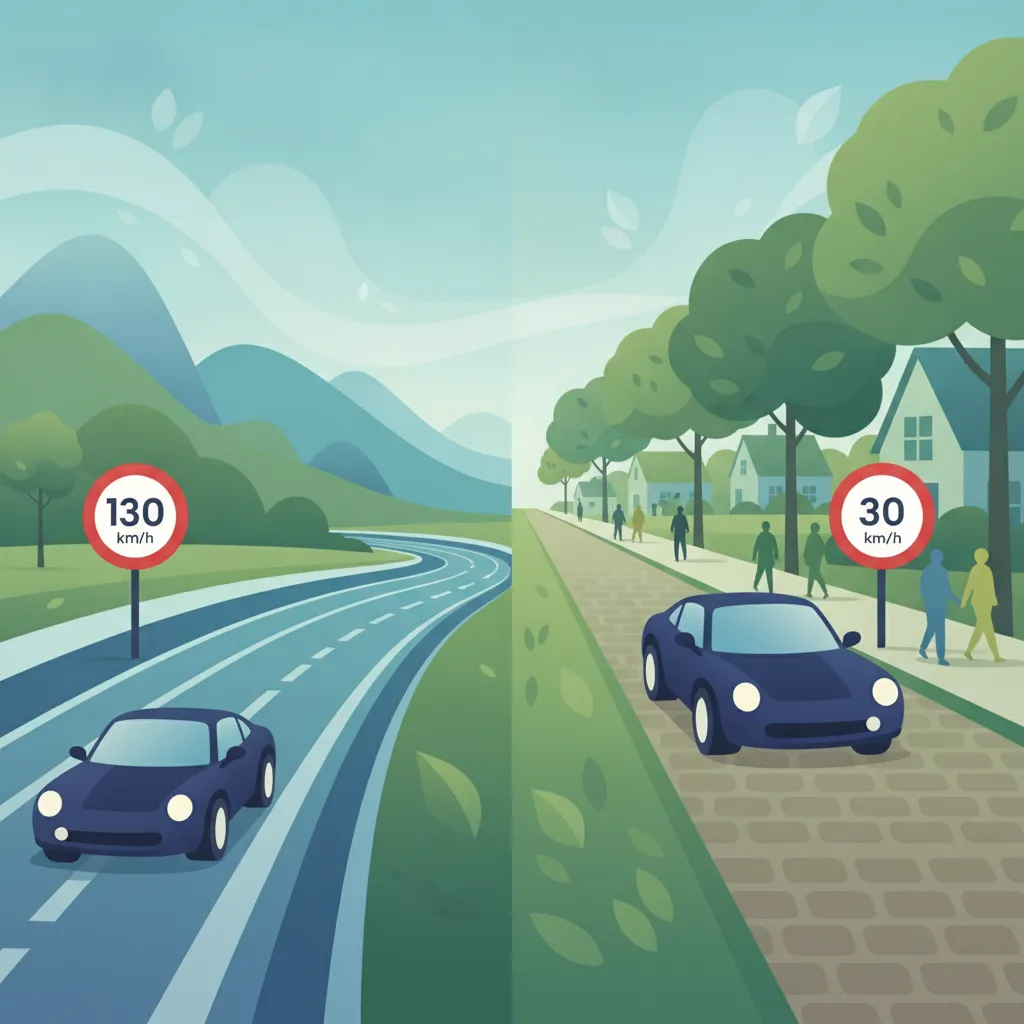
This lesson details the legally prescribed speed limits across Austria's road network, including the specific limits for urban areas (Ortsgebiet), rural roads (Landstraßen), motorways (Autobahnen), and expressways (Schnellstraßen). Learners will understand how to interpret speed limit signs, including those with supplementary conditions. Adherence to these legal requirements is a fundamental aspect of road safety and compliance with the Austrian road traffic act (StVO).
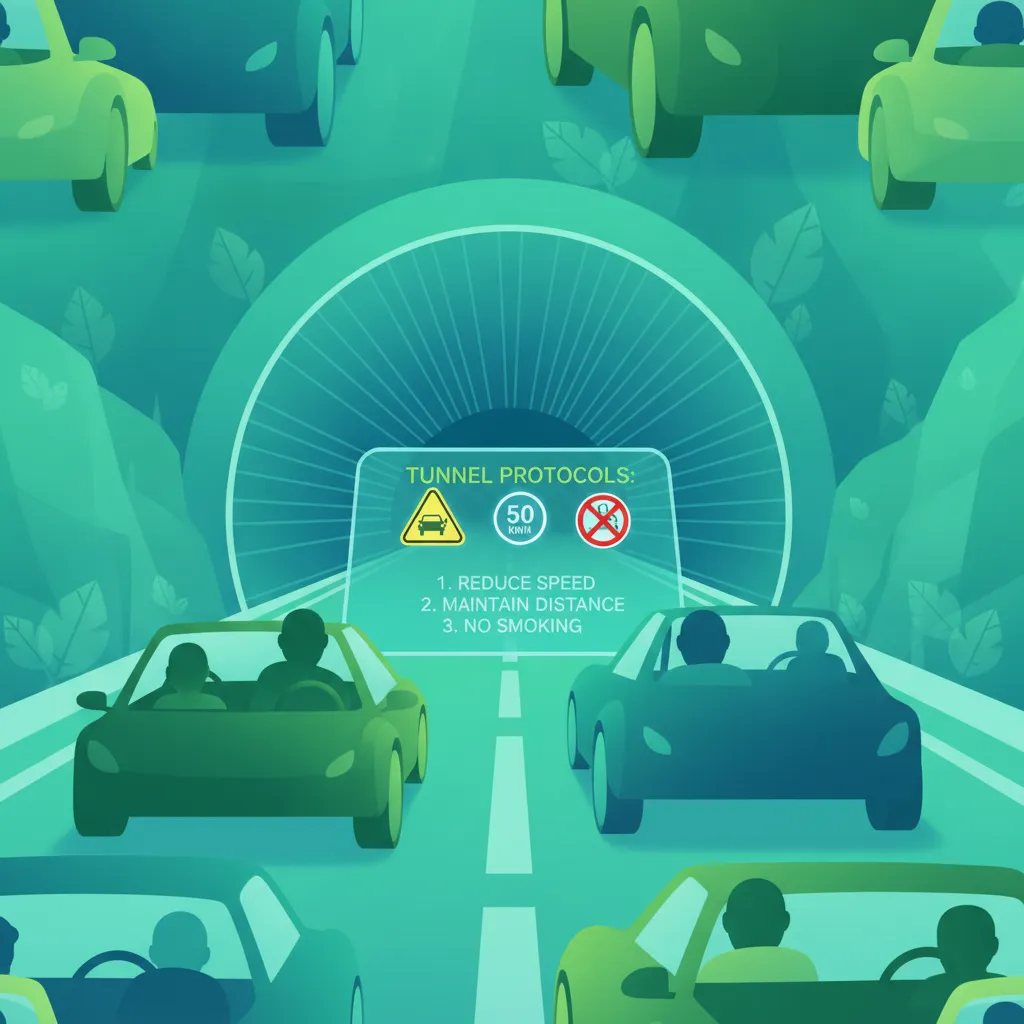
Austria's mountainous terrain means drivers will frequently encounter long tunnels. This lesson details the specific regulations, such as turning on lights and maintaining distance, as well as how to react to tunnel-specific warning signs and signals. Crucially, it covers the correct emergency procedures to follow in the event of a fire, accident, or breakdown inside a tunnel.

This lesson covers the proper and legal use of a vehicle's entire lighting system to see and be seen. It explains the regulations for using headlights, including daytime running lights, and the specific conditions under which fog lights and high beams are permitted. Correct use of turn signals and brake lights is also emphasized as essential for communicating intentions to other drivers and ensuring safety in all visibility conditions.

This lesson details the essential legal and administrative requirements for operating an AM vehicle in Austria. It covers the processes for vehicle registration, the obligation for licence plates, and the necessity of third-party liability insurance. Furthermore, it explains the importance of regular technical inspections to ensure the vehicle remains roadworthy and compliant with national standards.
This lesson focuses on the legal restrictions concerning a heavy vehicle's dimensions, including maximum height, width, and length. It teaches drivers how to interpret road signs and supplemental plates that indicate these limits. This knowledge is crucial for route planning, especially when navigating under bridges, through tunnels, and on restricted roads.
Learn the regulations for securing loads on your vehicle's roof in Austria, covering maximum load capacity, proper distribution and fastening, and rules for cargo that overhangs the vehicle body. Essential for driver responsibility.

This lesson explains the critical importance of properly securing any load, whether inside the vehicle, on a roof rack, or in a trailer. It covers the principles of correct weight distribution to maintain the vehicle's center of gravity and stability. Learners will understand the legal requirements and best practices for using tie-downs and other securing methods to prevent items from shifting or falling, which could create a serious hazard on the road.

This lesson details the legal ramifications of operating an overloaded heavy vehicle in Austria, which include significant fines and penalty points. It also emphasizes the severe safety risks, such as compromised braking performance and increased mechanical stress on the vehicle. Understanding these consequences reinforces the importance of strict adherence to weight limits.
This lesson focuses on the legal restrictions concerning a heavy vehicle's dimensions, including maximum height, width, and length. It teaches drivers how to interpret road signs and supplemental plates that indicate these limits. This knowledge is crucial for route planning, especially when navigating under bridges, through tunnels, and on restricted roads.

This lesson focuses on the practical methods and equipment used for securing cargo, a practice known as Ladungssicherung in Austria. It covers the different types of restraints, such as straps and chains, and the correct techniques for applying them. Ensuring cargo is properly secured is a legal requirement and is critical for preventing accidents caused by shifting loads.

This lesson emphasizes the need to inspect all load-securing equipment as part of the daily pre-trip check. It teaches drivers how to look for signs of wear, damage, or malfunction in straps, chains, ratchets, and other devices. Verifying the integrity of this equipment is essential before every journey to ensure the load remains secure.

This lesson explains the critical relationship between load distribution, the vehicle's centre of gravity, and its stability. It details how incorrect placement of cargo can negatively affect handling, increase the risk of rollovers, and reduce braking efficiency. Achieving a balanced load is a key component of safe heavy vehicle operation.

This lesson prepares drivers for the emergency scenario of a shifting or lost load. It covers how to react to the sudden change in vehicle handling, safely pull over, and assess the situation. The lesson also explains the driver's responsibility for securing the scene and reporting the incident to prevent hazards for other road users.

This lesson explains the regulations governing the use of designated delivery and loading zones in urban areas. It covers topics such as time restrictions, the potential need for permits, and the correct way to position the vehicle to minimize traffic disruption. Adhering to these rules is essential for efficient and legal urban logistics.

This lesson covers the practical aspects of planning a route for a heavy goods vehicle. It explains how to use maps and specialized GPS systems to identify and avoid roads with height, weight, or other restrictions. Proactive route planning is essential for ensuring an efficient, legal, and safe journey.

This lesson details the general traffic rules applicable to heavy goods vehicles on Austrian roads, highlighting differences from passenger car regulations. It covers key topics such as right-of-way at intersections, specific rules for overtaking, maintaining proper lane discipline, and adhering to designated speed limits. Understanding these rules is critical for safe integration into mixed traffic.
Find clear answers to common questions learners have about Passenger Safety: Seatbelts, Child Restraints, and Roof Loads. Learn how the lesson is structured, which driving theory objectives it supports, and how it fits into the overall learning path of units and curriculum progression in Austria. These explanations help you understand key concepts, lesson flow, and exam focused study goals.
Children may sit in the front seat provided they are secured in an approved child restraint system appropriate for their height and weight, as specified by Austrian law.
As the driver of a Category B vehicle, you are responsible for ensuring that all passengers are buckled up before moving. You may face legal penalties if passengers are not properly restrained.
You do not need a special permit for standard roof racks, but you are legally required to ensure the load is secured to prevent it from shifting or falling, which could endanger other road users.
In Austria, children under 135 cm in height must generally use an appropriate child restraint system. Always ensure the seat matches the specific weight and height requirements of the child.
Refine your study plan by searching for specific Austrian driving theory practice sets. Pinpoint questions related to particular road rules, signs, or challenge levels, and begin practicing immediately to reinforce your knowledge and excel in your official exam with confidence. Get started with focused revision today.