
Learning where and how to park is a core requirement for any driver in Denmark. This guide helps you navigate the complexities of municipal parking zones, the correct operation of your parking disc, and the critical rules of the Færdselsloven that examiners often test. By mastering these regulations, you ensure you can park safely, legally, and without risking unnecessary traffic penalties.
Article content overview
Learning where and how to park is a fundamental skill for every driver in Denmark. Whether you are navigating the narrow streets of Copenhagen or visiting the coastal towns of Jutland, understanding the nuances of the Færdselsloven (The Road Traffic Act) is essential. Parking regulations can often feel complex due to a mix of national laws and specific municipal bylaws, but mastering these rules is not only vital for passing your Danish driving theory exam—it is your first defense against costly parking fines.
One of the most unique aspects of Danish motoring is the mandatory use of the P-skive (parking disc). In many urban areas across Denmark, you will encounter zones marked with blue signs indicating time-limited parking. In these areas, it is a legal requirement to display a P-skive on the inside of your windscreen, typically in the lower right corner, set to the arrival time.
The P-skive must be set to the nearest following quarter-hour. For example, if you arrive at 14:10, you must set the disc to 14:15. It is crucial to remember that the P-skive is not just a suggestion; failing to display one, or setting it incorrectly, will almost certainly result in a parkeringsafgift (parking fine).
The Danish theory exam frequently tests your knowledge of "no-parking" zones. While signs are the most obvious indicators, the Færdselsloven dictates several "automatic" prohibitions that apply regardless of whether a sign is present.
You are strictly prohibited from stopping or parking your vehicle within 10 meters of an intersection. This distance is measured from the corner of the intersecting street or the nearest edge of a crossing cycle track. This rule is designed to ensure adequate sightlines for all road users, especially at junctions where visibility is limited.
Similarly, you must not stop or park on a pedestrian crossing or within 5 meters before one in your direction of travel. This ensures that pedestrians have a clear view of approaching traffic and that drivers can see pedestrians stepping into the road.
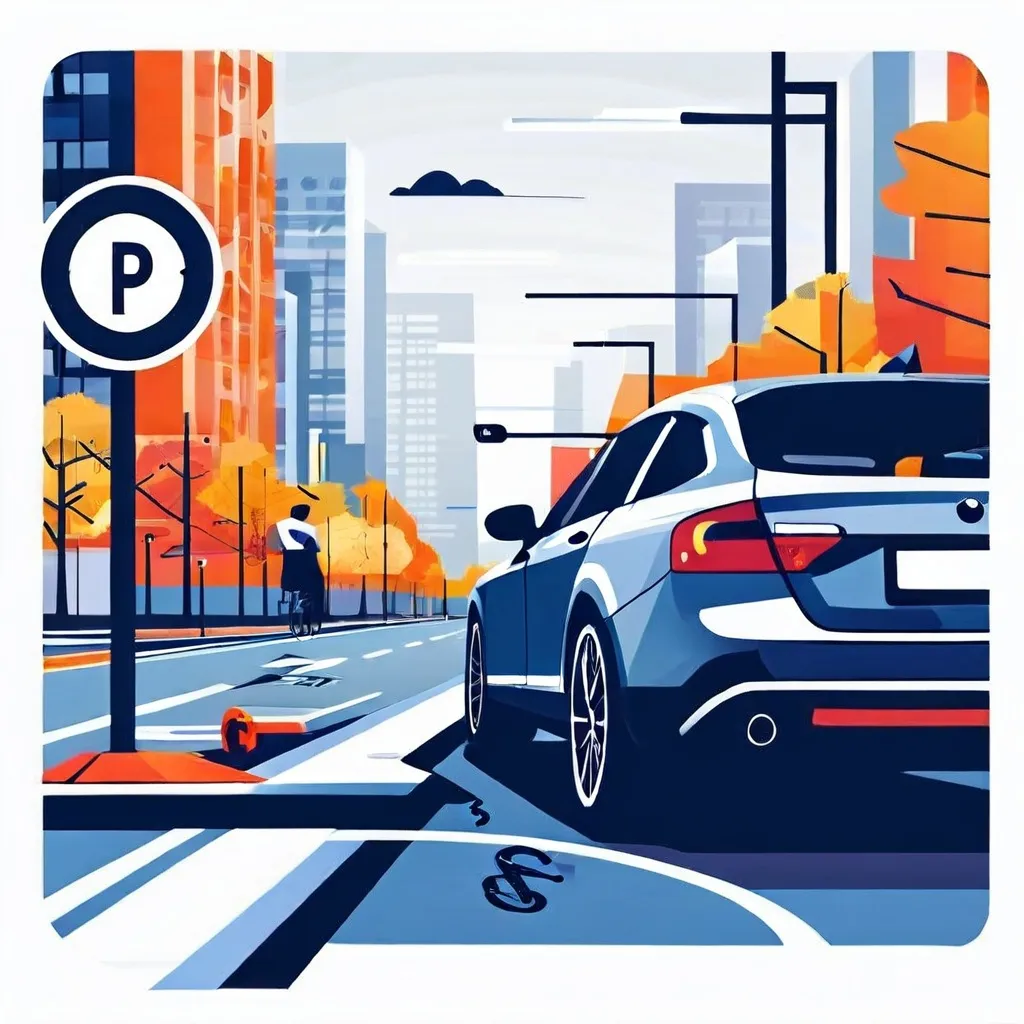
In Denmark, the bicycle is king. It is strictly illegal to stop or park your vehicle on a cykelsti (cycle track) or a sidewalk. Even parking partially on the curb to save space can lead to a fine. Because Denmark has such extensive cycling infrastructure, private parking enforcement companies are highly vigilant in patrolling these areas.
Large cities like Copenhagen and Aarhus utilize complex zoning systems. In Copenhagen, for instance, the city is divided into various parking zones, each with its own tariff and resident permit (beboerlicens) requirements.
When parking in these major cities, always look for the zone signs at the entry points of the district. If you are in a paid zone, you must register your vehicle via a parking app or a local payment kiosk. Cash is rarely accepted in modern Danish parking machines, making a smartphone-based parking app an essential tool for any driver.
To help you prepare for your theory test, refer to the table below regarding common parking violations.
| Situation | Can you stop? | Can you park? |
|---|---|---|
| On a cycle track | No | No |
| Within 10m of intersection | No | No |
| Within 5m of pedestrian crossing | No | No |
| At a bus stop | Only for passengers | No |
| In front of a driveway | Only for loading/unloading | No |
The Danish theory exam will often present you with images of complex traffic situations. You might see a car parked near a corner or a sign that includes a red number in parentheses, which indicates parking restrictions on Saturdays. Pay close attention to these details, as they are classic "trap" questions designed to see if you understand the hierarchy of road rules over signage.
Danish parking regulations require the mandatory P-skive set to the nearest quarter-hour in time-limited zones. Key distance rules prohibit parking within 10 meters of intersections and 5 meters before pedestrian crossings, and cycling infrastructure is strictly protected. The distinction between 'Standsning forbudt' (no stopping) and 'Parkering forbudt' (no parking) is critical for the theory exam, as the former allows no pause whatsoever. Urban zones like Copenhagen use app-based payment systems and resident permits rather than cash, making digital payment tools essential for drivers.
A short set of high-value points that capture the most important ideas from this article.
The P-skive must be set to the nearest quarter-hour and displayed on the windscreen in the lower right corner
You are prohibited from stopping or parking within 10 meters of any intersection, measured from the corner
Parking is forbidden on cycle tracks (cykelsti) and sidewalks, even partially
Distinguish between 'Standsning forbudt' (no stopping at all) and 'Parkering forbudt' (no parking only)
In urban zones like Copenhagen, parking payment is made via apps or kiosks, not cash
P-skive rounding rule: set to the next quarter-hour (arrive at 14:10, set to 14:15)
10-meter rule for intersections and 5-meter rule for pedestrian crossings apply even without signs
Cycle tracks are absolutely off-limits for vehicles in Denmark
Standsning (stopping) is more restrictive than Parkering (parking) and can result in immediate fines
Zone signs at district entry points indicate the specific tariff and permit requirements
Failing to display the P-skive or setting it to the actual arrival time instead of rounding up
Assuming a brief stop near an intersection is acceptable under the 10-meter rule
Parking partially on the curb or sidewalk to save space in crowded areas
Confusing the Saturday parking restriction numbers shown on signs with other time limits
Misunderstanding that 'Standsning forbudt' means no stopping whatsoever, not just no parking
Article content overview
A short set of high-value points that capture the most important ideas from this article.
The P-skive must be set to the nearest quarter-hour and displayed on the windscreen in the lower right corner
You are prohibited from stopping or parking within 10 meters of any intersection, measured from the corner
Parking is forbidden on cycle tracks (cykelsti) and sidewalks, even partially
Distinguish between 'Standsning forbudt' (no stopping at all) and 'Parkering forbudt' (no parking only)
In urban zones like Copenhagen, parking payment is made via apps or kiosks, not cash
P-skive rounding rule: set to the next quarter-hour (arrive at 14:10, set to 14:15)
10-meter rule for intersections and 5-meter rule for pedestrian crossings apply even without signs
Cycle tracks are absolutely off-limits for vehicles in Denmark
Standsning (stopping) is more restrictive than Parkering (parking) and can result in immediate fines
Zone signs at district entry points indicate the specific tariff and permit requirements
Failing to display the P-skive or setting it to the actual arrival time instead of rounding up
Assuming a brief stop near an intersection is acceptable under the 10-meter rule
Parking partially on the curb or sidewalk to save space in crowded areas
Confusing the Saturday parking restriction numbers shown on signs with other time limits
Misunderstanding that 'Standsning forbudt' means no stopping whatsoever, not just no parking
Explore related topics, search based questions, and concepts that learners often look up when studying Danish Parking Rules and Fines. These themes reflect real search intent and help you understand how this topic connects to wider driving theory knowledge in Denmark.
Find clear and practical answers to common questions learners often have about Danish Parking Rules and Fines. This section helps explain difficult points, remove confusion, and reinforce the key driving theory concepts that matter for learners in Denmark.
A P-skive (parking disc) is a device used to display your arrival time in time-limited parking zones. You must set it to the nearest following 15-minute increment upon parking in any area where time-restricted parking is indicated by a sign.
According to the Færdselsloven, it is prohibited to stop or park within 10 meters of the nearest edge of a crossing road or bicycle track at an intersection, as this is necessary for visibility and traffic safety.
No, it is strictly prohibited to stop or park your vehicle on or near a cycle track, including within 5 meters of a cycle track exit. This is heavily enforced and carries fines.
While the Færdselsloven sets the national standard, individual municipalities like Copenhagen or Aarhus may implement specific local bylaws regarding parking zones, permits, and payment systems.
Continue your learning journey by searching for additional articles or browsing our comprehensive topic categories. Deepen your knowledge of Danish road law, vehicle mechanics, and hazard perception to ensure complete preparation for your official theory exam.