
This lesson teaches you how to identify and react to the unique hazards found on high-exposure roads like bridges and coastal routes. Understanding these environmental factors is crucial for safe riding as it ensures you maintain control when faced with sudden crosswinds or changing road surface conditions on your motorcycle.

Lesson content overview
Riding a motorcycle on bridges and coastal roads presents a unique set of challenges that demand specific skills and heightened awareness. These environments are often exposed to varying weather conditions, particularly strong winds, and feature distinctive road geometries and surface transitions. Understanding these factors is crucial for maintaining control, ensuring stability, and riding safely. This lesson within the Danish Motorcycle Theory curriculum will equip you with the knowledge to anticipate and effectively manage the dynamics of these special routes.
Bridges and coastal roads are not merely stretches of pavement; they are distinct environments with specific characteristics that directly impact motorcycle handling and traffic flow. Their elevated positions and proximity to water bodies mean they are frequently exposed to stronger, less predictable winds than inland roads. Coastal routes, in particular, often combine scenic views with tight, winding curves and fluctuating road surfaces, demanding constant vigilance and adaptability from the rider.
The unique hazards of these routes include strong crosswinds that can destabilize a motorcycle, limited visibility around sharp coastal bends, and significant changes in road surface grip when transitioning onto or off bridge decks. Mastering these conditions is essential not only for personal safety but also for the safety of other road users. Proactive adjustments to speed, lane position, and riding technique are paramount to safely navigate these challenging yet rewarding sections of the road.
Crosswinds are one of the most significant environmental factors affecting motorcycle stability on exposed roads, especially bridges and open coastal stretches. A crosswind is defined as wind blowing perpendicular to your direction of travel, creating a lateral force that pushes your motorcycle sideways. This force can be surprisingly strong and, if not properly managed, can lead to a loss of control or unintended lane departure.
The impact of crosswinds increases with wind speed and the motorcycle's speed. At higher speeds, even moderate crosswinds can exert considerable pressure, making the motorcycle feel unstable. This phenomenon is further amplified on structures like bridges, where there are no natural barriers to block the wind, creating an uninterrupted flow across the road.
Crosswinds can manifest in two primary forms: constant crosswinds and variable gusts. A constant crosswind is a steady force coming from a consistent direction. While it requires continuous correction, its predictability can make it easier to manage once a rider adapts. The motorcycle will feel a sustained push, necessitating a steady counter-force from the rider.
Variable gusts, on the other hand, are sudden, brief increases in wind speed or rapid shifts in wind direction. These are far more challenging because they are unpredictable and can catch a rider off guard. A sudden gust can cause an abrupt sideways lurch, demanding immediate and precise corrective input to maintain lane position. Riders must develop a keen sense of awareness to anticipate potential gusts, especially when passing gaps in windbreaks (like buildings or trees) or when exiting tunnels onto exposed areas.
The lateral force of a crosswind directly affects a motorcycle’s stability by attempting to push it out of its intended path. This can result in the motorcycle drifting sideways within its lane or, in severe cases, being pushed into an adjacent lane or off the road. This drift is not merely a nuisance; it can compromise your lane discipline, bring you too close to oncoming traffic or roadside barriers, and increase the risk of a collision.
To counteract this force, riders must learn to apply subtle but effective steering corrections, often referred to as counter-steering. This involves a slight push on the handlebar on the side from which the wind is coming. For example, if the wind is pushing from the left, a slight push on the left handlebar will initiate a lean into the wind, effectively counteracting its force and helping maintain a straight trajectory.
Successfully managing crosswinds requires a combination of anticipation, subtle steering input, and appropriate speed adjustments. The key is to react smoothly and avoid overcorrection, which can lead to weaving or oscillation.
Anticipate the Wind: Pay attention to weather forecasts, observe wind direction flags, and watch for visual cues like trees swaying or water ripples, especially when approaching exposed areas.
Reduce Speed: Lowering your speed provides more time to react and reduces the intensity of the wind's effect on your motorcycle's stability. A slower speed also increases your tire's contact patch, offering more grip for lateral movements.
Apply Subtle Counter-Steering: If the wind is pushing your motorcycle to the left, apply a slight, continuous push on the left handlebar. This will cause the motorcycle to lean slightly into the wind, counteracting the lateral force. If the wind is from the right, push the right handlebar.
Maintain Relaxed Grip: A tense grip on the handlebars can lead to overcorrection and amplify the bike's reaction to gusts. Keep your arms relaxed, allowing the motorcycle to move subtly beneath you while you provide controlled inputs.
Adjust Lane Position: Consider shifting your lane position slightly to provide more buffer space. If the wind is from the left, position yourself slightly to the right of your lane to give you more room to drift left without crossing the lane line.
Lane positioning is a fundamental aspect of safe motorcycle riding, but its importance is amplified on bridges and winding coastal roads. Optimal lane position can significantly enhance visibility, provide more reaction time, and create a safer buffer zone against external forces like wind and other traffic.
When riding on a bridge, especially one exposed to crosswinds, your lane position should prioritize stability and safety. It's generally advisable to position your motorcycle towards the center of your lane. This provides an equal buffer zone on both sides, giving you maximum space to correct for wind-induced drift without encroaching on adjacent lanes or hugging the bridge's guardrails.
Riding too close to a guardrail on a bridge can be particularly dangerous. Guardrails offer no escape path, and sudden gusts could potentially push you into them, leading to a collision. Moreover, debris often accumulates near guardrails, posing an additional hazard. Maintaining a central position helps you navigate debris and maintain a consistent path.
On very wide, multi-lane bridges, assess the wind direction. If strong winds are consistently pushing from one side, a slight offset (e.g., slightly to the right if the wind is from the left) can provide a larger margin for correction while remaining safely within your lane. However, always prioritize maintaining a safe distance from other traffic.
Coastal roads are renowned for their scenic beauty, but they also often feature numerous curves, some of which may have limited sight distances. Proper lane positioning is critical for maximizing your visibility through these bends and identifying potential hazards early.
On a right-hand curve, position your motorcycle towards the left side of your lane as you approach and enter the bend. This provides the widest possible view around the curve, allowing you to see oncoming traffic, road debris, or other hazards sooner. As you pass the apex of the curve and the exit becomes visible, you can then move towards the right side of the lane, preparing for the next straight or curve.
Conversely, on a left-hand curve, position your motorcycle towards the right side of your lane. This again opens up your line of sight, allowing you to see further into the curve. As you exit, you can transition back towards the center or left of your lane. This strategic use of the lane to "straighten out" curves and improve visibility is a hallmark of advanced motorcycle riding technique.
The imaginary triangle formed by your line of sight to the vanishing point of a curve, your current position, and the potential hazard. Maximizing this triangle through proper lane positioning gives you more time to react.
Speed management is always fundamental to safe riding, but its importance is amplified in the dynamic and often unpredictable environments of bridges and coastal roads. Adjusting your speed proactively is key to maintaining control, stability, and responsiveness to sudden changes.
When riding across bridges, especially those that are high and exposed, reducing your speed is a critical safety measure. Lower speeds provide several advantages in windy conditions:
It is wise to reduce your speed before entering an exposed bridge section, rather than waiting until you are already in the midst of strong winds. Maintain a speed that feels comfortable and allows you to confidently manage any wind effects. Be particularly cautious when transitioning from a sheltered area (like a tunnel) to an exposed bridge, as the sudden impact of wind can be surprising.
Coastal roads, with their often tight and numerous curves, demand precise speed management. Riding too fast into a curve is a common cause of accidents, leading to loss of traction, target fixation, or running wide. The key is to adopt a provisional speed reduction strategy.
The act of reducing your speed significantly before entering a curve, based on your assessment of its tightness, visibility, and surface conditions, ensuring you can safely navigate it and accelerate out if necessary.
Before entering any curve on a coastal road, especially blind bends where your view of the exit is obstructed, reduce your speed to a level that allows you to:
Always remember the principle of "slow in, fast out." Enter curves at a speed you know is safe, allowing you to gradually accelerate as you exit, thereby maximizing control and stability.
Bridges often involve transitions between different road surfaces, such as from asphalt on the approach to concrete or metal grating on the bridge deck, and then back to asphalt on the exit. Each surface type has a different coefficient of friction, meaning they offer varying levels of grip. Failing to anticipate and adjust for these changes can lead to instability, particularly during braking or acceleration.
The most common surface transition occurs at the entrance and exit of bridges. While asphalt provides generally consistent grip, concrete bridge decks can feel different – sometimes smoother, sometimes rougher, and often with expansion joints. Metal grating, though less common for primary roads, offers significantly less grip, especially when wet.
It's crucial to identify these transitions visually as you approach them. Look for changes in color, texture, and the presence of expansion joints. These visual cues should prompt you to mentally prepare for a change in your motorcycle's response.
When crossing a surface transition, the key is to be smooth with all your control inputs:
Pay particular attention to the condition of expansion joints on concrete bridges. These metal or rubber strips can be slippery, especially when wet, and can cause a momentary wobble if ridden over at an awkward angle or with sudden input. Crossing them smoothly and with a relaxed grip minimizes any adverse effects.
Visibility is paramount for safety, and on winding coastal roads, it's often limited by the terrain and the road's curvature. Understanding curve geometry and how to position yourself to maximize your line of sight is a critical skill for any motorcyclist.
A "blind corner" is a curve where you cannot see the exit or any potential hazards beyond its apex. These are common on coastal roads where cliffs, vegetation, or sharp bends obscure the view. In such situations, your riding strategy must be focused on extending your visual reach as far as possible.
As discussed in lane positioning, moving to the outer edge of your lane on approach (left side for a right-hand bend, right side for a left-hand bend) opens up your view. Combine this with appropriate speed reduction to ensure that your stopping distance is always less than your visible distance. This principle, often called "riding within your line of sight," is non-negotiable for safety.
Your lane position fundamentally alters how you perceive a curve and how much information you gather from it. By strategically placing your motorcycle, you can make a curve feel less acute and give yourself more time to react.
When you take a wider line into a curve (starting from the outer edge of your lane), you effectively increase the radius of your arc through the curve, making it feel less sharp. This also provides a better perspective on the road ahead, allowing you to spot changes in road surface, debris, or other hazards earlier. Practicing this technique improves your ability to "read" the road and adapt your speed and lean angle fluidly.
While specific laws often cover general principles like speed limits and lane discipline, navigating bridges and coastal roads often relies on the application of these rules with heightened awareness and judgment. The Danish Road Traffic Act (Færdselsloven) forms the basis for all road use, and its principles are especially important in these challenging environments.
Under Danish traffic law, maintaining safe lane position is a mandatory requirement for all drivers. This means:
Standard speed limits apply unless otherwise indicated by signage. However, the Danish Road Traffic Act emphasizes that drivers must always adapt their speed to the conditions. This means:
These signs are a clear indication that a significant speed reduction is necessary to safely navigate the upcoming bend.
Beyond specific rules, general safety directives apply:
Understanding common pitfalls can help you prevent them. On bridges and coastal roads, these errors often relate to underestimating environmental forces or misjudging road conditions:
Riding on bridges and coastal roads is rarely a static experience. Various contextual factors can significantly alter the dynamics and demand further adjustments to your riding strategy.
Weather Conditions: Beyond just wind, rain, fog, or even bright sun glare off the water can impact safety. Wet surfaces on coastal roads drastically reduce tire grip, requiring even greater speed reduction and smoother inputs, particularly on painted lines or expansion joints. Fog or heavy rain can severely limit visibility, making proper lane positioning and reduced speed even more critical.
Vehicle State (Load and Passengers): A motorcycle carrying a passenger or heavy luggage will react differently to crosswinds and changes in road surface. The added weight raises the center of gravity and increases the surface area exposed to wind, making the bike more susceptible to drift. Acceleration, braking, and cornering dynamics are also affected. Always adjust your speed and riding style to account for the additional load.
Vulnerable Road Users: Coastal roads, being scenic, often attract cyclists, pedestrians, and even agricultural vehicles in rural areas. Be highly vigilant for these vulnerable road users, particularly around curves and on narrower sections of the road. Maintain a safe lateral distance, and be prepared to reduce speed significantly or stop if necessary. Proper lane positioning helps create this safety buffer.
Understanding the underlying physics reinforces why certain riding techniques are effective.
Stability and Wind: A motorcycle maintains stability through gyroscopic forces and the rider's active input. Crosswinds exert a lateral force that directly opposes this stability. By leaning the motorcycle into the wind (via counter-steering), you create an opposing lateral force that helps maintain your desired trajectory. This is a dynamic balance that requires continuous adjustment.
Traction and Road Surfaces: Traction, or grip, is generated by the friction between your tires and the road surface. Different surfaces (asphalt, concrete, metal, wet patches, painted lines) offer varying levels of friction. When grip is reduced (e.g., on a wet bridge deck or expansion joint), the forces your tires can withstand before sliding are significantly lower. This is why smooth throttle, braking, and steering inputs are vital during surface transitions.
Vision and Reaction Time: Human perception plays a crucial role. Your eyes gather information about the road ahead, which your brain processes to make decisions. The further ahead you can see (your "visibility triangle"), the more time your brain has to process information and initiate a reaction. Poor lane positioning on curves reduces this critical sight distance, shortening your reaction time and increasing the risk of an unexpected encounter with a hazard. By optimizing your lane position, you literally buy yourself more time to react.
This lesson covers the essential skills for riding motorcycles safely on Danish bridges and coastal roads, focusing on managing crosswind forces through counter-steering techniques, strategic lane positioning to maximize visibility and buffer space, and proactive speed management before entering exposed areas. Riders learn to anticipate grip changes at surface transitions by maintaining smooth control inputs and to read curve geometry by positioning themselves to maximize sight distance. The content emphasizes staying within lane boundaries under Danish traffic law (Færdselsloven), watching for warning signs like A11 and A12 for dangerous curves, and maintaining defensive awareness of vulnerable road users and weather conditions that compound wind effects.
A short set of high-value points that capture the most important learning from this lesson.
Crosswinds create lateral forces that push motorcycles sideways, requiring counter-steering input to maintain lane position.
Central lane positioning on bridges provides maximum buffer space for wind-induced drift correction without encroaching on adjacent lanes or guardrails.
Reducing speed before entering exposed areas gives more reaction time and reduces the intensity of wind effects on stability.
Surface transitions between asphalt and concrete bridge decks involve changing grip levels, demanding smooth throttle and braking inputs.
Proper lane positioning through curves maximizes the visibility triangle, giving riders more time to identify and react to hazards.
Explore all units and lessons included in this driving theory course.
Counter-steering technique: push the handlebar on the side from which the wind is coming to lean the motorcycle into the wind.
Constant crosswinds are predictable and manageable; variable gusts are sudden and require immediate, precise correction.
Enter curves slowly enough that your stopping distance is always less than your visible distance.
Maintain a relaxed grip on handlebars during wind and surface transitions to avoid overcorrection and amplified reactions.
Expansion joints on concrete bridges are slippery when wet and can cause momentary wobble if crossed abruptly.
Riding too close to guardrails on bridges, which eliminates escape space and offers no buffer against wind gusts.
Entering curves too fast, leading to loss of traction, target fixation, or running wide on coastal roads.
Overcompensating for wind with exaggerated steering inputs, which causes dangerous weaving instead of stability.
Applying abrupt braking or acceleration during surface transitions, which destabilizes the motorcycle when grip changes unexpectedly.
Using poor lane positioning on curves (riding on the inside line into a right-hand bend), which severely limits sight distance through the visibility triangle.
Lesson content overview
A short set of high-value points that capture the most important learning from this lesson.
Crosswinds create lateral forces that push motorcycles sideways, requiring counter-steering input to maintain lane position.
Central lane positioning on bridges provides maximum buffer space for wind-induced drift correction without encroaching on adjacent lanes or guardrails.
Reducing speed before entering exposed areas gives more reaction time and reduces the intensity of wind effects on stability.
Surface transitions between asphalt and concrete bridge decks involve changing grip levels, demanding smooth throttle and braking inputs.
Proper lane positioning through curves maximizes the visibility triangle, giving riders more time to identify and react to hazards.
Explore all units and lessons included in this driving theory course.
Counter-steering technique: push the handlebar on the side from which the wind is coming to lean the motorcycle into the wind.
Constant crosswinds are predictable and manageable; variable gusts are sudden and require immediate, precise correction.
Enter curves slowly enough that your stopping distance is always less than your visible distance.
Maintain a relaxed grip on handlebars during wind and surface transitions to avoid overcorrection and amplified reactions.
Expansion joints on concrete bridges are slippery when wet and can cause momentary wobble if crossed abruptly.
Riding too close to guardrails on bridges, which eliminates escape space and offers no buffer against wind gusts.
Entering curves too fast, leading to loss of traction, target fixation, or running wide on coastal roads.
Overcompensating for wind with exaggerated steering inputs, which causes dangerous weaving instead of stability.
Applying abrupt braking or acceleration during surface transitions, which destabilizes the motorcycle when grip changes unexpectedly.
Using poor lane positioning on curves (riding on the inside line into a right-hand bend), which severely limits sight distance through the visibility triangle.
Explore search topics learners often look for when studying Understanding Traffic Flow on Bridges and Coastal Roads. These topics reflect common questions about road rules, driving situations, safety guidance, and lesson level theory preparation for learners in Denmark.
Browse additional driving theory lessons that cover connected traffic rules, road signs, and common driving situations related to this topic. Improve your understanding of how different rules interact across everyday traffic scenarios.
Learn essential techniques for managing strong crosswinds and gusts when riding on exposed bridges and coastal roads. Understand how to maintain stability and control through specific steering and speed adjustments, vital for Danish theory.

This lesson addresses the specific hazards found on exposed structures like bridges and open coastal roads. It teaches techniques for managing strong crosswinds and sudden gusts that can affect stability. Additionally, it covers how to handle potentially slippery surfaces like metal expansion joints often found on bridges.

This lesson teaches riders how to manage the destabilizing effects of wind. It covers how to anticipate gusts, adjust body position to counteract pressure, and choose a lane position that offers more stability. These skills are essential for safety on open highways, bridges, and coastal areas.

Crossing large bridges presents unique challenges, including strict weight restrictions and significant exposure to crosswinds. This lesson explains how to identify and respect these limits and teaches techniques for maintaining vehicle stability when hit by strong wind gusts. It covers the importance of reducing speed and making subtle steering corrections to counteract aerodynamic forces and stay safely in your lane.

This lesson explains the strategic importance of lane positioning for a motorcyclist. It teaches how to select a position within the lane that makes you most visible to other road users and provides an escape route from potential hazards. The content covers how to adjust your position based on traffic, road conditions, and to avoid being in another vehicle's blind spot.

This lesson examines the specific risks inherent to motorcycling, emphasizing a rider's vulnerability due to reduced physical protection compared to other vehicles. It covers the heightened severity of injuries in accidents and the critical role of protective gear in mitigating harm. Learners will understand how to adopt defensive strategies, such as proper road positioning, to counteract these risks.

This lesson focuses on recognizing and navigating high-risk road surfaces that severely compromise traction. It provides practical advice on how to maintain control when riding over coarse gravel, slippery wet leaves, or frosted patches. The emphasis is on early detection, reducing speed, and making minimal control inputs to avoid skids.

This lesson focuses on techniques for riding when visibility and traction are compromised by weather. It explains how to adjust speed, increase following distance, and use lights to see and be seen in rain or fog. Understanding the risk of hydroplaning and making smooth control inputs are key takeaways.
This lesson equips riders with the knowledge to handle imperfect road surfaces safely. It covers how to adjust speed, steering, and braking inputs when encountering loose gravel, slippery wet leaves, or other hazards. The focus is on smooth control inputs to avoid upsetting the motorcycle's stability.
Explore how to optimize your lane position on winding coastal roads to improve visibility through curves. Understand how to anticipate road surface changes and manage speed effectively for safe navigation in Danish driving theory.
This lesson explains the strategic importance of lane positioning for a motorcyclist. It teaches how to select a position within the lane that makes you most visible to other road users and provides an escape route from potential hazards. The content covers how to adjust your position based on traffic, road conditions, and to avoid being in another vehicle's blind spot.
This lesson addresses the specific hazards found on exposed structures like bridges and open coastal roads. It teaches techniques for managing strong crosswinds and sudden gusts that can affect stability. Additionally, it covers how to handle potentially slippery surfaces like metal expansion joints often found on bridges.
This lesson teaches riders how to manage the destabilizing effects of wind. It covers how to anticipate gusts, adjust body position to counteract pressure, and choose a lane position that offers more stability. These skills are essential for safety on open highways, bridges, and coastal areas.

This lesson provides an in-depth look at the blind spots of other vehicles and how to manage them. It teaches riders to recognize the large 'no-zones' around trucks and buses where they cannot be seen. Strategies include avoiding lingering in these areas and positioning the motorcycle for maximum visibility.
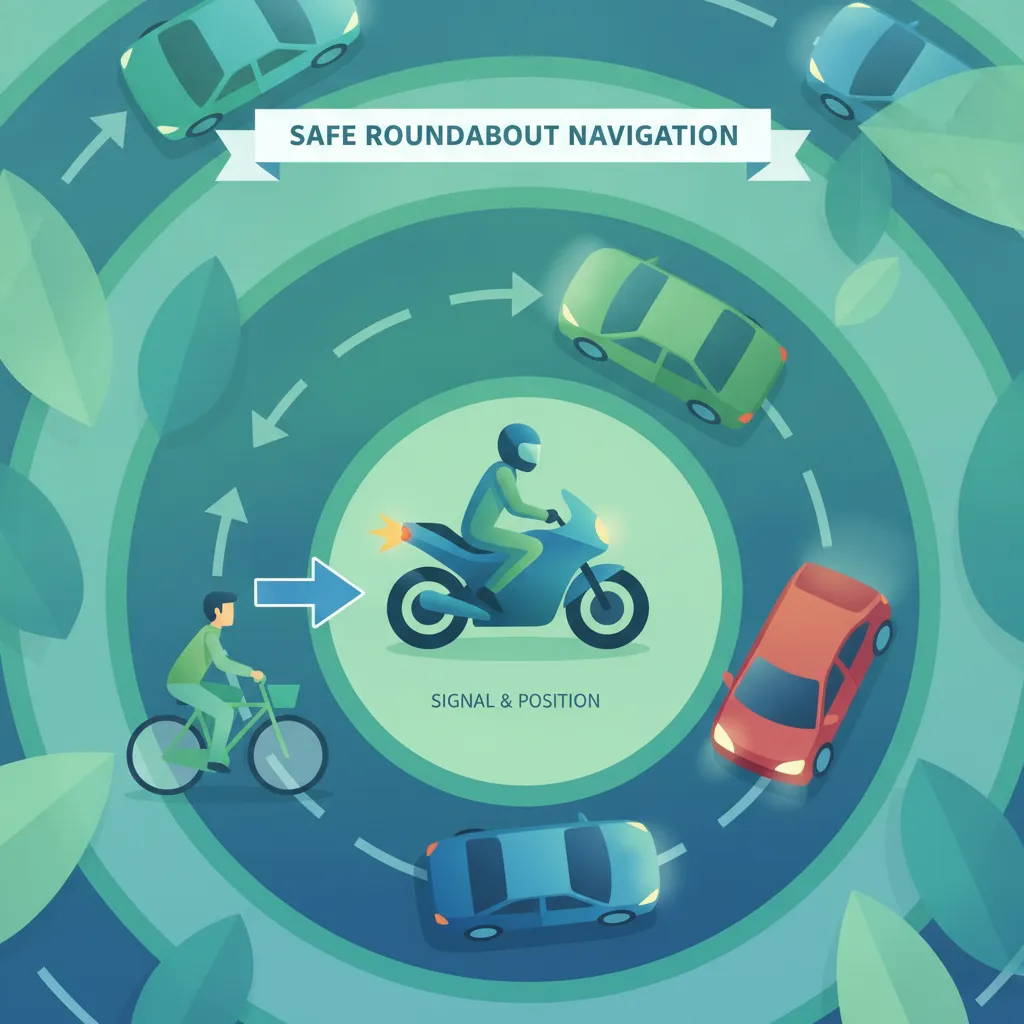
This lesson details the specific skills needed to navigate roundabouts on a motorcycle. It explains how to approach at a safe speed, select the correct lane based on your intended exit, and yield to circulating traffic. Proper use of signals to indicate intentions when entering and exiting is also covered.

This lesson teaches strategic road positioning to enhance safety and visibility. It explains how to select the correct part of the lane in different scenarios, such as approaching intersections or riding in heavy traffic. The goal is to maintain a safe buffer zone and avoid the blind spots of larger vehicles.

This lesson provides a guide to motorway riding, a high-speed and demanding environment. It details the process for using acceleration lanes to merge smoothly, maintaining proper lane discipline, and preparing for exits well in advance. Key safety principles like the two-second rule are reinforced for this context.
Find clear answers to common questions learners have about Understanding Traffic Flow on Bridges and Coastal Roads. Learn how the lesson is structured, which driving theory objectives it supports, and how it fits into the overall learning path of units and curriculum progression in Denmark. These explanations help you understand key concepts, lesson flow, and exam focused study goals.
Bridges are often exposed to higher wind speeds than surrounding terrain. As you move from the shelter of trees or buildings to an open bridge, the sudden impact of crosswinds can push your motorcycle out of your lane if you are not prepared.
Maintain a firm grip on the handlebars without being overly rigid, keep your elbows bent to allow the bike to track naturally, and slightly shift your body weight into the wind. Most importantly, ensure your eyes are focused far down the road rather than on the immediate hazard.
Yes, bridges cool down faster than ground-level roads, meaning they are more prone to ice or frost during colder months. They also accumulate surface water differently, which can reduce your tyre grip significantly.
The theory exam tests your hazard perception. You may encounter questions that present a scenario of a motorcycle on a bridge in windy conditions; knowing to slow down, increase your safety distance, and adjust your lane position is essential for scoring correctly.
Use our powerful search tool to pinpoint specific Danish driving theory topics, road signs, or traffic situations you need to review. Start exploring relevant practice sets now to reinforce your knowledge and build confidence for your upcoming driving licence exam.