
This lesson guides you through the specialized procedures for using ferries with your motorcycle in Denmark. You will learn how to safely navigate loading ramps, secure your bike on slippery decks, and transition back into road traffic after disembarking, ensuring you are prepared for both the theory exam and practical travel.
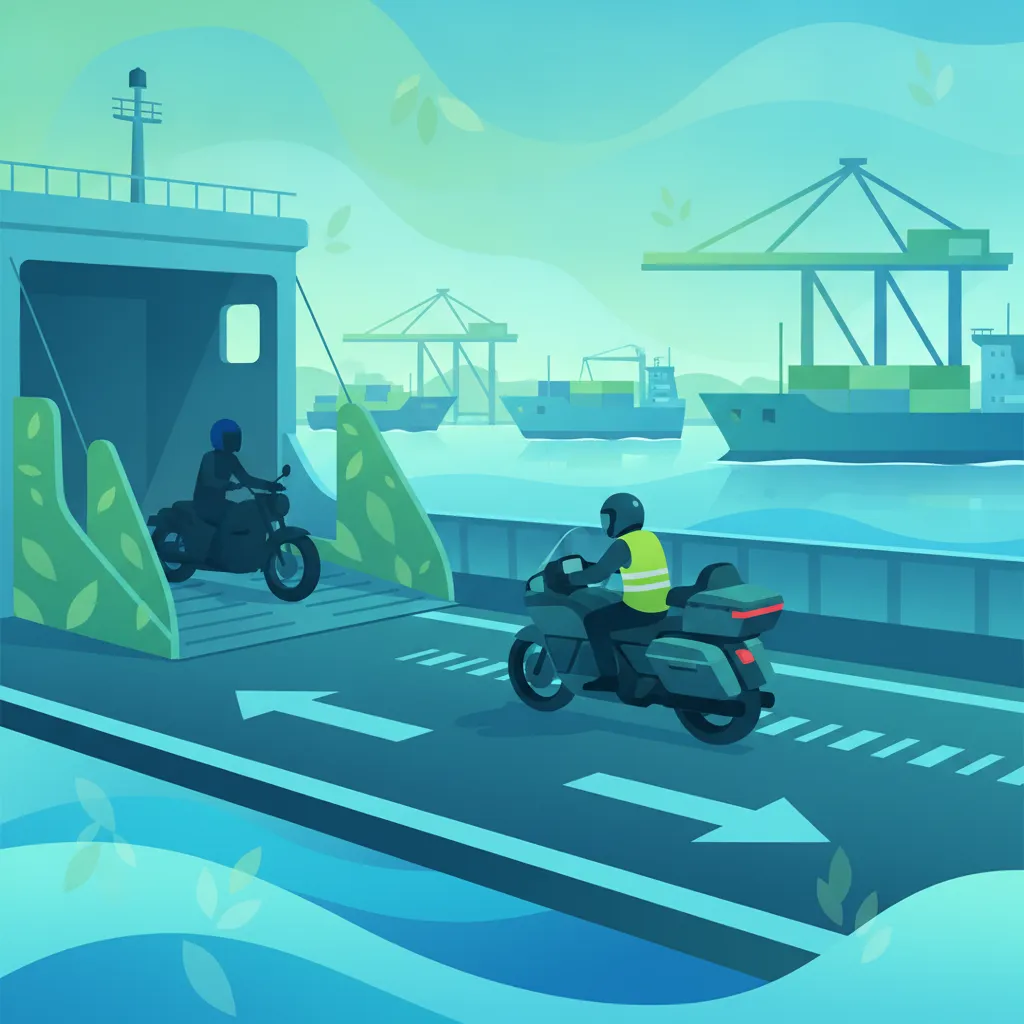
Lesson content overview
Riding a motorcycle in Denmark often involves crossing bodies of water, making ferries a common and integral part of the travel experience. While ferries offer picturesque routes and a chance to rest, they also introduce unique challenges and safety considerations for motorcyclists. This lesson, part of your Danish Motorcycle Theory training, provides comprehensive guidance on safely approaching harbours, boarding and securing your motorcycle on a ferry, navigating the deck, and disembarking back into traffic. Mastering these strategies is crucial for ensuring a smooth and safe journey for both you and your motorcycle.
Ferry travel is unlike riding on any road surface. It introduces distinct environmental factors that demand a different approach to motorcycle handling and situational awareness. The transition from a stable road to a moving, potentially slippery ship deck, combined with confined spaces and the need to secure your vehicle, requires specific skills and adherence to safety protocols. Recognizing these challenges is the first step towards mitigating risks.
Key factors to consider include:
Boarding a ferry involves more than just driving onto a large ship. It requires careful control, attention to crew signals, and awareness of the dynamic environment of a ferry ramp and deck. Proper technique during boarding sets the stage for a safe crossing.
As you approach the ferry terminal, look for signs or crew members directing motorcycles to specific lanes or staging areas. Ferry ramps can vary in steepness and surface material. Always approach slowly, preparing for changes in gradient and traction.
Once on the deck, you'll be directed to a designated parking area for motorcycles. These areas are often along the sides or in specific bays, sometimes close to pillars or bulkheads.
Securing your motorcycle properly is the single most critical step to prevent damage or injury during a ferry crossing. The vessel's motion, even in calm waters, can cause an unsecured bike to tip over, potentially damaging itself or adjacent vehicles.
A ferry is a moving platform, subject to pitching, rolling, and yawing motions. These movements, combined with potential acceleration or deceleration of the vessel, can exert considerable force on an unsecured motorcycle.
Most ferries provide sturdy straps for securing vehicles. It's vital to know how to use them correctly. Crew members are usually available to assist or guide you.
Locate Tie-Down Points: Identify strong, stable points on your motorcycle's frame where straps can be safely attached. Avoid attaching straps to handlebars, mirrors, or other easily bendable components. The triple clamp, lower frame rails, or sturdy engine guards are usually good options.
Position the Straps: Loop the straps around the designated tie-down points. Ensure the straps are not rubbing against any delicate parts, hoses, or wiring.
Attach to Deck Anchor Points: Connect the other end of the straps to the anchor points provided on the ferry deck. These are typically heavy-duty rings or hooks.
Apply Even Tension: Tighten the straps, ideally using at least two straps, one on each side, pulling the motorcycle slightly forward or backward to create a stable tripod with the sidestand. Ensure the tension is even on both sides, and the motorcycle feels firmly anchored. It should have minimal movement when gently pushed.
Compress the Suspension (Slightly): A common technique is to compress the motorcycle's suspension slightly, making it less prone to bouncing with the ferry's motion. Do not overtighten to the point of potentially damaging the suspension.
Check Sidestand/Centerstand: Ensure your sidestand or centerstand is fully deployed and stable. For sidestands, pulling the bike slightly towards the opposite side of the stand can increase stability.
Final Check: Give the motorcycle a final firm shake to ensure it's securely fastened and won't move. Confirm with a crew member if unsure.
Riding on a ferry deck requires a different riding technique than on a paved road. The combination of metallic surfaces, potential wetness, and the inherent motion of the vessel demands heightened caution and very smooth control.
Ferry decks are often made of steel, which, when wet or combined with oil and rubber residue, can become extremely slippery. This significantly reduces tire grip, making sudden movements dangerous.
The ferry's movement can be subtle or pronounced, depending on sea conditions. Anticipating this motion is key to maintaining control.
Disembarking from a ferry and merging back into land traffic is a critical phase that requires vigilance and adherence to traffic rules. The transition from the controlled environment of the ferry to dynamic road traffic demands a sharp return to full road awareness.
Before the ferry docks, mentally prepare for the disembarkation process.
Follow the instructions of the ferry crew precisely. They will guide you on when and how to exit.
Wait for Permission: Do not attempt to exit before the ferry has fully docked and the crew gives the signal to proceed. Rushing off prematurely is dangerous and can lead to collisions.
Slow and Steady Exit: Ride off the ramp at a slow, controlled speed, similar to boarding. Be aware that the ramp might be steep or have changes in surface.
Check Traffic Conditions: As you approach the end of the ramp, shift your focus immediately to the surrounding road traffic. This is a critical moment for re-integrating into the flow of traffic.
Signal Your Intent: Use your turn signals to indicate your intended direction of travel as you merge onto the road.
Yield to Road Traffic: This is a mandatory rule. Vehicles already on the road have the right-of-way. You must yield to them, stopping if necessary, before merging smoothly into a gap. Do not assume other drivers will see you or yield to you.
Accelerate Smoothly: Once you have a safe gap, accelerate smoothly to match the speed of the traffic. Avoid aggressive acceleration, especially if the road surface is still damp or greasy from the harbour environment.
Harbour approaches and terminal areas are often complex environments, characterized by heavy traffic, a mix of vehicle types, pedestrians, and sometimes even heavy machinery. Riding in these areas requires heightened situational awareness and adapted riding strategies.
Harbour areas are often bottlenecks, with vehicles queuing for ferries or dispersing after disembarkation.
Harbours are dynamic zones where different modes of transport interact closely.
Similar to ferry decks, harbour roads can present unique surface challenges.
Adhering to specific rules and regulations ensures safety and legal compliance when using ferries and navigating harbour areas. These regulations are designed to manage the unique risks associated with these environments.
Beyond the basic procedures, a deeper understanding of the underlying principles enhances safety during ferry travel.
Successfully navigating ferries and harbour approaches is a vital skill for motorcyclists in Denmark. It demands a blend of technical riding ability, careful preparation, and acute situational awareness. By meticulously following boarding procedures, securing your motorcycle correctly, adjusting your riding technique for slippery decks, and executing a safe disembarkation, you can ensure a comfortable and safe passage. Always prioritize safety, follow crew instructions, and be extra vigilant when transitioning between land and sea environments.
This lesson covers the specialized procedures Danish motorcyclists must follow when using ferries, from approaching harbour terminals to disembarking into road traffic. Safe boarding requires slow, controlled speed on steep ramps with smooth throttle and clutch use. Once parked on the metal deck, motorcycles must be secured with straps attached to solid frame points, using even tension on both sides. Riders should maintain extremely low speeds on deck and keep a relaxed grip to compensate for vessel motion. Upon disembarking, yielding to road traffic is mandatory—always wait for crew permission before exiting and merge only when a safe gap is available.
A short set of high-value points that capture the most important learning from this lesson.
Motorcycles must always be secured with straps on ferries regardless of sea conditions; sidestands or centerstands alone are never sufficient.
Ride on ferry decks at extremely low speed (walking pace) using smooth, gentle controls to maintain traction on slippery metal surfaces.
When disembarking, you must yield to all road traffic already on the main road—vehicles on the road always have priority.
Ferry decks are low-friction environments where wet metal, oil residue, and vessel motion combine to dramatically reduce tire grip.
Always follow crew instructions precisely and wait for explicit permission before boarding or disembarking from a ferry.
Explore all units and lessons included in this driving theory course.
Strap tie-down points should be solid frame anchors (triple clamp, lower rails, engine guards) — never attach to handlebars, mirrors, or lightweight components.
Keep a loose grip on handlebars while on deck to let the motorcycle move naturally with vessel sway rather than fighting it.
Anticipate longer stopping distances on ferry decks; avoid abrupt braking and sudden throttle inputs that could break traction.
Never exit the ferry before the crew signals permission and the vessel is fully docked.
In harbour areas, watch for pedestrians, mixed vehicle types, uneven surfaces, and slippery residues from heavy vehicle traffic.
Relying solely on the sidestand or centerstand without using securing straps, which fails when the vessel moves.
Riding too fast on the ferry deck, risking loss of traction and a low-speed drop on the metal surface.
Failing to yield to road traffic upon disembarking, assuming other drivers will see and accommodate the motorcycle.
Placing feet down on oily, wet, or greasy deck surfaces while trying to maintain balance during boarding.
Forgetting to switch off the engine before securing the motorcycle, which creates fumes in the enclosed deck space.
Lesson content overview
A short set of high-value points that capture the most important learning from this lesson.
Motorcycles must always be secured with straps on ferries regardless of sea conditions; sidestands or centerstands alone are never sufficient.
Ride on ferry decks at extremely low speed (walking pace) using smooth, gentle controls to maintain traction on slippery metal surfaces.
When disembarking, you must yield to all road traffic already on the main road—vehicles on the road always have priority.
Ferry decks are low-friction environments where wet metal, oil residue, and vessel motion combine to dramatically reduce tire grip.
Always follow crew instructions precisely and wait for explicit permission before boarding or disembarking from a ferry.
Explore all units and lessons included in this driving theory course.
Strap tie-down points should be solid frame anchors (triple clamp, lower rails, engine guards) — never attach to handlebars, mirrors, or lightweight components.
Keep a loose grip on handlebars while on deck to let the motorcycle move naturally with vessel sway rather than fighting it.
Anticipate longer stopping distances on ferry decks; avoid abrupt braking and sudden throttle inputs that could break traction.
Never exit the ferry before the crew signals permission and the vessel is fully docked.
In harbour areas, watch for pedestrians, mixed vehicle types, uneven surfaces, and slippery residues from heavy vehicle traffic.
Relying solely on the sidestand or centerstand without using securing straps, which fails when the vessel moves.
Riding too fast on the ferry deck, risking loss of traction and a low-speed drop on the metal surface.
Failing to yield to road traffic upon disembarking, assuming other drivers will see and accommodate the motorcycle.
Placing feet down on oily, wet, or greasy deck surfaces while trying to maintain balance during boarding.
Forgetting to switch off the engine before securing the motorcycle, which creates fumes in the enclosed deck space.
Explore search topics learners often look for when studying Strategies for Riding on Ferries and Harbour Approaches. These topics reflect common questions about road rules, driving situations, safety guidance, and lesson level theory preparation for learners in Denmark.
Browse additional driving theory lessons that cover connected traffic rules, road signs, and common driving situations related to this topic. Improve your understanding of how different rules interact across everyday traffic scenarios.
Learn essential techniques for riding onto ferries, securing your motorcycle on deck, and safely disembarking into harbour traffic. Covers rules for slippery surfaces and mixed vehicle environments in Denmark.

This lesson outlines a step-by-step procedure for managing a mechanical breakdown on the road. It covers moving the motorcycle to a safe location, using hazard lights, and wearing high-visibility clothing. The goal is to ensure personal safety while minimizing disruption and danger to other traffic.

This lesson details the systematic pre-ride inspection process that all motorcyclists must perform. It covers critical safety checks, including verifying correct tyre pressure, assessing brake pad wear, and ensuring all lights are functional. Regular completion of these checks is essential for preventing mechanical failures and ensuring rider safety.

This lesson details the specific procedures for safely transporting a heavy vehicle via ferry. It covers the process of boarding and maneuvering on the ferry deck, the correct methods for securing the vehicle and trailer for sea transit, and the relevant Danish regulations. The content also explains the safety protocols to follow during the crossing and the correct procedure for disembarking upon arrival.

This lesson addresses how to safely carry luggage or a passenger on a motorcycle. It explains the effects of added weight on the vehicle's balance, steering, and braking performance. Learners will understand correct procedures for securing loads and adjusting their riding technique to maintain control and stability.

This lesson provides a guide to motorway riding, a high-speed and demanding environment. It details the process for using acceleration lanes to merge smoothly, maintaining proper lane discipline, and preparing for exits well in advance. Key safety principles like the two-second rule are reinforced for this context.

This lesson provides a step-by-step guide for managing a vehicle breakdown safely. It instructs the rider on moving the vehicle to a safe location, making it visible to other traffic using hazard lights, and personal safety while waiting for assistance. The importance of staying away from active traffic lanes is a key point.
This lesson details the specific skills needed to navigate roundabouts on a motorcycle. It explains how to approach at a safe speed, select the correct lane based on your intended exit, and yield to circulating traffic. Proper use of signals to indicate intentions when entering and exiting is also covered.

This lesson provides a systematic approach to safely navigating intersections. It covers how to interpret priority signs and traffic signals, establish right-of-way, and scan for potential conflicts from all directions. The importance of clear sightlines and anticipating the movements of other vehicles is a key focus.

This lesson focuses on safe interactions with Denmark's large population of cyclists and other vulnerable road users. It covers the rules for passing cyclists, yielding at pedestrian crossings, and the specific hazard of turning across a bike lane. Developing heightened awareness for these interactions is critical for urban riding.

This lesson explains the physical effects of adding weight to a motorcycle. It covers how passengers or luggage change the center of gravity, affecting steering, stability, and increasing stopping distances. Learners will understand how to adjust suspension and tyre pressure, and adapt their riding inputs accordingly.
Explore the specific risks of ferry travel, including low friction surfaces and vessel motion. Understand Danish regulations for securing motorcycles and navigating congested harbour areas safely.
This lesson details the specific procedures for safely transporting a heavy vehicle via ferry. It covers the process of boarding and maneuvering on the ferry deck, the correct methods for securing the vehicle and trailer for sea transit, and the relevant Danish regulations. The content also explains the safety protocols to follow during the crossing and the correct procedure for disembarking upon arrival.

This lesson addresses the unique driving situations presented by bridges, tunnels, and ferries. It explains the need for speed adjustments, awareness of changing light conditions in tunnels, and following lane controls on long bridges. The material also provides practical guidance for safely boarding and disembarking from a vehicle ferry, including following crew instructions for parking.

This lesson focuses on the safe integration of cyclists and pedestrians within the traffic system, a key feature of Danish roads. It covers the specific rights and common behaviors of cyclists, including those on e-bikes and cargo bikes, and explains procedures for yielding to pedestrians. The content emphasizes maintaining safe distances and heightened awareness to prevent accidents and promote harmonious road sharing.

This lesson provides detailed guidance on navigating pedestrian crossings (fodgængerfelter) and areas with high cyclist traffic. It clarifies your legal obligation to stop for pedestrians at zebra crossings and the proper speed to approach these zones. A central theme is understanding the rights of vulnerable road users and how to yield safely to them in accordance with Danish traffic law.
This lesson identifies common high-risk behaviors, including riding while impaired by alcohol, drugs, or fatigue. It details the strict legal limits in Denmark and the severe penalties for violations. The dangers of distraction, particularly from mobile phones, are also explained as a significant cause of accidents.
This lesson provides guidance for navigating special infrastructure like long bridges, tunnels, and ferries. It covers awareness of height and weight restrictions, managing the effects of strong crosswinds on bridges, and adapting to lighting changes in tunnels. The content also details the procedures for boarding ferries and correctly securing the vehicle for transit.
This lesson focuses on identifying and mitigating common hazards in built-up areas. It covers the risks associated with pedestrians emerging from behind buses or parked cars, and the danger of suddenly opening car doors. Learners will understand the importance of reducing speed and increasing observation in these high-risk environments.

This lesson addresses the critical skill of safely coexisting with cyclists and cargo bikes, which are prevalent in Denmark. It explains how to maintain a safe distance, overtake properly, and be vigilant for cyclists, especially when turning right. Understanding the infrastructure of cycle lanes and predicting cyclist behavior is a key focus.

This lesson explains the procedures for safely riding through construction zones. It covers how to respond to temporary signage, lane closures, and flaggers directing traffic. Riders will learn to reduce speed and be vigilant for uneven pavement, loose gravel, and the movement of workers and equipment.

This lesson provides practical guidance for navigating the challenges of urban deliveries. It details Danish regulations for using loading zones, including time restrictions and parking rules, and offers strategies for effective route planning in dense traffic. The content emphasizes awareness of pedestrian-heavy areas and the importance of maneuvering with caution to ensure public safety during delivery operations.
Find clear answers to common questions learners have about Strategies for Riding on Ferries and Harbour Approaches. Learn how the lesson is structured, which driving theory objectives it supports, and how it fits into the overall learning path of units and curriculum progression in Denmark. These explanations help you understand key concepts, lesson flow, and exam focused study goals.
Ferries are an integral part of Denmark's infrastructure. The theory test includes questions on situational awareness and vehicle safety in various environments, including maritime transport, to ensure you can handle your bike safely in all conditions.
The primary risk is the deck surface, which can be extremely slippery, especially when wet or contaminated with oil. You must maintain a steady, slow speed and avoid sudden braking or steering while on the ramp or deck.
Yes, as the rider, you are responsible for ensuring your motorcycle is correctly positioned and secured with straps provided by the ferry operators. Always follow the crew's directions for the best location to park.
Ensure your helmet is on and secured before moving. Treat the exit ramp like an intersection, use your indicators, and scan for pedestrians and other vehicles, as harbour areas are often high-density, low-visibility zones.
Use our powerful search tool to pinpoint specific Danish driving theory topics, road signs, or traffic situations you need to review. Start exploring relevant practice sets now to reinforce your knowledge and build confidence for your upcoming driving licence exam.