
This lesson guides you through the essential process of planning routes for heavy vehicles, ensuring your vehicle's dimensions and mass remain within legal limits. You will learn to identify critical restrictions such as bridge heights, weight-limited roads, and tunnels to ensure a safe and compliant journey in accordance with German traffic regulations.
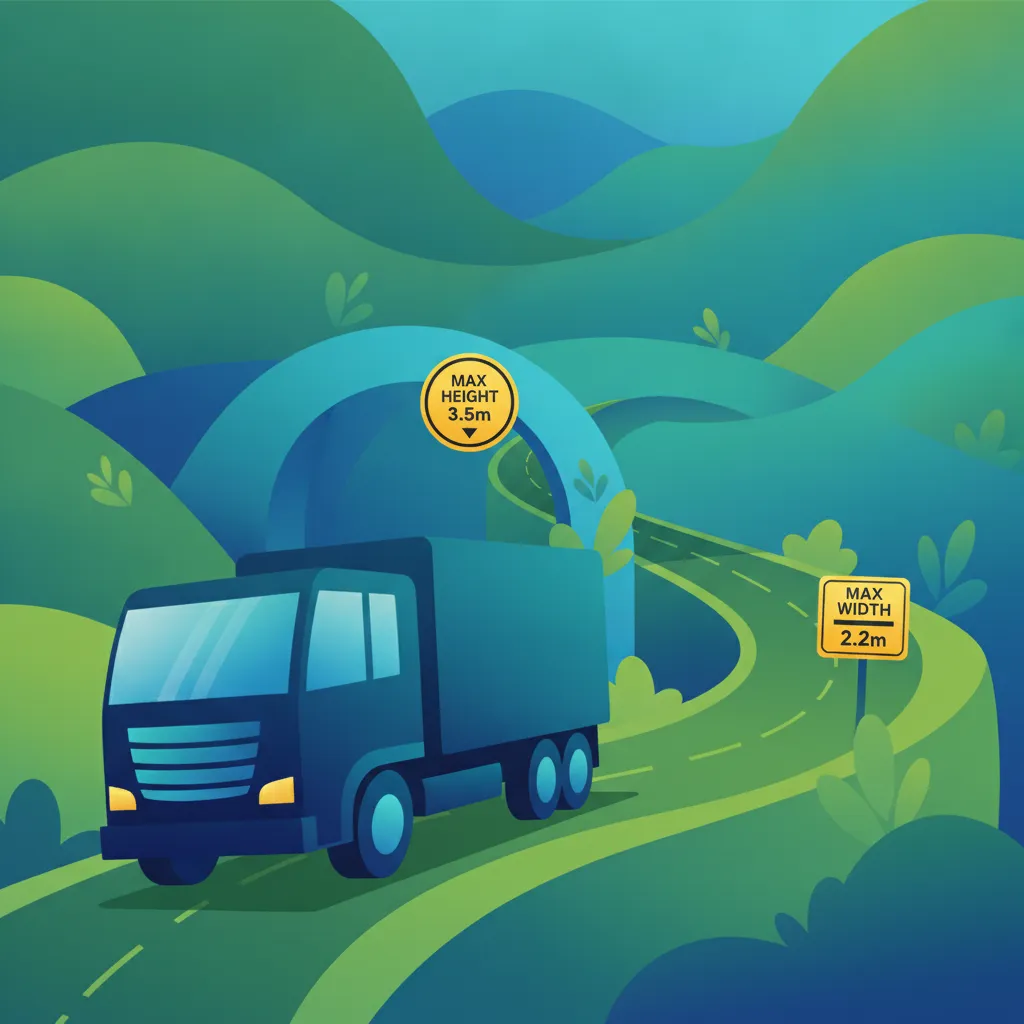
Lesson content overview
Effective and safe operation of heavy vehicles within Germany, particularly for those holding a German Heavy Vehicle Driving License in categories C1, C1E, C, and CE, demands meticulous route planning. This lesson delves into the critical aspects of preparing your journey, with a particular focus on navigating the various height, width, and weight restrictions imposed by road infrastructure and legal regulations. Ignoring these crucial parameters can lead to severe consequences, including vehicle damage, infrastructure harm, accidents, and substantial legal penalties.
This comprehensive guide will equip you with the knowledge to identify and respond to dimensional and weight constraints, utilize specialized planning tools, and interpret critical road signage to ensure legal compliance and the safety of all road users.
Thorough route planning is not merely a recommendation for heavy vehicle drivers; it is a fundamental pillar of professional and responsible operation. Unlike passenger cars, heavy goods vehicles (HGVs) have significant dimensions and mass that severely limit the roads they can safely and legally use. A route that appears straightforward on a standard map might contain numerous impassable obstacles for a truck, such as low bridges, narrow tunnels, or roads with strict weight limits.
The goal of pre-trip planning is to proactively identify and avoid these restrictions. This foresight protects your vehicle from damage, prevents costly delays, ensures compliance with German traffic laws (StVO), and most importantly, safeguards lives by preventing structural damage to roads and bridges or hazardous situations on narrow paths.
Driving a heavy vehicle necessitates a deep understanding of the physical constraints it imposes on its environment. These constraints are primarily categorized into height, width, and weight, each with distinct implications for route selection and safety.
Height restrictions define the maximum allowable vertical clearance for a vehicle to safely pass under overhead structures. These structures commonly include bridges, tunnels, underpasses, and even utility lines or overhanging tree limbs.
The practical meaning of a height restriction is that if your vehicle, including its load, exceeds the posted limit, you absolutely cannot proceed. Attempting to do so will inevitably lead to a collision, resulting in severe damage to your vehicle, the infrastructure, and potentially causing injuries or fatalities. Drivers must account for the actual loaded height of their vehicle, which can sometimes differ from the empty height due to suspension compression or load placement.
Always consider the highest point of your vehicle, including any load, tarpaulins, or attached equipment. Even seemingly minor miscalculations can have catastrophic consequences.
Width restrictions specify the maximum lateral width a vehicle can occupy for safe navigation through roadways. These are critical in areas where lanes are narrow, or where roadside obstacles, such as barriers, walls, or even other parked vehicles, reduce the available clear space.
Road sections with width limitations often include single-lane roads, particularly in rural or historic areas, construction zones with reduced lane widths, or city streets with narrow entry points. A heavy vehicle that is too wide risks colliding with stationary objects, encroaching into opposing traffic lanes, or damaging its side mirrors and bodywork. This can also pose a significant danger to vulnerable road users, such as pedestrians or cyclists, by leaving insufficient safety margins.
When planning a route, always consider the maximum width of your vehicle, including extended mirrors, and allow for an adequate safety margin, especially when passing or maneuvering.
Weight limits restrict the total mass of a vehicle, individual axle loads, or the weight per unit length that is permitted on specific roads or structures. These regulations are paramount for protecting road surfaces, bridges, tunnels, and other infrastructure from excessive wear and structural damage.
The practical meaning is that an overloaded vehicle, or one with poorly distributed weight causing excessive axle loads, can compromise the structural integrity of a bridge or road surface, leading to collapse or rapid deterioration. Furthermore, exceeding weight limits significantly impairs a vehicle's handling, braking efficiency, and stability, increasing the risk of accidents. German regulations (StVO) strictly enforce these limits to ensure both infrastructure longevity and road safety.
The total weight exerted by all wheels connected to a single axle or group of axles onto the road surface. This is a critical factor for bridge and road surface preservation.
Modern drivers have access to a variety of tools and resources that are indispensable for effective route planning. Relying solely on a generic car GPS system is a common misconception and a dangerous practice for heavy vehicle operators.
For heavy vehicles, generic GPS applications are often insufficient as they do not factor in critical vehicle parameters like height, width, and weight. Specialized digital navigation systems and apps designed for trucks are crucial. These systems allow drivers to input their specific vehicle dimensions and weight, including the load, enabling them to generate routes that automatically avoid known restrictions.
Many modern truck navigation systems also provide real-time traffic updates and temporary roadwork information, which can include temporary height or weight restrictions not yet reflected on permanent signage. Always ensure your mapping data is up to date.
While digital tools are powerful, traditional paper maps and truck atlases remain valuable resources, especially in areas with poor satellite reception or for cross-referencing. Dedicated truck atlases often highlight specific restrictions, such as low bridges or roads unsuitable for heavy vehicles, providing a broader overview that digital tools might sometimes simplify too much. They can serve as an excellent backup and a tool for initial strategic route planning.
Official sources from German transportation authorities (e.g., Bundesanstalt für Straßenwesen - BASt, or regional traffic departments) are the most authoritative for detailed and up-to-date information on road restrictions. These resources may include online portals, downloadable maps, or specific advisories regarding oversized loads or temporary construction-related closures and limitations. Always verify critical parts of your route, especially for unusually large or heavy loads, using these official channels.
Before embarking on a long journey, especially to unfamiliar regions, always cross-reference your planned route with at least two different sources, prioritizing specialized truck navigation and official government advisories.
Road signs are the primary means by which authorities communicate restrictions to drivers. Correctly interpreting these signs is a fundamental skill for every heavy vehicle operator. In Germany, standard signs governed by the Straßenverkehrs-Ordnung (StVO) are used to indicate height, width, and weight limits.
This sign indicates the maximum permissible height (including load) for vehicles to pass under an overhead structure or into a specific area. The value shown on the sign, typically in meters, is the absolute maximum. For example, a sign showing "4.0 m" means no vehicle taller than 4.0 meters can pass. Drivers must always compare this value with their vehicle's actual height.
This sign indicates the maximum permissible width (including load) for vehicles to use a particular road section. The value is usually shown in meters. For example, a sign displaying "2.0 m" means vehicles wider than 2.0 meters are not permitted. This is particularly common on narrow streets, old city centers, or mountain passes. Always factor in your vehicle's widest point, including mirrors.
This circular sign, often displaying a weight in tonnes, restricts vehicles whose actual total mass (vehicle + load) exceeds the indicated limit. This is crucial for bridges, parking garages, or roads with vulnerable subsurfaces.
This sign indicates the maximum permissible axle load, typically displayed in tonnes, for individual axles or axle groups. Even if your total vehicle weight is within limits, improper load distribution could lead to an axle exceeding this limit. This sign is common on roads or bridges sensitive to concentrated weight.
Always obey temporary restriction signs. These are often erected due to ongoing construction, road damage, or special events, and ignoring them can lead to immediate danger.
Adherence to dimensional and weight regulations is not merely a matter of safety but also a strict legal requirement under German law, primarily outlined in the Straßenverkehrs-Ordnung (StVO - Road Traffic Regulations). Violations can result in significant fines, penalty points, and even a temporary suspension of driving privileges or confiscation of the vehicle until compliance is achieved.
The StVO specifies that drivers must not proceed if their vehicle's height, including its load, exceeds the posted limit. This applies to all passages under bridges, tunnels, and other overhead structures. The rationale is to prevent collisions that can cause severe structural damage to infrastructure and endanger lives.
Vehicles exceeding an indicated width are prohibited from using the specified road section. This is especially relevant in constrained environments where lane widths or overall road width might be insufficient for safe passage. Compliance is mandatory to prevent collisions with other vehicles, roadside objects, or infrastructure.
Drivers must ensure their vehicle's total mass (including load) does not exceed the posted weight limit for roads, bridges, and other sections with weight limitations. This regulation is critical for preserving road infrastructure and maintaining safe vehicle handling characteristics.
Beyond total weight, individual axle loads must not exceed the limits posted on specific road sections. This prevents excessive wear and tear or structural failure, particularly on sensitive bridge decks or older road surfaces. Proper load distribution across all axles is therefore not just a best practice but a legal necessity.
Even experienced drivers can fall victim to common misunderstandings or challenging situations related to dimensional and weight restrictions. Awareness of these can help prevent costly mistakes.
External conditions and the state of your vehicle can introduce additional complexities to route planning and adherence to restrictions.
Heavy rain, snow, or fog can significantly reduce visibility, making it difficult to spot crucial restriction signs, especially temporary ones. In such conditions, relying on a thoroughly pre-planned route becomes even more critical. Snow accumulation on roads or bridges can also subtly reduce effective clearance or add unforeseen weight.
Driving at night or in low light conditions can also impair visibility of road signs. Illuminated signs are common, but non-illuminated temporary signs may be harder to see. Again, pre-planning is the best defense against missing vital information.
Rural roads, often older and less maintained, may have tighter corners, narrower lanes, and lower bridge clearances than modern autobahns or Kraftfahrstraßen. Urban routes, especially in historic city centers, frequently impose strict width and weight limits due to older infrastructure and high pedestrian traffic.
The way a vehicle is loaded fundamentally affects its dimensions and weight. An unevenly distributed load can lead to an axle exceeding its limit, even if the total weight is acceptable. Certain types of cargo, like those requiring specialized transport frames, can also significantly alter the vehicle's height or width. Always re-evaluate your vehicle's parameters after any changes to its load.
The stringent regulations surrounding heavy vehicle dimensions and weight are rooted in fundamental safety and engineering principles:
Mastering route planning for heavy vehicles is an indispensable skill for professional drivers in Germany. It requires a comprehensive understanding of your vehicle's dimensions and weight, diligent use of specialized navigation tools, accurate interpretation of road signage, and a thorough knowledge of German traffic regulations. By proactively identifying and accounting for height, width, and weight restrictions, you not only ensure legal compliance but also safeguard your vehicle, protect vital infrastructure, and contribute significantly to overall road safety for yourself and others. Always plan ahead, stay informed, and drive responsibly.
This lesson covers the essential skills for planning routes for heavy goods vehicles in Germany, focusing on height, width, weight, and axle load restrictions defined by the Straßenverkehrs-Ordnung (StVO). Drivers must use specialized truck navigation systems rather than standard GPS, interpret key restriction signs accurately, and cross-reference official sources to ensure routes avoid low bridges, weight-limited roads, and narrow passages. The content emphasizes that professional drivers bear legal responsibility for compliance, and violations can result in fines, penalties, and vehicle confiscation. Understanding how vehicle characteristics change dynamically with load and conditions is critical for safe and legal heavy vehicle operation.
A short set of high-value points that capture the most important learning from this lesson.
Heavy vehicle route planning must account for height, width, weight, and axle load restrictions to ensure legal compliance and prevent infrastructure damage
Road sign 265 indicates height limits, 263 for width limits, 262 for total mass limits, and 266 for axle load limits under StVO
Standard car GPS systems are inadequate; truck-specific navigation that accepts vehicle dimensions is essential
Always cross-reference planned routes using at least two sources, prioritizing official transport authority resources
Vehicle dimensions and weight are dynamic and can change based on load distribution, suspension settings, and road gradients
Explore all units and lessons included in this driving theory course.
The posted value on any restriction sign is an absolute maximum that cannot be exceeded under any circumstances
Axle load limits apply to individual axles or groups of axles, not just total vehicle mass
Temporary restriction signs carry the same legal force as permanent ones and must always be obeyed
Official German sources from BASt and regional traffic departments provide the most authoritative and up-to-date restriction information
Total vehicle mass includes the vehicle itself plus all load, fuel, and equipment
Relying on generic car GPS without entering heavy vehicle parameters, leading to routes containing impassable obstacles
Assuming a bridge clearance is uniform throughout a journey when heights can vary significantly between structures
Failing to account for the width of extended mirrors when checking width restriction signs
Neglecting to recalculate vehicle dimensions and weight after loading or unloading cargo
Assuming that if total weight is within limits, axle load limits are also satisfied without checking distribution
Lesson content overview
A short set of high-value points that capture the most important learning from this lesson.
Heavy vehicle route planning must account for height, width, weight, and axle load restrictions to ensure legal compliance and prevent infrastructure damage
Road sign 265 indicates height limits, 263 for width limits, 262 for total mass limits, and 266 for axle load limits under StVO
Standard car GPS systems are inadequate; truck-specific navigation that accepts vehicle dimensions is essential
Always cross-reference planned routes using at least two sources, prioritizing official transport authority resources
Vehicle dimensions and weight are dynamic and can change based on load distribution, suspension settings, and road gradients
Explore all units and lessons included in this driving theory course.
The posted value on any restriction sign is an absolute maximum that cannot be exceeded under any circumstances
Axle load limits apply to individual axles or groups of axles, not just total vehicle mass
Temporary restriction signs carry the same legal force as permanent ones and must always be obeyed
Official German sources from BASt and regional traffic departments provide the most authoritative and up-to-date restriction information
Total vehicle mass includes the vehicle itself plus all load, fuel, and equipment
Relying on generic car GPS without entering heavy vehicle parameters, leading to routes containing impassable obstacles
Assuming a bridge clearance is uniform throughout a journey when heights can vary significantly between structures
Failing to account for the width of extended mirrors when checking width restriction signs
Neglecting to recalculate vehicle dimensions and weight after loading or unloading cargo
Assuming that if total weight is within limits, axle load limits are also satisfied without checking distribution
Explore search topics learners often look for when studying Route Planning Considering Height, Width, and Weight Limits. These topics reflect common questions about road rules, driving situations, safety guidance, and lesson level theory preparation for learners in Germany.
Browse additional driving theory lessons that cover connected traffic rules, road signs, and common driving situations related to this topic. Improve your understanding of how different rules interact across everyday traffic scenarios.
Explore specific challenges in route planning for heavy vehicles on German autobahns and through tunnels. Learn about managing height, width, and weight limits in these critical infrastructure environments to ensure safe and legal transit, covering essential StVO regulations.
This lesson explains the specific regulations for operating heavy vehicles on Autobahnen, including speed limits, lane discipline, and overtaking rules. It discusses the use of dedicated truck lanes and the importance of maintaining appropriate following distances. The content also covers procedures for merging and exiting high-speed roads safely.

This lesson provides instruction on the rules and best practices for operating a large passenger vehicle on the Autobahn. It covers the principles of strict lane discipline, regulations for minimum speed, and correct procedures for overtaking and merging. The importance of maintaining significantly increased following distances at high speeds and planning for exits well in advance is a key focus.
This lesson details the specific regulations and safety considerations for driving in tunnels. It explains the importance of using headlights, adhering to lower speed limits, and maintaining a steady pace to ensure smooth traffic flow. Learners will also be taught how to interpret tunnel-specific signage and the correct procedures to follow in case of a breakdown or fire, including locating emergency exits and breakdown bays.

This lesson provides a complete guide to driving on the German Autobahn. It covers the correct procedure for entering and exiting via acceleration and deceleration lanes, the strict lane discipline rule of keeping right ('Rechtsfahrgebot'), and the principle of overtaking only on the left. It also explains the recommended speed limit and the critical procedure for forming an emergency corridor ('Rettungsgasse') in a traffic jam.

This lesson covers the specific rules and safety precautions for driving through tunnels. This includes turning on dipped headlights, maintaining a safe distance, and knowing the location and use of emergency exits and equipment. It also addresses the potential hazards on bridges, such as increased risk of ice in winter and susceptibility to strong crosswinds.

This lesson covers the dimensional limits for heavy vehicles, focusing on height, width, and length restrictions. It explains how to interpret clearance signage for bridges, tunnels, and overhead obstacles, and discusses the implications for route planning. The content also addresses the importance of understanding turning radii and swept paths to avoid collisions.

This lesson focuses on the safe passage of heavy vehicles through tunnels and over bridges, with an emphasis on clearance checks. It explains how to interpret height restriction signs and assess whether the vehicle's load complies with limits. The content also covers appropriate speed control and emergency procedures specific to these structures.
This lesson covers the principles of effective route planning and the practical skills for navigating different types of junctions. It provides guidance on using navigation aids and understanding the specific challenges large vehicles face at roundabouts and complex intersections. Emphasis is placed on correct lane selection and positioning well in advance of a turn to execute the maneuver safely and without impeding other traffic.

This lesson examines the specific height, width, and length constraints that affect heavy vehicle operation, including bridge and tunnel clearances. It discusses how to interpret and comply with traffic signs indicating dimensional limits and the consequences of violating these restrictions. The content also covers practical strategies for route planning to avoid restricted areas.
Understand the process of identifying and utilizing alternative routes when primary paths have height, width, or weight restrictions. This lesson covers practical aspects of re-routing for heavy goods vehicles according to German driving theory and StVO guidelines.
This lesson covers the dimensional limits for heavy vehicles, focusing on height, width, and length restrictions. It explains how to interpret clearance signage for bridges, tunnels, and overhead obstacles, and discusses the implications for route planning. The content also addresses the importance of understanding turning radii and swept paths to avoid collisions.
This lesson explains the specific regulations for operating heavy vehicles on Autobahnen, including speed limits, lane discipline, and overtaking rules. It discusses the use of dedicated truck lanes and the importance of maintaining appropriate following distances. The content also covers procedures for merging and exiting high-speed roads safely.
This lesson addresses the concept of environmental zones in German cities, explaining the requirements for emission stickers and the impact on heavy vehicles. It discusses the legal consequences of non-compliance, such as fines, and the importance of ensuring the vehicle meets emission standards. The content covers planning routes to avoid restricted zones if necessary.
This lesson examines the specific height, width, and length constraints that affect heavy vehicle operation, including bridge and tunnel clearances. It discusses how to interpret and comply with traffic signs indicating dimensional limits and the consequences of violating these restrictions. The content also covers practical strategies for route planning to avoid restricted areas.

This lesson focuses on the right-of-way rules that heavy vehicles must follow when interacting with cyclists and pedestrians, particularly at intersections and crossings. It emphasizes the need for trucks to yield appropriately and maintain safe distances. The content also covers the interpretation of traffic signs governing priority in urban areas.

This lesson outlines the legal requirements for vehicle roadworthiness, including mandatory periodic inspections (TÜV) and the issuance of safety certificates. It explains the standards for emissions, safety devices, and the proper documentation of defects. The content underscores the importance of complying with inspection intervals and addressing repair obligations promptly.

This lesson explores the legal framework governing heavy vehicle operation in Germany, focusing on the Straßenverkehrs-Ordnung (StVO) and specific commercial transport regulations. It details the professional duty of care required from drivers, including responsibilities for vehicle inspection and documentation. You will understand the enforcement mechanisms and potential penalties for non-compliance.
This lesson focuses on the safe passage of heavy vehicles through tunnels and over bridges, with an emphasis on clearance checks. It explains how to interpret height restriction signs and assess whether the vehicle's load complies with limits. The content also covers appropriate speed control and emergency procedures specific to these structures.

This lesson focuses on the unique challenges and safety protocols required when operating alongside trams and light rail systems. It clarifies the strict right-of-way rules that typically favor trams and explains how to safely navigate shared roadways and cross tracks. Learners will be taught to recognize specific signals and markings related to tramways to prevent conflicts and ensure the safety of all road users.
This lesson covers safe interaction with special vehicles. It details the challenges of driving near large trucks (LKW), including their extensive blind spots, longer stopping distances, and the effects of wind turbulence when overtaking them. A critical part of the lesson is explaining the correct procedure for reacting to emergency vehicles by creating an emergency corridor ('Rettungsgasse') on multi-lane roads.
Find clear answers to common questions learners have about Route Planning Considering Height, Width, and Weight Limits. Learn how the lesson is structured, which driving theory objectives it supports, and how it fits into the overall learning path of units and curriculum progression in Germany. These explanations help you understand key concepts, lesson flow, and exam focused study goals.
Heavy vehicles have significantly larger dimensions and masses. A height or weight restriction that a car can ignore could lead to a collision with a bridge or structural damage to road infrastructure if hit by a truck.
Look for specific traffic signs regarding actual mass, axle load, and height. The exam will often present scenarios where you must choose the correct route based on the vehicle's provided dimensions and the restrictions shown on road signs.
No, professional drivers must always prioritize physical road signs over satellite navigation. GPS data may be outdated or incorrect for heavy vehicle specifications, so your primary responsibility is to observe and react to official signage.
Ignoring weight restrictions is a violation of traffic law and can lead to heavy fines, points on your license, and increased safety risks such as road surface failure or inability to navigate upcoming hazards.
Begin your targeted revision now. Use our practice search to quickly find specific German driving theory questions. Filter by StVO rules, road signs, or hazard perception to create your focused study plan. Master challenging areas and prepare confidently for your theoretical driving test.