
This lesson covers the critical rules for operating large passenger vehicles on the Autobahn. You will learn essential techniques for lane discipline, safe overtaking, and managing following distances to ensure passenger comfort and road safety in your D1, D, or DE category vehicle.

Lesson content overview
Operating large passenger vehicles, such as buses and coaches, on Germany's Autobahn system demands a specialized understanding of traffic regulations, vehicle dynamics, and advanced driving techniques. This lesson is tailored for aspiring professional drivers pursuing German licence categories D1, D1E, D, and DE, providing comprehensive instruction on safe and efficient Autobahn navigation. It emphasizes strict adherence to lane discipline, minimum speed requirements, extended following distances, and meticulous planning for merging and exiting.
The Autobahn, Germany's renowned high-speed motorway network, presents unique challenges and requirements for all drivers, especially those at the helm of large passenger vehicles. The inherent higher speeds, coupled with the significant dimensions and mass of buses and coaches, amplify the importance of precise control, acute awareness, and strict adherence to specific rules. This lesson builds upon foundational knowledge of vehicle control, speed management, braking, and following distances, tailoring these concepts to the demanding environment of Autobahn driving. Mastering these principles is crucial for ensuring the safety and comfort of passengers, maintaining smooth traffic flow, and fulfilling the professional responsibilities associated with passenger transport.
Safety and efficiency on the Autobahn for passenger vehicles are founded on several core principles that guide driver behavior and decision-making. These principles are designed to mitigate risks associated with high-speed traffic, larger vehicle sizes, and the need for predictable driving patterns. Adherence to these guidelines ensures not only the safety of your passengers but also contributes to the overall safety of all road users.
Strict lane discipline is fundamental for safe and predictable driving on the Autobahn, particularly for large passenger vehicles. It means maintaining a consistent position within a designated lane and avoiding erratic or unnecessary lane changes. For professional drivers of buses and coaches, the general rule is to remain in the right-hand lane whenever possible.
You should only move into a left-hand lane to overtake a slower vehicle or when preparing to exit the Autobahn from a left-hand exit, which is rare. Failing to adhere to this principle, such as continually switching lanes or remaining in a left lane without actively overtaking, disrupts traffic flow and significantly increases the risk of collisions. Such actions are not only dangerous but also constitute a traffic offense. Maintaining lane discipline ensures that other drivers can anticipate your movements and helps to keep the high-speed traffic environment as predictable as possible.
While the Autobahn is famous for its lack of a general speed limit for cars, specific regulations apply to professional passenger vehicles, and minimum speed requirements are crucial for all traffic. A key rule is that only vehicles capable of achieving a speed of at least 60 km/h are permitted to use the Autobahn. Furthermore, certain sections of the Autobahn may have explicitly posted minimum speed limits.
When a minimum speed sign is displayed, drivers of passenger vehicles must ensure they maintain at least that speed, provided road, traffic, and weather conditions permit. The purpose of these regulations is to prevent vehicles from unduly impeding the flow of traffic, which can create dangerous speed differentials. Driving significantly below the minimum speed without a valid reason, such as heavy traffic or adverse weather, is considered a violation and can lead to fines. Professional drivers must consistently assess conditions and adjust their speed to comply with these regulations while always prioritizing safety.
Maintaining an adequate following distance is one of the most critical safety measures on the Autobahn, especially when operating a large passenger vehicle. Due to their significant weight and length, buses and coaches require considerably longer braking distances compared to smaller vehicles, particularly at the high speeds typical of the Autobahn. A safe following distance allows you sufficient time to react to sudden braking by the vehicle ahead and provides enough space for your vehicle to come to a complete stop without collision.
The general recommendation for a safe following distance is to maintain at least a "3-second gap" with the vehicle in front, under ideal conditions. To estimate this, pick a fixed point on the road (like a bridge or sign), and once the vehicle ahead passes it, count "one thousand one, one thousand two, one thousand three." If your vehicle reaches the same point before you finish counting, you are too close. This gap should be increased even further in adverse weather conditions, with heavier loads, or when visibility is reduced.
Successfully exiting the Autobahn with a large passenger vehicle requires careful foresight and advanced planning. Abrupt lane changes or sudden braking near an exit can be hazardous, disrupting the flow of traffic and potentially causing rear-end collisions, particularly with the extended stopping distances of buses. Therefore, professional drivers must begin preparing for their exit well in advance.
This means identifying your exit well before you reach it, often by paying attention to signage indicating distances to upcoming exits (e.g., Ausfahrt signs). You should aim to initiate any necessary lane changes to move into the rightmost lane at least 500 meters to 1.5 kilometers before the actual exit ramp. This allows ample time to smoothly reduce your speed and position your vehicle correctly without creating a hazard for other road users. Delaying this process can lead to last-minute, dangerous maneuvers.
Overtaking on the Autobahn, especially with a bus or coach, must be a controlled, decisive, and safe maneuver. Given the larger dimensions and slower acceleration of passenger vehicles compared to cars, overtaking takes more time and covers a greater distance. It is imperative to assess the situation thoroughly before initiating an overtake.
Assess the Situation: Ensure there is sufficient visibility ahead and behind. Check mirrors thoroughly and be aware of the speed and intentions of vehicles in the adjacent lanes. Confirm you have enough power to complete the maneuver promptly.
Signal Clearly: Activate your left turn signal well in advance to indicate your intention to change lanes.
Execute Decisively: Change lanes smoothly and accelerate to safely pass the slower vehicle. Do not linger in the left lane.
Maintain Distance: Ensure you leave sufficient space before returning to the right lane, checking your right mirror to confirm you can see the overtaken vehicle clearly.
Return to Right Lane: Signal right and smoothly move back into the rightmost lane once it is safe to do so.
Never overtake if it means exceeding the speed limit for your vehicle type or if there isn't enough space to complete the maneuver safely and return to the right lane without impeding faster traffic. Avoid undertaking (passing on the right) unless explicitly allowed by traffic conditions (e.g., in very dense, slow-moving traffic where lanes are clearly designated and moving at different speeds, though caution is always advised).
Professional drivers of passenger vehicles must be acutely aware of specific regulations governing their operations on the German Autobahn. While general traffic laws apply to all, additional rules often pertain to vehicle dimensions, speed limits, and specific operational requirements for transporting passengers.
A fundamental rule for all vehicles on the Autobahn is that they must be constructed to reach a minimum speed of 60 km/h. While there is no general speed limit for passenger cars in Germany, buses and coaches are subject to strict speed limits, typically 80 km/h, though certain modern coaches meeting specific safety standards may be allowed to travel at 100 km/h on the Autobahn (indicated by a '100' sticker on the rear). Regardless of the maximum allowed speed, drivers must always prioritize safety and adjust speed according to prevailing conditions, never driving faster than is safe and responsible. Failure to comply with posted minimum speeds or vehicle-specific maximum speeds can result in significant fines and points on a driver's licence.
Even experienced drivers can fall into common traps on the Autobahn, but for professional passenger vehicle drivers, such errors carry higher risks and responsibilities. Recognizing and actively avoiding these mistakes is vital for safety and professional conduct.
Autobahn driving strategies must be dynamically adjusted to account for varying weather and road conditions. While minimum speed limits are generally mandatory, safety always takes precedence. Professional drivers must exercise sound judgment and adapt their driving to ensure passenger safety and vehicle stability.
In adverse weather conditions (rain, fog, ice, snow), the absolute priority is safety. Posted minimum speeds or maximum speed limits for your vehicle type become secondary to the need for a safe, controlled speed. Always drive at a speed appropriate for the prevailing conditions.
The overarching philosophy for safe Autobahn driving, particularly for professional passenger vehicle operators, revolves around predictability and creating sufficient reaction time. At high speeds, every action a driver takes has amplified consequences. Sudden braking, abrupt lane changes, or unpredictable speed variations can trigger chain reactions that are difficult to control, especially for following vehicles which may also be large and heavy.
By strictly adhering to lane discipline, maintaining generous following distances, planning maneuvers well in advance, and driving at an appropriate and consistent speed, you contribute to a predictable traffic environment. This predictability allows other drivers to anticipate your movements, reducing stress and significantly lowering the risk of incidents. Ultimately, the safety of your passengers, your vehicle, and other road users hinges on your ability to drive professionally, predictably, and with an unwavering focus on safety.
A professional driver is operating a passenger bus on a stretch of Autobahn where a new minimum speed sign Vz 275 (Minimum Speed 80 km/h) is encountered. The bus is currently traveling at 70 km/h due to earlier light traffic. The road surface is dry, and visibility is excellent.
The driver's correct action is to smoothly accelerate the bus to at least 80 km/h to comply with the posted minimum speed, ensuring this acceleration does not compromise the safe following distance to the vehicle ahead. This action prevents the bus from becoming an impediment to faster-moving traffic and maintains the expected flow.
A bus driver is transporting passengers on a busy Autobahn and needs to take an upcoming exit, indicated by Ausfahrt signs starting 2 km prior. The bus is currently in the middle lane, but the exit is from the rightmost lane. Traffic is moderate to heavy, with vehicles maintaining generally high speeds.
The driver begins observing traffic in the right lane and indicating a right turn signal at least 1.5 km before the exit. They gradually reduce speed and carefully merge into the right lane, allowing ample time and space for other vehicles to react. By 500 meters before the exit, the bus is safely in the right lane, allowing for a smooth deceleration onto the exit ramp without abrupt braking or forcing other drivers to take evasive action.
This lesson covers the essential rules for driving large passenger vehicles on German Autobahnen, emphasizing strict lane discipline (stay right unless overtaking), adherence to minimum speed requirements, and the critical importance of maintaining extended following distances due to heavy vehicle braking characteristics. Professional drivers must plan exits well in advance (500m-1.5km), execute overtaking maneuvers decisively, and adapt their speed and behavior to adverse weather conditions. Speed limits for buses are typically 80 km/h, rising to 100 km/h only with a specific safety sticker, and safety considerations always override posted minimum speeds when conditions demand lower speeds.
A short set of high-value points that capture the most important learning from this lesson.
Stay in the rightmost lane whenever possible; only use left lanes for overtaking or left-hand exits
Heavy passenger vehicles require substantially longer braking distances, making generous following distances essential
Begin exit planning and lane changes 500 meters to 1.5 kilometers before the actual exit ramp
Buses and coaches are typically limited to 80 km/h on the Autobahn, with 100 km/h only permitted with a specific safety sticker
Posted minimum speed limits become secondary to safety when road or weather conditions require a lower speed
Explore all units and lessons included in this driving theory course.
The 3-second rule: count 'one thousand one, one thousand two, one thousand three' to check your following distance
Autobahn use requires vehicles capable of at least 60 km/h; buses typically max at 80 km/h or 100 km/h with sticker
Overtaking must be decisive—complete the maneuver and return to the right lane promptly
Weather conditions override minimum speed requirements; safety always takes priority
Lane discipline creates predictability, which is crucial for high-speed safety with heavy vehicles
Weaving between lanes unnecessarily instead of maintaining strict lane discipline
Tailgating or maintaining insufficient following distance for the vehicle's weight and speed
Delaying lane changes until the last moment before an exit, forcing abrupt maneuvers
Remaining in the overtaking lane after completing a pass instead of returning to the right
Attempting to maintain minimum speed when conditions (weather, traffic) make it unsafe to do so
Lesson content overview
A short set of high-value points that capture the most important learning from this lesson.
Stay in the rightmost lane whenever possible; only use left lanes for overtaking or left-hand exits
Heavy passenger vehicles require substantially longer braking distances, making generous following distances essential
Begin exit planning and lane changes 500 meters to 1.5 kilometers before the actual exit ramp
Buses and coaches are typically limited to 80 km/h on the Autobahn, with 100 km/h only permitted with a specific safety sticker
Posted minimum speed limits become secondary to safety when road or weather conditions require a lower speed
Explore all units and lessons included in this driving theory course.
The 3-second rule: count 'one thousand one, one thousand two, one thousand three' to check your following distance
Autobahn use requires vehicles capable of at least 60 km/h; buses typically max at 80 km/h or 100 km/h with sticker
Overtaking must be decisive—complete the maneuver and return to the right lane promptly
Weather conditions override minimum speed requirements; safety always takes priority
Lane discipline creates predictability, which is crucial for high-speed safety with heavy vehicles
Weaving between lanes unnecessarily instead of maintaining strict lane discipline
Tailgating or maintaining insufficient following distance for the vehicle's weight and speed
Delaying lane changes until the last moment before an exit, forcing abrupt maneuvers
Remaining in the overtaking lane after completing a pass instead of returning to the right
Attempting to maintain minimum speed when conditions (weather, traffic) make it unsafe to do so
Explore search topics learners often look for when studying Autobahn Driving for Passenger Vehicles. These topics reflect common questions about road rules, driving situations, safety guidance, and lesson level theory preparation for learners in Germany.
Browse additional driving theory lessons that cover connected traffic rules, road signs, and common driving situations related to this topic. Improve your understanding of how different rules interact across everyday traffic scenarios.
Explore complex driving situations on the German Autobahn specifically for large passenger vehicles. This lesson details challenging merges, multi-lane overtaking strategies, and critical decisions needed at high speeds, building upon fundamental Autobahn rules.

This lesson provides a complete guide to driving on the German Autobahn. It covers the correct procedure for entering and exiting via acceleration and deceleration lanes, the strict lane discipline rule of keeping right ('Rechtsfahrgebot'), and the principle of overtaking only on the left. It also explains the recommended speed limit and the critical procedure for forming an emergency corridor ('Rettungsgasse') in a traffic jam.
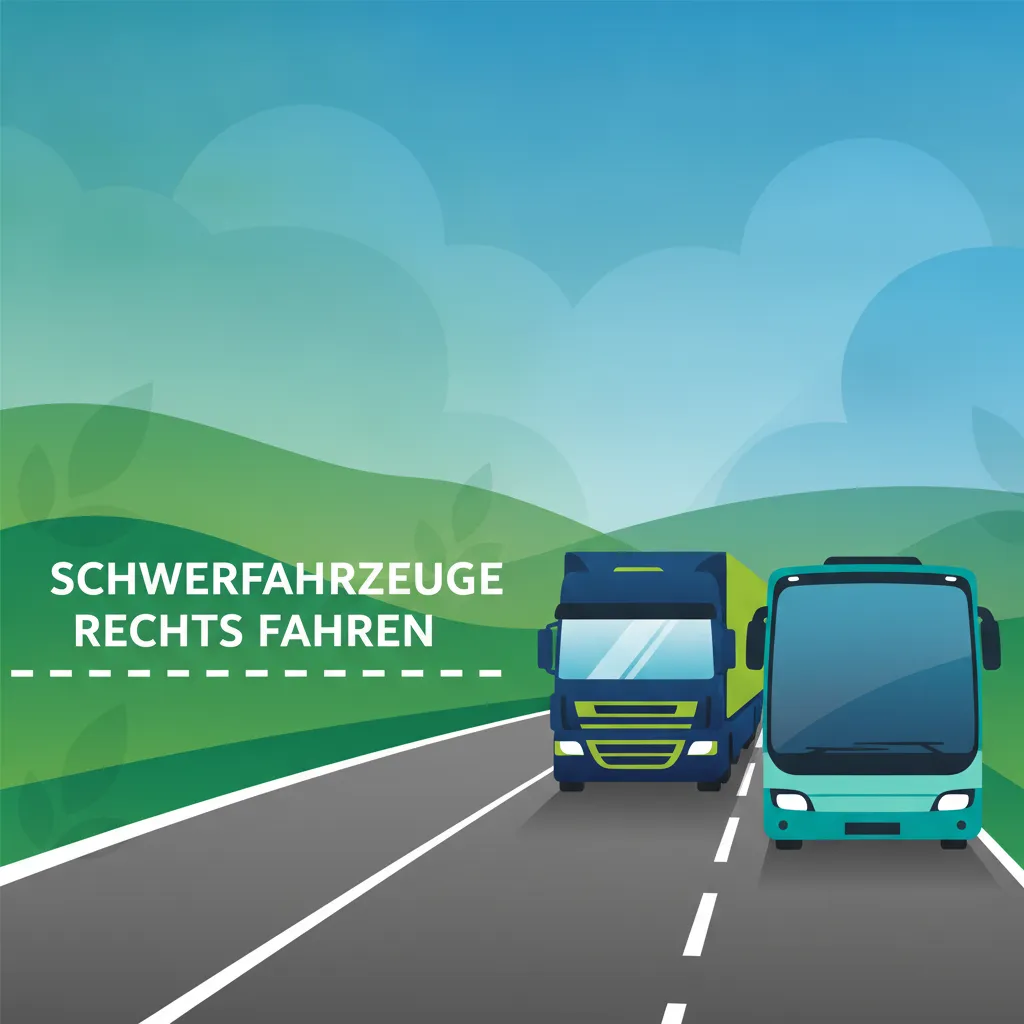
This lesson explains the specific regulations for operating heavy vehicles on Autobahnen, including speed limits, lane discipline, and overtaking rules. It discusses the use of dedicated truck lanes and the importance of maintaining appropriate following distances. The content also covers procedures for merging and exiting high-speed roads safely.

This lesson focuses on the critical maneuver of changing lanes ('Fahrstreifenwechsel'), a common cause of accidents if done incorrectly. It teaches a systematic, safe procedure based on thorough observation, clear signaling, and a final blind spot check. You will learn how to assess traffic speed and identify a safe gap before smoothly moving into the adjacent lane.

This lesson details the correct procedures for entering a motorway, using the acceleration lane to match traffic speed, and merging safely. It reinforces the strict lane discipline required, including keeping to the right lane except when overtaking. The content also provides guidance on maintaining increased following distances and performing safe lane changes at high speeds.

This lesson covers the rules and safety considerations for overtaking ('Überholen'). It explains where overtaking is prohibited and how to assess whether it is safe and necessary to do so. The procedure for checking traffic, signaling, moving out, passing, and safely returning to the lane is detailed, with a strong focus on judging the speed and distance of oncoming traffic.

This lesson provides a step-by-step guide to executing turns safely at intersections and other locations. It details the full observation sequence (mirrors, signal, blind spot check) required before initiating a turn. The lesson covers correct lane positioning for both left and right turns and explains the rules for performing U-turns or three-point turns where permitted.

This lesson focuses on complex traffic environments where different types of road users share the same space. It provides guidance on situations like driving on streets with integrated tram tracks or where bus and bicycle lanes are part of the roadway. The content emphasizes understanding the specific priority rules and being extra vigilant to anticipate potential conflicts in these busy, shared zones.

This lesson addresses the challenges of operating a small AM vehicle in dense, mixed traffic. It provides strategies for increasing visibility to other drivers, positioning oneself defensively, and safely sharing lanes with cyclists. The content emphasizes awareness of larger vehicles' blind spots and maintaining a safe space cushion.
This lesson covers the principles of correct vehicle positioning and lane discipline, which are essential for predictable and safe driving. It reinforces the 'Rechtsfahrgebot' (drive on the right) principle and explains how to choose the appropriate lane on multi-lane roads and motorways. Proper positioning for turns and maintaining a safe space cushion around the vehicle are also key topics.
Understand the specific regulations for speed and safe following distances when driving passenger vehicles on the German Autobahn. This lesson focuses on the legal requirements and practical considerations for maintaining safety at high speeds.
This lesson provides a complete guide to driving on the German Autobahn. It covers the correct procedure for entering and exiting via acceleration and deceleration lanes, the strict lane discipline rule of keeping right ('Rechtsfahrgebot'), and the principle of overtaking only on the left. It also explains the recommended speed limit and the critical procedure for forming an emergency corridor ('Rettungsgasse') in a traffic jam.
This lesson explains the specific regulations for operating heavy vehicles on Autobahnen, including speed limits, lane discipline, and overtaking rules. It discusses the use of dedicated truck lanes and the importance of maintaining appropriate following distances. The content also covers procedures for merging and exiting high-speed roads safely.

This lesson covers the crucial skills of managing speed and maintaining a safe buffer from other vehicles. It teaches methods for calculating an appropriate following distance, such as the time-gap method, which adapts to different speeds and conditions. Learners will understand how to adjust their speed based on traffic flow, road surface, and weather to ensure they always have enough time and space to stop safely.

This lesson focuses on the importance of maintaining a safe following distance ('Sicherheitsabstand') to the vehicle ahead. It teaches practical methods for judging this distance, including the universally applicable two-second rule and the German 'halber Tacho' (half the speedometer reading in meters) rule. The lesson stresses the need to increase this distance in poor weather or when visibility is reduced.
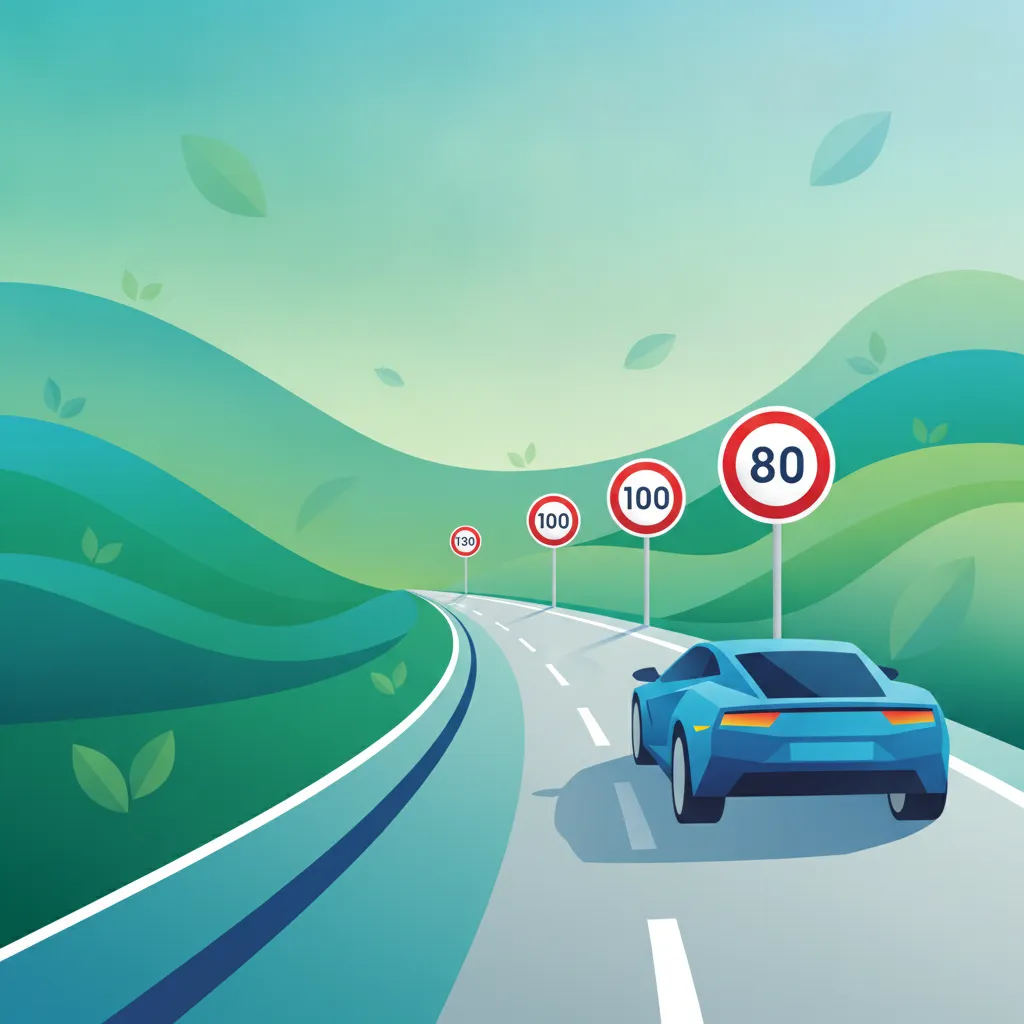
This lesson details the statutory speed limits in Germany, including the standard limits within built-up areas, on rural roads, and on the Autobahn. It emphasizes that the posted limit is a maximum and that drivers must always adapt their speed to traffic, weather, and visibility conditions. The concept of the recommended speed ('Richtgeschwindigkeit') on the Autobahn is also explained.
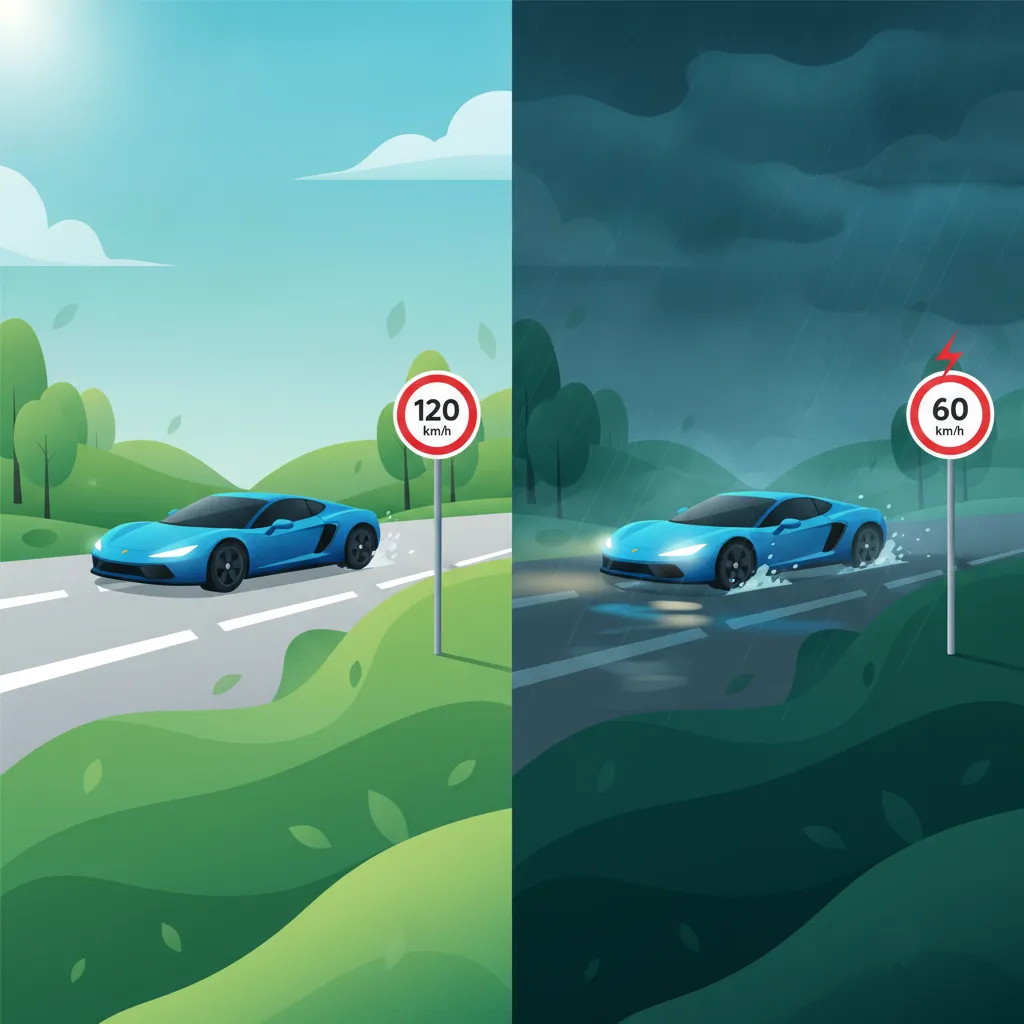
This lesson details the various speed limits applicable in Germany, from urban zones to rural roads. It emphasizes the critical skill of adapting speed to prevailing conditions such as rain, fog, or poor road surfaces. The content explains how external factors significantly impact vehicle handling and stopping distances.

This lesson covers the dimensional limits for heavy vehicles, focusing on height, width, and length restrictions. It explains how to interpret clearance signage for bridges, tunnels, and overhead obstacles, and discusses the implications for route planning. The content also addresses the importance of understanding turning radii and swept paths to avoid collisions.
This lesson details the correct procedures for entering a motorway, using the acceleration lane to match traffic speed, and merging safely. It reinforces the strict lane discipline required, including keeping to the right lane except when overtaking. The content also provides guidance on maintaining increased following distances and performing safe lane changes at high speeds.
Find clear answers to common questions learners have about Autobahn Driving for Passenger Vehicles. Learn how the lesson is structured, which driving theory objectives it supports, and how it fits into the overall learning path of units and curriculum progression in Germany. These explanations help you understand key concepts, lesson flow, and exam focused study goals.
No, buses and large passenger vehicles have specific speed restrictions defined by law, even on the Autobahn. Always refer to your vehicle class and official speed limits to ensure compliance.
General rules require you to stay in the right-hand lane unless you are overtaking or preparing to turn. Professional drivers must strictly adhere to this to maintain traffic flow.
Visibility and space. Because of your vehicle's length and mass, you must ensure you have a significantly larger gap before initiating an overtake and verify your blind spots using all available mirrors and cameras.
A fully loaded bus or coach has a significantly longer braking distance. You must increase your following distance well beyond the 'half-speed' rule typically used for smaller vehicles to ensure you can stop safely.
Begin your targeted revision now. Use our practice search to quickly find specific German driving theory questions. Filter by StVO rules, road signs, or hazard perception to create your focused study plan. Master challenging areas and prepare confidently for your theoretical driving test.