
This lesson details the serious legal repercussions of operating heavy vehicles while fatigued or exceeding mass limits. It covers the regulatory framework for professional drivers in Germany, ensuring you understand the implications for your license and liability.

Lesson content overview
Operating heavy vehicles, such as those in categories C1, C1E, C, and CE, demands a high degree of responsibility due to their size, weight, and potential impact on road safety. Two critical factors that significantly elevate the risk of accidents and carry severe legal repercussions are driver fatigue and vehicle overloading. This lesson delves into the legal framework governing these violations in Germany, outlining potential penalties, liability shifts, and the crucial role of compliance for professional drivers.
Understanding these legal ramifications is not just about avoiding punishment; it's fundamental to maintaining road safety, protecting human lives, and ensuring the smooth operation of commercial transport. For professional drivers and fleet operators, a thorough grasp of these regulations is indispensable.
Driver fatigue is a state of reduced mental and physical performance caused by insufficient rest. It impairs a driver's ability to operate a vehicle safely, leading to slower reaction times, reduced concentration, impaired judgment, and even microsleeps, where a person falls asleep for a few seconds without realizing it. The risks associated with fatigue are comparable to or even exceed those of driving under the influence of alcohol.
The German legal system, in alignment with EU regulations, establishes strict rules regarding driving and rest periods to combat fatigue. These regulations aim to ensure that heavy vehicle drivers are always in a fit state to control their vehicles, thereby mitigating accident risks.
Fatigue can manifest in various forms:
A fatigued driver might miss critical traffic signals, drift unintentionally out of their lane, or react too slowly to sudden hazards. These lapses can have catastrophic consequences, especially when operating a heavy vehicle. It's a common misconception that stimulants like coffee or energy drinks can fully counteract fatigue; while they might offer a temporary boost, they do not restore cognitive function or compensate for lost sleep.
Strict rules govern the maximum driving times and minimum rest periods for professional drivers. These are outlined primarily in Regulation (EC) No 561/2006 and its national implementations, such as the German Driving Personnel Ordinance (Fahrpersonalverordnung - FPersV). Compliance is mandatory to ensure driver fitness and prevent fatigue-related incidents.
Drivers must take a regular daily rest period of at least 11 consecutive hours within a 24-hour period. This period can be split into two parts, with the first part being at least 3 hours and the second part at least 9 hours, totaling a minimum of 12 hours. The daily rest period can be reduced to a minimum of 9 consecutive hours, but not more than three times between two weekly rest periods.
A driver must take a regular weekly rest period of at least 45 consecutive hours, or a reduced weekly rest period of at least 24 consecutive hours. Any reduction must be compensated by an equivalent period of rest taken en bloc before the end of the third week following the week in question. In any two consecutive weeks, a driver must take at least two regular weekly rest periods or one regular and one reduced weekly rest period.
After a driving period of 4.5 hours, a driver must take an uninterrupted break of at least 45 minutes. This break can be split into two parts: a first break of at least 15 minutes, followed by a second break of at least 30 minutes, distributed over the 4.5-hour driving period. These breaks are crucial for physical and mental recovery, preventing the onset of acute fatigue.
Non-compliance with driving and rest time regulations can lead to significant penalties, affecting both the driver and the transport company. These penalties are designed to act as a deterrent and reinforce safety standards.
Attempting to falsify tachograph data or manipulate recording equipment to conceal fatigue is a grave offense. Such actions are met with very heavy fines, immediate license suspension, and potential criminal charges.
Overloading a heavy vehicle is another critical safety violation with severe legal consequences. It compromises vehicle performance, increases accident risk, and causes accelerated wear and tear on both the vehicle and road infrastructure. German law sets strict limits on the maximum permissible weights to ensure vehicles operate safely.
Overloading occurs when a vehicle's actual weight exceeds its GTW, or when the load on any individual axle surpasses its GKW. This can happen even if the total weight is within limits, if the cargo is improperly distributed.
Operating an overloaded heavy vehicle significantly alters its fundamental characteristics and introduces numerous dangers:
German traffic law (e.g., Straßenverkehrs-Zulassungs-Ordnung - StVZO, and Straßenverkehrsgesetz - StVG) explicitly prohibits overloading and imposes strict penalties on drivers and, in many cases, on the vehicle owner, loader, and transport company.
The penalties for overloading are typically scaled according to the percentage by which the weight limits are exceeded.
For severe cases of overloading, or when a vehicle presents an immediate danger due to its condition, authorities have the power to temporarily withdraw the vehicle from traffic (Immissionen). This means the vehicle is impounded until the issue is resolved, or even permanently if the vehicle is deemed unfit for road use. Attempting to evade weight checkpoints or refusing to comply with police directives regarding overload checks is considered a serious offense and can lead to immediate vehicle seizure and legal prosecution.
Before every journey, it is the driver's responsibility to ensure the vehicle is correctly loaded and not overloaded. This includes checking load distribution and, if possible, verifying the weight against vehicle documents.
Beyond direct fines and points, operating a heavy vehicle while fatigued or overloaded carries profound implications for legal liability and insurance coverage, particularly in the event of an accident.
In standard accident cases, the burden of proof often lies with the party claiming damages to show negligence. However, if an accident involves a heavy vehicle where the driver was fatigued or the vehicle was overloaded, a "liability shift" can occur. This means the driver or transport company may have to proactively demonstrate that they adhered to all relevant driving time regulations and load limits.
If it is established that fatigue or overloading contributed to an accident, the culpability of the driver and the company significantly increases. This can lead to:
Insurance policies for heavy vehicles are typically contingent on the operator adhering to all legal requirements. Violations of driving time regulations or load limits can have severe consequences for insurance coverage:
Both the individual driver and the fleet operator bear a significant "duty of care" (Sorgfaltspflicht) to ensure safe vehicle operation.
Adhering to legal requirements regarding fatigue and overloading is not merely a legal obligation but a cornerstone of professional, safe, and sustainable heavy vehicle operation. Proactive measures are essential for both drivers and transport companies.
Preventing driver fatigue requires a multi-faceted approach:
For long-haul journeys, consider utilizing designated truck stops or rest areas equipped with amenities for safe and comfortable breaks. Never rely on short naps to replace legally required rest periods.
Preventing overloading and improper load distribution is a shared responsibility:
Tachographs are indispensable for monitoring and enforcing driving and rest time regulations. Both drivers and transport companies must ensure:
Accurate record-keeping provides a clear audit trail, demonstrating compliance with regulations. In the event of an investigation or accident, robust records are vital for proving adherence to the law and mitigating liability.
Operating a heavy vehicle under the German Heavy Vehicle Driving License Theory – C1, C1E, C, CE comes with significant responsibilities, particularly concerning driver fatigue and vehicle overloading. The legal consequences for non-compliance are stringent and are designed to uphold the highest standards of road safety.
By deeply understanding and consistently applying these principles, professional heavy vehicle drivers contribute to safer roads for everyone and protect themselves and their livelihoods from severe legal and financial repercussions.
This lesson covers the legal framework governing driver fatigue and vehicle overloading for German heavy vehicle drivers (C/CE categories). Drivers must adhere to strict EU and German rest regulations: minimum 11-hour daily rest, 45-minute breaks after 4.5 hours of driving, and 45-hour weekly rest periods. Overloading violations occur when Gross Total Weight or Gross Axle Weight limits are exceeded, with penalties scaling by percentage and potential consequences including fines, demerit points, license suspension, and vehicle impoundment. In accidents involving fatigue or overloading, a liability shift increases culpability, potentially leading to higher damages and criminal charges, while insurance coverage may be denied entirely.
A short set of high-value points that capture the most important learning from this lesson.
Driver fatigue impairs reaction time and judgment similarly to alcohol intoxication, making strict rest period compliance legally and safety-critical.
Overloading occurs when Gross Total Weight (GTW) or any Gross Axle Weight (GKW) limit is exceeded, even if total weight is within limits due to improper load distribution.
Violations of driving time regulations trigger escalating penalties including fines, demerit points, license suspension, and criminal charges if accidents result.
When fatigue or overloading contributes to an accident, a liability shift occurs that increases culpability and potential damages against the driver and transport company.
Insurers may refuse claims or revoke policies if violations like fatigue or overloading contributed to an accident, leaving operators financially exposed.
Explore all units and lessons included in this driving theory course.
Daily rest: minimum 11 consecutive hours (can be split into 3 + 9 hours) within 24 hours; reduced to minimum 9 hours no more than three times between weekly rest periods.
Mandatory break: 45 uninterrupted minutes after 4.5 hours of driving, or split into 15 + 30 minutes distributed across that period.
Overloading penalties scale by percentage exceeded; even small overruns incur fines, with severe cases risking vehicle impoundment and license suspension.
Fatigue cannot be counteracted by coffee or energy drinks—only adequate sleep restores cognitive function and alertness.
Drivers must personally verify load weight, distribution, and securing before departure; this is a non-delegable legal responsibility.
Confusing daily rest split rules—splitting into two parts requires the first part to be at least 3 hours and the second at least 9 hours, totaling 12 hours minimum.
Assuming overloading fines are fixed amounts rather than scaling with percentage exceeded; the same applies to axle load violations.
Believing that short power naps can replace mandatory rest periods—only the full legally required rest period satisfies the regulation.
Overlooking that even if total vehicle weight is within GTW, axle-specific overload (GKW) is a separate and prosecutable violation.
Assuming insurance will cover accidents if general policy conditions are met, without realizing violations like fatigue or overloading can void coverage entirely.
Lesson content overview
A short set of high-value points that capture the most important learning from this lesson.
Driver fatigue impairs reaction time and judgment similarly to alcohol intoxication, making strict rest period compliance legally and safety-critical.
Overloading occurs when Gross Total Weight (GTW) or any Gross Axle Weight (GKW) limit is exceeded, even if total weight is within limits due to improper load distribution.
Violations of driving time regulations trigger escalating penalties including fines, demerit points, license suspension, and criminal charges if accidents result.
When fatigue or overloading contributes to an accident, a liability shift occurs that increases culpability and potential damages against the driver and transport company.
Insurers may refuse claims or revoke policies if violations like fatigue or overloading contributed to an accident, leaving operators financially exposed.
Explore all units and lessons included in this driving theory course.
Daily rest: minimum 11 consecutive hours (can be split into 3 + 9 hours) within 24 hours; reduced to minimum 9 hours no more than three times between weekly rest periods.
Mandatory break: 45 uninterrupted minutes after 4.5 hours of driving, or split into 15 + 30 minutes distributed across that period.
Overloading penalties scale by percentage exceeded; even small overruns incur fines, with severe cases risking vehicle impoundment and license suspension.
Fatigue cannot be counteracted by coffee or energy drinks—only adequate sleep restores cognitive function and alertness.
Drivers must personally verify load weight, distribution, and securing before departure; this is a non-delegable legal responsibility.
Confusing daily rest split rules—splitting into two parts requires the first part to be at least 3 hours and the second at least 9 hours, totaling 12 hours minimum.
Assuming overloading fines are fixed amounts rather than scaling with percentage exceeded; the same applies to axle load violations.
Believing that short power naps can replace mandatory rest periods—only the full legally required rest period satisfies the regulation.
Overlooking that even if total vehicle weight is within GTW, axle-specific overload (GKW) is a separate and prosecutable violation.
Assuming insurance will cover accidents if general policy conditions are met, without realizing violations like fatigue or overloading can void coverage entirely.
Explore search topics learners often look for when studying Legal Consequences of Fatigue and Overloading. These topics reflect common questions about road rules, driving situations, safety guidance, and lesson level theory preparation for learners in Germany.
Browse additional driving theory lessons that cover connected traffic rules, road signs, and common driving situations related to this topic. Improve your understanding of how different rules interact across everyday traffic scenarios.
Understand the severe legal consequences of operating heavy vehicles while fatigued or overloaded. This lesson covers fines, license suspension, and increased liability in Germany, crucial for C/CE license holders.

This lesson explores the legal framework governing heavy vehicle operation in Germany, focusing on the Straßenverkehrs-Ordnung (StVO) and specific commercial transport regulations. It details the professional duty of care required from drivers, including responsibilities for vehicle inspection and documentation. You will understand the enforcement mechanisms and potential penalties for non-compliance.

This lesson covers the dimensional limits for heavy vehicles, focusing on height, width, and length restrictions. It explains how to interpret clearance signage for bridges, tunnels, and overhead obstacles, and discusses the implications for route planning. The content also addresses the importance of understanding turning radii and swept paths to avoid collisions.

This lesson explains the concepts of permissible total mass and actual mass, as well as the risks and legal consequences of overloading. It discusses how exceeding mass limits can lead to fines, increased stopping distances, and a higher risk of instability. Additionally, the content highlights the impact of overloading on vehicle wear and legal liabilities.

This lesson provides a detailed overview of the German licence categories C1, C1E, C, and CE, explaining the specific vehicle weight limits associated with each class. It clarifies the legal definitions that differentiate rigid trucks from vehicle combinations. You will also learn about the required driver qualifications and the theoretical knowledge necessary for each category.

This lesson examines the ethical and environmental responsibilities of heavy vehicle drivers, including the impact of emissions, fuel consumption, and noise pollution. It explains the principles of sustainable logistics and making environmentally conscious decisions while operating heavy vehicles. The content also covers the broader implications of transportation on public health and resource usage.
This lesson explains the specific regulations for operating heavy vehicles on Autobahnen, including speed limits, lane discipline, and overtaking rules. It discusses the use of dedicated truck lanes and the importance of maintaining appropriate following distances. The content also covers procedures for merging and exiting high-speed roads safely.

This lesson focuses on the importance of thorough route planning for heavy vehicles, taking into account dimensional and weight limits. It discusses how to use mapping tools and road signage to identify bridges, tunnels, and roads with restrictions. The content also covers how to plan alternative routes to avoid impassable areas.
This lesson provides an overview of the German system for penalizing traffic offenses. It explains the catalogue of fines ('Bußgeldkatalog'), the system of demerit points ('Punkte in Flensburg') for more serious violations, and the conditions under which a temporary driving ban ('Fahrverbot') or a full revocation of the license can be imposed. Understanding these consequences reinforces the importance of lawful driving.

This lesson outlines the proper response to an accident involving a heavy vehicle, including immediate actions and contacting emergency services. It details the legal obligations for reporting accidents and cooperating with police investigations. The content also covers documentation requirements for insurance claims and the importance of preserving the accident scene.

This lesson provides a step-by-step guide for safely managing a vehicle breakdown on the road. It includes instructions on performing an emergency stop, deploying hazard lights and warning triangles, and contacting assistance. The content emphasizes maintaining safety for both the driver and other road users during the breakdown.
Explore how fatigue and overloading directly increase driver liability in the event of an accident. This lesson details the legal and insurance implications for professional drivers in Germany.
This lesson outlines the proper response to an accident involving a heavy vehicle, including immediate actions and contacting emergency services. It details the legal obligations for reporting accidents and cooperating with police investigations. The content also covers documentation requirements for insurance claims and the importance of preserving the accident scene.
This lesson explains the specific regulations for operating heavy vehicles on Autobahnen, including speed limits, lane discipline, and overtaking rules. It discusses the use of dedicated truck lanes and the importance of maintaining appropriate following distances. The content also covers procedures for merging and exiting high-speed roads safely.
This lesson explores the legal framework governing heavy vehicle operation in Germany, focusing on the Straßenverkehrs-Ordnung (StVO) and specific commercial transport regulations. It details the professional duty of care required from drivers, including responsibilities for vehicle inspection and documentation. You will understand the enforcement mechanisms and potential penalties for non-compliance.
This lesson covers the dimensional limits for heavy vehicles, focusing on height, width, and length restrictions. It explains how to interpret clearance signage for bridges, tunnels, and overhead obstacles, and discusses the implications for route planning. The content also addresses the importance of understanding turning radii and swept paths to avoid collisions.

This lesson focuses on the legal responsibilities and duties of a vehicle operator according to German traffic law, primarily the StVO. It covers the obligation to drive safely, the rules of conduct at an accident scene, and the legal consequences of traffic violations. Understanding these principles is crucial for maintaining road safety and avoiding penalties such as fines, points, or driving bans.

This lesson examines the risks associated with load shifting during braking and cornering maneuvers. It explains how inertia and weight transfer can cause cargo to move, potentially leading to instability or loss of control. The content emphasizes the importance of proper load securing to mitigate these risks and maintain vehicle stability.

This lesson covers the lighting and reflector requirements for heavy vehicles, including headlamps, side markers, and brake lights. It explains the function of these systems and the necessity of underrun protection to safeguard other road users. The content also discusses regulations governing lighting systems and their importance for safety in all conditions.
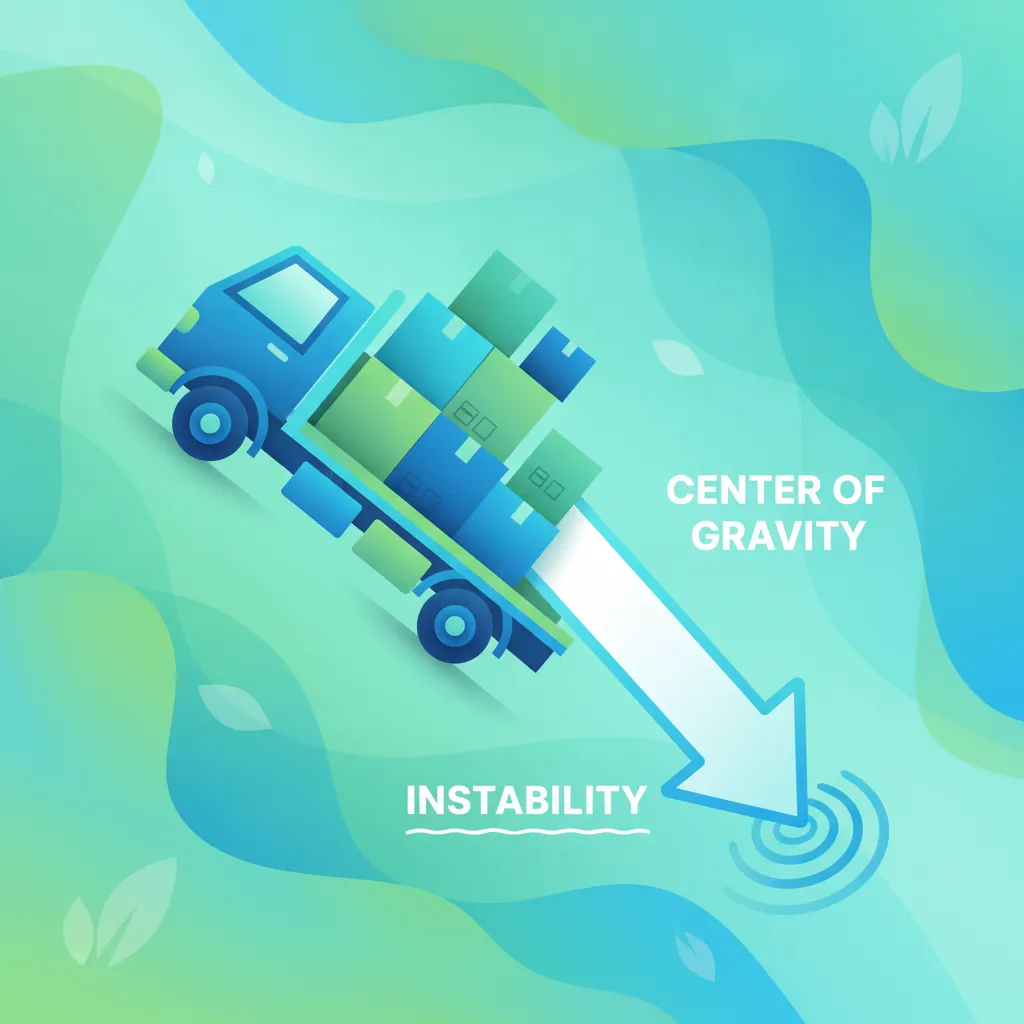
This lesson introduces the principles of load distribution and the impact of the centre of gravity on vehicle stability. It explains how cargo placement influences axle loads and the overall balance of the vehicle. The content emphasizes the importance of maintaining a low centre of gravity to reduce rollover risk.

This lesson explains the legal and safety requirements for transporting goods and cargo. It covers the importance of proper load distribution to maintain vehicle stability and the methods for securely fastening items to prevent them from shifting or falling. The regulations concerning maximum vehicle weight, roof loads, and the correct marking of loads that overhang the vehicle are also detailed.

This lesson focuses on the distribution of loads across axle groups and the legal limits for axle loads. It explains the importance of correct weight distribution to avoid axle overloading, which can lead to road damage and safety hazards. The content also covers methods for measuring axle loads and the legal requirements for maintaining proper axle load limits.
Find clear answers to common questions learners have about Legal Consequences of Fatigue and Overloading. Learn how the lesson is structured, which driving theory objectives it supports, and how it fits into the overall learning path of units and curriculum progression in Germany. These explanations help you understand key concepts, lesson flow, and exam focused study goals.
Driving while fatigued is treated as a severe traffic violation. Beyond the immediate risk of an accident, it can lead to heavy fines, points in the Flensburg register, and potential suspension of your heavy vehicle license if it is deemed a significant safety failure.
No, overloading impacts vehicle stability, steering, and suspension integrity. Legally, exceeding your registered mass limits can void your insurance coverage in the event of an accident, leaving the driver personally liable for damages.
Yes, professional drivers must strictly adhere to EU and German driving and rest time regulations. Failing to document these or ignoring mandated breaks is a violation that can result in immediate fines and strict enforcement actions during roadside checks.
The exam often presents scenarios where a driver is tempted to rush a delivery despite signs of fatigue or overloading. You must identify the correct legal response, which prioritizes safety and regulatory compliance over schedule adherence.
Begin your targeted revision now. Use our practice search to quickly find specific German driving theory questions. Filter by StVO rules, road signs, or hazard perception to create your focused study plan. Master challenging areas and prepare confidently for your theoretical driving test.