
This lesson details the critical safety responsibilities for professional drivers transporting schoolchildren in Germany. You will learn the precise legal requirements for picking up and dropping off students, the proper use of specialized warning equipment, and how to manage high-risk traffic zones around schools.
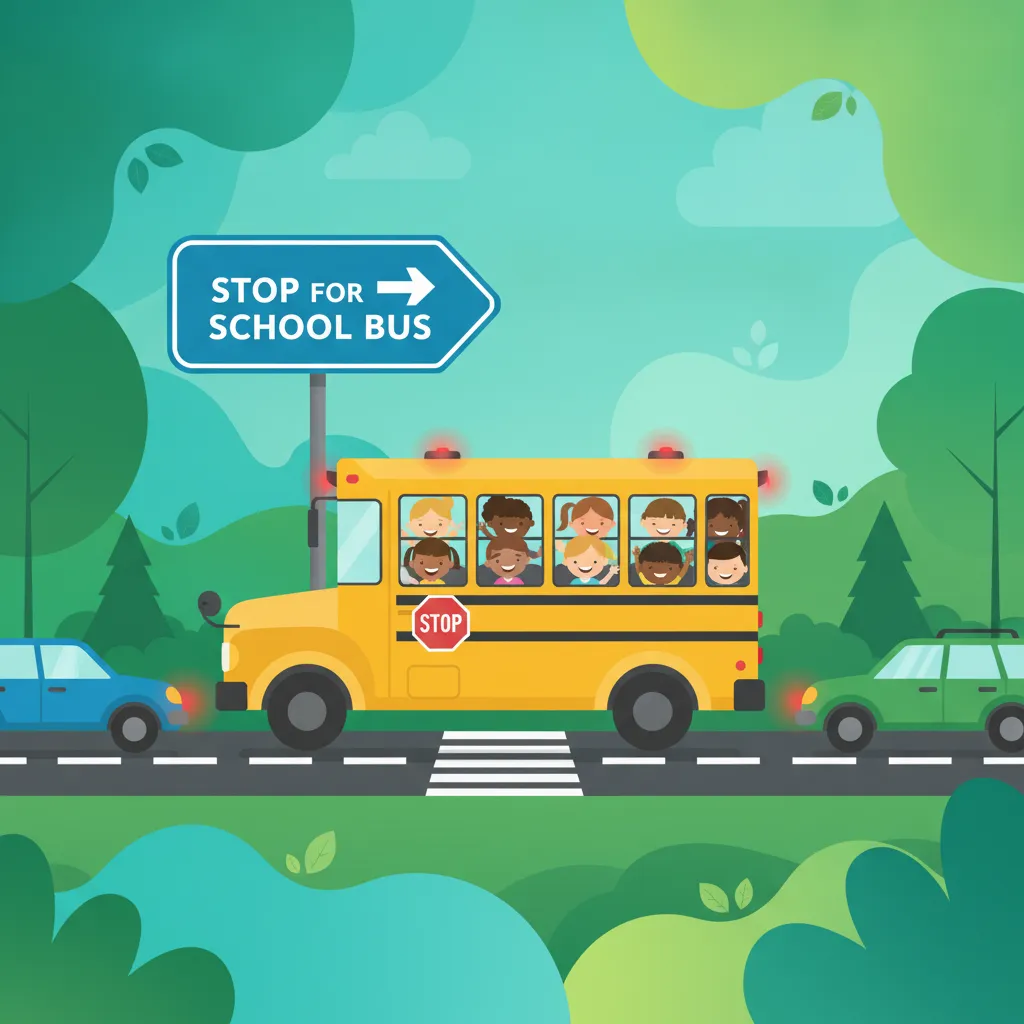
Lesson content overview
Transporting schoolchildren requires an elevated level of vigilance, adherence to specific legal obligations, and a deep understanding of safety protocols unique to the task. As a professional driver operating passenger vehicles in Germany (licence categories D1, D1E, D, DE), your role in safeguarding young passengers is paramount. This lesson details the critical procedures and responsibilities for safely navigating school routes, ensuring secure pick-up and drop-off, and managing interactions with other road users and school personnel.
When transporting children, especially to and from school, drivers assume an enhanced legal and ethical responsibility known as the Duty of Care (Sorgfaltspflicht). This goes beyond the standard duty of care for adult passengers, acknowledging children's inherent vulnerability due to their limited situational awareness, unpredictability, and slower reaction times. Children may not perceive traffic hazards in the same way adults do, making every decision by the driver crucial for their protection.
This enhanced duty necessitates heightened vigilance, slower and more deliberate maneuvering, and strict adherence to specific signaling practices. It means always prioritizing the safety of children above all else, ensuring that all necessary safety measures, such as seat belts and proper supervision, are in place throughout the journey. Understanding this fundamental principle forms the bedrock of safe school transport.
One of the most critical safety protocols for school transport in Germany is the correct and timely use of Warning Lights (Warnblinklicht), also known as hazard lights. These flashing lights serve as a vital visual cue to alert other road users that your vehicle is temporarily stationary for the purpose of boarding or alighting passengers, particularly in busy school zones or at designated stops.
The simultaneous activation of all vehicle turn signals, indicating the vehicle is temporarily stopped, poses a hazard, or is performing a specific maneuver requiring heightened attention from other road users.
Drivers must activate the warning lights before the vehicle comes to a complete stop at any designated school pick-up or drop-off point. This proactive measure provides oncoming and following traffic ample time to recognize your intention to stop, slow down, and adjust their driving accordingly. The warning lights should remain active throughout the entire boarding or alighting process and only be switched off once the vehicle is ready to safely pull away from the stop. Relying solely on brake lights is insufficient, as they do not provide the same level of advance warning or visibility from multiple angles.
The process of children entering (boarding) and exiting (alighting) the vehicle requires careful supervision to prevent accidents. Children should never be permitted to board or alight while the vehicle is in motion, no matter how slow. Any movement of the vehicle, even a slight roll, can cause a child to lose balance, fall, and sustain serious injury.
The driver, or a designated school escort, must actively oversee the entire boarding and alighting process. This supervision ensures that children wait patiently until the vehicle has come to a complete stop and the driver has signaled that it is safe to proceed. During alighting, the supervisor must ensure that children safely move away from the vehicle and are aware of any surrounding traffic before allowing them to proceed, especially if crossing the road is involved. Every child must be seated safely with their seat belt secured (if applicable) before the vehicle begins to move.
Approach Safely: Slow down well in advance of the stop, activate warning lights before stopping fully.
Complete Stop: Bring the vehicle to a full and complete stop at the designated point. Engage the parking brake.
Open Doors: Only open doors once the vehicle is stationary and secure.
Supervise: Ensure a responsible adult (driver or escort) supervises children entering or exiting.
Check Safety: Confirm all boarding children are safely seated and secured (e.g., seat belts fastened). For alighting children, ensure they are clear of the vehicle and any immediate traffic hazards.
Close Doors & Depart: Close doors, check surroundings, and switch off warning lights before carefully pulling away.
In many school zones, particularly during peak times, you will encounter School Crossing Guards (Verkehrslehrer or Schulweggeleitet). These officials, whether paid personnel, volunteers, or designated school staff, are authorized to manage traffic flow to ensure children can safely cross streets or navigate busy areas around schools. Their signals take precedence over standard traffic lights or road signs.
As a professional driver, you must always obey the gestures and instructions of a school crossing guard, even if their directives appear to conflict with existing traffic signals, such as a green light. Their primary role is to ensure the immediate safety of children, and they have the authority to stop traffic or direct children to cross when they deem it safe. Ignoring a crossing guard's signal is not only a serious traffic violation but also significantly endangers children.
School Zones (Schulweg) are designated areas around schools, often marked by specific signage and reduced speed limits, designed to enhance safety for children. Navigating these zones requires a significant adjustment in driving behavior, prioritizing caution and anticipating the unpredictable movements of children.
A designated area surrounding a school, typically marked with special signs and reduced speed limits, where heightened vigilance and specific traffic rules apply to protect schoolchildren.
The speed limits posted in school zones, commonly 30 km/h in Germany, are not merely suggestions; they are mandatory limits that must be strictly observed. Reduced speed provides drivers with increased reaction time to unexpected situations, significantly shortens stopping distances, and reduces the severity of potential impacts. Drivers must reduce their speed before entering the marked school zone and maintain it until they have fully exited.
Within a school zone, drivers must always anticipate children's movements. Children may dart into the road, emerge from between parked cars, or not pay attention to traffic. Therefore, maintain a heightened level of awareness, continuously scan the surroundings, and be prepared to stop at any moment. This includes being especially careful near school entrances, exits, and bus stops within the zone.
Always assume children may act unpredictably. Maintain a safe distance from parked cars and anticipate sudden movements, especially around school dismissal times.
German road traffic regulations (StVO) and the Driver Qualification Directive (EU) provide a robust framework for professional passenger transport, with specific provisions for school transport. Understanding these mandatory rules is crucial for compliance and, more importantly, for ensuring the safety of children.
Rule Statement: Children must only board or alight when the vehicle is completely stationary.
This rule is absolute. Any movement of the vehicle, even minimal, poses a significant risk of injury, from falls to being caught in a closing door or run over. The vehicle must be fully stopped, with the parking brake engaged, before any child is allowed to move towards or away from the doors.
Correct Application Example: The driver brings the bus to a full stop at the designated pick-up spot, engages the parking brake, and then signals for the children to begin boarding. Incorrect Application Example: The driver allows a child to step onto the curb while the bus is still slowly rolling forward.
Rule Statement: Hazard lights (Warnblinklicht) must be activated before the vehicle comes to a complete stop at a school pick-up or drop-off point.
This mandatory regulation ensures that other road users are given sufficient advance warning of your stationary vehicle. It is a critical measure for preventing rear-end collisions and for managing traffic flow around school stops. The lights must remain on until the vehicle safely departs.
Correct Application Example: Approaching a school bus stop, the driver activates the hazard warning lights approximately 50 meters before stopping, then gently brings the vehicle to a standstill. Incorrect Application Example: The driver stops the vehicle and then, as an afterthought, activates the hazard lights, or forgets to activate them altogether.
Rule Statement: Drivers must obey the gestures and signals of school crossing guards (Verkehrslehrer/Schulweggeleitet) without exception.
School crossing guards are legally empowered to control traffic for the safety of children. Their signals override other traffic control devices. Failure to comply is a serious offense that directly endangers vulnerable pedestrians.
Correct Application Example: A school crossing guard holds up a stop sign, signaling children to cross. The bus driver stops, even though the traffic light is green, and waits for the children to pass safely. Incorrect Application Example: The bus driver, seeing a green light, ignores the crossing guard's stop signal and attempts to proceed.
Rule Statement: The speed limit indicated by school zone signage (e.g., 30 km/h) must be strictly adhered to within the marked boundaries of the school zone.
Reduced speed limits in school zones are designed to increase reaction time and decrease stopping distances, providing a crucial safety margin when children are present. Exceeding these limits significantly increases the risk and severity of accidents.
Correct Application Example: Upon seeing the "Schulweg" sign and the 30 km/h speed limit sign, the driver immediately reduces speed to 30 km/h and maintains it until clear of the zone.
Incorrect Application Example: A driver maintains 50 km/h through a 30 km/h school zone because there appear to be no children immediately present.
Rule Statement: Vehicles must not stop on school pedestrian crossings (Zebrastreifen) unless explicitly instructed to do so by a school crossing guard or police officer.
Stopping on a pedestrian crossing blocks the designated safe pathway for children, forcing them to walk around the vehicle, potentially into the path of other traffic. Always stop before the crossing line.
Correct Application Example: The driver stops the bus behind the white stop line, ensuring the pedestrian crossing is completely clear for children to use. Incorrect Application Example: The driver pulls the bus forward and stops directly on the zebra crossing, obstructing the path of walking children.
Understanding common mistakes can help professional drivers proactively avoid dangerous situations and legal repercussions.
| Violation | Why It's Wrong | Correct Behavior | Potential Consequence |
|---|---|---|---|
| Allowing children to board/alight while the vehicle is moving. | Extremely high risk of severe injury (falls, being run over). | Vehicle must be fully stationary, and parking brake engaged, before opening doors for boarding/alighting. | Severe personal injury, significant legal liability, loss of driving licence. |
| Not activating warning lights before stopping at a school stop. | Reduces visibility to other road users, increases collision risk. | Activate Warnblinklicht well in advance of the stop, maintain until departure. | Increased risk of rear-end collision, fines, points on driving record. |
| Ignoring signals from a school crossing guard. | Directly endangers children crossing the road, undermines traffic control. | Always obey the crossing guard's signals, regardless of traffic lights or signs. | Endangering children, severe fines, driving licence suspension, criminal charges in case of incident. |
| Exceeding the posted speed limit in a school zone. | Significantly reduces reaction time and increases stopping distance; heightens accident severity. | Strictly observe and reduce speed to the posted limit (e.g., 30 km/h) before entering the school zone. | Fines, points on driving record, increased accident risk. |
| Stopping on a pedestrian crossing (Zebrastreifen) near a school. | Blocks safe passage for children, forcing them into potentially dangerous traffic. | Always stop before the white stop line, keeping the entire crossing clear. | Fines, obstruction of traffic, danger to pedestrians. |
| Allowing children to disembark without adult supervision. | Children may not be aware of immediate traffic hazards or safe routes. | Ensure a responsible adult (driver or escort) supervises all children until they are safely clear of the vehicle and immediate traffic. | Increased risk of child injury due to lack of awareness or poor judgment. |
Driving conditions are rarely constant, and professional drivers must adapt their approach to school transport based on various environmental and situational factors.
Understanding the direct links between actions and outcomes reinforces the importance of correct procedures:
The responsibilities associated with transporting schoolchildren are among the most critical for professional passenger vehicle drivers. They demand an exceptional level of attention, strict adherence to legal mandates, and a proactive approach to safety. By consistently applying the rules for using warning lights, ensuring supervised boarding and alighting, obeying crossing guards, and diligently observing school zone regulations, you contribute significantly to the safety and well-being of the most vulnerable passengers. Mastering these concepts is not just about compliance; it's about upholding a professional standard that prioritizes every child's safe journey.
Transporting schoolchildren requires professional drivers to uphold an enhanced Duty of Care (Sorgfaltspflicht) due to children's limited situational awareness. Key procedures include activating warning lights before stopping at designated school stops, ensuring the vehicle is completely stationary with parking brake engaged before children board or alight, and maintaining strict adult supervision throughout. Drivers must obey school crossing guards unconditionally as their signals override traffic lights, observe mandatory school zone speed limits (typically 30 km/h), and never stop on pedestrian crossings. These protocols are governed by German traffic law (StVO) and carry serious legal consequences for violations, making compliance essential for both exam preparation and daily professional practice.
A short set of high-value points that capture the most important learning from this lesson.
Drivers transporting schoolchildren bear an enhanced Duty of Care (Sorgfaltspflicht) requiring heightened vigilance beyond standard passenger transport
Warning lights (Warnblinklicht) must be activated before stopping and remain on throughout the entire boarding or alighting process
Children may only board or alight when the vehicle is completely stationary with the parking brake engaged
School crossing guard signals (Verkehrslehrer/Schulweggeleitet) legally override traffic lights and standard road signs
School zones (Schulweg) enforce mandatory reduced speed limits, typically 30 km/h, that must be strictly observed within marked boundaries
Explore all units and lessons included in this driving theory course.
Warnblinklicht activation must happen before the vehicle stops, not after, to give other road users advance warning
The vehicle must be fully stationary with parking brake on before any child moves toward or away from the doors
Never stop on a pedestrian crossing (Zebrastreifen) near schools; always stop behind the white stop line
Always assume children may act unpredictably and dart into the road, especially near parked cars and bus stops
Supervision (Aufsicht) by a responsible adult is required during all boarding and alighting until children are clear of traffic hazards
Allowing children to board or alight while the vehicle is still slowly rolling, creating fall and injury risks
Activating hazard lights only after stopping or forgetting to use them altogether at school stops
Proceeding through an intersection with a green light when a crossing guard is signaling to stop
Maintaining normal speed (e.g., 50 km/h) through a 30 km/h school zone when no children appear visible
Stopping the vehicle on a pedestrian crossing, blocking the safe pathway for children and forcing them into traffic
Lesson content overview
A short set of high-value points that capture the most important learning from this lesson.
Drivers transporting schoolchildren bear an enhanced Duty of Care (Sorgfaltspflicht) requiring heightened vigilance beyond standard passenger transport
Warning lights (Warnblinklicht) must be activated before stopping and remain on throughout the entire boarding or alighting process
Children may only board or alight when the vehicle is completely stationary with the parking brake engaged
School crossing guard signals (Verkehrslehrer/Schulweggeleitet) legally override traffic lights and standard road signs
School zones (Schulweg) enforce mandatory reduced speed limits, typically 30 km/h, that must be strictly observed within marked boundaries
Explore all units and lessons included in this driving theory course.
Warnblinklicht activation must happen before the vehicle stops, not after, to give other road users advance warning
The vehicle must be fully stationary with parking brake on before any child moves toward or away from the doors
Never stop on a pedestrian crossing (Zebrastreifen) near schools; always stop behind the white stop line
Always assume children may act unpredictably and dart into the road, especially near parked cars and bus stops
Supervision (Aufsicht) by a responsible adult is required during all boarding and alighting until children are clear of traffic hazards
Allowing children to board or alight while the vehicle is still slowly rolling, creating fall and injury risks
Activating hazard lights only after stopping or forgetting to use them altogether at school stops
Proceeding through an intersection with a green light when a crossing guard is signaling to stop
Maintaining normal speed (e.g., 50 km/h) through a 30 km/h school zone when no children appear visible
Stopping the vehicle on a pedestrian crossing, blocking the safe pathway for children and forcing them into traffic
Explore search topics learners often look for when studying School Transport Responsibilities. These topics reflect common questions about road rules, driving situations, safety guidance, and lesson level theory preparation for learners in Germany.
Browse additional driving theory lessons that cover connected traffic rules, road signs, and common driving situations related to this topic. Improve your understanding of how different rules interact across everyday traffic scenarios.
Understand the specific legal duties and safety protocols for driving schoolchildren in Germany. Learn about safe boarding and alighting, proper use of warning signals, and effective interaction with school crossing guards to ensure child safety.

This lesson focuses on the particular care required when driving near pedestrians, with a special emphasis on children and the elderly, whose behavior can be unpredictable. It covers the rules for yielding at zebra crossings and the importance of reducing speed near schools, playgrounds, and residential areas. The goal is to instill a habit of constant vigilance and readiness to stop.
This lesson focuses on identifying road users who require special attention and caution, such as children, the elderly, and individuals with disabilities. It details the appropriate behavior when encountering school buses and public transport, which often involve unpredictable pedestrian movement. A critical topic covered is the legal requirement to form an emergency corridor ('Rettungsgasse') for responding emergency vehicles.
This lesson details the driver's legal responsibility for the safety of all passengers. It reinforces the mandatory use of seat belts for everyone in the vehicle. A significant focus is placed on the strict regulations for child safety, explaining the types of child restraint systems required based on a child's age, height, and weight, and how to install them correctly.
This lesson explains the specific regulations when encountering public transport. It covers the legal requirement to yield to public buses signaling to leave a bus stop and the strict rules for passing school buses with flashing hazard lights. You will also learn about the absolute priority of trams ('Straßenbahn') and how to safely drive on or across their tracks.
This lesson focuses on the critical moments of interaction with pedestrians and cyclists near bus stops, a common location for accidents. It reinforces the importance of reducing speed, yielding right-of-way, and constantly monitoring blind spots during the stopping process. Learners will practice techniques like making eye contact and using signals to communicate intentions, creating a safer environment for everyone around the vehicle.

This lesson examines the professional standards expected of passenger-vehicle drivers. It covers the importance of maintaining public trust through reliability, punctuality, and a professional demeanor. Key skills such as effective passenger communication, conflict resolution, and stress management are discussed as vital components of a driver's accountability and adherence to regulations.
This lesson focuses on the legal responsibilities and duties of a vehicle operator according to German traffic law, primarily the StVO. It covers the obligation to drive safely, the rules of conduct at an accident scene, and the legal consequences of traffic violations. Understanding these principles is crucial for maintaining road safety and avoiding penalties such as fines, points, or driving bans.

This lesson focuses on the essential legal principle of a heightened duty of care when carrying passengers. It details the driver's responsibility to ensure the safety, comfort, and accessibility of everyone on board, from boarding to alighting. Learners will understand how to conduct risk assessments, manage passenger behavior, and prepare for potential emergencies to fulfill this crucial obligation.
This lesson provides strategies for proactively managing passenger behavior to maintain a safe environment for everyone. It covers techniques for supervising passengers, enforcing rules on seat belt use, smoking, and alcohol, and managing luggage placement. The lesson also addresses how to handle disruptive behavior and the driver's role in assisting passengers during an emergency evacuation to ensure an orderly process.
This lesson teaches riders how to interact safely and predictably with pedestrians, cyclists, and public transport vehicles. It highlights the importance of yielding at designated crossings, maintaining a safe passing distance, and anticipating the movements of buses and trams. The content emphasizes using eye contact and clear signaling to foster safe and respectful interactions with all road users.
Learn how to safely navigate school zones and other high-risk environments in Germany. This lesson covers hazard perception, speed control, and crucial interactions with vulnerable road users to prevent accidents during pick-up and drop-off.
This lesson teaches drivers how to identify and assess stop locations that present elevated risks, such as those in dense residential areas, near schools, or with limited visibility. It provides strategies for mitigating these risks through careful vehicle positioning and heightened situational awareness. The goal is to ensure that passenger exchanges can be conducted safely even when the surrounding environment is challenging and unpredictable.
This lesson focuses on the critical moments of interaction with pedestrians and cyclists near bus stops, a common location for accidents. It reinforces the importance of reducing speed, yielding right-of-way, and constantly monitoring blind spots during the stopping process. Learners will practice techniques like making eye contact and using signals to communicate intentions, creating a safer environment for everyone around the vehicle.
This lesson focuses on the particular care required when driving near pedestrians, with a special emphasis on children and the elderly, whose behavior can be unpredictable. It covers the rules for yielding at zebra crossings and the importance of reducing speed near schools, playgrounds, and residential areas. The goal is to instill a habit of constant vigilance and readiness to stop.
This lesson trains drivers to proactively identify vulnerable road users and anticipate their often unpredictable behavior. It highlights the specific risks posed by children, elderly pedestrians, cyclists, and e-scooter users, particularly near bus stops and crossings. The goal is to develop a heightened sense of risk perception and apply defensive driving techniques to protect those who are most at risk on the road.
This lesson focuses on the interaction between heavy vehicles and vulnerable road users at crossings, particularly when turning right. It covers the need for heightened vigilance, the importance of properly using mirrors, and correct signaling to alert others. The content highlights legal responsibilities and safe distance requirements to prevent accidents.
This lesson focuses on identifying road users who require special attention and caution, such as children, the elderly, and individuals with disabilities. It details the appropriate behavior when encountering school buses and public transport, which often involve unpredictable pedestrian movement. A critical topic covered is the legal requirement to form an emergency corridor ('Rettungsgasse') for responding emergency vehicles.

This lesson builds on defensive driving by focusing specifically on hazard perception ('Gefahrenerkennung'). It teaches you how to actively scan the driving environment for potential risks, not just immediate dangers. You will learn to anticipate the likely actions of other road users and identify clues that signal a developing hazardous situation, allowing you to react early and safely.

This lesson explores the critical role of visibility in safe driving, covering topics such as sight distance, managing blind spots, and the correct use of mirrors. It provides guidance on how to adjust your driving in conditions of reduced visibility, such as at night, in fog, or during heavy rain, including the proper use of headlights. The importance of the over-the-shoulder check ('Schulterblick') is also a key focus.
This lesson explores the complex and fast-paced nature of urban traffic environments. It covers topics such as high traffic density, frequent pedestrian crossings, and complex intersections that require heightened awareness. Learners will develop strategies for adapting their speed and lane positioning to navigate these challenges safely, especially during peak rush hour periods and in areas with traffic calming measures.
This lesson introduces the concept of defensive driving ('vorausschauendes Fahren'), a proactive approach focused on anticipating and mitigating potential risks. It teaches techniques for scanning the road ahead, identifying potential hazards early, and managing the space around your vehicle to create a safety buffer. The goal is to develop a mindset that prioritizes safety and collision avoidance above all else.
Find clear answers to common questions learners have about School Transport Responsibilities. Learn how the lesson is structured, which driving theory objectives it supports, and how it fits into the overall learning path of units and curriculum progression in Germany. These explanations help you understand key concepts, lesson flow, and exam focused study goals.
You must use hazard lights when approaching and stopping at designated school bus stops if students are boarding or alighting, as mandated by German traffic regulations to alert other road users to the presence of children.
Position your vehicle parallel to the curb, ensuring there is enough space for students to exit safely without stepping directly into traffic. Always ensure the boarding area is clear and visibility is optimized for following traffic.
Your duty of care is heightened; you must anticipate unpredictable behavior from children, maintain a low speed, and never resume movement until you are certain that all students have safely cleared the doors and are not in the vehicle's blind spots.
Yes, you must obey the signals of crossing guards immediately. They have the authority to halt traffic to ensure student safety, and failure to comply is a serious traffic violation in Germany.
Begin your targeted revision now. Use our practice search to quickly find specific German driving theory questions. Filter by StVO rules, road signs, or hazard perception to create your focused study plan. Master challenging areas and prepare confidently for your theoretical driving test.