
This lesson explores the essential safety procedures for managing interactions with vulnerable road users, such as pedestrians and cyclists, near bus stops. As a professional driver, your ability to monitor blind spots and anticipate movement is critical for passenger safety and exam success in your D1, D1E, D, or DE licence journey.
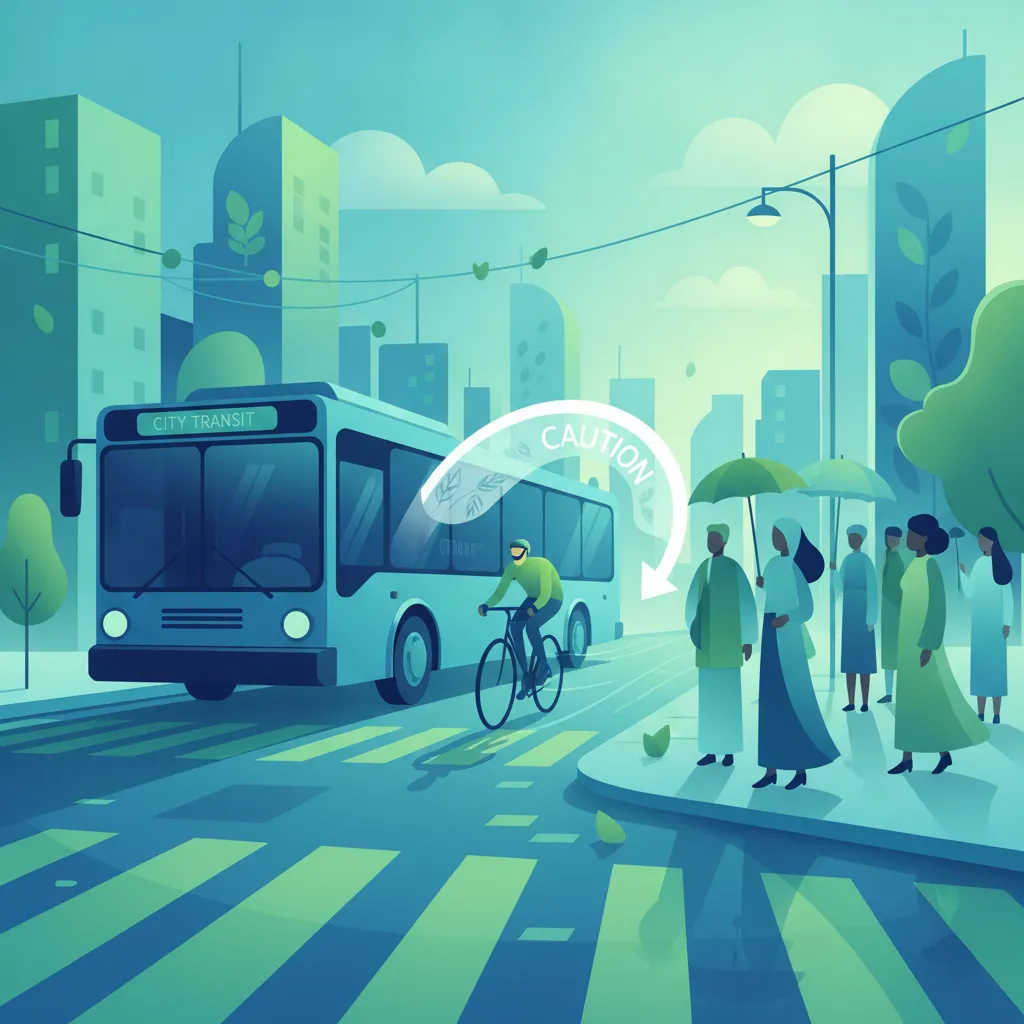
Lesson content overview
Operating a professional passenger vehicle, such as a bus or coach, requires an exceptionally high level of awareness, especially when interacting with vulnerable road users like pedestrians and cyclists. Areas around designated stops are particularly high-risk zones, where frequent movements of people and vehicles create complex and often unpredictable scenarios. This lesson for Professional German Passenger-Vehicle Theory (Licence Categories D1, D1E, D, DE) delves into the critical principles and techniques essential for ensuring the safety of everyone in the vicinity of stops. By mastering these interactions, you not only comply with German traffic law but also uphold your professional responsibility to passenger and public safety.
Bus and coach stops are dynamic environments where various road users converge, often in close proximity to a large vehicle. Pedestrians typically move towards or away from the stop, sometimes crossing roads or navigating crowded sidewalks. Cyclists may use dedicated lanes, share the road with traffic, or even ride on sidewalks depending on local regulations. The very act of a large passenger vehicle approaching, stopping, and departing a stop creates numerous potential conflict points.
These zones are classified as high-risk due to several factors:
Professional drivers must approach these areas with heightened caution, anticipating potential hazards and consistently applying defensive driving techniques. The interplay of legal obligations, safety considerations, and effective communication is paramount.
One of the most crucial aspects of safe interaction near stops is a clear understanding and consistent application of right-of-way rules. In Germany, § 13 of the Straßenverkehrs-Ordnung (StVO), the German Road Traffic Regulations, specifies the priority of pedestrians and cyclists in various situations, many of which are relevant near stops.
Pedestrians are granted specific protections, particularly at marked pedestrian crossings (zebra crossings) or when their path is clearly established. When a professional passenger vehicle approaches a bus stop that is adjacent to a pedestrian crossing, the driver's primary responsibility is to ensure the safe passage of pedestrians. This means yielding right-of-way, regardless of whether the pedestrians are actively crossing or simply waiting to cross.
Drivers must always allow pedestrians at marked crossings (Zebrastreifen) to cross safely before proceeding. This applies even if the vehicle is attempting to pull into or away from a stop.
Similarly, at stop locations where pedestrians frequently cross driveways, paths, or designated areas, drivers must anticipate their presence and be prepared to yield. The assumption should always be that pedestrians may be present and may intend to cross, even if there isn't a formal crossing. The sheer size and potential impact of a passenger vehicle necessitate this cautious approach.
Cyclists also have specific right-of-way considerations, particularly when they are in designated cycle lanes or when their path converges with a vehicle turning into or out of a stop. If a bus stop is located where a cycle path runs alongside the road, drivers must be acutely aware of cyclists approaching from either direction. When turning across a cycle path to enter or exit a stop, the cyclist usually has priority.
It is common for bus stops to be designed in a way that allows buses to pull out of the main flow of traffic. However, this often means crossing a cycle lane or a portion of the road also used by cyclists. In such situations, the driver must signal their intention early, slow down, and yield to any approaching cyclists to prevent collisions. Always assume that a cyclist may be less visible and may not anticipate your vehicle's movement.
A common and dangerous misunderstanding is the belief that a large passenger vehicle, especially one operating on a schedule, always has priority when pulling into or away from a designated stop. This is false. While other vehicles might be required to facilitate a bus pulling away from a stop (as per § 20 StVO), this does not override the fundamental right-of-way of pedestrians and cyclists, especially at marked crossings or when their path is established.
The legal framework in Germany prioritizes the protection of vulnerable road users. Professional drivers must internalize that their responsibility to yield to pedestrians and cyclists near stops is paramount and takes precedence over adherence to a timetable or the convenience of other road users.
Due to their substantial size and structure, passenger vehicles inherently have large blind spots—areas around the vehicle that are not directly visible to the driver through mirrors or windows. These blind spots become particularly hazardous near stops, where pedestrians and cyclists are frequently in motion and may quickly enter these unseen zones.
Blind spots can occur in various areas around a large passenger vehicle:
German regulations, specifically § 1 of the Fahrerlaubnis-Verordnung (FeV), concerning vehicle inspection, mandate that mirrors must be adjusted to provide the best possible view of the rear and sides of the vehicle. However, even perfectly adjusted mirrors cannot eliminate all blind spots.
To counteract the dangers of blind spots, professional drivers must employ a multi-faceted approach:
Proper Mirror Adjustment: Ensure all mirrors (main, wide-angle, curb-view) are correctly adjusted before starting a journey and periodically checked.
Systematic Head Checks (Shoulder Checks): Before any lateral movement, such as pulling into or away from a stop, physically turn your head to look over your shoulder into the blind spot area. This is the only way to confirm no vulnerable road user is present.
Scanning: Continuously scan the environment around your vehicle, including areas beyond your immediate mirrors, for any signs of movement.
Anticipation: Expect pedestrians and cyclists to appear in blind spots, especially when nearing a stop.
Communication: Use signals early to alert others to your intentions, giving them time to react and move out of potential blind spots.
Constant vigilance and proactive checks are vital. Never assume a blind spot is clear without verifying it through a physical head turn.
The speed at which a professional passenger vehicle approaches a stop directly impacts the driver's ability to react, the vehicle's stopping distance, and the severity of any potential incident. German traffic law, particularly § 3 StVO, emphasizes that drivers must always adjust their speed to the prevailing conditions, ensuring they can stop safely.
Reducing speed is not just about braking at the last moment; it's about early and controlled deceleration. As soon as a driver identifies an approaching stop, they should begin to gradually reduce their speed. This proactive approach offers several key benefits:
When approaching a stop, consider the "rolling stop" principle: reduce speed sufficiently early so that you can react to any sudden appearance of a pedestrian or cyclist without needing harsh braking.
Professional passenger vehicles, being significantly heavier than private cars, require substantially longer stopping distances. This is especially true when fully loaded with passengers. The stopping distance is influenced by:
The total distance covered from the moment a driver perceives a hazard to the moment the vehicle comes to a complete stop. It comprises reaction distance and braking distance.
Therefore, when approaching stops, professional drivers must factor in the current conditions and the vehicle's state. A bus loaded with passengers on a wet road will need to begin decelerating much earlier than an empty bus on a dry day to achieve a safe stopping distance. A general rule of thumb is to allow ample space, often significantly more than what feels necessary in a private car, to accommodate these factors.
Clear and unambiguous communication is a cornerstone of safe driving, particularly when interacting with pedestrians and cyclists who may not always be aware of a large vehicle's intentions. German traffic law, specifically § 39 StVO, mandates the use of signals to indicate movements and intentions to other road users. Beyond formal signals, non-verbal communication plays a vital role in accident prevention.
The most fundamental form of communication is the correct and timely use of vehicle signals:
The aim is to make your intentions clear and predictable. Avoid abrupt signaling or failing to signal altogether, as this can lead to confusion and dangerous situations.
While vehicle signals are crucial, they can sometimes go unnoticed by distracted pedestrians or cyclists, especially in noisy urban environments. This is where personal communication becomes invaluable:
However, use hand gestures with caution. They must be clear, unambiguous, and not lead to confusion. Avoid gestures that could be misinterpreted as aggressive or dismissive. The goal is to build a shared understanding and foster a safe, predictable interaction.
Understanding the specific paragraphs of German traffic law (StVO) and related regulations is not just about compliance; it's about internalizing the principles that underpin safe driving.
Statement: Pedestrians always have the right-of-way at pedestrian crossings, and cyclists have similar priority at designated cyclist crossings and when their path is established in relation to a turning vehicle. Applicability: Crucial at all designated stops and adjacent crossing areas. Legal Status: Mandatory. Rationale: To protect the most vulnerable road users at points of frequent conflict with vehicles. Professional drivers must be acutely aware that their vehicle's size does not grant them automatic priority over pedestrians or cyclists.
Statement: Mirrors must be adjusted to provide the best possible view of the rear and sides of the vehicle. Applicability: At all times, but particularly critical when maneuvering near stops where vulnerable users may be present. Legal Status: Mandatory. Rationale: To ensure drivers can effectively monitor their surroundings, especially blind spots, thereby preventing collisions. Proper mirror usage, combined with physical head checks, is non-negotiable.
Statement: Drivers must always adjust their speed to the conditions of the road, traffic, visibility, and their vehicle's capabilities to stop safely. Applicability: Universally applicable, but heavily emphasized when approaching and departing stops. Legal Status: Mandatory. Rationale: To provide sufficient reaction time and allow for safe stopping distances, especially in situations involving unexpected appearances of vulnerable road users or adverse conditions.
Statement: Turn signals must be used to communicate intentions to other road users, and other signals (like horn, lights) must be used judiciously. Applicability: While pulling up to, departing from, or maneuvering near a stop. Legal Status: Mandatory. Rationale: Clear and timely communication reduces misunderstandings, prevents abrupt maneuvers, and enhances overall road safety by making vehicle movements predictable.
Despite clear regulations and training, certain common errors frequently lead to incidents or near-misses involving pedestrians and cyclists near stops. Professional drivers must be aware of these pitfalls to actively avoid them.
One of the most frequent violations is failing to yield right-of-way to pedestrians or cyclists when legally required. This can manifest as:
Failing to yield to vulnerable road users is a serious offense that can result in significant fines, points on your license, and, most importantly, severe injuries or fatalities.
These violations are not merely technical infractions; they represent a breakdown in the proactive safety mindset essential for professional passenger transport.
Driving is rarely static, and conditions can change rapidly. Professional drivers must adapt their approach to stops based on various environmental and vehicle-specific factors.
The performance characteristics of a passenger vehicle change significantly with its load:
Understanding these conditional variations allows professional drivers to adapt their techniques, ensuring safety regardless of the external circumstances.
Let's consider two practical scenarios to illustrate the application of these safety principles.
Setting: A city street during a rainy afternoon. A bus is approaching a designated bus stop that is positioned just before a marked pedestrian crosswalk. Several pedestrians are waiting at the crosswalk, and one or two have already stepped onto the crossing. Relevant Rules: § 13 StVO (pedestrian right-of-way), § 3 StVO (safe speed), § 39 StVO (signal use). Correct Driver Behavior:
Setting: A bus has completed passenger operations at a stop and is ready to pull back into traffic. The designated bus lane at this stop is also marked as a shared cycle path. A cyclist is approaching from behind the bus, riding in this shared lane. Relevant Rules: § 13 StVO (cyclist priority), § 39 StVO (signal use), § 1 FeV (mirror visibility), § 20 StVO (facilitating departure from stops). Correct Driver Behavior:
This lesson covers the critical safety procedures for professional D/DE licence drivers when interacting with pedestrians and cyclists near bus stops. Key legal foundations from the StVO establish that pedestrians have unconditional priority at crossings and cyclists retain priority on their established paths, even when a vehicle is entering or leaving a stop. Effective blind spot management requires both properly adjusted mirrors and physical head checks, as large vehicles create significant unseen zones. Speed reduction must begin early, accounting for vehicle load, weather, and road conditions, to maintain safe stopping distances. Clear communication through turn signals, eye contact, and hand gestures coordinates movements with vulnerable road users and prevents misunderstandings that can lead to serious accidents.
A short set of high-value points that capture the most important learning from this lesson.
Pedestrians always have priority at marked crossings (Zebrastreifen) under §13 StVO, regardless of the driver's schedule or proximity to a stop.
Large passenger vehicles have significant blind spots on all sides; physical head checks are mandatory because mirrors alone cannot confirm these areas are clear.
Speed must be reduced early and gradually when approaching stops, accounting for the vehicle's weight, load, and current road conditions.
Cyclists have priority when their established path crosses a vehicle's turning path into or out of a stop, even in shared bus-cycle lanes.
Communication through timely signals, eye contact, and hand gestures reduces confusion and helps vulnerable road users anticipate vehicle movements.
Explore all units and lessons included in this driving theory course.
§13 StVO mandates yielding to pedestrians at crossings; §20 StVO requiring other traffic to facilitate bus departure does not override this protection for vulnerable users.
The stopping distance for a loaded passenger vehicle on wet roads is substantially longer than for an empty vehicle on dry pavement—begin deceleration much earlier.
When turning across a cycle path to enter or exit a stop, the cyclist already in that lane has priority and must be allowed to pass safely.
Mirror adjustment per §1 FeV must provide the best possible view, supplemented by shoulder head checks before any lateral movement near stops.
§3 StVO requires speed adaptation to conditions—rain, fog, darkness, or heavy loads all demand slower approach speeds and greater following distances.
Failing to perform a physical head check over the shoulder before pulling away from a stop, assuming the blind spot is clear based solely on mirror observation.
Approaching a stop at excessive speed, requiring harsh braking and reducing reaction time for unexpected pedestrian or cyclist movements.
Pulling into or out of a stop without signaling, or signaling too late, leaving cyclists and pedestrians unable to anticipate the vehicle's lateral movement.
Assuming a large bus has automatic priority over cyclists when leaving a stop in a shared bus-cycle lane, rather than yielding to cyclists already in the lane.
Neglecting to reduce speed appropriately for weather conditions—rain, snow, or ice dramatically increase stopping distances and reduce visibility.
Lesson content overview
A short set of high-value points that capture the most important learning from this lesson.
Pedestrians always have priority at marked crossings (Zebrastreifen) under §13 StVO, regardless of the driver's schedule or proximity to a stop.
Large passenger vehicles have significant blind spots on all sides; physical head checks are mandatory because mirrors alone cannot confirm these areas are clear.
Speed must be reduced early and gradually when approaching stops, accounting for the vehicle's weight, load, and current road conditions.
Cyclists have priority when their established path crosses a vehicle's turning path into or out of a stop, even in shared bus-cycle lanes.
Communication through timely signals, eye contact, and hand gestures reduces confusion and helps vulnerable road users anticipate vehicle movements.
Explore all units and lessons included in this driving theory course.
§13 StVO mandates yielding to pedestrians at crossings; §20 StVO requiring other traffic to facilitate bus departure does not override this protection for vulnerable users.
The stopping distance for a loaded passenger vehicle on wet roads is substantially longer than for an empty vehicle on dry pavement—begin deceleration much earlier.
When turning across a cycle path to enter or exit a stop, the cyclist already in that lane has priority and must be allowed to pass safely.
Mirror adjustment per §1 FeV must provide the best possible view, supplemented by shoulder head checks before any lateral movement near stops.
§3 StVO requires speed adaptation to conditions—rain, fog, darkness, or heavy loads all demand slower approach speeds and greater following distances.
Failing to perform a physical head check over the shoulder before pulling away from a stop, assuming the blind spot is clear based solely on mirror observation.
Approaching a stop at excessive speed, requiring harsh braking and reducing reaction time for unexpected pedestrian or cyclist movements.
Pulling into or out of a stop without signaling, or signaling too late, leaving cyclists and pedestrians unable to anticipate the vehicle's lateral movement.
Assuming a large bus has automatic priority over cyclists when leaving a stop in a shared bus-cycle lane, rather than yielding to cyclists already in the lane.
Neglecting to reduce speed appropriately for weather conditions—rain, snow, or ice dramatically increase stopping distances and reduce visibility.
Explore search topics learners often look for when studying Pedestrian and Cyclist Interaction Near Stops. These topics reflect common questions about road rules, driving situations, safety guidance, and lesson level theory preparation for learners in Germany.
Browse additional driving theory lessons that cover connected traffic rules, road signs, and common driving situations related to this topic. Improve your understanding of how different rules interact across everyday traffic scenarios.
Understand essential German traffic rules for safe interaction with pedestrians and cyclists around bus stops. This lesson covers yielding, blind spot awareness, and communication to prevent accidents for D licence holders.

This lesson trains drivers to proactively identify vulnerable road users and anticipate their often unpredictable behavior. It highlights the specific risks posed by children, elderly pedestrians, cyclists, and e-scooter users, particularly near bus stops and crossings. The goal is to develop a heightened sense of risk perception and apply defensive driving techniques to protect those who are most at risk on the road.

This lesson provides a comprehensive guide to identifying and managing the significant blind spots around a large passenger vehicle. It covers the correct adjustment and use of all mirrors, supplemented by camera systems, to gain maximum visibility. The importance of performing physical checks ('shoulder checks') before turning or changing lanes is emphasized to detect smaller road users like cyclists and pedestrians who may be hidden from view.
This lesson focuses on identifying road users who require special attention and caution, such as children, the elderly, and individuals with disabilities. It details the appropriate behavior when encountering school buses and public transport, which often involve unpredictable pedestrian movement. A critical topic covered is the legal requirement to form an emergency corridor ('Rettungsgasse') for responding emergency vehicles.

This lesson teaches riders how to interact safely and predictably with pedestrians, cyclists, and public transport vehicles. It highlights the importance of yielding at designated crossings, maintaining a safe passing distance, and anticipating the movements of buses and trams. The content emphasizes using eye contact and clear signaling to foster safe and respectful interactions with all road users.
This lesson provides specific guidance on how to safely share the road with pedestrians and cyclists, who are among the most vulnerable road users. It covers the rules of conduct at zebra crossings, traffic lights for pedestrians, and designated cycle lanes. The content emphasizes the importance of vigilance, yielding right-of-way, and maintaining a safe distance to prevent accidents in urban and rural environments.
This lesson teaches drivers how to identify and assess stop locations that present elevated risks, such as those in dense residential areas, near schools, or with limited visibility. It provides strategies for mitigating these risks through careful vehicle positioning and heightened situational awareness. The goal is to ensure that passenger exchanges can be conducted safely even when the surrounding environment is challenging and unpredictable.
This lesson focuses on the interaction between heavy vehicles and vulnerable road users at crossings, particularly when turning right. It covers the need for heightened vigilance, the importance of properly using mirrors, and correct signaling to alert others. The content highlights legal responsibilities and safe distance requirements to prevent accidents.

This lesson teaches the precise techniques for positioning a passenger vehicle at a bus stop to ensure safety and accessibility. It covers proper alignment with the curb, managing approach speed, and positioning the doors in a safe zone away from hazards. Learners will understand how to perform these maneuvers without disrupting traffic flow and while maintaining awareness of pedestrians and cyclists in the vicinity.

This lesson provides an overview of the various types of bus stops, such as scheduled, request, and marked station stops. It explains the legal regulations governing stopping procedures, including how to interpret official signage and the importance of adhering to the route timetable. Learners will understand their obligations and the correct procedures for each type of stop to ensure legal compliance and efficient service.

This lesson focuses on the particular care required when driving near pedestrians, with a special emphasis on children and the elderly, whose behavior can be unpredictable. It covers the rules for yielding at zebra crossings and the importance of reducing speed near schools, playgrounds, and residential areas. The goal is to instill a habit of constant vigilance and readiness to stop.
Explore the specific safety considerations for passenger vehicles at high-risk stops, including school transport situations. Learn about German traffic regulations for protecting pedestrians and cyclists in these critical areas.
This lesson teaches drivers how to identify and assess stop locations that present elevated risks, such as those in dense residential areas, near schools, or with limited visibility. It provides strategies for mitigating these risks through careful vehicle positioning and heightened situational awareness. The goal is to ensure that passenger exchanges can be conducted safely even when the surrounding environment is challenging and unpredictable.
This lesson focuses on the particular care required when driving near pedestrians, with a special emphasis on children and the elderly, whose behavior can be unpredictable. It covers the rules for yielding at zebra crossings and the importance of reducing speed near schools, playgrounds, and residential areas. The goal is to instill a habit of constant vigilance and readiness to stop.
This lesson details the specific legal obligations and safety protocols required for transporting schoolchildren. It covers the correct procedures for pick-up and drop-off, the use of warning lights, and the importance of supervised boarding and alighting. The lesson also explains how to interact with school crossing guards and navigate school zones safely to ensure the highest level of protection for children.
This lesson focuses on identifying road users who require special attention and caution, such as children, the elderly, and individuals with disabilities. It details the appropriate behavior when encountering school buses and public transport, which often involve unpredictable pedestrian movement. A critical topic covered is the legal requirement to form an emergency corridor ('Rettungsgasse') for responding emergency vehicles.
This lesson focuses on the interaction between heavy vehicles and vulnerable road users at crossings, particularly when turning right. It covers the need for heightened vigilance, the importance of properly using mirrors, and correct signaling to alert others. The content highlights legal responsibilities and safe distance requirements to prevent accidents.

This lesson provides strategies for proactively managing passenger behavior to maintain a safe environment for everyone. It covers techniques for supervising passengers, enforcing rules on seat belt use, smoking, and alcohol, and managing luggage placement. The lesson also addresses how to handle disruptive behavior and the driver's role in assisting passengers during an emergency evacuation to ensure an orderly process.
This lesson explores the complex and fast-paced nature of urban traffic environments. It covers topics such as high traffic density, frequent pedestrian crossings, and complex intersections that require heightened awareness. Learners will develop strategies for adapting their speed and lane positioning to navigate these challenges safely, especially during peak rush hour periods and in areas with traffic calming measures.
This lesson trains drivers to proactively identify vulnerable road users and anticipate their often unpredictable behavior. It highlights the specific risks posed by children, elderly pedestrians, cyclists, and e-scooter users, particularly near bus stops and crossings. The goal is to develop a heightened sense of risk perception and apply defensive driving techniques to protect those who are most at risk on the road.

This lesson covers the crucial skills of managing speed and maintaining a safe buffer from other vehicles. It teaches methods for calculating an appropriate following distance, such as the time-gap method, which adapts to different speeds and conditions. Learners will understand how to adjust their speed based on traffic flow, road surface, and weather to ensure they always have enough time and space to stop safely.
This lesson provides specific guidance on how to safely share the road with pedestrians and cyclists, who are among the most vulnerable road users. It covers the rules of conduct at zebra crossings, traffic lights for pedestrians, and designated cycle lanes. The content emphasizes the importance of vigilance, yielding right-of-way, and maintaining a safe distance to prevent accidents in urban and rural environments.
Find clear answers to common questions learners have about Pedestrian and Cyclist Interaction Near Stops. Learn how the lesson is structured, which driving theory objectives it supports, and how it fits into the overall learning path of units and curriculum progression in Germany. These explanations help you understand key concepts, lesson flow, and exam focused study goals.
Due to the large size and length of buses (categories D1/D), there are significantly larger blind spots around the vehicle. Cyclists and pedestrians can easily disappear from your view, especially near the front-left and side doors, making extra mirror and camera checks vital.
Yes, as a professional driver, you have a heightened duty of care. When pulling into or departing from a stop, you must ensure your path is clear. You must not impede or endanger cyclists who have the right to pass, particularly when there is a dedicated cycle lane.
The theory exam often uses hazard perception clips and multiple-choice scenarios. You will be tested on your ability to recognize risks in complex urban environments, such as a child running from behind a bus or a cyclist attempting to overtake on the right side.
The most common mistake is failing to check all mirrors before moving off. Drivers often focus on the passengers boarding and forget to verify that no cyclist is entering the 'danger zone' on the right side of the bus.
Begin your targeted revision now. Use our practice search to quickly find specific German driving theory questions. Filter by StVO rules, road signs, or hazard perception to create your focused study plan. Master challenging areas and prepare confidently for your theoretical driving test.