
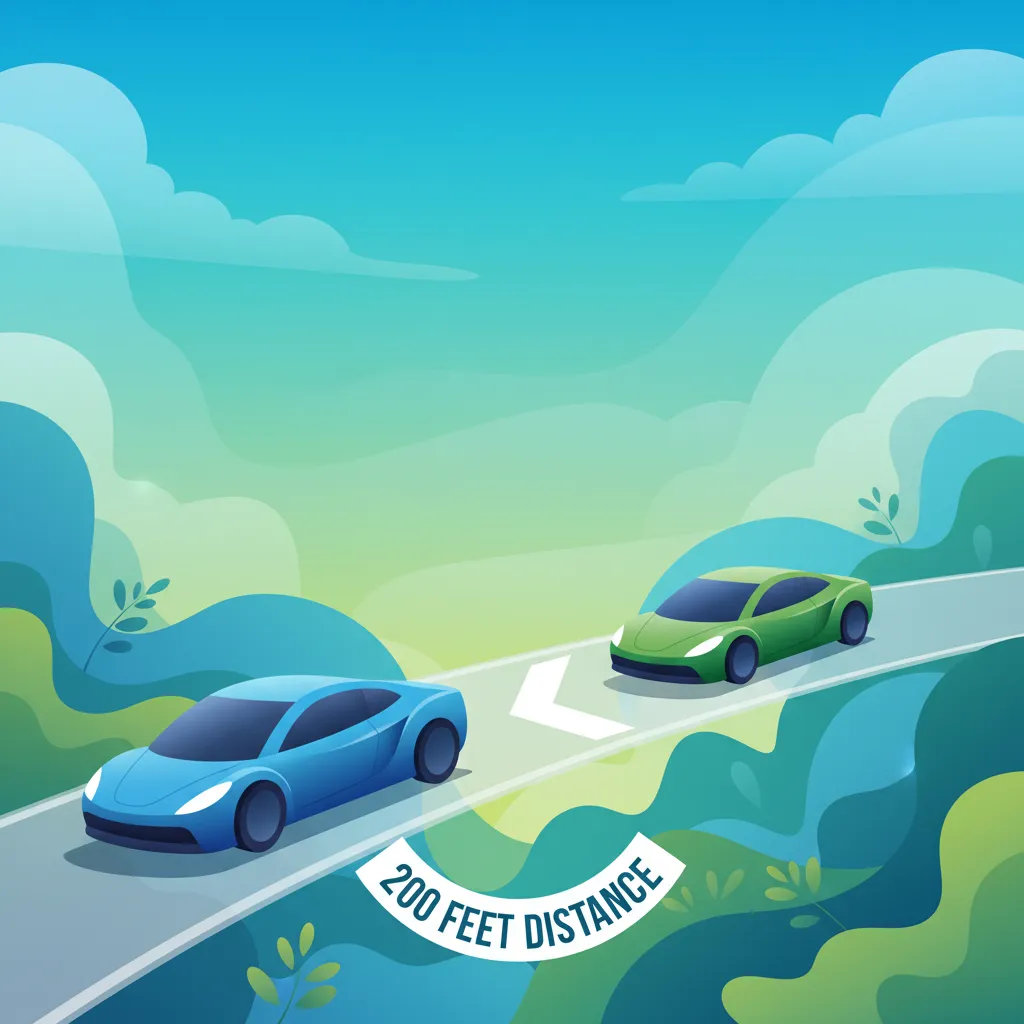
Maintaining safe distances from the vehicle ahead is crucial for preventing collisions, especially in varied Icelandic conditions. This lesson focuses on understanding and applying safe following distances, exploring the two-second rule and the factors that influence your braking distance. Mastering these concepts is key to safe driving and passing your Category B theory exam.
Lesson content overview
Driving safely on Icelandic roads requires a profound understanding of how to maintain adequate space around your vehicle. This lesson delves into the critical concepts of safe following distances and braking zones, which are fundamental to preventing collisions, ensuring sufficient reaction time, and complying with Icelandic traffic regulations. Given Iceland's unique and often challenging weather and road conditions, mastering these principles is not just about passing your driving test—it's essential for everyday safety.
Maintaining proper distances provides you with a crucial safety margin. It allows you to react to unexpected events, anticipate the actions of other drivers, and adapt to rapidly changing road conditions, whether you're navigating urban streets, open highways, or winding gravel paths.
The two-second rule is a foundational principle for maintaining a safe following distance. It dictates that a driver should keep a gap between their vehicle and the vehicle ahead that takes at least two seconds to cover at the current speed. This rule provides a simple, intuitive, and effective way to estimate a safe distance under ideal driving conditions.
To use the two-second rule, select a fixed object on the road ahead, such as a road sign, a bridge, or a shadow. As the rear of the vehicle in front of you passes that object, begin counting "one-thousand-one, one-thousand-two." Your vehicle should not reach that same object until you have finished counting "one-thousand-two." If you reach the object before completing the count, you are following too closely and need to increase your distance.
This method works because it inherently accounts for your current speed. The faster you drive, the greater the physical distance covered in two seconds, thus providing a proportional safety gap.
While the counting method is practical, understanding the underlying distance can reinforce its importance. To calculate the approximate distance covered in two seconds, you can convert your speed from kilometers per hour (km/h) to meters per second (m/s) and then multiply by two.
To convert km/h to m/s, divide by 3.6. For example, at 50 km/h: (50 km/h ÷ 3.6) ≈ 13.9 m/s Safe following distance (two seconds) ≈ 13.9 m/s × 2 s ≈ 27.8 meters.
At 90 km/h: (90 km/h ÷ 3.6) = 25 m/s Safe following distance (two seconds) = 25 m/s × 2 s = 50 meters.
These calculations demonstrate that safe following distances increase significantly with speed, emphasizing why higher speeds demand greater vigilance and larger gaps.
The standard two-second rule is a baseline for ideal conditions: dry roads, good visibility, and light traffic. However, driving conditions in Iceland are frequently far from ideal. Therefore, drivers must adjust their following distance by extending the two-second rule to three, four, or even more seconds, depending on the circumstances. This is often referred to as the adjusted following distance (AFD).
This adjustment is critical because adverse conditions increase the time and distance needed to react and stop safely. Failing to extend your following distance under challenging conditions is a major cause of rear-end collisions.
To truly understand why safe following distances are so important, it's essential to break down the total space required to bring a vehicle to a complete stop. This total stopping distance is the sum of two distinct components: reaction distance and braking distance.
Reaction distance is the distance your vehicle travels from the moment you perceive a hazard until you physically begin to apply the brakes. This interval is known as your perception-reaction time.
For an alert and unimpaired driver, the average perception-reaction time is typically assumed to be around 1.5 seconds. This time accounts for:
The formula for reaction distance is: Reaction Distance = Speed (m/s) × Perception-Reaction Time (s)
For example, if you are driving at 72 km/h (20 m/s) and your perception-reaction time is 1.5 seconds, your reaction distance would be: 20 m/s × 1.5 s = 30 meters.
Factors like fatigue, distraction, alcohol, drugs, or even simply being in an unfamiliar environment can significantly increase your perception-reaction time, thereby increasing your reaction distance and the overall space needed to stop. On icy roads, for instance, the increased stress and cognitive load can extend reaction times to 2 seconds or more.
Always assume your reaction time might be longer than average. Drive defensively, anticipate hazards, and maintain a generous following distance, especially in demanding conditions.
Braking distance is the distance your vehicle travels from the moment you apply the brakes until it comes to a complete stop. Unlike reaction distance, which is primarily a function of driver response, braking distance is heavily influenced by physics and external factors.
The simplified formula for braking distance is: Braking Distance = (Speed²) / (2 × μ × g)
Where:
This formula reveals a crucial relationship: braking distance increases quadratically with speed. This means if you double your speed, your braking distance quadruples, highlighting why higher speeds demand exponentially larger safety margins.
The coefficient of friction (μ) is particularly critical in Iceland.
Consider the difference:
This drastic increase in braking distance on slippery surfaces underscores why significant speed reduction and extended following distances are paramount in Icelandic winter conditions.
The total stopping distance is the complete space required for your vehicle to come to a halt from the moment a hazard is recognized. It is the sum of the reaction distance and the braking distance:
Total Stopping Distance = Reaction Distance + Braking Distance
This combined distance is what you must always account for when judging a safe following distance. Your two-second rule and its adjustments are designed to provide a gap that is at least equal to, and ideally greater than, your total stopping distance under the prevailing conditions.
Several factors beyond basic speed influence your total stopping distance and, consequently, how much following distance you need. Drivers in Iceland must be particularly aware of these variables due to the country's diverse and often challenging environment.
Weather profoundly affects the coefficient of friction and driver perception.
The type and condition of the road surface also play a significant role.
The state of your vehicle directly impacts its ability to stop.
Reduced visibility, whether due to darkness, fog, or heavy precipitation, directly impacts your perception time.
Beyond maintaining appropriate following distances, specific techniques are required for certain situations to ensure vehicle control and safety. One such critical technique in Iceland, with its varied terrain, is the hill-start.
When starting a vehicle on an incline, particularly a steep one, there is a risk of the vehicle rolling backward before you can engage forward gear and apply power. This is especially hazardous on busy roads, gravel surfaces, or in slippery conditions. The hill-start braking technique is used to prevent this rollback.
Hold with Handbrake: Apply the parking (hand) brake firmly before attempting to move. This secures the vehicle and prevents rollback.
Select Gear and Find Biting Point: For a manual transmission, engage first gear. Slowly release the clutch pedal until you feel the engine note change or the vehicle just begins to vibrate—this is the "biting point."
Apply Gentle Throttle: Once at the biting point, gently press the accelerator pedal to provide enough power to move the vehicle.
Release Handbrake Smoothly: As the engine gains power and the vehicle feels ready to move forward, smoothly release the handbrake. The vehicle should pull away without rolling backward.
Modern Vehicles with Hill-Start Assist (HSA): Many modern vehicles, including those with automatic transmissions, are equipped with Hill-Start Assist (HSA). This system automatically holds the brakes for a few seconds after you release the foot brake on an incline, giving you time to transition to the accelerator without rolling back. Learn how your vehicle's HSA system works if it has one.
Using the handbrake technique or relying on HSA is crucial on slopes, particularly those exceeding a 5% grade. Uncontrolled rollback can lead to collisions with vehicles behind you or loss of control, especially on gravel or snow where traction is already limited.
In Iceland, maintaining a safe following distance is not merely a recommendation; it is a legal requirement. The Icelandic traffic code explicitly addresses the responsibility of drivers to keep sufficient distance and avoid dangerous practices like tailgating.
Tailgating is defined as following another vehicle so closely that you cannot stop safely if the leading vehicle brakes suddenly. This practice is not only dangerous but also a punishable offense under Icelandic traffic law.
The act of driving too closely behind another vehicle, impeding the ability to stop safely in an emergency. It is a legal violation under Icelandic traffic law.
Icelandic traffic law (Article 56) considers tailgating a serious safety violation. Drivers found tailgating can face significant fines and may incur demerit points on their driving record. This legal provision underscores the importance the law places on maintaining adequate safety margins for all road users.
Failing to maintain a safe following distance can lead to several severe consequences:
Icelandic Regulation §61 mandates that drivers must maintain a distance that allows them to stop without colliding, based on speed and conditions. Furthermore, §66 specifies that in adverse conditions such as rain, snow, fog, or darkness, the following distance must be increased by at least 50%. Ignoring these regulations can lead to charges of reckless driving under §62.
Always consider the legal ramifications in addition to the safety risks. Following too closely can have lasting legal and financial consequences.
Understanding the underlying principles of safe following distances involves a blend of physics and human psychology.
Proactive driving involves constantly assessing and reassessing the road conditions, traffic flow, and your vehicle's capabilities to maintain a dynamic and safe following distance. This constant vigilance is especially important when encountering vulnerable road users like pedestrians and cyclists, where a sudden movement might require an immediate, full stop.
Safe following distances and braking zones are not arbitrary rules; they are carefully calculated safety principles rooted in physics, human physiology, and legal requirements. For drivers undertaking the Official Icelandic Driving License B Theory Course, internalizing these concepts is paramount.
Always start with the two-second rule as your baseline. Then, critically evaluate current conditions—weather, road surface, visibility, traffic density, and vehicle load—and consciously extend that following distance as needed. Remember that on wet roads, aim for three seconds; on snow or ice, four seconds or more. When towing or heavily loaded, factor in the increased braking distance. Master the hill-start technique to ensure control on inclines.
By consistently maintaining adequate space and adapting your driving to the conditions, you significantly reduce the risk of collisions, enhance your ability to react to emergencies, and contribute to safer roads for everyone in Iceland.
Safe following distances in Iceland require applying the two-second rule as a baseline and adjusting it based on speed, weather, road surface, visibility, and vehicle load. Total stopping distance combines reaction distance (affected by perception time) and braking distance (affected by speed squared and road friction). Icelandic weather conditions—rain, snow, ice, and fog—significantly reduce tire grip and can extend braking distances fivefold or more compared to dry conditions. The law mandates safe distances and specifically requires a 50% increase in adverse conditions, with tailgating being a prosecutable offense. Mastering these concepts is essential for both passing the Category B theory exam and real-world driving safety on Icelandic roads.
A short set of high-value points that capture the most important learning from this lesson.
The two-second rule provides a baseline safe following distance, with physical distance increasing proportionally as speed increases
Total stopping distance equals reaction distance plus braking distance; average perception-reaction time is approximately 1.5 seconds
Braking distance increases quadratically with speed, meaning doubling speed quadruples braking distance
In Icelandic conditions, extend following distance to 3 seconds in rain and 4+ seconds in snow or ice
Tailgating is a legal violation under Icelandic traffic law with potential fines and demerit points
Explore all units and lessons included in this driving theory course.
To calculate approximate following distance in meters, convert km/h to m/s (divide by 3.6) and multiply by the number of seconds in your following gap
On dry asphalt the coefficient of friction (μ) is ~0.7, but on ice it drops to ~0.1-0.15, increasing braking distance by 5x or more at the same speed
When towing or carrying heavy cargo, Icelandic law requires at least 20% more braking distance
On inclines exceeding 5% grade, use the hill-start braking technique with handbrake or Hill-Start Assist system to prevent rollback
Icelandic Regulation §66 requires a 50% minimum increase in following distance in adverse conditions (rain, snow, fog, darkness)
Using the same following distance regardless of weather, failing to account for reduced friction on wet or icy roads
Underestimating how dramatically braking distance increases on slippery surfaces—up to 5-10 times longer than on dry roads
Not adjusting following distance when carrying heavy loads or towing, which increases momentum and stopping distance
Forgetting that braking distance grows quadratically with speed, not linearly—higher speeds demand exponentially greater space
Ignoring reduced visibility at night or in fog, which effectively increases reaction time beyond the standard 1.5 seconds
Lesson content overview
A short set of high-value points that capture the most important learning from this lesson.
The two-second rule provides a baseline safe following distance, with physical distance increasing proportionally as speed increases
Total stopping distance equals reaction distance plus braking distance; average perception-reaction time is approximately 1.5 seconds
Braking distance increases quadratically with speed, meaning doubling speed quadruples braking distance
In Icelandic conditions, extend following distance to 3 seconds in rain and 4+ seconds in snow or ice
Tailgating is a legal violation under Icelandic traffic law with potential fines and demerit points
Explore all units and lessons included in this driving theory course.
To calculate approximate following distance in meters, convert km/h to m/s (divide by 3.6) and multiply by the number of seconds in your following gap
On dry asphalt the coefficient of friction (μ) is ~0.7, but on ice it drops to ~0.1-0.15, increasing braking distance by 5x or more at the same speed
When towing or carrying heavy cargo, Icelandic law requires at least 20% more braking distance
On inclines exceeding 5% grade, use the hill-start braking technique with handbrake or Hill-Start Assist system to prevent rollback
Icelandic Regulation §66 requires a 50% minimum increase in following distance in adverse conditions (rain, snow, fog, darkness)
Using the same following distance regardless of weather, failing to account for reduced friction on wet or icy roads
Underestimating how dramatically braking distance increases on slippery surfaces—up to 5-10 times longer than on dry roads
Not adjusting following distance when carrying heavy loads or towing, which increases momentum and stopping distance
Forgetting that braking distance grows quadratically with speed, not linearly—higher speeds demand exponentially greater space
Ignoring reduced visibility at night or in fog, which effectively increases reaction time beyond the standard 1.5 seconds
Explore search topics learners often look for when studying Safe Following Distances and Braking Zones. These topics reflect common questions about road rules, driving situations, safety guidance, and lesson level theory preparation for learners in Iceland.
Browse additional driving theory lessons that cover connected traffic rules, road signs, and common driving situations related to this topic. Improve your understanding of how different rules interact across everyday traffic scenarios.
Explore how speed, road surface conditions, vehicle load, and weather impact a vehicle's braking distance. Understand the physics and Icelandic regulations for safe stopping.

This lesson details the fundamentals of effective braking, covering both controlled deceleration and emergency stops. Learners will understand how factors like speed, road surface, and reaction time collectively determine total stopping distance. It also explains how to balance front and rear brake application to maximize stopping power without losing control.
Learn to apply safe following distance rules in practical Icelandic driving situations, including adverse weather, rural roads, and urban traffic. Understand Icelandic tailgating laws.
This lesson focuses on the regulations governing highland travel and off-road restrictions, including environmental protections that prohibit off-road driving in certain zones. The lesson details how to interpret highland road signage, understand restrictions related to wildlife crossings like reindeer and sheep, and adhere to road width management guidelines. Learners are also instructed on using emergency contact points in sparsely populated regions.
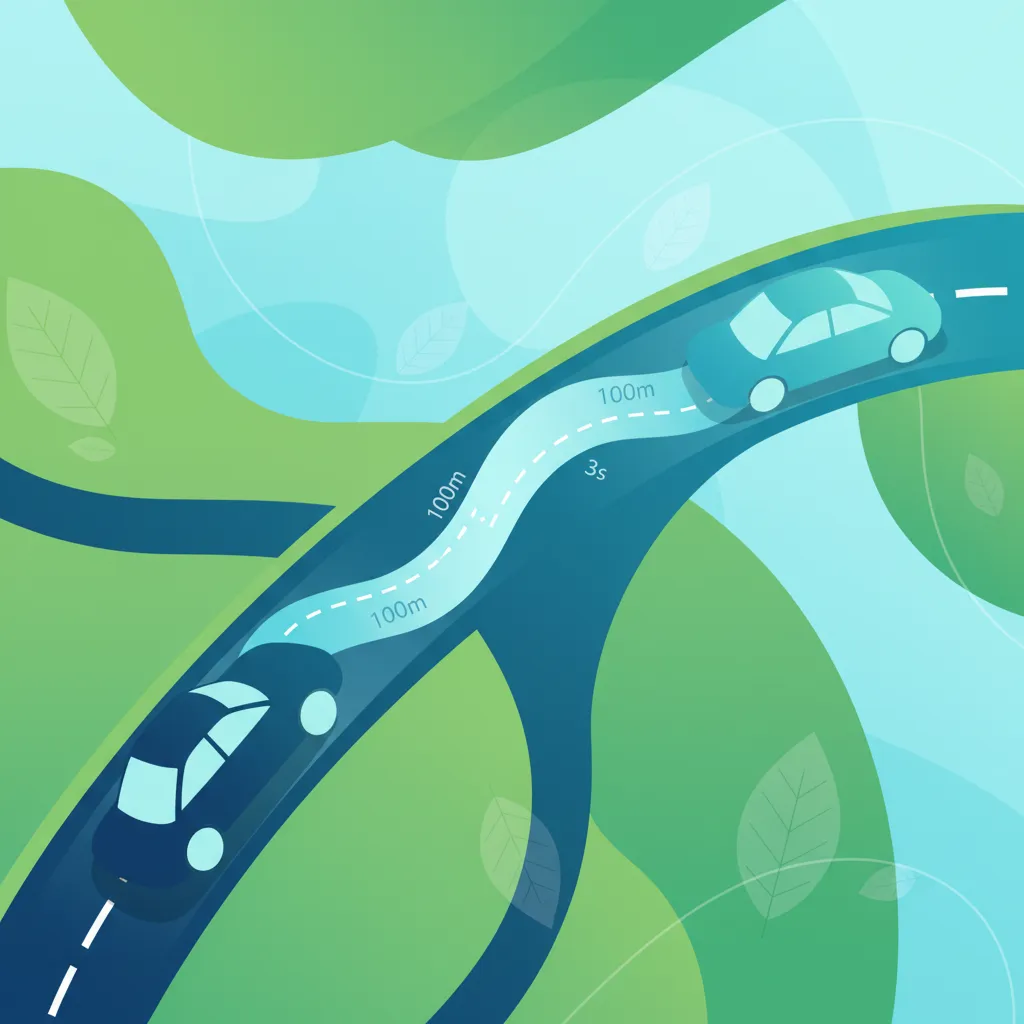
This lesson focuses on the concept of maintaining a safe following distance using the time-gap method. It explains how to create a sufficient buffer zone to react to sudden stops by the vehicle ahead. Riders will learn to adjust this gap based on speed, weather, and visibility to prevent rear-end collisions and ensure adequate reaction time.
This lesson outlines the speed limits applicable to various road types in Iceland, from urban streets to rural highways and special zones like tunnels. Learners will interpret speed sign markings, understand variable speed limits that adjust for weather, and recognize when temporary speed reductions are enforced. The content also covers speed monitoring devices and the legal consequences of exceeding limits, emphasizing speed awareness in all driving contexts.
This lesson helps learners develop an understanding of how drivers perceive and assess risks on Icelandic roads, particularly under variable weather and lighting conditions. The content discusses mental models used to anticipate the actions of other road users and the importance of identifying subtle hazards. By analysing environmental cues and applying systematic hazard perception strategies, students learn to enhance their situational awareness and make safer driving decisions.
This lesson addresses the challenges of driving in rain and fog, focusing on strategies to maintain visibility and vehicle control. Learners will explore the correct use of windshield wipers, defoggers, and appropriate headlight settings, including when to use fog lights. The content also covers the increased risk of hydroplaning, the importance of adjusting speed in wet conditions, and the need to extend following distances to account for longer stopping distances.
This lesson explores the proper use of lane markings to maintain correct vehicle centering and adherence to the prescribed traffic flow direction in Iceland. The content describes how to interpret solid and broken lines, maintain safe following distances within a lane, and avoid unintended lane departures. Learners also examine the legal prohibitions on using the road shoulder for general travel, ensuring compliance with lane discipline rules for overall traffic safety.

This lesson details the essential actions to take immediately after a collision, focusing on securing the accident scene and contacting emergency services using the universal number 112. The content explains how to use hazard lights, position vehicles to avoid secondary collisions, and assess the situation for immediate dangers. Learners also review their legal duty to report accidents and the appropriate information to provide to the police to ensure the scene remains safe.
This lesson examines the set of safety equipment required by Icelandic law to be present in every passenger vehicle, focusing on seat belts, airbags, fire extinguishers, and reflective vests. The content explains the correct placement and usage protocols for each item, including how to operate a fire extinguisher and don a reflective vest. Additionally, learners are introduced to the legal requirement for an emergency triangle and a first-aid kit.

This lesson outlines the regulations governing pedestrian crossings, including zebra crossings, pedestrian traffic lights, and the driver’s obligations to yield. Learners will study how to identify crosswalk markings, interpret pedestrian signal phases, and understand the enhanced caution required in school zones and areas with high foot traffic. The content also emphasizes the need for drivers to anticipate vulnerable pedestrians and provide additional yielding in low-visibility conditions.
This lesson focuses on the operation of roundabouts, which are common in Icelandic towns and rural areas, and explains how drivers must yield to circulating traffic upon entry. The content covers how to interpret roundabout signage and follow lane markings to maintain correct positioning. Students also learn strategies for safe exit, handling multi-lane roundabouts, and recognizing deceptive entries that require heightened vigilance for smooth navigation.
Find clear answers to common questions learners have about Safe Following Distances and Braking Zones. Learn how the lesson is structured, which driving theory objectives it supports, and how it fits into the overall learning path of units and curriculum progression in Iceland. These explanations help you understand key concepts, lesson flow, and exam focused study goals.
The two-second rule is a simple method to estimate a safe following distance. Pick a fixed object the car ahead passes (like a sign or lamppost). Start counting 'one thousand one, one thousand two'. If you pass the same object before you finish counting, you are too close. Increase your speed slightly and repeat the count until you have a two-second gap. On wet or icy roads, this gap should be increased to three or four seconds.
Speed has a significant impact on braking distance; it doesn't just increase linearly, it increases by the square of the speed. This means if you double your speed, your braking distance will be four times longer. This is why maintaining appropriate speeds, especially in conditions where you might need to brake suddenly, is vital for safety on Icelandic roads.
Several factors affect stopping distance. These include the driver's reaction time (affected by fatigue, distraction, or impairment), the condition of the brakes and tires, the weight of the vehicle and its load, and crucially, the road surface condition. Icy, wet, or loose gravel surfaces significantly increase braking distance compared to dry asphalt.
Absolutely. Icelandic weather often requires a greater following distance than the standard two-second rule. In rain, snow, fog, or on icy roads, you should extend your following distance to at least three or four seconds, or even more in very poor conditions, to account for reduced visibility and longer braking times.
The braking zone refers to the distance your vehicle travels from the moment you perceive a hazard or decide to brake until your vehicle comes to a complete stop. It includes both your reaction distance (distance covered during your reaction time) and the actual braking distance (distance covered while the brakes are applied).
Tailgating, or following too closely, is dangerous because it leaves you insufficient time and space to react if the vehicle in front brakes suddenly, leading to a collision. To avoid it, actively use the two-second rule (or more in bad weather), check your mirrors regularly, and if someone is tailgating you, don't panic. Slow down gradually if safe to do so, allowing them to pass, or move to a passing lane if available.
Utilize our advanced practice set search to pinpoint the exact Icelandic driving theory topics you need to review. Filter by subject, difficulty, or question type to create a highly effective study plan and ensure you are fully prepared for your official driving licence test in Iceland.