
This lesson focuses on fundamental lane discipline and road positioning, crucial for safe driving and success in the Icelandic Category B theory exam. You will learn to interpret road markings and maintain your vehicle's correct place within a lane, building on basic traffic rules and preparing you for more complex driving scenarios.
Lesson content overview
Welcome to this essential lesson within your Official Icelandic Driving License B Theory Course. Understanding and practicing proper lane discipline and road positioning is fundamental to safe and efficient driving in Iceland. This lesson delves into the critical aspects of how to interpret road markings, maintain your vehicle's correct position on the road, and navigate various traffic situations with confidence and compliance. By mastering these principles, you contribute significantly to reducing collision risks and ensuring predictable traffic flow for all road users.
Lane discipline is the practice of adhering to the rules and guidelines that govern a vehicle's position on the road. It ensures that every driver occupies their designated space, follows the prescribed direction of travel, and respects the separation intended by road markings. This structured approach to driving creates an organized flow, minimizes conflict points, and allows drivers to anticipate each other's actions, which is especially important given Iceland's diverse road conditions, from bustling urban areas to challenging rural and winter environments.
The core idea is to ensure each vehicle uses its designated space on the carriageway, follows the intended direction, and respects road markings. This reduces conflict and allows drivers to anticipate movements. From a safety perspective, staying centered in your lane maximizes buffer zones on either side of your vehicle, improves visibility of crucial road markings, and helps you avoid encroaching on opposing traffic or endangering vulnerable road users such as pedestrians and cyclists. Consistent and correct lane use also simplifies decision-making, particularly under adverse conditions like snow, ice, or limited visibility, which are common challenges in Iceland.
This lesson connects closely with knowledge gained from 'Road Signs, Traffic Lights & Road Markings' (Unit 3) for understanding symbols, 'Priority Rules, Intersections & Roundabouts' (Unit 4) for yielding within lanes, and 'Speed, Following Distance, Stopping & Parking' (Unit 6) for safe longitudinal spacing. It also lays the groundwork for 'Turning Principles and Signalling' (Unit 5.2) and 'Urban Driving, Pedestrians, Cyclists & Vulnerable Road Users' (Unit 7), where correct lane use is paramount for safety.
Effective lane discipline is built upon several core principles that guide a driver's actions and decisions on the road. Adhering to these principles is not only a legal requirement but also a commitment to safety.
The practice of keeping the vehicle’s wheels consistently within the lateral bounds of the lane markings throughout travel, aiming for the central portion of the lane.
Lane centering means maintaining a steady trajectory within your lane, avoiding any tendency to drift towards the edges. This provides a predictable path for your vehicle, maximizes clearance from roadside hazards like guardrails or ditches, and ensures you remain compliant with the intended traffic flow direction. Drivers must continuously make small steering adjustments to maintain this central position, especially when navigating curves, inclines, or encountering road irregularities. Proper centering also keeps your vehicle out of adjacent lanes and away from vulnerable road users on the shoulder.
Lane discipline extends beyond mere centering; it encompasses adhering to the prescribed use of each lane. This includes respecting the direction of travel, understanding overtaking rules, and obeying any specific lane restriction signs. Proper lane discipline is crucial for preventing head-on and side collisions, supporting efficient traffic movement, and complying with legal restrictions. For instance, overtaking is only permitted on designated lanes, and mandatory lane changes are dictated by signage and road markings, which drivers must learn to interpret accurately.
Road markings are visual cues painted on the roadway that delineate lane boundaries, indicate directions, and specify permitted maneuvers. Understanding the meaning of solid, broken, double, and combined lines in various contexts is essential. These markings tell drivers where crossing is allowed, where lane changes are prohibited, and where they must stay within a lane. Violating these markings, such as crossing a solid line, not only carries legal penalties but also significantly increases the risk of a crash.
Maintaining an adequate longitudinal space to the vehicle ahead, while staying within your designated lane, is paramount for safety. This safe following distance allows you sufficient reaction time for braking or evasive maneuvers, particularly under Iceland's low-traction conditions, such as those caused by ice or snow. The required distance must always be increased in adverse weather or when visibility is reduced to compensate for longer stopping distances.
In Iceland, there is a strict legal restriction against using the road shoulder for normal travel. The shoulder is primarily reserved for emergencies, such as vehicle breakdowns, or where specific signage explicitly permits its use (e.g., for buses at certain times). This rule prevents the obstruction of emergency lanes, reduces wear on surfaces not designed for regular traffic, and avoids creating hazards for pedestrians or cyclists who may use the shoulder. Drivers must remain in the carriageway lanes unless legally allowed to use the shoulder.
Road markings are a critical language for drivers. In Iceland, as elsewhere, these painted lines provide constant guidance on how to use the road safely and legally.
A solid line painted on the road surface indicates a strict prohibition against crossing it. This means you must maintain your lane position and are not permitted to change lanes or overtake. Solid lines are used in areas where crossing would be hazardous, such as near curves, hills, intersections, or where there is a risk of head-on collisions.
A continuous line marking the boundary of a lane or separating traffic flows, indicating that crossing it is prohibited.
Violating this rule can lead to significant penalties and is a major cause of accidents. Drivers must remain in their current lane when a solid line is present on their side of the road.
In contrast to solid lines, a broken (or dashed) line indicates that crossing is permitted, provided it is safe to do so. This typically applies to lane changes or overtaking maneuvers. When you see a broken line, you may proceed with a lane change after carefully checking your mirrors, signaling your intention, and ensuring there is ample space and no approaching hazards.
A dashed line marking that permits crossing for lane changes or overtaking, provided it is safe and legal.
It is crucial to remember that "permitted" does not mean "mandatory" or "always safe." Always assess the traffic situation, road conditions, and visibility before crossing a broken line.
A double solid line consists of two parallel continuous lines. This marking signifies an absolute prohibition against crossing for traffic moving in either direction. Double solid lines are typically found separating opposing traffic flows on two-way roads, especially in areas with high traffic volume, limited visibility, or high-speed limits where head-on collisions are particularly dangerous. They can also mark central reservations or areas where turns are strictly forbidden.
Two parallel continuous lines separating traffic flows; crossing is prohibited for vehicles in both directions.
Drivers must always remain on their side of a double solid line. There are generally no exceptions for normal driving, only for specific emergencies or explicit police direction.
Sometimes, you will encounter a combination of a solid line and a broken line painted side-by-side. The rule for these markings is determined by the line closest to your vehicle. If the solid line is on your side, you may not cross it. If the broken line is on your side, you may cross it (e.g., to overtake or change lanes), provided it is safe. This setup is often used to allow overtaking for traffic moving in one direction, while simultaneously prohibiting it for traffic moving in the opposite direction.
Do not confuse a broken line near the shoulder with permission to use the shoulder for regular travel. Edge lines simply mark the road's boundary.
Lane centering is more than just staying between the lines; it's a dynamic skill that significantly enhances safety and predictability on the road.
On straight sections of road, static centering involves keeping your vehicle consistently in the middle of your lane. This provides the maximum possible buffer space on both sides, minimizing the risk of side-swiping other vehicles, roadside objects, or vulnerable road users. To achieve this, drivers should look well ahead, focusing on where their vehicle is going, rather than directly at the lane lines immediately in front of the hood. Small, continuous steering adjustments are more effective than sudden, large corrections.
Dynamic centering involves adjusting your vehicle's position through curves, inclines, declines, and when encountering road irregularities. For example, on a curving road, your aiming point will shift, and you will need to gently steer through the curve while maintaining your central position. Similarly, if there's a pothole or debris in your lane, you might momentarily shift slightly to one side to avoid it, then return to the center as soon as it's safe. In challenging Icelandic weather, such as strong winds or icy patches, dynamic centering becomes even more critical, requiring heightened awareness and precise control to counter environmental forces.
When driving in strong crosswinds, a common occurrence in Iceland, anticipate gusts and be prepared to make minor steering corrections to maintain your lane position.
Navigating curves requires a specific approach to road positioning to maximize safety, visibility, and vehicle stability, particularly on winding Icelandic roads.
When approaching a curve, especially a sharp one or one with limited visibility, the safest practice is to adopt an "outside position." This means positioning your vehicle closer to the outer edge of your lane as you enter the curve. As you move through the curve, you can gently steer towards the inner edge of your lane, then gradually back towards the outside as you exit. This technique, sometimes called "late apexing" in advanced driving, effectively widens your turning radius, making the curve feel less sharp and increasing your line of sight deeper into the curve.
This outside-inside-outside trajectory provides a crucial safety margin. It gives you more time to react to unexpected hazards, such as an oncoming vehicle drifting into your lane, a pedestrian, or debris. It also helps to maintain vehicle stability, reducing the lateral forces that can cause loss of traction, particularly on slippery surfaces like ice or gravel.
Driving too close to the inside edge of a curve at speed reduces your turning radius and can severely limit your visibility of oncoming traffic or hazards hidden around the bend. This significantly increases the risk of collision or running off the road.
A critical aspect of lane discipline is maintaining a safe following distance from the vehicle ahead. This distance is measured in time, not just vehicle lengths, and ensures you have enough time to perceive a hazard, react, and brake safely without colliding.
Under normal driving conditions (dry roads, good visibility), the widely accepted minimum safe following distance is the "two-second rule." To apply this, choose a fixed point on the road, such as a sign or a bridge. When the vehicle in front of you passes that point, start counting "one thousand one, one thousand two." If your vehicle reaches that same point before you finish counting, you are following too closely. This rule is effective because it accounts for your speed; the faster you travel, the more distance you cover in two seconds.
Iceland's unique environment often demands a greater following distance. In adverse weather conditions, such as rain, snow, ice, fog, or when visibility is reduced (e.g., at night), the two-second rule is insufficient. The four-second rule should be adopted as a minimum. This doubled distance provides the extra time needed to react to unexpected events and accounts for the significantly longer braking distances required on low-traction surfaces. For extreme conditions, such as black ice or heavy blizzards, even longer distances may be necessary.
The minimum safe longitudinal gap between your vehicle and the vehicle ahead, measured in seconds, to allow for safe reaction and braking.
Factors that necessitate increasing your following distance:
While Icelandic law does not codify a strict numerical rule for following distance, it mandates maintaining a "reasonable stopping distance" (RSR §14-1-25). This implies that drivers must adapt their following distance to prevailing conditions, and failure to do so can result in legal penalties and liability in case of a rear-end collision.
The road shoulder, also known as the verge, is the area immediately adjacent to the travel lanes. In Iceland, using the road shoulder for regular travel is strictly prohibited by law (RSR §14-1-21).
This legal restriction serves several critical purposes:
The only instances where using the shoulder is permitted are:
Never use the shoulder to bypass traffic jams, to avoid a queue at an intersection, or to turn right more quickly. This is illegal, dangerous, and can result in significant fines.
The rules governing lane discipline in Iceland are codified in the Icelandic Road Traffic Regulation (Ráðgjöf um ökutæki og umferð – RSR). Adherence to these regulations is mandatory for all drivers.
Understanding common mistakes helps in preventing them and fostering safer driving habits.
Lane discipline is not a static set of rules; it must be adapted to various driving conditions and contexts.
Icelandic weather can change rapidly. In conditions like snow, ice, heavy rain, or fog, several adjustments are necessary:
The cumulative effect of correct lane discipline is profound. When drivers maintain their lanes, respect markings, and keep safe distances, the entire traffic system operates more predictably. This predictability is the cornerstone of road safety, allowing drivers to anticipate movements, react calmly to changes, and significantly reduce the likelihood of collisions.
By mastering these concepts, drivers contribute to a safer, more efficient, and more enjoyable driving experience across Iceland’s diverse road network.
Let's explore how these concepts apply in real-world Icelandic driving situations.
Setting: You are driving on a single carriageway rural road. On your side of the road, the lane is separated from the opposing traffic by a solid white line. On the opposing traffic's side, there is a broken line. Ahead, you notice a slower vehicle.
Correct behavior: Since there is a solid line on your side, you are not permitted to cross it to overtake. You must remain patiently behind the slower vehicle, maintaining a safe following distance. You continue driving until you reach a section of the road where the line on your side becomes broken, and it is safe to overtake.
Incorrect behavior: You attempt to overtake by crossing the solid line, forcing the oncoming traffic (which had a broken line on their side, allowing them to potentially cross if safe) to react suddenly, creating a head-on collision risk.
Setting: You are driving on a dual-lane urban road in Reykjavík during a light snowfall. The lanes are separated by broken lines.
Correct behavior: Recognize the reduced traction due to snow. Instead of the normal two-second rule, you increase your following distance to at least four seconds behind the vehicle ahead. You ensure your vehicle is centered in your lane and only consider changing lanes if there's a clear, large gap, signaling your intention well in advance. Your steering inputs are smooth and gentle.
Incorrect behavior: You follow the vehicle ahead at a two-second distance, assuming normal braking performance. When the vehicle in front brakes suddenly, you are unable to stop in time on the slippery surface, resulting in a rear-end collision.
Setting: You are on a multi-lane motorway approaching a construction zone. Temporary signs indicate a lane closure ahead, and a solid white line has been painted to merge traffic into the open lane.
Correct behavior: You begin to merge into the open lane well before the solid line, as instructed by the temporary signage. You check your mirrors, signal your intention, and adjust your speed to blend smoothly with traffic in the open lane. You then maintain a centered position within the new lane and a safe following distance.
Incorrect behavior: You continue driving in the closing lane until the last possible moment, attempting to pass other vehicles before aggressively merging over the solid white line, causing disruption and potential collisions with drivers who merged earlier.
Setting: You are driving on a winding mountain road in rural Iceland. There are no central lane markings, but solid edge lines define the road. You approach a sharp, blind curve.
Correct behavior: You reduce your speed significantly before entering the curve. You position your vehicle towards the outer edge of your lane, maximizing your line of sight into the curve. You gently steer through the curve, staying well within the edge lines, ready to react to any unseen hazards.
Incorrect behavior: You enter the curve at too high a speed, hugging the inner edge. This limits your visibility, and you are surprised by an oncoming vehicle or an unexpected hazard, leading to a potential loss of control or collision.
Setting: While driving on a main road in Iceland, your car suddenly starts making a loud noise, indicating a mechanical failure. There's a clear shoulder on your right.
Correct behavior: You activate your hazard warning lights immediately. You safely and gradually steer your vehicle off the main carriageway onto the shoulder, bringing it to a complete stop as far away from the flow of traffic as possible. Once safe, you can assess the situation and call for assistance.
Incorrect behavior: You continue driving on the shoulder for several kilometers, trying to reach the next town, using it as an additional lane. This is illegal and puts you, your passengers, and anyone else on or near the shoulder in danger.
Mastering lane discipline and road positioning is not merely about adhering to a set of rules; it's about developing a proactive and safety-conscious approach to driving. In Iceland, where road conditions can vary dramatically and present unique challenges, a thorough understanding and consistent application of these principles are paramount.
By correctly interpreting road markings, maintaining a precise lane position, adjusting your following distance for prevailing conditions, and respecting the purpose of road shoulders, you contribute to a predictable and safe driving environment for everyone. These skills are foundational for all aspects of driving and will serve you well as you navigate the beautiful and often challenging roads of Iceland.
This lesson covers the essential rules for lane discipline and road positioning specific to Icelandic driving. Key topics include interpreting solid, broken, double solid, and combined lane markings, maintaining proper vehicle centering within lanes, and applying the two-second rule (normal conditions) or four-second rule (adverse weather) for following distances. Drivers must never use the road shoulder for regular travel except during emergencies or when explicitly sign-posted. When navigating curves, the outside position technique provides better visibility and stability by widening your turning radius.
A short set of high-value points that capture the most important learning from this lesson.
Solid lines prohibit lane changes; broken lines permit them when safe, but never mandatory or always safe
Lane centering maximizes buffer zones on both sides and improves visibility of road markings
Use the four-second rule in Iceland's adverse weather conditions instead of the standard two-second rule
Position your vehicle toward the outer edge when entering curves to maximize visibility and stability
The road shoulder is reserved strictly for emergencies or designated signage; it cannot be used for regular travel or bypassing traffic
Explore all units and lessons included in this driving theory course.
Double solid lines prohibit crossing in BOTH directions with no general exceptions
Combined lines follow the side-closest-to-you rule: solid on your side means no crossing
In curves, the outside-inside-outside technique widens your turning radius and sight lines
Following distance must increase when: carrying heavy loads, towing trailers, driving on gravel, or visibility is reduced
Only use the shoulder for breakdowns (with hazard lights activated) or when official signs explicitly permit it
Crossing a solid line to overtake on a narrow rural road instead of waiting for a broken-line section
Maintaining a two-second following distance in icy or snowy conditions, leading to rear-end collisions
Hugging the inner edge of a curve, which reduces visibility and increases collision risk
Using the shoulder to bypass traffic jams, endangering emergency vehicles and vulnerable road users
Not signaling a lane change until the last moment near a solid line, creating unpredictable maneuvers
Lesson content overview
A short set of high-value points that capture the most important learning from this lesson.
Solid lines prohibit lane changes; broken lines permit them when safe, but never mandatory or always safe
Lane centering maximizes buffer zones on both sides and improves visibility of road markings
Use the four-second rule in Iceland's adverse weather conditions instead of the standard two-second rule
Position your vehicle toward the outer edge when entering curves to maximize visibility and stability
The road shoulder is reserved strictly for emergencies or designated signage; it cannot be used for regular travel or bypassing traffic
Explore all units and lessons included in this driving theory course.
Double solid lines prohibit crossing in BOTH directions with no general exceptions
Combined lines follow the side-closest-to-you rule: solid on your side means no crossing
In curves, the outside-inside-outside technique widens your turning radius and sight lines
Following distance must increase when: carrying heavy loads, towing trailers, driving on gravel, or visibility is reduced
Only use the shoulder for breakdowns (with hazard lights activated) or when official signs explicitly permit it
Crossing a solid line to overtake on a narrow rural road instead of waiting for a broken-line section
Maintaining a two-second following distance in icy or snowy conditions, leading to rear-end collisions
Hugging the inner edge of a curve, which reduces visibility and increases collision risk
Using the shoulder to bypass traffic jams, endangering emergency vehicles and vulnerable road users
Not signaling a lane change until the last moment near a solid line, creating unpredictable maneuvers
Explore search topics learners often look for when studying Lane Discipline and Road Positioning. These topics reflect common questions about road rules, driving situations, safety guidance, and lesson level theory preparation for learners in Iceland.
Browse additional driving theory lessons that cover connected traffic rules, road signs, and common driving situations related to this topic. Improve your understanding of how different rules interact across everyday traffic scenarios.
Explore advanced techniques for lane positioning and road usage in Iceland, covering complex scenarios, special road types, and adapting to diverse traffic and weather conditions. This lesson builds upon basic lane discipline principles for enhanced safety and compliance.
This lesson helps learners develop an understanding of how drivers perceive and assess risks on Icelandic roads, particularly under variable weather and lighting conditions. The content discusses mental models used to anticipate the actions of other road users and the importance of identifying subtle hazards. By analysing environmental cues and applying systematic hazard perception strategies, students learn to enhance their situational awareness and make safer driving decisions.
This lesson addresses the challenges of driving in rain and fog, focusing on strategies to maintain visibility and vehicle control. Learners will explore the correct use of windshield wipers, defoggers, and appropriate headlight settings, including when to use fog lights. The content also covers the increased risk of hydroplaning, the importance of adjusting speed in wet conditions, and the need to extend following distances to account for longer stopping distances.
This lesson focuses on interpreting road surface markings, including solid and broken lines that govern lane changes and positioning. Learners will understand the rules associated with turning arrows, pedestrian crossings, and markings for dedicated lanes. Correctly reading these markings is essential for maintaining proper lane discipline and navigating complex road layouts safely.
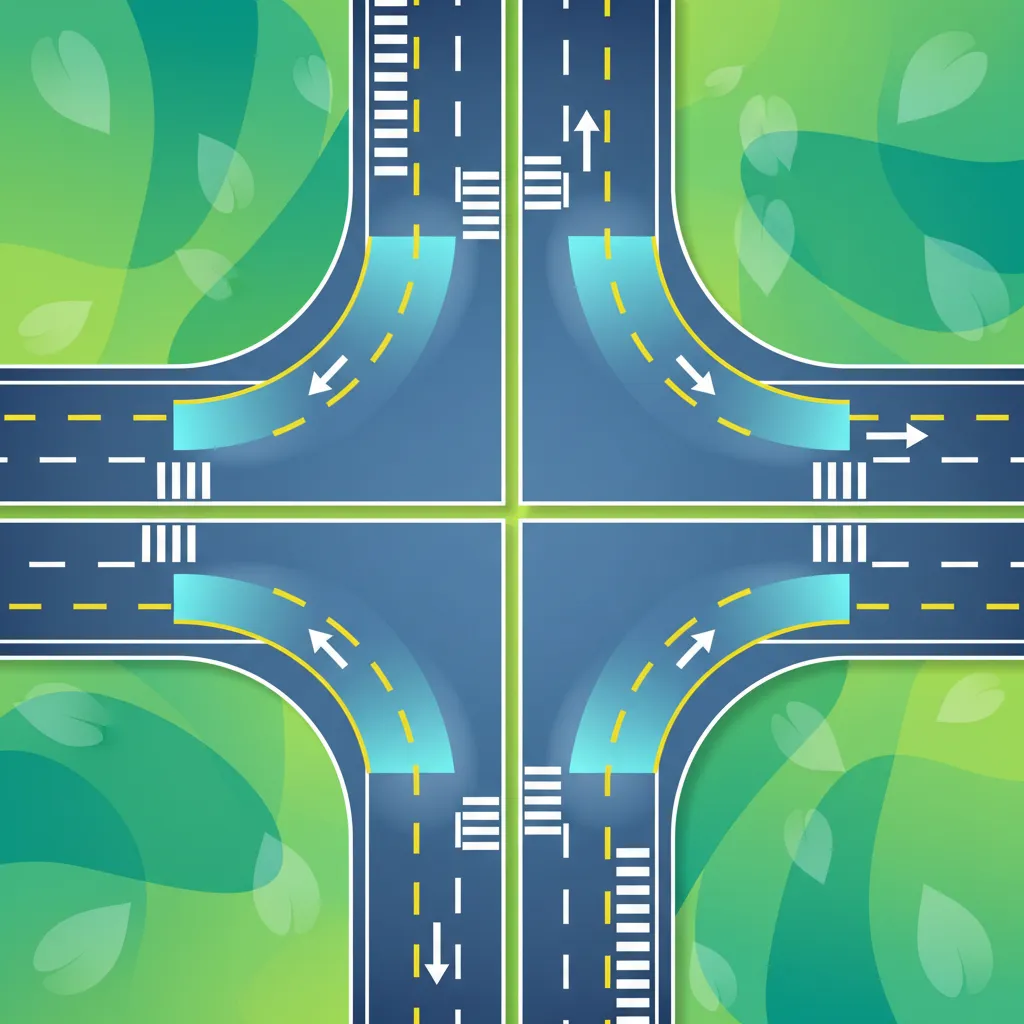
This lesson provides a comprehensive overview of the road markings found on Icelandic roads, from solid and broken lane lines to symbols indicating turning lanes and pedestrian crossings. The content details the visual meanings of each marking, such as solid lines indicating no crossing and broken lines permitting lane changes. Additionally, the lesson addresses the purpose of reflective markers and surface textures used in low-visibility or icy conditions, providing a framework for interpreting pavement cues.
This lesson examines the specific techniques required for safe driving on snow-covered or icy roads in Iceland, covering the mandatory use of winter tires and the operation of anti-lock braking systems. Learners will study optimal low-speed cornering, proper braking distances on ice, and how to recover from a skid safely. By mastering these techniques, drivers can maintain control in challenging winter conditions and significantly reduce the risk of accidents on slippery surfaces.

This lesson explores the specific challenges of driving on Icelandic gravel roads, focusing on the reduced traction and vehicle dynamics associated with loose surfaces. The content explains how to adapt speed appropriately, maintain safe following distances, and use gentle braking to avoid skidding. Learners also study proper lane sharing etiquette, including how to safely pass other vehicles and manage loose stones that may be thrown, ensuring vehicle stability.
This lesson focuses on the principles of executing safe turns, highlighting the correct use of turn signals and lane positioning before initiating a turn. Learners examine the timing required for signaling, the rules governing right-turns and left-turn yields, and the importance of checking blind spots and cyclist lanes. The lesson also addresses the concept of turning radius to ensure drivers can complete turns without compromising the safety of others on the road.

This lesson examines how strong winds and varying light conditions affect vehicle handling and safety, including techniques for maintaining stability under cross-winds and assessing gust intensity. The content also explains proper headlight usage during daylight, dusk, and nighttime, addressing glare reduction strategies and when to employ high-beam headlights. By mastering these concepts, drivers can navigate Icelandic weather and lighting challenges confidently and safely.
This lesson focuses on the regulations governing highland travel and off-road restrictions, including environmental protections that prohibit off-road driving in certain zones. The lesson details how to interpret highland road signage, understand restrictions related to wildlife crossings like reindeer and sheep, and adhere to road width management guidelines. Learners are also instructed on using emergency contact points in sparsely populated regions.

This lesson focuses on the operation of traffic lights in Iceland, describing standard three-phase cycles (red, amber, green) and variations such as flashing amber for yielding. Learners will also explore dedicated signals for pedestrians, cyclists, and turning movements, including arrow indications. The lesson explains how signal timing integrates with right-of-way rules at intersections, ensuring drivers can interpret and respond to each light state to maintain safety.
Understand typical errors and violations related to lane discipline, road markings, and shoulder usage in Iceland. This lesson details how to avoid frequent mistakes that compromise safety and legal compliance, crucial for the Icelandic theory exam.
This lesson provides a comprehensive overview of the road markings found on Icelandic roads, from solid and broken lane lines to symbols indicating turning lanes and pedestrian crossings. The content details the visual meanings of each marking, such as solid lines indicating no crossing and broken lines permitting lane changes. Additionally, the lesson addresses the purpose of reflective markers and surface textures used in low-visibility or icy conditions, providing a framework for interpreting pavement cues.
This lesson focuses on interpreting road surface markings, including solid and broken lines that govern lane changes and positioning. Learners will understand the rules associated with turning arrows, pedestrian crossings, and markings for dedicated lanes. Correctly reading these markings is essential for maintaining proper lane discipline and navigating complex road layouts safely.
This lesson focuses on the operation of roundabouts, which are common in Icelandic towns and rural areas, and explains how drivers must yield to circulating traffic upon entry. The content covers how to interpret roundabout signage and follow lane markings to maintain correct positioning. Students also learn strategies for safe exit, handling multi-lane roundabouts, and recognizing deceptive entries that require heightened vigilance for smooth navigation.
This lesson focuses on the principles of executing safe turns, highlighting the correct use of turn signals and lane positioning before initiating a turn. Learners examine the timing required for signaling, the rules governing right-turns and left-turn yields, and the importance of checking blind spots and cyclist lanes. The lesson also addresses the concept of turning radius to ensure drivers can complete turns without compromising the safety of others on the road.
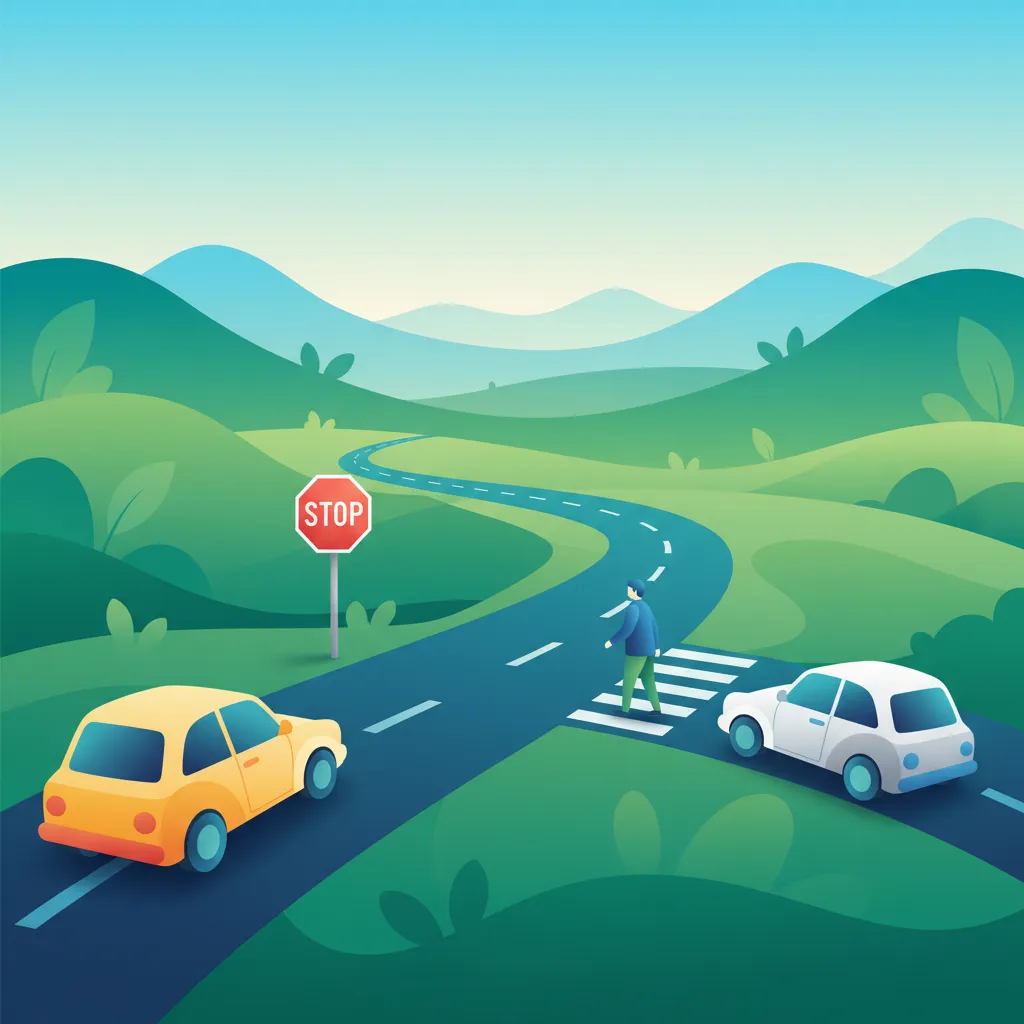
This lesson introduces the fundamental concepts of right-of-way in Iceland, explaining the priority hierarchy that dictates when a driver must yield to others. Learners study the meaning of give-way and yield signs, the distinction between main and side roads, and how stop signs and markings affect vehicle positioning. By understanding these legal obligations, students will be able to determine correct actions at any junction, reducing the risk of collisions.
This lesson focuses on the regulations governing highland travel and off-road restrictions, including environmental protections that prohibit off-road driving in certain zones. The lesson details how to interpret highland road signage, understand restrictions related to wildlife crossings like reindeer and sheep, and adhere to road width management guidelines. Learners are also instructed on using emergency contact points in sparsely populated regions.

This lesson outlines the regulations governing pedestrian crossings, including zebra crossings, pedestrian traffic lights, and the driver’s obligations to yield. Learners will study how to identify crosswalk markings, interpret pedestrian signal phases, and understand the enhanced caution required in school zones and areas with high foot traffic. The content also emphasizes the need for drivers to anticipate vulnerable pedestrians and provide additional yielding in low-visibility conditions.
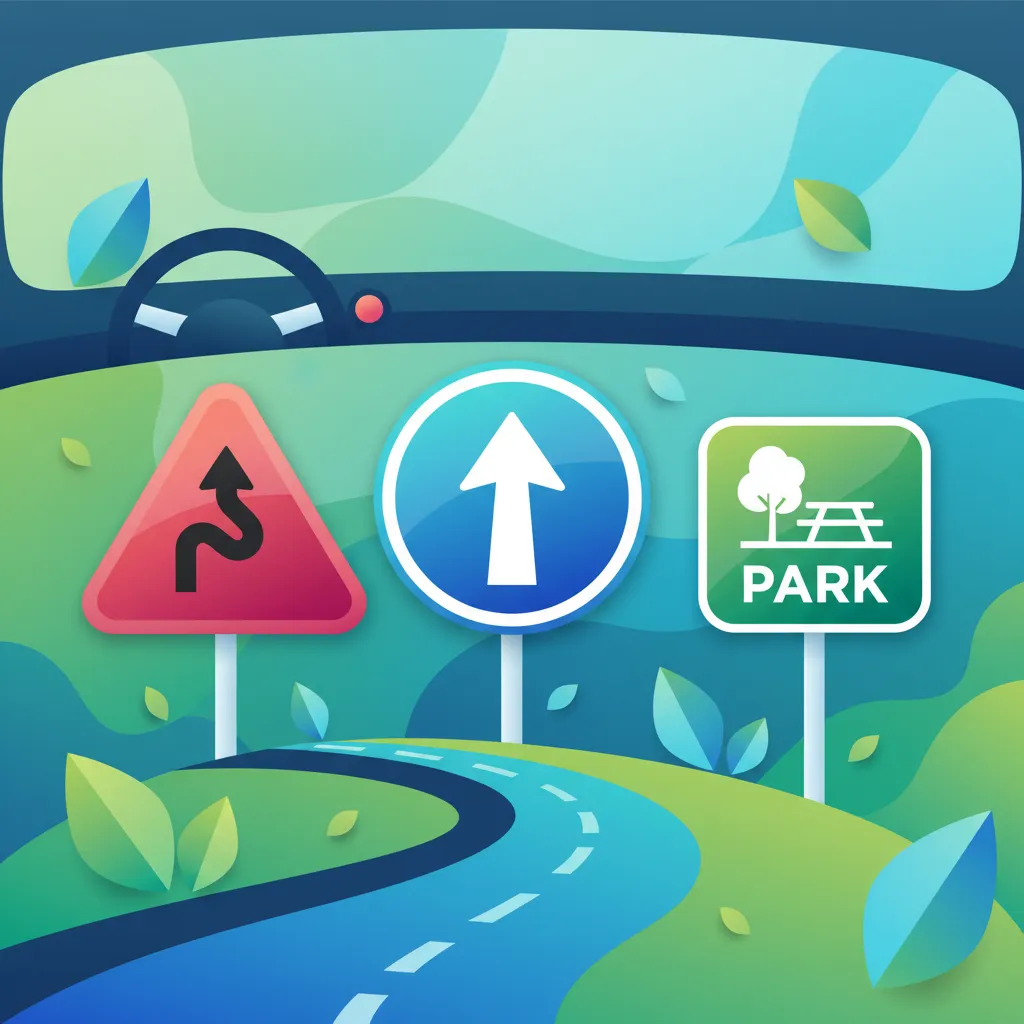
This lesson categorizes Icelandic road signs into regulatory signs that dictate mandatory actions, warning signs that alert drivers to hazards, and informational signs that provide guidance. It explains the distinctive shapes and colour schemes for each category, such as circles for prohibitions and triangles for warnings. By mastering these conventions, students will be able to interpret sign intent instantly and adapt their driving behaviour accordingly to comply with legal obligations.
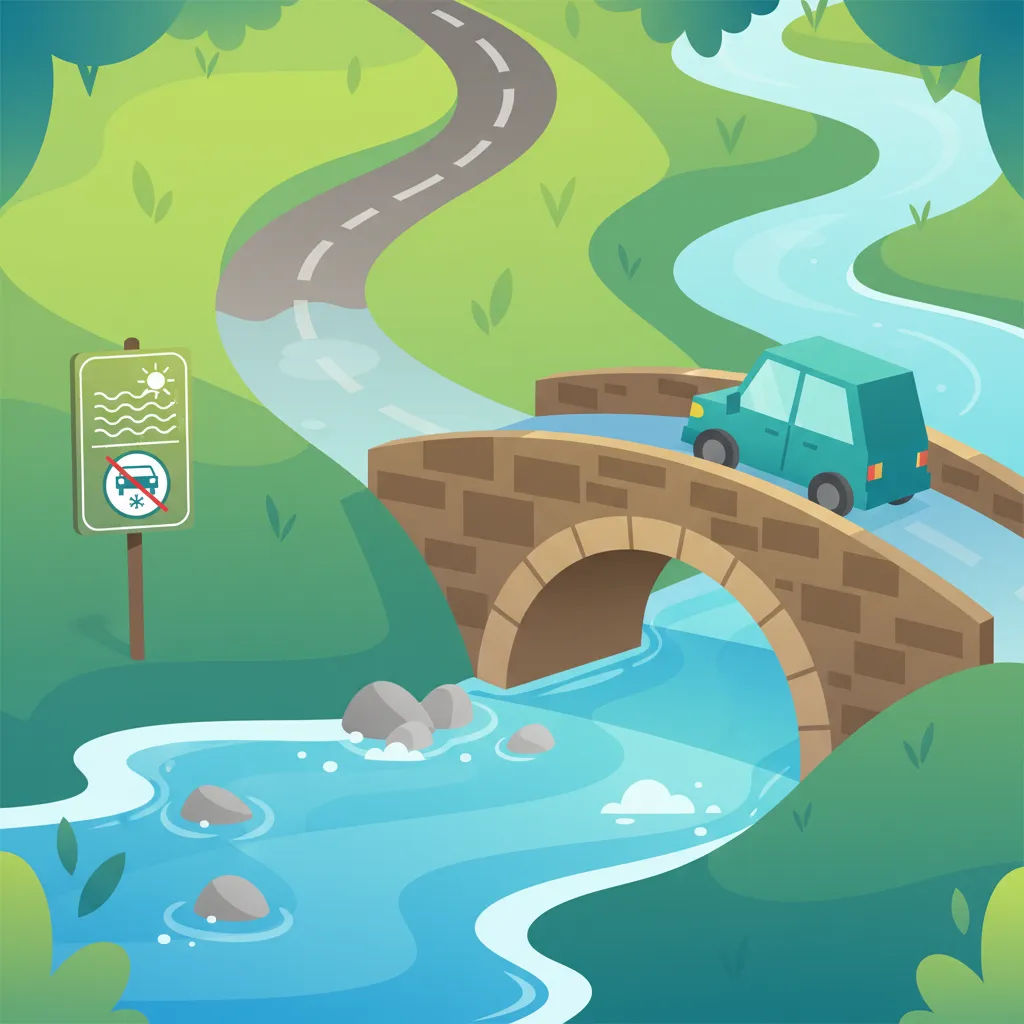
This lesson examines procedures for crossing single-lane bridges and water fords, paying particular attention to right-of-way rules and appropriate vehicle positioning. Learners will learn how to assess water depth before fording, understand seasonal restrictions that may affect access, and recognize signage indicating temporary closures. The lesson also covers the need for highland travel permits on certain routes and weight limits for bridges.
This lesson details the fundamentals of lane discipline and proper turning techniques for moped riders. It covers the correct use of turn signals, judging appropriate cornering speed, and executing safe lane changes. The material provides a step-by-step guide to navigating intersections and curves with control and predictability, ensuring safety for the rider and other road users.
Find clear answers to common questions learners have about Lane Discipline and Road Positioning. Learn how the lesson is structured, which driving theory objectives it supports, and how it fits into the overall learning path of units and curriculum progression in Iceland. These explanations help you understand key concepts, lesson flow, and exam focused study goals.
In Iceland, broken white lines indicate that you may cross into another lane when safe to do so, for overtaking or changing direction. Solid white lines, especially closer to the edge of the road or when indicating a hazard, generally prohibit lane changes. Always assess the specific context and surrounding traffic before making any manoeuvre.
No, the road shoulder is generally reserved for emergencies, breakdowns, or specific authorized vehicles. It is illegal and unsafe to use the road shoulder for general travel, overtaking, or as a regular part of your lane. This ensures the shoulder remains clear for legitimate use and prevents accidents.
You should aim to keep your vehicle centred within the lane markings. This typically means maintaining an equal distance from both the left and right lane lines. Regular checks of your mirrors and your vehicle's position relative to the lines will help you stay centred and aware of your surroundings.
Lane discipline is a fundamental aspect of road safety tested in the Icelandic driving theory exam. Questions will assess your understanding of lane markings, correct lane usage, and safe manoeuvring, directly impacting your ability to pass. Mastering these concepts ensures you can answer relevant questions correctly and drive safely.
On urban roads, lanes are often narrower and traffic denser, requiring precise positioning and adherence to markings. On rural roads, especially unpaved ones, lane discipline involves managing vehicle position to avoid hazards like loose gravel or uneven surfaces, while still respecting the road's general path and any defined lanes.
Utilize our advanced practice set search to pinpoint the exact Icelandic driving theory topics you need to review. Filter by subject, difficulty, or question type to create a highly effective study plan and ensure you are fully prepared for your official driving licence test in Iceland.