
Parallel parking is a key maneuver tested in the driving theory exam and essential for everyday driving. This lesson breaks down the process into simple steps, teaching you how to use reference points and adhere to legal requirements for safe and correct parking. It builds on the basic maneuvering skills introduced earlier in the curriculum.

Lesson content overview
Parallel parking is a fundamental driving skill and a crucial maneuver for obtaining a Category B driver's license in Poland. This lesson provides a detailed breakdown of the technique, emphasizing precision through vehicle reference points, and covers the specific legal requirements governing parked vehicles in Poland. Mastery of parallel parking demonstrates not only spatial awareness and vehicle control but also a deep understanding of traffic law, all essential for safe and responsible urban driving.
Parallel parking involves aligning your vehicle parallel to the curb within a designated space, typically between two other parked cars or alongside a specific section of the road. It is a controlled reverse-movement maneuver that demands careful judgment and execution. For those preparing for their Polish Category B driving theory and practical exams, proficiency in this skill is mandatory, showcasing your ability to operate a vehicle safely and legally in tight urban environments.
This lesson forms an integral part of your comprehensive Category B license preparation, building upon foundational knowledge from earlier sections such as "Vehicle Controls and Operation" (understanding clutch, brakes, and steering), "Traffic Signs and Road Markings" (identifying permissible parking zones), and "Urban and Residential Driving" (navigating high-density traffic situations).
Successful parallel parking relies on a set of fundamental principles that ensure both safety and legal compliance. These principles guide your actions throughout the maneuver, allowing for repeatable and effective execution.
Executing a parallel park efficiently and safely requires a systematic approach. By following these steps, you can consistently achieve a well-positioned vehicle.
Step 1: Preparing for the Maneuver
Approach the desired parking space and position your vehicle parallel to the car in front of the empty space. Ensure there is approximately one meter of lateral clearance between your vehicle and the parked car. Your rear bumper should ideally align with the rear bumper of the parked car. Signal your intention to park by activating your right or left turn signal, depending on which side of the road you are parking on. Check your mirrors and blind spots for any approaching traffic, pedestrians, or cyclists.
Step 2: The Initial Reverse Turn
Engage reverse gear. Begin backing up slowly, looking over your right shoulder and using your side mirrors. When your rear wheels are roughly aligned with the rear bumper of the parked car (or a specific reference point you've identified, often the side mirror aligning with the rear bumper of the front car), turn your steering wheel fully towards the curb (e.g., to the right if parking on the right side of the road). Continue reversing slowly, observing your left side mirror to monitor the clearance between your vehicle's front and the parked car ahead, and your right side mirror to watch the curb.
Step 3: Straightening and Alignment
As your vehicle's rear wheel approaches the curb and the body of your car reaches an angle of approximately 45 degrees to the curb, begin to straighten your steering wheel (turn it back to the center position). Continue backing slowly. At this point, your vehicle's front should be clearing the parked car ahead. Once your vehicle's front bumper clears the parked car ahead, turn your steering wheel fully in the opposite direction (e.g., to the left). This will swing the front of your vehicle towards the curb, bringing it parallel to the curb line.
Step 4: Final Adjustments
Continue reversing slowly until your vehicle is parallel to the curb and positioned centrally within the parking space. Ensure there is adequate space both in front of and behind your vehicle. Once parallel, straighten your wheels to the center position. If necessary, perform minor forward or reverse adjustments (correction maneuvers) to achieve the ideal distance from the curb and equal spacing from the vehicles ahead and behind. Engage the handbrake and select a gear (first gear if parking facing uphill, reverse gear if facing downhill) to secure the vehicle.
Accurate judgment of distances is paramount in parallel parking. Rather than relying solely on intuition, experienced drivers utilize specific reference points on their vehicle to gauge their position relative to the curb and other vehicles.
Familiarize yourself with these reference points for your specific vehicle before practicing. What works for one car might need slight adjustment for another due to differing dimensions.
The mechanics of your vehicle play a significant role in parallel parking. Your car's turning radius—the smallest circular turn it can make—is determined by factors such as its wheelbase (distance between front and rear axles) and maximum steering angle. A larger vehicle generally has a larger turning radius, requiring more space and a broader arc to maneuver.
Understanding your vehicle's geometry helps you anticipate its movement. When you turn the steering wheel sharply while reversing, the rear of your car swings inward more quickly than the front. Conversely, when you counter-steer, the front of the car swings into position. Misjudging these movements can lead to over-steering (hitting the car ahead) or under-steering (ending up too far from the curb or hitting the curb sharply). Consciously using your mirrors to observe the path of both the front and rear of your vehicle as you turn is vital.
In Poland, specific regulations govern how and where vehicles must be parked to ensure road safety and maintain traffic flow. Adhering to these rules is not just about passing an exam; it's about responsible driving. The primary legislation governing these requirements is the Polish Road Traffic Act (Ustawa Prawo o ruchu drogowym).
When parallel parking, your vehicle must be positioned appropriately close to the curb.
The Polish Road Traffic Act generally mandates that a vehicle must be parked no more than 30 centimeters from the curb, measured from the outer edge of the vehicle body (often from the tire sidewall or the rear bumper corner closest to the curb). Parking too far from the curb can cause your vehicle to protrude into the traffic lane, creating a hazard for passing vehicles. This is a common violation and can result in fines.
When parking between two other vehicles, sufficient space must be maintained to allow for safe entry and exit from all vehicles.
While general guidelines often suggest at least 50 centimeters, the rule of thumb is to ensure that doors can be opened safely without impacting adjacent vehicles. This clearance allows occupants to enter and exit their cars freely and prevents minor side-impacts that can occur when vehicles are parked too close together. If parking markers dictate specific spaces, you must adhere to those.
Knowing where you are permitted to park is as important as knowing how to park. Road signs and markings clearly define legal parking zones and prohibited areas.
These signs indicate areas where parking is permitted. They may be supplemented with additional information, such as parking method (e.g., perpendicular, angled), time limits, or payment requirements.
The "Zakaz parkowania" (B-36) sign prohibits parking but allows for short stops (e.g., to pick up or drop off passengers) as long as the vehicle is not left unattended and traffic is not impeded. The "Zakaz postoju" (B-35) sign is more restrictive, prohibiting both stopping and parking. These signs are crucial to observe, and ignoring them will lead to fines and potentially penalty points on your license. Additionally, yellow lines painted on the curb or roadside often indicate parking restrictions.
When choosing a parking spot, always consider its impact on other road users.
It is generally recommended not to park too close to pedestrian crossings, intersections, or road curves, as this can obstruct the line of sight (LOS) for pedestrians, cyclists, and other drivers. Obscuring visibility can significantly increase the risk of accidents. For pedestrian crossings, a minimum distance (e.g., 5 meters) is often advised or legally mandated. Always ensure your parked vehicle does not block driveways, access points for emergency services, or designated disabled parking spaces (MOP - Miejsce Parkingowe dla Osób Niepełnosprawnych) unless you possess the appropriate permit.
Even experienced drivers can make errors during parallel parking. Awareness of these common pitfalls can help you avoid them and maintain a clean driving record.
Parallel parking is not a static maneuver; it requires adaptation based on environmental and situational factors.
The techniques and regulations surrounding parallel parking are designed with safety and efficiency in mind.
Parallel parking in Poland is a controlled four-step reverse maneuver requiring precise reference points and a two-stage steering technique to position your vehicle within 30 cm of the curb while maintaining at least 50 cm clearance from adjacent vehicles. Key legal requirements include observing parking zone signs (D-18 series for permitted zones, B-36 and B-35 for prohibitions) and maintaining adequate distance from pedestrian crossings and intersections to preserve line of sight. Critical safety habits include checking mirrors and blind spots continuously, engaging the handbrake on slopes with correct wheel positioning, and using appropriate lighting at night. Common mistakes include parking too far from the curb, insufficient spacing, ignoring prohibited zone signs, and driving too fast to maintain control.
A short set of high-value points that capture the most important learning from this lesson.
Parallel parking requires a precise two-stage reverse maneuver: first turning sharply toward the curb, then counter-steering to align parallel to the curb.
Use fixed vehicle reference points (rear bumper corner, side mirror alignment, front axle position) to judge distances accurately instead of intuition.
Polish law mandates a maximum 30 cm distance from the curb when parked; insufficient clearance risks fines and traffic hazards.
Maintain at least 50 cm clearance between your vehicle and parked cars to allow safe door opening for all occupants.
On slopes, engage the handbrake and turn front wheels toward the curb when facing downhill, away from the curb when facing uphill.
Explore all units and lessons included in this driving theory course.
The B-36 (Zakaz parkowania) sign prohibits parking but allows brief stops; the B-35 (Zakaz postoju) sign prohibits both stopping and parking entirely.
Always check mirrors and blind spots before and during the maneuver to detect pedestrians, cyclists, and approaching traffic.
Begin straightening your steering wheel when your vehicle reaches approximately 45 degrees to the curb during the second stage.
Do not park within 5 meters of pedestrian crossings, intersections, or curves; these zones are mandated to preserve line of sight for all road users.
At night or in poor visibility, activate parking lights and consider hazard lights if your vehicle is in a poorly visible location.
Parking more than 30 cm from the curb, which narrows the traffic lane and endangers passing vehicles.
Leaving insufficient gap between parked vehicles, preventing safe door opening and risking damage to adjacent cars.
Failing to observe 'Zakaz parkowania' (B-36) or 'Zakaz postoju' (B-35) signs, resulting in fines or vehicle towing.
Neglecting to engage the handbrake on inclines, causing the vehicle to roll and create hazards for traffic.
Driving too fast during the maneuver, reducing control and increasing the risk of clipping the curb or colliding with vehicles.
Lesson content overview
A short set of high-value points that capture the most important learning from this lesson.
Parallel parking requires a precise two-stage reverse maneuver: first turning sharply toward the curb, then counter-steering to align parallel to the curb.
Use fixed vehicle reference points (rear bumper corner, side mirror alignment, front axle position) to judge distances accurately instead of intuition.
Polish law mandates a maximum 30 cm distance from the curb when parked; insufficient clearance risks fines and traffic hazards.
Maintain at least 50 cm clearance between your vehicle and parked cars to allow safe door opening for all occupants.
On slopes, engage the handbrake and turn front wheels toward the curb when facing downhill, away from the curb when facing uphill.
Explore all units and lessons included in this driving theory course.
The B-36 (Zakaz parkowania) sign prohibits parking but allows brief stops; the B-35 (Zakaz postoju) sign prohibits both stopping and parking entirely.
Always check mirrors and blind spots before and during the maneuver to detect pedestrians, cyclists, and approaching traffic.
Begin straightening your steering wheel when your vehicle reaches approximately 45 degrees to the curb during the second stage.
Do not park within 5 meters of pedestrian crossings, intersections, or curves; these zones are mandated to preserve line of sight for all road users.
At night or in poor visibility, activate parking lights and consider hazard lights if your vehicle is in a poorly visible location.
Parking more than 30 cm from the curb, which narrows the traffic lane and endangers passing vehicles.
Leaving insufficient gap between parked vehicles, preventing safe door opening and risking damage to adjacent cars.
Failing to observe 'Zakaz parkowania' (B-36) or 'Zakaz postoju' (B-35) signs, resulting in fines or vehicle towing.
Neglecting to engage the handbrake on inclines, causing the vehicle to roll and create hazards for traffic.
Driving too fast during the maneuver, reducing control and increasing the risk of clipping the curb or colliding with vehicles.
Explore search topics learners often look for when studying Parallel Parking Technique and Legal Requirements. These topics reflect common questions about road rules, driving situations, safety guidance, and lesson level theory preparation for learners in Poland.
Browse additional driving theory lessons that cover connected traffic rules, road signs, and common driving situations related to this topic. Improve your understanding of how different rules interact across everyday traffic scenarios.
Explore advanced techniques for parallel parking and other essential maneuvers. Understand complex scenarios, common errors to avoid, and specific Polish legal requirements for safe and successful parking.
This lesson covers the common parking scenarios found in car parks: perpendicular (90-degree) and angled bays. It explains the techniques for both driving in forwards and reversing in, highlighting the visibility and safety advantages of the latter. Proper alignment within the marked lines is a key focus to ensure space for other vehicles.
This lesson details the various parking regulations encountered in residential areas. It explains how to interpret signs indicating permitted parking zones, time restrictions, and areas where parking is prohibited. Correctly positioning the vehicle within marked bays and understanding rules about pavement parking are also covered to avoid fines and obstruction.
This lesson teaches fundamental maneuvering skills essential for everyday driving. It provides a step-by-step guide to reversing in a straight line and around a corner, emphasizing constant observation. The lesson also details the procedure for a three-point turn, a necessary skill for changing direction on a narrow road safely and efficiently.
This lesson focuses on the rules and social responsibility surrounding parking spaces designated for disabled individuals. It explains the eligibility requirements for a disabled parking permit and the correct way to display it. The content stresses the severe penalties for misuse and the importance of leaving these spaces available for those who genuinely need them.
This lesson clarifies the legal distinction between 'stopping' and 'parking' and the rules that apply to each. It teaches how to read and understand a variety of parking signs, including those that indicate time limits, paid parking zones, and areas where stopping is completely forbidden. This knowledge is essential for avoiding fines and ensuring traffic flow is not obstructed.

This lesson teaches the fundamentals of safely reversing a bus using mirrors, cameras, and alarms. It covers low-speed control essential for depot navigation, where precise steering is required to avoid collisions. Specific techniques for handling articulated buses and coordinating with ground staff are also discussed to ensure safe maneuvers.

This lesson focuses on reversing and maneuvering techniques required when operating a tractor with a trailer, particularly in confined farmyards or on narrow rural roads. It outlines the use of mirrors to monitor trailer swing and suggests best practices for using spotters to improve safety. The lesson also covers planning reversal paths and executing wide-angle turns without compromising load stability.

This lesson addresses the high-risk maneuver of reversing a large truck. It provides systematic techniques for using mirrors and, if available, cameras to monitor the vehicle's path, while strongly emphasizing the importance of managing extensive blind spots. Learners will study procedures for maneuvering within tight spaces like loading docks and yards, including the proper use of a spotter (banksman) to ensure the area is clear and to provide guidance, minimizing the risk of collisions.
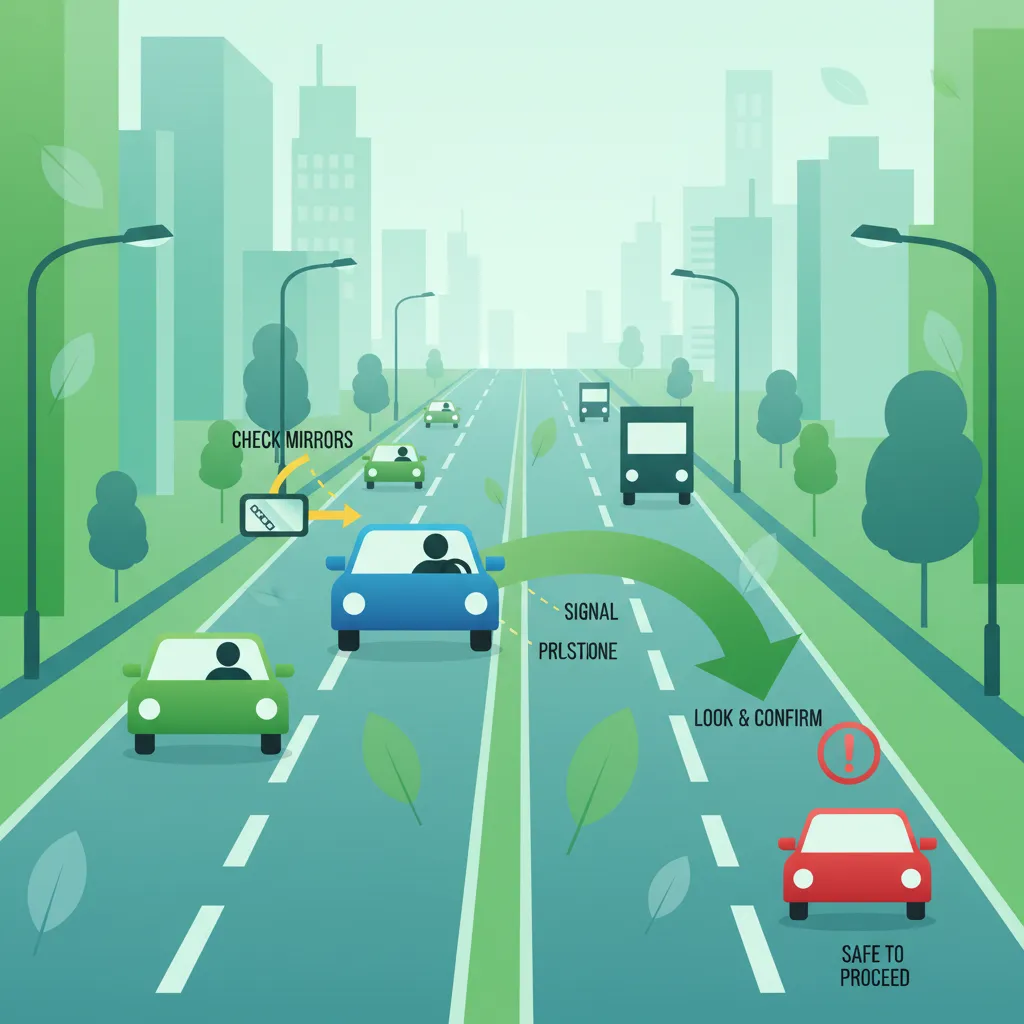
This lesson adapts lane-changing principles for the challenging environment of dense city traffic. It reinforces the critical 'mirror, signal, maneuver' sequence, with a strong focus on checking blind spots immediately before moving. The content advises on judging gaps in traffic and executing the lane change smoothly and decisively.
This lesson emphasizes the importance of systematic observation for safe driving. It teaches how to correctly adjust and use rearview and side mirrors to monitor traffic, and explains why shoulder checks are essential for detecting hazards in blind spots. These techniques are fundamental for safe lane changes, turns, and overall situational awareness.
Learn the detailed legal requirements for parallel parking in Poland, including mandatory distances from the curb, clearance between vehicles, and understanding parking zone signage. Ensure compliance with Polish road traffic law.
This lesson details the various parking regulations encountered in residential areas. It explains how to interpret signs indicating permitted parking zones, time restrictions, and areas where parking is prohibited. Correctly positioning the vehicle within marked bays and understanding rules about pavement parking are also covered to avoid fines and obstruction.
This lesson clarifies the legal distinction between 'stopping' and 'parking' and the rules that apply to each. It teaches how to read and understand a variety of parking signs, including those that indicate time limits, paid parking zones, and areas where stopping is completely forbidden. This knowledge is essential for avoiding fines and ensuring traffic flow is not obstructed.
This lesson covers the common parking scenarios found in car parks: perpendicular (90-degree) and angled bays. It explains the techniques for both driving in forwards and reversing in, highlighting the visibility and safety advantages of the latter. Proper alignment within the marked lines is a key focus to ensure space for other vehicles.
This lesson focuses on the rules and social responsibility surrounding parking spaces designated for disabled individuals. It explains the eligibility requirements for a disabled parking permit and the correct way to display it. The content stresses the severe penalties for misuse and the importance of leaving these spaces available for those who genuinely need them.
This lesson details the legal framework for overtaking in Poland. It explains how to interpret road markings, such as solid and double solid lines, and prohibition signs that forbid passing. The content emphasizes the critical need for sufficient sight distance and a clear path before initiating an overtaking maneuver to ensure safety.
This lesson provides practical methods for maintaining a safe buffer zone behind the vehicle in front. It explains the 'two-second rule' as a minimum following distance in good conditions and how to increase it to three or more seconds in adverse weather. This skill is critical for allowing enough time to react and brake safely to avoid rear-end collisions.
This lesson teaches fundamental maneuvering skills essential for everyday driving. It provides a step-by-step guide to reversing in a straight line and around a corner, emphasizing constant observation. The lesson also details the procedure for a three-point turn, a necessary skill for changing direction on a narrow road safely and efficiently.

This lesson focuses on the rules of lane usage for maintaining safe and efficient traffic flow. It covers the meaning of different lane markings, such as solid versus broken lines, and the general principle of keeping to the rightmost lane unless overtaking. Proper lane discipline is crucial for predictability and preventing conflicts on multi-lane roads.

This lesson provides essential guidance for driving in fog, one of the most dangerous conditions. It instructs on the correct use of low-beam headlights and fog lights to maximize visibility without causing glare. The core advice is to significantly reduce speed and use the edge of the road or markings as a guide.
Find clear answers to common questions learners have about Parallel Parking Technique and Legal Requirements. Learn how the lesson is structured, which driving theory objectives it supports, and how it fits into the overall learning path of units and curriculum progression in Poland. These explanations help you understand key concepts, lesson flow, and exam focused study goals.
According to Polish regulations, your vehicle should be parallel to the curb and no more than 0.2 meters (20 cm) away from it. This lesson will guide you on how to achieve this distance accurately.
Reference points vary slightly depending on the vehicle, but common ones involve aligning your rear bumper with the other car's rear bumper, then using your side mirror to line up with the curb. This lesson details specific points and how to use them.
Yes, you must watch out for prohibition signs (znaki zakazu), particularly 'no parking' (zakaz postoju) and 'no stopping' (zakaz zatrzymywania się) signs. This lesson covers how to identify these and other situations where parking is illegal, such as blocking driveways or too close to intersections.
It's common to need a few adjustments. If you're not perfectly positioned, you can reposition your vehicle by moving forward or backward and continuing the maneuver, as long as you do so safely and without obstructing other road users. This lesson teaches you how to make corrections effectively.
The theory test will include questions on the rules, legal distances, and prohibited areas for parallel parking. The practical test assesses your ability to perform the maneuver safely, legally, and efficiently, demonstrating control and spatial awareness.
Build custom practice sessions tailored precisely to your needs. Focus on areas requiring improvement, review specific Polish road signs, or master complex traffic rules to ensure full preparation for your official driving license exam.