
This lesson focuses on essential low-speed vehicle control maneuvers crucial for everyday driving in Poland. You'll learn step-by-step techniques for reversing, executing a safe three-point turn on narrow roads, and navigating other tight spaces. Mastering these skills is key to completing your Category B theory preparation and building confidence behind the wheel.

Lesson content overview
Mastery of vehicle maneuvering in confined spaces is an essential skill for every driver, particularly for those preparing for the Polish Category B driving license. This comprehensive lesson details the techniques, legal requirements, and safety considerations for reversing in a straight line, reversing around corners (often called reverse parking), performing three-point turns, and navigating various tight-space scenarios. These skills are fundamental for safe operation in urban, residential, and restricted environments, demanding acute spatial awareness, precise vehicle control, and constant hazard anticipation.
Operating a vehicle in reverse or within tight confines presents unique challenges, primarily due to limited visibility and the altered steering dynamics. The Polish Road Traffic Law (Prawo o ruchu drogowym) places clear obligations on drivers to ensure these maneuvers are conducted safely, without endangering other road users. This section lays the groundwork by outlining the critical principles that underpin all effective and lawful maneuvering.
To truly understand these advanced maneuvers, it's beneficial to have a foundational grasp of vehicle controls, including steering, clutch/brake operation, accelerator use, and gear selection, typically covered in the "Vehicle Controls and Operation" section of your Polish Driving Theory course. Additionally, familiarity with general right-of-way rules and knowledge of road signs pertaining to parking and stopping zones is crucial.
Regardless of the specific maneuver, certain core principles must always be applied. These principles ensure not only your safety but also the safety of pedestrians, cyclists, and other drivers around you.
Effective observation is the cornerstone of safe maneuvering. When reversing or performing complex turns, a driver's field of view is significantly reduced, creating "blind spots" – areas around the vehicle that are not visible through mirrors.
A systematic and repeated sequence of visual checks: rear-view mirror → side mirrors → over-the-shoulder (direct look back) → forward view (when pulling out or resuming forward motion).
This continuous cycle ensures that the driver perceives all moving and stationary hazards before and throughout the maneuver. Failing to allocate sufficient time for each check can lead to missed obstacles, resulting in collisions or near-misses. It’s not just about looking; listening for approaching vehicles or pedestrians and feeling for unexpected movements of the vehicle also contribute to this comprehensive awareness.
Maintaining a low, controllable speed is paramount during any reverse or tight-space maneuver. Typically, a speed not exceeding 20 km/h is recommended. For manual transmission vehicles, this requires careful clutch control to prevent stalling while allowing the vehicle to creep slowly. In automatic transmissions, gentle use of the accelerator or simply releasing the brake pedal will achieve a similar slow speed.
Slow speed drastically reduces stopping distance, allowing for fine adjustments and giving you more time to react to unexpected hazards, like a child suddenly appearing behind your vehicle.
Clearly communicating your intentions to other road users is a legal requirement and a critical safety measure. Before initiating any reverse maneuver or a three-point turn, you must activate the appropriate direction indicators. For instance, when beginning a three-point turn, you would signal left for the initial forward motion, then right before reversing.
Polish law also provides for situations where vehicle lights may be insufficient or non-functional. According to the Polish Road Traffic Act (Prawo o ruchu drogowym), if your vehicle's rear lights are broken or obscured (e.g., by a large load), you are legally obligated to use a hand signal. This typically involves extending your arm upward to indicate reversing.
A fundamental principle enshrined in Polish traffic law is the absolute requirement to yield right-of-way to vulnerable road users, such as pedestrians, cyclists, and disabled persons, at all times when reversing or turning. This is not merely a recommendation but a legal obligation. Drivers must stop and allow them to pass, even if it causes a delay to the maneuver. This rule is in place to protect those who have reduced reaction ability or may not anticipate a vehicle moving in an unusual direction.
Before initiating any complex maneuver, proper positioning of your vehicle is crucial. This involves aligning your vehicle correctly relative to road markings, curb edges, and other parked vehicles. Accurate judgment of your vehicle's dimensions and turning radius is essential to prevent collisions with curbs or encroaching into opposing traffic lanes.
The careful assessment of available lateral (side-to-side) and longitudinal (front-to-back) space required to complete a maneuver without hitting obstacles or intruding on adjacent traffic areas.
Misjudging clearance can lead to the vehicle becoming stuck, scraping against objects, or causing a side-swipe collision. Always ensure there is ample space before committing to a maneuver.
Reversing in a straight line is the most basic backward maneuver, yet it requires precision and constant vigilance.
Driving the vehicle backwards along its current lane, maintaining a stable trajectory without veering to the sides.
This skill is used in various situations, from backing out of a short parking spot to reversing a longer distance out of a driveway onto a street.
Under Article 22, Paragraph 2 of the Polish Road Traffic Act, drivers are obligated to reverse only when it can be done safely and without endangering other road users. Specific rules include:
Reversing around a corner, often synonymous with reverse parking, involves backing into a space that is not directly aligned with your vehicle's forward direction. This technique is often more efficient and safer than nose-first parking, as it allows you to exit the space moving forward with better visibility.
A maneuver where the vehicle is driven backward into a parking space or around a turn, requiring precise steering to guide the rear of the vehicle into the desired position.
When reversing into a marked parking space, adherence to specific rules is crucial:
A three-point turn, also known as a Y-turn, is a necessary maneuver for changing the direction of your vehicle on a road too narrow for a simple U-turn. It involves a sequence of forward, reverse, and then forward motions to complete a 180-degree change in direction.
A three-step maneuver (forward, reverse, forward again) to turn a vehicle around on a narrow road when a U-turn is not possible due to space constraints.
Step 1: Initial Forward Movement. Approach the right side of the road (in Poland, where driving is on the right) and stop. Check all mirrors and over your shoulder for traffic. If clear, activate your left turn signal. Turn the steering wheel fully to the left and slowly move forward, aiming towards the opposite curb. Stop just before touching the curb.
Step 2: Reverse Movement. Once stopped, activate your right turn signal. Check all mirrors and over your shoulder again, paying close attention to any traffic approaching from behind or pedestrians. Engage reverse gear, turn the steering wheel fully to the right, and slowly reverse until you are aligned to move forward in the new direction. Stop before hitting the curb or an obstruction behind you.
Step 3: Final Forward Movement. Engage a forward gear, activate your left turn signal again (if necessary to indicate your new direction), check for traffic, and steer to straighten the vehicle as you drive away in the opposite direction.
Tight-space maneuvers encompass any driving action performed where lateral or longitudinal clearance is severely limited. These are common in urban and residential settings and require heightened awareness and precise vehicle control.
Any vehicle maneuver performed within extremely limited clearance, such as backing out of a narrow driveway, executing a sharp turn in a confined area, or parking in a particularly small space.
Backing out of a driveway onto a busy road is a common tight-space maneuver. This requires extreme caution due to restricted views of the main road. The observation cycle is particularly important here, as you'll often have a limited view of approaching traffic until the very last moment.
This includes scenarios such as parking at an angle greater than 45 degrees in a crowded lot or navigating a U-turn in a lane that barely accommodates your vehicle's length. Such maneuvers require meticulous clearance management. If a U-turn in a narrow lane is not possible without encroaching on sidewalks or opposite lanes, a three-point turn should be considered instead.
Understanding the specific legal framework within Poland is vital for safe and compliant driving. The Polish Road Traffic Act (Prawo o ruchu drogowym) outlines several key regulations directly impacting reversing, three-point turns, and tight-space maneuvers.
Article 59 of the Polish Road Traffic Act explicitly states that a vehicle may not be driven in reverse at a speed exceeding 20 km/h. This limit is non-negotiable and applies to all road types and conditions. Exceeding this limit reduces your ability to react and stop safely.
Furthermore, a critical aspect reinforced by Polish law is the absolute requirement to yield to pedestrians when reversing. This means drivers must always give way to any pedestrian whose path the vehicle crosses, regardless of where they are (sidewalk, driveway, or crossing). This mandate is in place to protect vulnerable road users who may not anticipate a vehicle moving backward.
Article 23 of the Road Traffic Act stipulates that direction indicators must be activated before initiating a reverse maneuver or a three-point turn. This ensures other road users are informed of your intentions.
In cases where a vehicle's rear lights are non-functional, Article 73 (and related regulations on vehicle equipment) requires the use of a hand signal. For reversing, the driver should extend their arm upward to clearly signify backward movement to others.
When reversing into a marked parking space, whether parallel, perpendicular, or angled, Article 25 (parking restrictions) dictates that the vehicle must remain strictly within the designated lines. Parking partially on a sidewalk or across multiple bays is a violation and can lead to fines.
Finally, drivers are prohibited from initiating a reverse maneuver that will block the normal flow of traffic for an unreasonable duration. This "obstruction rule" prevents drivers from creating unnecessary hazards or congestion, especially in busy streets or intersections.
Safe maneuvering goes beyond simply knowing the rules; it involves understanding the underlying physics, human limitations, and adapting to changing conditions.
Driving conditions significantly impact safe maneuvering:
Many common driving test failures stem from poor maneuvering habits:
Studies show that a significant percentage of driveway-related collisions in Poland involve drivers failing to yield to pedestrians while reversing. Always prioritize pedestrian safety.
Mastering reversing, three-point turns, and tight-space maneuvers builds upon and reinforces knowledge from other areas of the Polish Category B driving theory curriculum. To deepen your understanding and ensure comprehensive preparation, we recommend revisiting the following lessons:
This lesson has provided you with the theoretical foundation for safe and effective maneuvering in confined spaces. Remember, consistent practice combined with a thorough understanding of Polish traffic laws will build the confidence and skill needed to execute these critical maneuvers safely on the road.
This lesson covers essential low-speed maneuvers required for the Polish Category B driving test, focusing on controlled reversing in straight lines and around corners, plus the three-point turn (Y-turn) for narrow roads. Key legal requirements include a 20 km/h reversing speed limit, mandatory yielding to pedestrians and cyclists, proper signaling throughout all maneuvers, and using hand signals when rear lights fail. The observation cycle—checking mirrors, performing over-the-shoulder checks, and maintaining forward awareness—forms the safety foundation for all maneuvers. Common errors include insufficient observation, over-steering, inadequate signaling, and failing to adjust speed for weather conditions or trailers.
A short set of high-value points that capture the most important learning from this lesson.
The observation cycle (mirrors, over-the-shoulder check, forward view) must be continuous throughout all reversing and turning maneuvers
The mandatory speed limit while reversing is 20 km/h across all road types in Poland
Pedestrians and cyclists have absolute right-of-way when reversing, requiring you to stop and yield regardless of delays
A three-point turn involves three distinct phases with specific signal changes: left signal forward, right signal reverse, then left signal to depart
Hand signals are legally required when vehicle rear lights are non-functional, with an upward arm gesture indicating reversing
Explore all units and lessons included in this driving theory course.
Polish Road Traffic Act Article 59 mandates no more than 20 km/h when reversing, and Article 25 requires staying within parking bay markings
In a three-point turn, you position near the right curb, steer fully left to move forward, then fully right to reverse, then straight to depart
Reduce reversing speed to 10 km/h in adverse weather (rain, snow, ice, fog) or when towing a trailer due to longer stopping distances
The over-the-shoulder check is indispensable because mirrors alone cannot eliminate all blind spots around the vehicle
When reversing with a trailer or heavy load, load shift can cause unpredictable swaying and requires significantly reduced speed
Insufficient observation: relying on only one mirror or skipping the over-the-shoulder check, leading to missed pedestrians or obstacles
Over-steering during reversing, causing the vehicle to fishtail or deviate from the intended straight path
Failing to signal intentions during a three-point turn by forgetting to change signals between forward and reverse phases
Blocking traffic flow during reverse parking or a three-point turn by taking too long to complete the maneuver
Cutting corners during reverse parking, striking curbs or adjacent vehicles due to misjudging the turning radius
Lesson content overview
A short set of high-value points that capture the most important learning from this lesson.
The observation cycle (mirrors, over-the-shoulder check, forward view) must be continuous throughout all reversing and turning maneuvers
The mandatory speed limit while reversing is 20 km/h across all road types in Poland
Pedestrians and cyclists have absolute right-of-way when reversing, requiring you to stop and yield regardless of delays
A three-point turn involves three distinct phases with specific signal changes: left signal forward, right signal reverse, then left signal to depart
Hand signals are legally required when vehicle rear lights are non-functional, with an upward arm gesture indicating reversing
Explore all units and lessons included in this driving theory course.
Polish Road Traffic Act Article 59 mandates no more than 20 km/h when reversing, and Article 25 requires staying within parking bay markings
In a three-point turn, you position near the right curb, steer fully left to move forward, then fully right to reverse, then straight to depart
Reduce reversing speed to 10 km/h in adverse weather (rain, snow, ice, fog) or when towing a trailer due to longer stopping distances
The over-the-shoulder check is indispensable because mirrors alone cannot eliminate all blind spots around the vehicle
When reversing with a trailer or heavy load, load shift can cause unpredictable swaying and requires significantly reduced speed
Insufficient observation: relying on only one mirror or skipping the over-the-shoulder check, leading to missed pedestrians or obstacles
Over-steering during reversing, causing the vehicle to fishtail or deviate from the intended straight path
Failing to signal intentions during a three-point turn by forgetting to change signals between forward and reverse phases
Blocking traffic flow during reverse parking or a three-point turn by taking too long to complete the maneuver
Cutting corners during reverse parking, striking curbs or adjacent vehicles due to misjudging the turning radius
Explore search topics learners often look for when studying Reversing, Three-Point Turns, and Tight-Space Maneuvers. These topics reflect common questions about road rules, driving situations, safety guidance, and lesson level theory preparation for learners in Poland.
Browse additional driving theory lessons that cover connected traffic rules, road signs, and common driving situations related to this topic. Improve your understanding of how different rules interact across everyday traffic scenarios.
Explore advanced techniques for tight-space maneuvers and complex turns beyond basic reversing. This lesson covers adapting to challenging urban and rural Polish road conditions, understanding clearance, and executing maneuvers safely and efficiently.
This lesson covers the common parking scenarios found in car parks: perpendicular (90-degree) and angled bays. It explains the techniques for both driving in forwards and reversing in, highlighting the visibility and safety advantages of the latter. Proper alignment within the marked lines is a key focus to ensure space for other vehicles.

This lesson breaks down the often-daunting task of parallel parking into a simple, repeatable process. It teaches drivers how to use specific reference points on their vehicle to gauge positioning relative to the curb and other cars. Correcting the maneuver and ensuring the final position is legal and safe are also key components.

This lesson provides strategies for safely navigating the numerous intersections typical of urban environments. It reinforces the application of priority rules in situations with limited visibility and high traffic volume. Techniques for making turns in narrow streets and being aware of pedestrians and cyclists at junctions are central to the instruction.

This lesson focuses on reversing and maneuvering techniques required when operating a tractor with a trailer, particularly in confined farmyards or on narrow rural roads. It outlines the use of mirrors to monitor trailer swing and suggests best practices for using spotters to improve safety. The lesson also covers planning reversal paths and executing wide-angle turns without compromising load stability.

This lesson teaches the fundamentals of safely reversing a bus using mirrors, cameras, and alarms. It covers low-speed control essential for depot navigation, where precise steering is required to avoid collisions. Specific techniques for handling articulated buses and coordinating with ground staff are also discussed to ensure safe maneuvers.
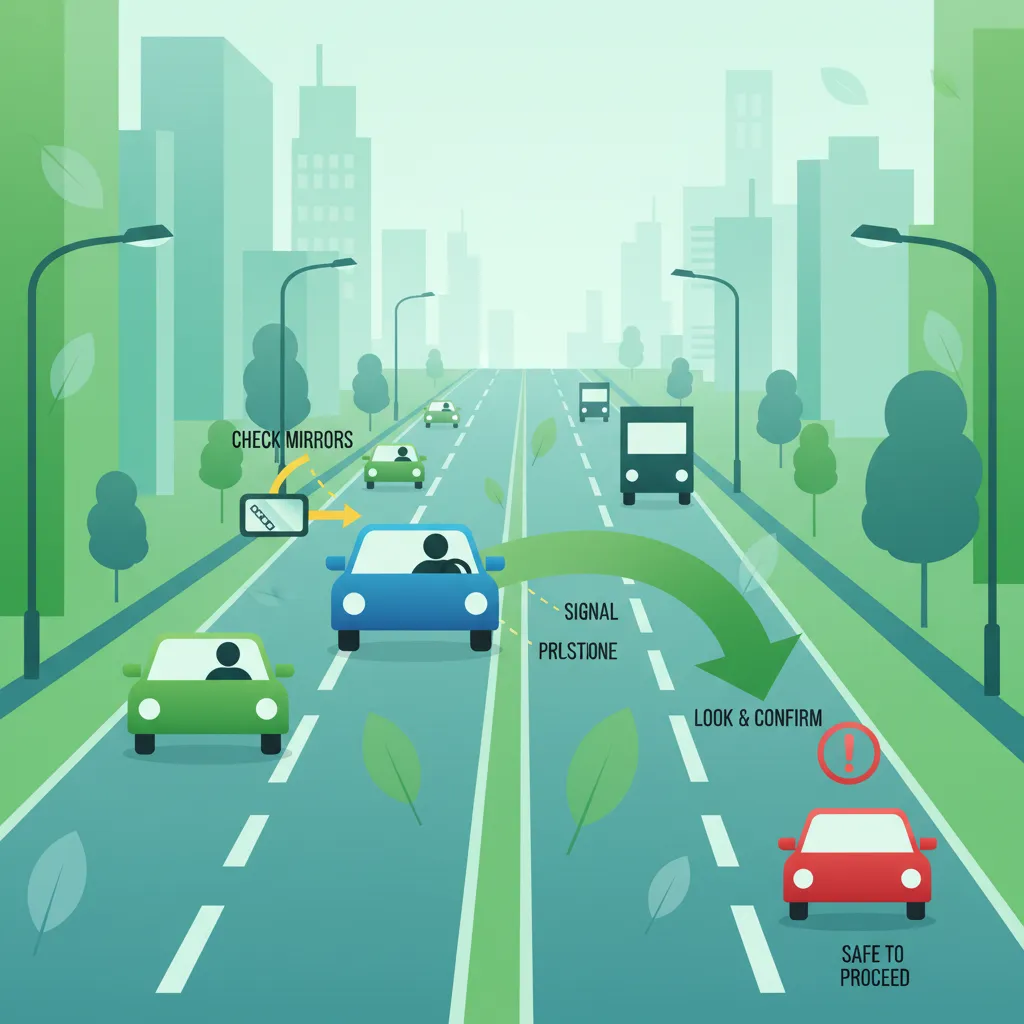
This lesson adapts lane-changing principles for the challenging environment of dense city traffic. It reinforces the critical 'mirror, signal, maneuver' sequence, with a strong focus on checking blind spots immediately before moving. The content advises on judging gaps in traffic and executing the lane change smoothly and decisively.

This lesson addresses the high-risk maneuver of reversing a large truck. It provides systematic techniques for using mirrors and, if available, cameras to monitor the vehicle's path, while strongly emphasizing the importance of managing extensive blind spots. Learners will study procedures for maneuvering within tight spaces like loading docks and yards, including the proper use of a spotter (banksman) to ensure the area is clear and to provide guidance, minimizing the risk of collisions.

This lesson focuses on the practical considerations of cornering large buses, particularly articulated models. It examines turning radius, the effect of the articulation joint, and the importance of maintaining appropriate speed for passenger stability. The content also outlines lane positioning strategies for intersections to avoid over-steering or under-steering.

This lesson focuses on the specific challenges HGVs face when navigating roundabouts. It details the correct procedure for approach, including selecting the appropriate lane based on the intended exit and yielding to traffic already circulating. The content emphasizes the need to account for the vehicle's large turning radius and off-tracking to avoid encroaching on adjacent lanes or mounting curbs, ensuring a smooth and safe passage through the roundabout.
This lesson details the various parking regulations encountered in residential areas. It explains how to interpret signs indicating permitted parking zones, time restrictions, and areas where parking is prohibited. Correctly positioning the vehicle within marked bays and understanding rules about pavement parking are also covered to avoid fines and obstruction.
Understand common mistakes made during reversing, three-point turns, and tight-space maneuvers according to Polish driving theory. Learn safety insights, how to adapt to weather, and avoid typical errors that lead to collisions or test failures.
This lesson addresses the high-risk maneuver of reversing a large truck. It provides systematic techniques for using mirrors and, if available, cameras to monitor the vehicle's path, while strongly emphasizing the importance of managing extensive blind spots. Learners will study procedures for maneuvering within tight spaces like loading docks and yards, including the proper use of a spotter (banksman) to ensure the area is clear and to provide guidance, minimizing the risk of collisions.
This lesson teaches the fundamentals of safely reversing a bus using mirrors, cameras, and alarms. It covers low-speed control essential for depot navigation, where precise steering is required to avoid collisions. Specific techniques for handling articulated buses and coordinating with ground staff are also discussed to ensure safe maneuvers.
This lesson focuses on reversing and maneuvering techniques required when operating a tractor with a trailer, particularly in confined farmyards or on narrow rural roads. It outlines the use of mirrors to monitor trailer swing and suggests best practices for using spotters to improve safety. The lesson also covers planning reversal paths and executing wide-angle turns without compromising load stability.
This lesson provides strategies for safely navigating the numerous intersections typical of urban environments. It reinforces the application of priority rules in situations with limited visibility and high traffic volume. Techniques for making turns in narrow streets and being aware of pedestrians and cyclists at junctions are central to the instruction.
This lesson focuses on navigating intersections that are not controlled by traffic signals. It covers the interpretation of the 'Yield' sign (ustąp pierwszeństwa) and the application of the 'priority to the right' rule at junctions of equal roads. Safe decision-making and proper observation techniques are emphasized for these common scenarios.

This lesson introduces defensive driving principles for rural settings, teaching learners how to continually scan the environment and anticipate potential hazards. It discusses the unique challenges posed by slow-moving agricultural traffic, field entrances, and unpredictable farm equipment maneuvers. The lesson emphasizes proactive decision-making and early brake application to avoid collisions in mixed traffic.

This lesson explains the critical concept of off-tracking, where the rear wheels follow a shorter path than the front wheels during a turn. Learners will understand how to calculate the required space for a turn and position the vehicle correctly before entering a corner to avoid striking curbs, signs, or other vehicles. The content provides practical strategies for safely navigating intersections and roundabouts by anticipating the vehicle's sweep path and maintaining adequate clearance.
This lesson adapts lane-changing principles for the challenging environment of dense city traffic. It reinforces the critical 'mirror, signal, maneuver' sequence, with a strong focus on checking blind spots immediately before moving. The content advises on judging gaps in traffic and executing the lane change smoothly and decisively.
This lesson provides practical methods for maintaining a safe buffer zone behind the vehicle in front. It explains the 'two-second rule' as a minimum following distance in good conditions and how to increase it to three or more seconds in adverse weather. This skill is critical for allowing enough time to react and brake safely to avoid rear-end collisions.

This lesson addresses encounters with slow-moving vehicles, such as tractors, which are common on rural roads. It teaches drivers to be patient, maintain a safe following distance, and only overtake when it is absolutely safe and legal to do so. Recognizing the large size and limited maneuverability of such vehicles is crucial for avoiding accidents.
Find clear answers to common questions learners have about Reversing, Three-Point Turns, and Tight-Space Maneuvers. Learn how the lesson is structured, which driving theory objectives it supports, and how it fits into the overall learning path of units and curriculum progression in Poland. These explanations help you understand key concepts, lesson flow, and exam focused study goals.
The Polish term commonly used for a three-point turn, especially in the context of driving lessons and exams, is 'zawracanie na trzy razy' or sometimes referred to as 'manewr typu 'anglik''. It signifies a maneuver to change direction in a confined space by performing forward and reverse movements.
Observation is absolutely critical when reversing. You must constantly check your mirrors and look over your shoulder to be aware of pedestrians, cyclists, other vehicles, and obstacles. Failure to observe properly during reversing is a common reason for failing practical driving tests and can lead to accidents.
In Poland, as in most places, reversing is generally permitted only when it doesn't endanger traffic safety. You must give way to all other road users. It is prohibited in places where it would create a hazard, such as on expressways, motorways, or in tunnels. Always prioritize safety and awareness.
Reversing in a straight line requires maintaining a consistent steering input to keep the vehicle straight. Reversing around a corner involves more complex steering adjustments as the vehicle's rear swings out and the front swings in. For both, constant mirror checks and looking behind are essential, but the steering technique differs significantly.
While the theory exam is primarily knowledge-based, understanding these maneuvers helps in correctly answering questions about safe driving practices, vehicle control, and hazard perception. You might encounter questions about the correct procedure for a three-point turn or the safety precautions needed when reversing.
Build custom practice sessions tailored precisely to your needs. Focus on areas requiring improvement, review specific Polish road signs, or master complex traffic rules to ensure full preparation for your official driving license exam.