
This lesson is part of the 'Parking and Maneuvering' unit, focusing on a vital aspect of responsible driving: respecting designated parking spaces for individuals with disabilities. Understanding and adhering to these rules is not just about passing your Polish Category B theory test, but also about demonstrating social awareness and courtesy on the road.

Lesson content overview
Welcome to this lesson on using parking spaces designated for disabled persons (MOP) within the Polish Driving Theory – Comprehensive Category B License Preparation curriculum. Understanding and adhering to the rules surrounding these special parking bays is not just about legal compliance; it is a fundamental aspect of road safety, social responsibility, and ensuring accessibility for all road users. This chapter will thoroughly explain the legal framework, eligibility criteria, proper usage, and severe penalties associated with these critical parking provisions in Poland.
Designated parking spaces for disabled persons are a crucial element of urban infrastructure, designed to support individuals with reduced mobility. In Poland, these are commonly referred to as "MOP" spaces, standing for "Miejsca dla osób niepełnosprawnych" (places for disabled persons).
An MOP parking space is a specific parking bay clearly marked to indicate its exclusive use by disabled individuals. These spaces are typically identified by a blue background, a white wheelchair symbol, and often the letter "P" or the acronym "MOP" itself. They are strategically located in close proximity to building entrances, facilities, and public services to minimize the distance a person with mobility impairments must travel.
The presence of this sign, combined with specific ground markings (usually blue painted lines and a white wheelchair symbol on the asphalt), unequivocally designates the space. These markings are not merely suggestions; they are legally binding instructions that must be strictly followed.
The rationale behind reserving these spaces is multi-faceted, focusing on safety, equity, and legal intent:
The right to use an MOP parking space is not universal; it is granted through a specific official document known as the "Karta Parkingowa" (Parking Card). This blue card is the key to legally accessing these reserved spaces.
Eligibility for a Karta Parkingowa is strictly defined by Polish law and medical certification. The permit is issued to individuals with recognized disabilities that significantly impair their mobility or require special assistance. Common categories include:
It is crucial to understand that a temporary injury, such as a sprained ankle or a broken leg, generally does not qualify a person for a Karta Parkingowa without formal, long-term medical certification of a permanent or significant disability.
The process of obtaining a Karta Parkingowa involves presenting comprehensive medical documentation to the appropriate municipal office (usually the local powiat, or district, office). This documentation must clearly detail the nature and extent of the disability, confirming that it meets the legal criteria for a permit.
Gather required medical documentation from your physician, clearly outlining your disability and its impact on your mobility.
Submit an application along with your medical certificate and identity documents to your local powiat (district) office.
Attend a medical commission evaluation if required by the office to verify your condition.
Upon approval, you will be issued your Karta Parkingowa, typically valid for a specified period (e.g., 1 to 5 years).
Remember to renew your permit well in advance of its expiration date to ensure continuous eligibility.
The permit is issued for a specified period, after which it must be renewed. Failure to renew means the permit is no longer valid, and its use constitutes illegal parking.
Simply possessing a Karta Parkingowa is not enough; it must be used correctly to be valid. Strict rules govern how and when the permit must be displayed.
When a vehicle is parked in an MOP space, the Karta Parkingowa must be placed in a clearly visible position on the vehicle's windshield or dashboard. This allows law enforcement and traffic wardens to quickly and easily verify that the vehicle is entitled to occupy the space.
Always ensure your Karta Parkingowa is placed on the passenger side of the front windshield or on the dashboard, with the identifying details clearly visible from outside the vehicle. This helps authorities confirm your eligibility quickly, especially in varying light or weather conditions.
Failure to display the permit correctly, even if the driver is eligible and has the card in the vehicle, can result in a fine. This regulation underscores the principle that the right to park in these spaces is conditional on immediate, visual verification.
A fundamental principle governing the Karta Parkingowa is its non-transferability. The permit is tied to the individual holder, not to a specific vehicle. This means:
Misuse through transferability is considered a serious violation, as it undermines the purpose of the permit and deprives genuinely disabled individuals of necessary parking access.
Unlike some general parking rules that impose time limits, there is typically no fixed time limit for parking in an MOP space, provided the Karta Parkingowa is valid and correctly displayed. However, this does not grant an indefinite right to occupy the space if it is not actively needed.
The implicit expectation is that the driver will vacate the space once their errands are complete or when it becomes evident that another eligible disabled driver needs the space. Prolonged, unnecessary occupation, especially if other disabled drivers are actively seeking parking, goes against the spirit of the law and the social responsibility it represents.
Recognizing MOP spaces is crucial for all drivers. They are marked with specific signs and ground markings that leave no room for ambiguity.
MOP spaces are primarily identified by the D-18a parking sign (a blue square with a white 'P' and a white wheelchair symbol). This sign may also have an additional plate (e.g., "MOP" or "T-29") indicating the specific group of users.
In addition to signage, the parking bays themselves are typically painted with blue lines, and a large white wheelchair symbol is often painted on the ground within the bay. These visual cues serve as unmistakable indicators. Drivers must ensure their vehicle is parked entirely within these painted lines. Parking partially outside the lines can lead to a fine, not only for potential obstruction but also for improper parking, even if a valid permit is displayed.
While most MOP spaces are standard in size, designed to accommodate typical passenger vehicles, some may have additional markings or size specifications:
For drivers who do not possess a valid Karta Parkingowa, the obligations are straightforward and absolute: you must not park in an MOP space under any circumstances.
The key obligation for non-permit holders is a complete prohibition on using these spaces. This includes:
The primary purpose of these regulations is to maintain accessibility for those who genuinely need it. Choosing to park in an MOP space without a permit, even if other parking is scarce or "just for a minute," has immediate and negative consequences for disabled individuals. It forces them to park farther away, potentially causing significant physical strain, increasing their exposure to traffic hazards, and creating a sense of exclusion.
As a responsible driver, your duty is to actively seek out regular parking spots and to never impede access to MOP spaces. This includes not parking in areas that block access to MOP bays or their associated ramps.
The Polish legal system imposes severe penalties for the illegal occupation or misuse of disabled parking spaces, reflecting the high social importance placed on accessibility.
The consequences for violating MOP parking rules are typically harsher than for general illegal parking:
Understanding typical violations can help drivers avoid them:
| Violation | Why It’s Wrong | Correct Behavior | Typical Consequence |
|---|---|---|---|
| Parking in MOP space without a valid permit | Deprives eligible disabled individuals of needed access. | Always seek and use regular parking spaces. | Monetary fine (≥ 300 PLN) and possible vehicle towing. |
| Displaying an expired Karta Parkingowa | The permit is no longer valid; it's effectively parking without one. | Renew your permit well before its expiration date. | Fine for illegal use of a disabled space. |
| Displaying permit while the holder is not present | The permit is personal to the holder, not the vehicle. | Only use the permit when the entitled disabled person is in the vehicle. | Fine. |
| Parking partially outside painted lines | Obstructs adjacent spaces or traffic flow, even with a permit. | Ensure your vehicle is fully contained within the marked bay. | Fine for improper parking, potentially an additional fine for obstruction. |
| Using MOP space for a brief stop or loading/unloading without a permit | Still blocks access and is considered illegal parking. | Seek designated loading zones or regular parking. | Fine, even for very short stops. |
| Ignoring temporary restriction signs overlaying MOP markings | Violates additional local regulations designed for specific times. | Always read and obey all supplementary signage, even in MOP spaces. | Higher fine, potentially combining penalties for multiple violations. |
Rules, while generally consistent, can sometimes be affected by environmental factors or specific local conditions.
Drivers must ensure their Karta Parkingowa remains clearly visible regardless of weather conditions.
Some MOP bays may feature additional signage that temporarily modifies or restricts their use. These could include:
Always observe all signs present at a parking location. Temporary restrictions generally supersede permanent ones for their specified duration.
The presence of MOP spaces highlights the importance of awareness of vulnerable road users. When parking near MOP spaces or observing a disabled person loading or unloading:
Understanding and respecting the rules for disabled parking spaces is a critical aspect of becoming a responsible and compliant driver in Poland. For your Polish Category B license, mastering these principles is essential.
By diligently following these rules, you not only ensure legal compliance but also contribute to a more accessible and equitable road environment for everyone.
This lesson covers Poland's disabled parking (MOP) regulations essential for the Category B theory test. MOP spaces are marked with the D-18a sign (blue with white 'P' and wheelchair symbol) and are reserved exclusively for holders of a valid Karta Parkingowa—a blue permit issued through medical certification to individuals with recognized mobility impairments. The permit must be clearly visible on the windshield or dashboard whenever the vehicle occupies an MOP space, and critically, the entitled disabled person must be present in the vehicle. Penalties for misuse are severe, starting at 300 PLN, plus possible towing and points. Drivers without a permit face an absolute prohibition against parking or stopping in these spaces, and all users must respect additional temporary restrictions that may overlay the MOP designation.
A short set of high-value points that capture the most important learning from this lesson.
MOP parking spaces are identified by a blue background, white wheelchair symbol, and D-18a sign, reserved exclusively for disabled persons with a valid Karta Parkingowa.
The Karta Parkingowa is a blue permit issued only to individuals with recognized mobility or qualifying disabilities after medical certification through the local powiat office.
The permit holder must be physically present in the vehicle whenever it occupies an MOP space—the Karta Parkingowa is non-transferable.
Drivers without a valid permit must never park or stop in an MOP space, even briefly; this prohibition is absolute.
Vehicles parked in MOP spaces must be fully contained within the painted lines, and the permit must remain clearly visible regardless of weather conditions.
Explore all units and lessons included in this driving theory course.
Karta Parkingowa eligibility requires permanent or long-term disability certification—temporary injuries like a sprained ankle do not qualify.
The D-18a sign (blue square with white 'P' and wheelchair symbol) is the official traffic sign marking disabled parking spaces.
Permit misuse consequences include fines of at least 300 PLN, possible points on your driver's record, and vehicle towing at the owner's expense.
Temporary restriction signs (such as time-limited no-stopping rules) can override MOP designations during specified hours—always read all signage.
An expired Karta Parkingowa is legally invalid and its display constitutes illegal parking, even if the holder is present.
Assuming that a temporary injury qualifies for a permit—only formally certified long-term or permanent disabilities meet the legal criteria.
Displaying the Karta Parkingowa while the permit holder is not in the vehicle; the permit is personal and tied to the individual, not the vehicle.
Believing that a very brief stop (such as dropping someone off) is permissible in an MOP space without a permit—it is not, regardless of duration.
Parking partially outside the painted lines of an MOP bay, which can result in fines for improper parking even with a valid permit displayed.
Overlooking supplementary temporary restriction signs that may limit or prohibit MOP use during certain hours or conditions.
Lesson content overview
A short set of high-value points that capture the most important learning from this lesson.
MOP parking spaces are identified by a blue background, white wheelchair symbol, and D-18a sign, reserved exclusively for disabled persons with a valid Karta Parkingowa.
The Karta Parkingowa is a blue permit issued only to individuals with recognized mobility or qualifying disabilities after medical certification through the local powiat office.
The permit holder must be physically present in the vehicle whenever it occupies an MOP space—the Karta Parkingowa is non-transferable.
Drivers without a valid permit must never park or stop in an MOP space, even briefly; this prohibition is absolute.
Vehicles parked in MOP spaces must be fully contained within the painted lines, and the permit must remain clearly visible regardless of weather conditions.
Explore all units and lessons included in this driving theory course.
Karta Parkingowa eligibility requires permanent or long-term disability certification—temporary injuries like a sprained ankle do not qualify.
The D-18a sign (blue square with white 'P' and wheelchair symbol) is the official traffic sign marking disabled parking spaces.
Permit misuse consequences include fines of at least 300 PLN, possible points on your driver's record, and vehicle towing at the owner's expense.
Temporary restriction signs (such as time-limited no-stopping rules) can override MOP designations during specified hours—always read all signage.
An expired Karta Parkingowa is legally invalid and its display constitutes illegal parking, even if the holder is present.
Assuming that a temporary injury qualifies for a permit—only formally certified long-term or permanent disabilities meet the legal criteria.
Displaying the Karta Parkingowa while the permit holder is not in the vehicle; the permit is personal and tied to the individual, not the vehicle.
Believing that a very brief stop (such as dropping someone off) is permissible in an MOP space without a permit—it is not, regardless of duration.
Parking partially outside the painted lines of an MOP bay, which can result in fines for improper parking even with a valid permit displayed.
Overlooking supplementary temporary restriction signs that may limit or prohibit MOP use during certain hours or conditions.
Explore search topics learners often look for when studying Using Parking Spaces for Disabled Persons (MOP). These topics reflect common questions about road rules, driving situations, safety guidance, and lesson level theory preparation for learners in Poland.
Browse additional driving theory lessons that cover connected traffic rules, road signs, and common driving situations related to this topic. Improve your understanding of how different rules interact across everyday traffic scenarios.
Expand your understanding of Polish parking laws for disabled spaces (MOP). This lesson delves deeper into complex scenarios, common driver errors, and reinforces the legal framework for using a Karta Parkingowa correctly, ensuring compliance and accessibility for all.

This lesson details the various parking regulations encountered in residential areas. It explains how to interpret signs indicating permitted parking zones, time restrictions, and areas where parking is prohibited. Correctly positioning the vehicle within marked bays and understanding rules about pavement parking are also covered to avoid fines and obstruction.
This lesson clarifies the legal distinction between 'stopping' and 'parking' and the rules that apply to each. It teaches how to read and understand a variety of parking signs, including those that indicate time limits, paid parking zones, and areas where stopping is completely forbidden. This knowledge is essential for avoiding fines and ensuring traffic flow is not obstructed.

This lesson covers the common parking scenarios found in car parks: perpendicular (90-degree) and angled bays. It explains the techniques for both driving in forwards and reversing in, highlighting the visibility and safety advantages of the latter. Proper alignment within the marked lines is a key focus to ensure space for other vehicles.

This lesson breaks down the often-daunting task of parallel parking into a simple, repeatable process. It teaches drivers how to use specific reference points on their vehicle to gauge positioning relative to the curb and other cars. Correcting the maneuver and ensuring the final position is legal and safe are also key components.
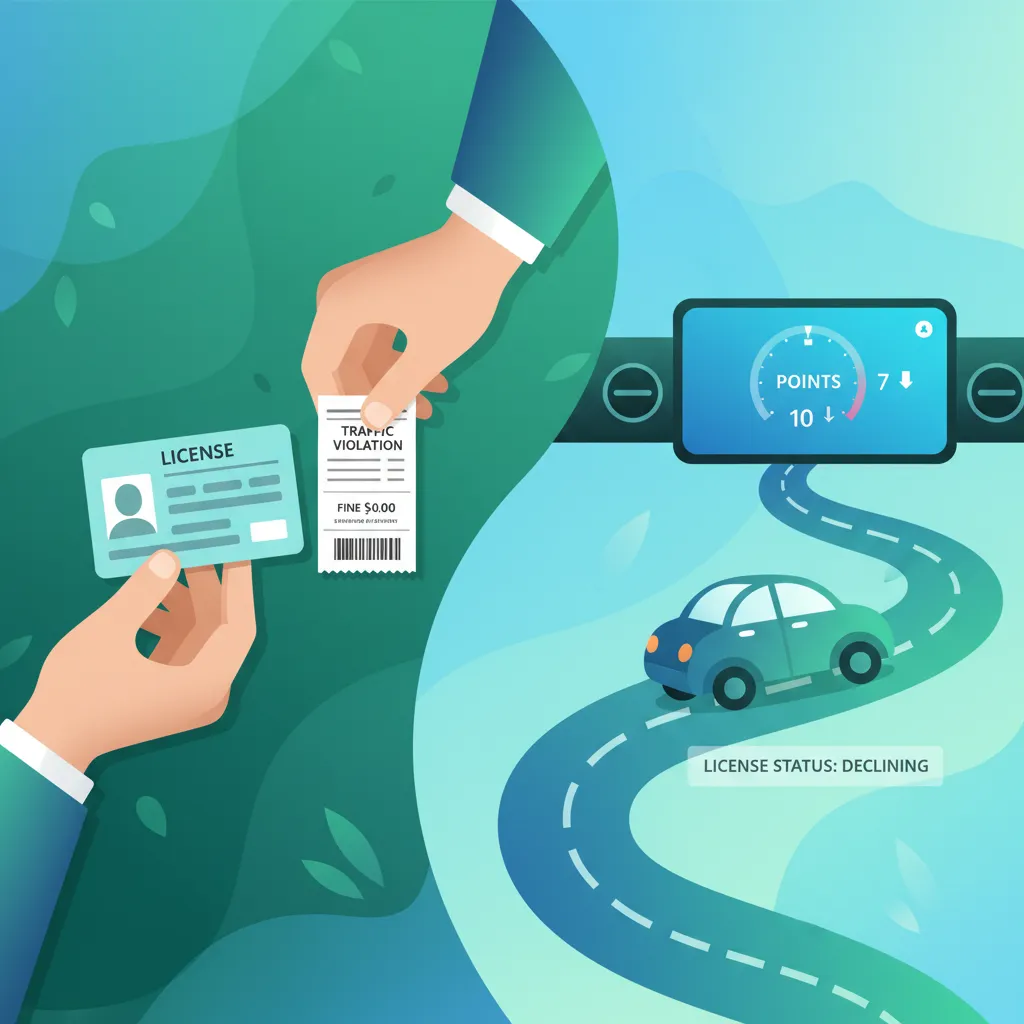
This lesson details the Polish traffic penalty system, explaining how violations result in fines and the accumulation of demerit points (punkty karne). It covers the point thresholds that can lead to licence suspension and the legal responsibilities of a driver involved in a traffic offense. Understanding this system is crucial for maintaining a clean driving record and promoting lawful behavior on the road.
Learn about the broader context of parking and its impact on vulnerable road users in Poland. This lesson connects disabled parking rules to overall road safety, focusing on courtesy, accessibility, and preventing obstructions for those with mobility challenges.

This lesson highlights the professional driver's heightened responsibility to protect vulnerable road users. It focuses on the significant blind spots around a large truck, particularly during turns in urban areas where pedestrians and cyclists are common. The content teaches strategies for anticipating the unpredictable movements of these users, providing ample space when passing, and using warning signals to communicate intentions clearly, fostering a culture of shared road safety.

This lesson focuses on safe coexistence with cyclists and pedestrians, who are prevalent in urban areas. It covers the rules for driving alongside dedicated bicycle lanes and the legal requirement to yield to pedestrians at marked crossings. The content stresses the importance of constant awareness, especially when turning at intersections, to prevent conflicts with vulnerable road users.

This lesson examines the responsibilities of motorcyclists when approaching pedestrian crossings and interacting with cyclists, emphasizing the marked right-of-way for pedestrians at zebra crossings. Learners will study how to determine safe passing distances, adjust speed, and use visual cues such as eye contact to ensure pedestrians have cleared the crossing. The content also covers interactions with cyclists sharing the road, highlighting the need for anticipation and adequate passing gaps.

This lesson addresses advanced scenarios, including multi-lane intersections and interactions with vulnerable road users. It reinforces the legal obligation to give absolute priority to pedestrians at marked crossings (zebra crossings). The content also covers navigating around traffic islands and using dedicated turning lanes in complex urban environments.
This lesson covers the common parking scenarios found in car parks: perpendicular (90-degree) and angled bays. It explains the techniques for both driving in forwards and reversing in, highlighting the visibility and safety advantages of the latter. Proper alignment within the marked lines is a key focus to ensure space for other vehicles.

This lesson introduces defensive driving strategies tailored for bus operation, emphasizing hazard perception and risk management. Learners will study techniques for continuous situational awareness and maintaining safe following distances for adequate reaction time. The content covers emergency maneuvers and interaction with vulnerable road users to reduce accident likelihood.

This lesson provides a step-by-step process for safe passenger boarding and alighting, emphasizing clear communication and the correct use of wheelchair ramps. Learners will study the legal requirements for assisting passengers with reduced mobility, including securing wheelchairs. The content also covers time management at stops and safety checks before departure.

This lesson examines how a tractor driver should interact with a variety of road users, focusing on right-of-way rules at intersections and with cars, trucks, cyclists, and pedestrians. It discusses safe overtaking practices, appropriate signaling to communicate intentions, and the importance of checking blind spots. The lesson highlights the need for heightened caution near schools, villages, and areas with high pedestrian activity.
This lesson details the various parking regulations encountered in residential areas. It explains how to interpret signs indicating permitted parking zones, time restrictions, and areas where parking is prohibited. Correctly positioning the vehicle within marked bays and understanding rules about pavement parking are also covered to avoid fines and obstruction.

This lesson focuses on areas with high pedestrian activity, requiring special caution. It covers the rules for 'living zones' (strefa zamieszkania), where pedestrians have priority and the speed limit is 20 km/h. The content also addresses regulations for school zones and other designated pedestrian areas to ensure the safety of the most vulnerable road users.
Find clear answers to common questions learners have about Using Parking Spaces for Disabled Persons (MOP). Learn how the lesson is structured, which driving theory objectives it supports, and how it fits into the overall learning path of units and curriculum progression in Poland. These explanations help you understand key concepts, lesson flow, and exam focused study goals.
MOP stands for Miejsce Oznaczone dla Niepełnosprawnych, which translates to 'Marked Place for the Disabled'. These are the designated parking bays reserved for individuals with a valid disabled parking permit.
Only individuals who possess a valid disabled parking permit issued in Poland or recognized under international agreements may park in these designated spaces. The permit must be clearly displayed on the vehicle's dashboard or front window.
Misusing disabled parking spaces carries severe penalties in Poland. This can include significant fines and the vehicle being towed away. The intention is to ensure these vital spaces are always available for those who genuinely require them.
The disabled parking permit must be placed visibly on the dashboard or the front of the vehicle, typically on the driver's side, so that it is clearly visible to parking enforcement officers and other road users. Ensure it's not obscured.
Yes, the Polish Category B theory test includes questions related to disabled parking spaces (MOP). Understanding the rules, eligibility, and penalties is essential to answer these questions correctly and pass your exam.
Build custom practice sessions tailored precisely to your needs. Focus on areas requiring improvement, review specific Polish road signs, or master complex traffic rules to ensure full preparation for your official driving license exam.