
Welcome to the lesson on Turning Radius, Off-Tracking, and Cornering for Category C truck drivers. Understanding how a large vehicle moves during turns is crucial for safe driving and passing your theory exam. This lesson builds on vehicle dynamics knowledge and prepares you for complex maneuvers.

Lesson content overview
For every aspiring professional truck driver preparing for the Polish Category C theory exam, understanding how heavy goods vehicles (HGVs) navigate turns is paramount. Unlike smaller passenger cars, HGVs have unique geometric and dynamic properties that significantly influence their turning behavior. This lesson delves into the critical concepts of turning radius, off-tracking, and overall cornering strategy, providing you with the essential knowledge to safely and efficiently maneuver large vehicles on Polish and international roads.
Mastery of these principles is not just about passing an exam; it's about preventing collisions, maintaining proper road positioning, protecting your cargo, and ensuring compliance with stringent Polish traffic legislation concerning vehicle dimensions and safe driving practices. By anticipating your vehicle's sweep path and maintaining adequate clearance, you can confidently navigate complex environments like intersections and roundabouts.
When an HGV turns, its front and rear wheels follow distinctly different paths. This phenomenon, known as off-tracking, means the rear wheels cut a shorter, more inward arc than the front wheels. This fundamental characteristic necessitates precise positioning and careful control to prevent striking curbs, road signs, or other vehicles. The interplay of physics, vehicle design, and safety regulations dictates the minimum space required for any turn. Drivers must learn to anticipate the vehicle's full sweep and adjust their entry speed, steering angle, and lane choice proactively.
The turning radius of a heavy goods vehicle refers to the smallest circular path that its outer front wheel can follow when the steering wheel is turned to its maximum angle, also known as full lock. This is a critical measurement that informs road design, parking space dimensions, and, most importantly, a driver's ability to plan maneuvers.
The radius measured from the centre of the turning circle to the centre of the path followed by the outer front wheel at full steering lock.
Manufacturers provide a nominal turning radius for vehicles under standard, unloaded conditions. However, the effective turning radius in real-world driving can be influenced by factors such as load shift, tire wear, and the condition of the steering system. For instance, a 12-ton truck might have a nominal turning radius of 12 metres, meaning it requires a turning circle diameter of at least 24 metres. Drivers must always add a safety margin to this, typically around 3 metres, to account for road markings, uneven surfaces, or unexpected vehicle movements.
Polish road regulations, specifically Article 31-4 of the Polish Road Traffic Act, stipulate that the centreline of a lane must be designed to accommodate the turning radius of the largest permitted vehicle type. This ensures that infrastructure supports safe HGV navigation, but drivers still bear the responsibility of ensuring their specific vehicle can comply. A common misunderstanding is equating the turning radius solely with the lane width or forgetting that the rear axles will inevitably follow a shorter, inner path due to off-tracking.
Off-tracking is perhaps the most crucial concept for HGV drivers to grasp when cornering. It is defined as the lateral offset between the path of the front wheels and the path of the rear wheels during a turn. Essentially, the rear wheels follow an inner, shorter arc compared to the front wheels. This phenomenon is a direct result of the vehicle's wheelbase and steering geometry.
The lateral distance by which the rear axle(s) lag behind the front axle path during a turn; the rear wheels follow an inner, shorter arc.
Off-tracking accounts for the vehicle's physical dimensions, including its wheelbase, axle configurations, and, critically, trailer articulation in articulated vehicles. Understanding and anticipating off-tracking ensures the vehicle body does not collide with obstacles like curbs, traffic islands, or other road users. It necessitates that drivers position their vehicles wider on approach to a turn than they might intuitively for a car, to allow the rear wheels sufficient clearance.
Off-tracking can be categorized as single-axle off-tracking for rigid trucks, or multi-axle/trailer off-tracking, which involves cumulative offsets for each axle in a multi-unit combination. Polish road traffic regulations emphasize maintaining a minimum distance of 0.5 metres from the curb on inner lanes to account for off-tracking (Polish Road Traffic Regulation – Annex 2, point 5). A common error is assuming rear wheels follow the exact path of the front wheels or underestimating the effect of a long trailer on the total offset.
Two fundamental dimensions of any HGV significantly influence its turning characteristics: wheelbase and track width.
These dimensions directly determine the magnitude of off-tracking and the overall spatial requirements for a turn. Longer wheelbases inherently lead to greater off-tracking, requiring more space and more careful maneuvering to complete a turn without encroachment. Wider track widths, while potentially reducing the likelihood of a wheel-to-curb contact, increase the vehicle's overall width, which must be considered in relation to lane boundaries and obstacles.
The distance between the centre points of the front and rear axles of a vehicle.
The distance between the left and right wheels on the same axle, measured from their centre points.
Polish regulations concerning vehicle dimensions, including load protrusions, mandate that the total width must not exceed specified lane width allowances (Polish Regulation on Dimensions of Vehicles, Annex 4). Failing to consider how wheelbase and track width affect the dynamic footprint of the vehicle can lead to illegal lane crossings or collisions. Drivers should avoid confusing overall vehicle length with wheelbase, as it's the latter that primarily dictates off-tracking.
For articulated heavy goods vehicles, the articulation angle plays a crucial role in cornering safety and dynamics. This angle is formed between the longitudinal axes of the towing vehicle (tractor) and the trailer(s) during a turn.
The angle formed between the longitudinal axes of the towing unit (tractor) and the trailer(s) during a turn.
The design of the coupling system typically imposes a maximum articulation angle, often around 30 degrees for Category C vehicles, beyond which structural damage or instability can occur. The dynamic articulation angle, however, is the real-time angle determined by the driver's speed, steering input, and the load's characteristics.
Excessive articulation is a significant risk factor, as it can lead to dangerous trailer swing-out, where the rear of the trailer moves far beyond the intended path, increasing the effective off-track and risking collisions with vehicles in adjacent lanes or roadside objects. Polish law (Regulation 3/2014 – Articulation Control) requires drivers to maintain control over the trailer's path and keep the articulation within safe limits. This often means reducing speed significantly before a sharp bend to manage the angle effectively. A common mistake is to assume the trailer will precisely follow the tractor, neglecting the articulation lag induced by speed and momentum.
When driving a multi-trailer combination, anticipate that each additional articulation point will contribute to cumulative off-tracking. This requires even greater precision and speed reduction.
The load distribution within a heavy goods vehicle refers to the spatial location of the vehicle’s overall mass centre relative to its axle positions. This includes both longitudinal (front-to-rear) and lateral (side-to-side) distribution. The combined effect of the vehicle and its cargo creates the centre of gravity (CG).
The spatial arrangement of cargo weight on a vehicle's axles, influencing the overall centre of gravity.
The geometric centre of a vehicle's total mass, both longitudinally and laterally.
How cargo is placed directly impacts the vehicle's stability, particularly during turns and braking. A rear-heavy load, for instance, increases pressure on the rear axles, which can widen the off-track radius and reduce overall stability during cornering. Conversely, a load with a very high CG significantly increases the risk of rollover on sharp turns, even at moderate speeds.
Polish cargo securing regulations (Rozporządzenie Ministra Infrastruktury 2022) are strict about load distribution. They require the Centre of Gravity (CG) to stay within 30% of the wheelbase, measured from the front axle, for Category C vehicles. This prevents unsafe weight shifts that could compromise handling. Drivers often underestimate how load placement affects dynamic behavior, leading to increased risk during maneuvers.
The clearance envelope is a comprehensive term for the total area occupied by the vehicle during a maneuver. It encompasses the paths of all wheels and any protruding parts of the vehicle, such as mirrors or load extensions.
The geometric area covered by the vehicle during a maneuver, encompassing the paths of all wheels and any protruding parts.
There are two main types:
The practical importance of the clearance envelope is paramount: it must fit within the available road width, particularly at intersections, roundabouts, and during lane changes. Polish Traffic Regulation Annex 5 specifies that road signage and markings must provide a minimum clearance of 1 metre from the lane centreline for Category C vehicles, acknowledging their larger dynamic envelope. Drivers must be aware of their vehicle's maximum width, including mirrors, as these are often the first points of contact with obstacles. A common error is assuming the dynamic envelope is merely the vehicle's length times width, neglecting the significant additional space required due to off-tracking and mirror swing.
Adherence to specific regulations is critical for Category C drivers in Poland. These rules are designed to ensure safety and prevent common HGV-related accidents during turns.
Rule: The width of the lane must be at least the vehicle’s dynamic clearance envelope plus a 0.5-metre safety margin. Applicability: This rule applies to all public roads, but is especially critical at intersections, roundabouts, and lane merges where turns are common. Legal Status: Mandatory (Polish Road Traffic Act, Art. 31-4). Rationale: This regulation guarantees sufficient space for HGVs to execute turns safely, accommodating off-tracking without encroaching on adjacent lanes or hitting roadside obstacles.
Rule: Drivers must maintain at least 0.5 metres between the path of their rear axle(s) and any fixed roadside object, such as a curb, traffic island, or pole. Applicability: Essential on urban streets, within parking lots, and at any road feature with a physical boundary. Legal Status: Mandatory (Regulation Annex 2, point 5). Rationale: This mandatory clearance prevents vehicle damage, tyre damage, and collisions with roadside infrastructure, which can be costly and dangerous.
Rule: The cargo’s centre of gravity (CG) must lie within 30% of the wheelbase, measured from the front axle, for Category C vehicles. Applicability: This rule applies to all loaded Category C vehicles. Legal Status: Mandatory (Rozporządzenie Ministra Infrastruktury, 2022). Rationale: Proper CG placement is fundamental for maintaining vehicle stability during turns, braking, and acceleration, significantly reducing the risk of rollover or jack-knifing.
Rule: Speed must be reduced sufficiently before entering a turn so that the vehicle can complete the maneuver without exceeding its safe turning radius or experiencing excessive articulation. Applicability: Particularly relevant when approaching curves with a radius less than 15 metres for vehicles over 8 tons. Legal Status: Strongly recommended (Polish Traffic Safety Guidelines). Rationale: Reducing speed minimizes the risk of trailer swing-out, loss of control, and potential rollover, especially for vehicles with high centres of gravity.
Always reduce your speed before entering a curve, not while in the curve. Braking within a turn, especially with an HGV, can destabilize the vehicle and increase the risk of skidding or jack-knifing.
Rule: When initiating a turn, the driver must position the vehicle such that the front axle follows the centreline of the intended lane, allowing the off-track of the rear wheels to stay within the lane boundaries. Applicability: This applies to all lane-change and turning maneuvers, including navigating intersections and roundabouts. Legal Status: Mandatory (Road Traffic Act, Art. 45-2). Rationale: Correct lane positioning ensures safe interaction with other traffic, prevents illegal lane crossings, and helps the HGV adhere to the designed road geometry without causing obstruction or danger.
Despite clear rules and guidelines, Category C drivers frequently encounter challenges or commit violations related to turning dynamics. Understanding these common pitfalls is key to avoiding them.
Safe HGV cornering is not a static skill; it requires constant adaptation to changing conditions.
Never attempt to 'cut' across multiple lanes in a roundabout. This is dangerous and illegal. Plan your entry and exit lane well in advance.
When pedestrians or cyclists are present near the curb, drivers must maintain a greater off-track clearance (at least 0.75 metres, or more if possible). This is crucial to avoid inadvertent encroachment onto their space, as the rear wheels can unexpectedly sweep into areas that seem clear to the front of the vehicle. On shared-use paths adjacent to the road, anticipate that the rear wheel path may cross the boundary if the vehicle is not correctly positioned.
Successful HGV cornering hinges on a disciplined approach and constant spatial awareness.
The principles discussed in this lesson are rooted in the fundamental physics of vehicle dynamics. The steering geometry of an HGV creates an instantaneous pivot point behind the front axle. The longer the distance from this pivot point to the rear axle, the larger the radius of the rear wheel path relative to the front, hence the phenomenon of off-tracking. This is a predictable outcome of design, not an anomaly.
Heavy vehicles exhibit delayed steering response compared to cars. This means drivers must anticipate the vehicle's path much further in advance rather than reacting instantaneously to the road ahead. This predictive driving is a cornerstone of HGV safety.
Statistical analysis, particularly in Poland, indicates that a significant percentage of HGV collisions at intersections (over 30%) are directly attributable to a failure to account for off-tracking. These incidents often result in curb strikes, damage to infrastructure, or side-collisions with smaller vehicles caught in the truck's sweep path.
To manage the high cognitive load associated with complex HGV maneuvers, drivers can simplify their mental model: "front wheels follow centreline, rear wheels swing inward." This simplification helps in pre-planning lane positioning and steering adjustments. Maintaining a consistent safety margin, typically a minimum of 0.5 metres from obstacles, is a crucial risk mitigation strategy. This margin accounts for minor vehicle sway due to wind, road camber, or slight load shifts, preventing accidental contact and reducing overall accident risk.
This lesson covers the essential physics and regulations governing Category C HGV turning in Poland. Off-tracking is the fundamental concept where rear wheels cut a tighter arc than front wheels, making precise vehicle positioning critical. Polish law mandates specific clearances—minimum 0.5 metres from curbs and centre of gravity within 30% of wheelbase from the front axle. Successful cornering requires speed reduction before the turn, correct lane positioning with front wheels following centreline, and continuous mirror monitoring to track trailer path. Common errors include underestimating off-track magnitude, excessive entry speed causing trailer swing-out, and neglecting the dynamic clearance envelope that includes mirror swing and multi-axle offset effects.
A short set of high-value points that capture the most important learning from this lesson.
Off-tracking means rear wheels follow a shorter, inner path than front wheels during turns, requiring drivers to position wider on approach
The turning radius is the smallest circle the outer front wheel can follow at full lock, but real-world effective radius differs from nominal specifications
The articulation angle in articulated vehicles determines how the trailer follows the tractor; excessive angles cause dangerous trailer swing-out
Load distribution directly affects vehicle stability and off-tracking magnitude, with Polish regulations mandating the centre of gravity stays within 30% of wheelbase from the front axle
The dynamic clearance envelope is always larger than the static envelope due to off-tracking, steering angles, and mirror swing
Explore all units and lessons included in this driving theory course.
Maintain minimum 0.5-metre clearance from curbs and fixed obstacles for rear axle path at all times
Always reduce speed before entering a curve, never brake within a turn, especially with an HGV
Front wheels should follow lane centreline; rear wheels swing inward due to off-tracking
Each additional trailer articulation point contributes cumulative off-tracking, requiring greater precision
Mirror swing extends beyond static vehicle width and must be accounted for in clearance calculations
Assuming rear wheels follow the exact path of front wheels, leading to curb strikes at intersections and roundabouts
Entering tight curves at excessive speed, causing trailer swing-out into adjacent lanes or rollover risk
Placing cargo with centre of gravity too far rearward, which increases off-track radius and reduces stability
Neglecting mirror swing area when judging lane clearance during turns
Relying on static vehicle dimensions alone for lane clearance without accounting for the larger dynamic envelope
Lesson content overview
A short set of high-value points that capture the most important learning from this lesson.
Off-tracking means rear wheels follow a shorter, inner path than front wheels during turns, requiring drivers to position wider on approach
The turning radius is the smallest circle the outer front wheel can follow at full lock, but real-world effective radius differs from nominal specifications
The articulation angle in articulated vehicles determines how the trailer follows the tractor; excessive angles cause dangerous trailer swing-out
Load distribution directly affects vehicle stability and off-tracking magnitude, with Polish regulations mandating the centre of gravity stays within 30% of wheelbase from the front axle
The dynamic clearance envelope is always larger than the static envelope due to off-tracking, steering angles, and mirror swing
Explore all units and lessons included in this driving theory course.
Maintain minimum 0.5-metre clearance from curbs and fixed obstacles for rear axle path at all times
Always reduce speed before entering a curve, never brake within a turn, especially with an HGV
Front wheels should follow lane centreline; rear wheels swing inward due to off-tracking
Each additional trailer articulation point contributes cumulative off-tracking, requiring greater precision
Mirror swing extends beyond static vehicle width and must be accounted for in clearance calculations
Assuming rear wheels follow the exact path of front wheels, leading to curb strikes at intersections and roundabouts
Entering tight curves at excessive speed, causing trailer swing-out into adjacent lanes or rollover risk
Placing cargo with centre of gravity too far rearward, which increases off-track radius and reduces stability
Neglecting mirror swing area when judging lane clearance during turns
Relying on static vehicle dimensions alone for lane clearance without accounting for the larger dynamic envelope
Explore search topics learners often look for when studying Turning Radius, Off-Tracking, and Cornering. These topics reflect common questions about road rules, driving situations, safety guidance, and lesson level theory preparation for learners in Poland.
Browse additional driving theory lessons that cover connected traffic rules, road signs, and common driving situations related to this topic. Improve your understanding of how different rules interact across everyday traffic scenarios.
Explore advanced strategies for managing HGV turning radius and off-tracking in complex Polish traffic situations. Understand how load distribution, vehicle dynamics, and specific road conditions impact safe cornering for Category C drivers.

This lesson focuses on the specific challenges HGVs face when navigating roundabouts. It details the correct procedure for approach, including selecting the appropriate lane based on the intended exit and yielding to traffic already circulating. The content emphasizes the need to account for the vehicle's large turning radius and off-tracking to avoid encroaching on adjacent lanes or mounting curbs, ensuring a smooth and safe passage through the roundabout.

This lesson explains the specialized techniques required for initiating movement and bringing a heavy, loaded truck to a halt. It emphasizes fine clutch and throttle control to overcome inertia without causing driveline stress or cargo shift. Learners will also study methods for smooth, gradual braking that account for the vehicle's significant momentum, ensuring safety, passenger comfort, and the integrity of the cargo while minimizing wear on the braking system.

This lesson addresses the high-risk maneuver of reversing a large truck. It provides systematic techniques for using mirrors and, if available, cameras to monitor the vehicle's path, while strongly emphasizing the importance of managing extensive blind spots. Learners will study procedures for maneuvering within tight spaces like loading docks and yards, including the proper use of a spotter (banksman) to ensure the area is clear and to provide guidance, minimizing the risk of collisions.

This lesson teaches drivers how to adapt their speed, following distance, and control inputs to safely navigate adverse conditions. It covers the challenges posed by rain, snow, and ice, explaining the loss of traction and the increased risk of skidding or aquaplaning. The content provides specific strategies for driving in fog, which reduces visibility, and strong crosswinds, which can affect the stability of a high-sided vehicle, promoting a proactive and defensive driving mindset.

This lesson explores the dynamic relationship between cargo weight and a vehicle's performance. It explains how increased mass raises kinetic energy, significantly lengthening braking distances and requiring earlier, more gradual brake application. Learners will also analyze how a heavy or poorly distributed load alters the vehicle's handling characteristics, particularly during cornering, and understand the necessity of adjusting speed and driving style to compensate for these effects.

This lesson explores the key components responsible for vehicle stability and control. It compares different suspension technologies, like traditional leaf springs and modern air suspension, and explains their impact on ride quality and load handling. Learners will also study the principles of hydraulic power steering and the importance of correct wheel alignment, as well as understand how different axle configurations affect load distribution and maneuverability.

This lesson focuses on the practical considerations of cornering large buses, particularly articulated models. It examines turning radius, the effect of the articulation joint, and the importance of maintaining appropriate speed for passenger stability. The content also outlines lane positioning strategies for intersections to avoid over-steering or under-steering.
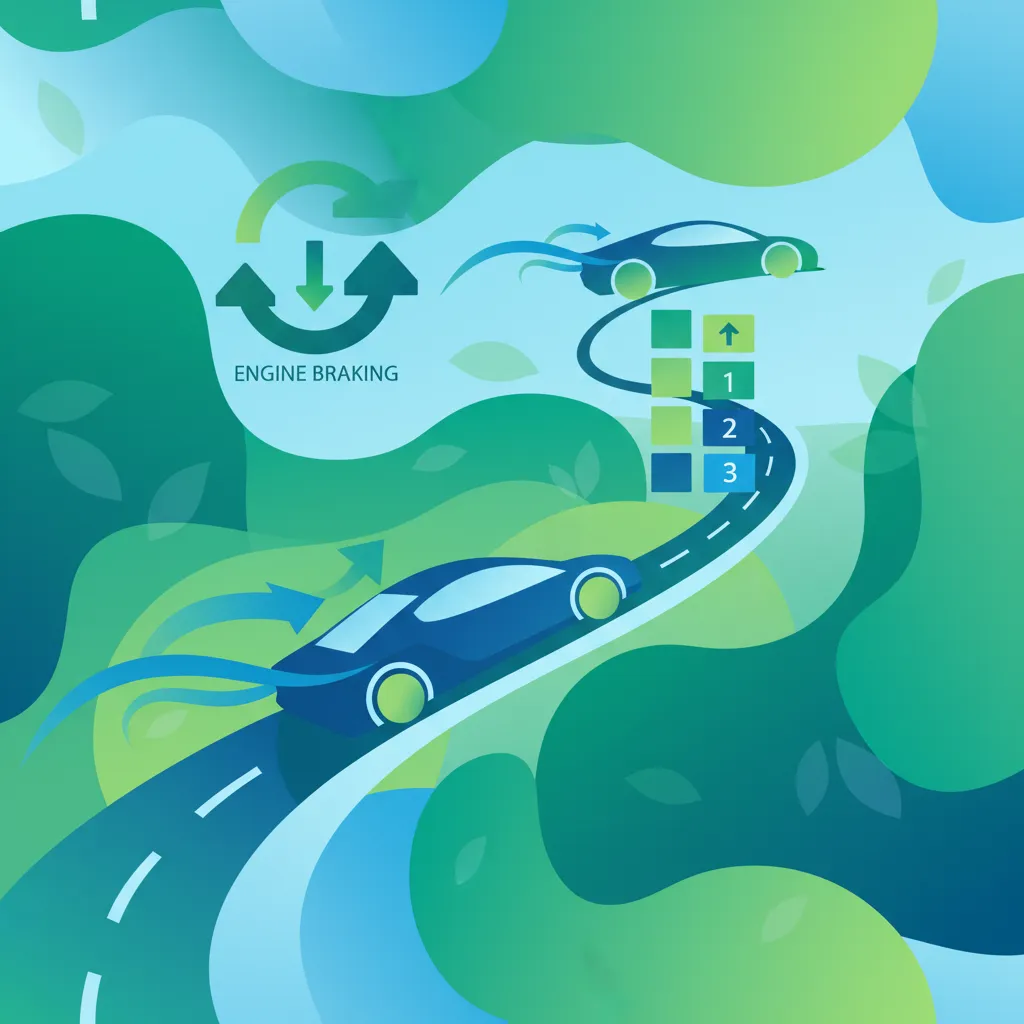
This lesson focuses on optimizing powertrain performance through skilled driving techniques. It teaches learners how to select the correct gears and shift points by understanding the engine's torque curve, which is crucial for both efficient acceleration and fuel economy. Additionally, the content details the proper application of engine braking and retarders to control speed on descents, preserving the service brakes and maintaining vehicle control without excessive fuel use.

This lesson teaches the fundamentals of safely reversing a bus using mirrors, cameras, and alarms. It covers low-speed control essential for depot navigation, where precise steering is required to avoid collisions. Specific techniques for handling articulated buses and coordinating with ground staff are also discussed to ensure safe maneuvers.

This lesson focuses on reversing and maneuvering techniques required when operating a tractor with a trailer, particularly in confined farmyards or on narrow rural roads. It outlines the use of mirrors to monitor trailer swing and suggests best practices for using spotters to improve safety. The lesson also covers planning reversal paths and executing wide-angle turns without compromising load stability.
Learn from typical mistakes made by Category C drivers when navigating turns and roundabouts. This lesson uses scenarios to highlight the consequences of misjudging off-tracking and turning radius on Polish roads.
This lesson focuses on the specific challenges HGVs face when navigating roundabouts. It details the correct procedure for approach, including selecting the appropriate lane based on the intended exit and yielding to traffic already circulating. The content emphasizes the need to account for the vehicle's large turning radius and off-tracking to avoid encroaching on adjacent lanes or mounting curbs, ensuring a smooth and safe passage through the roundabout.
This lesson addresses the high-risk maneuver of reversing a large truck. It provides systematic techniques for using mirrors and, if available, cameras to monitor the vehicle's path, while strongly emphasizing the importance of managing extensive blind spots. Learners will study procedures for maneuvering within tight spaces like loading docks and yards, including the proper use of a spotter (banksman) to ensure the area is clear and to provide guidance, minimizing the risk of collisions.

This lesson examines real-world case studies of harvest traffic, where multiple tractors and trailers share limited road space during peak agricultural periods. Learners explore strategies for coordinating speed, maintaining safe distances, and using signaling to communicate intentions. The content also addresses the challenges of field access points and the need for cooperation with other drivers.

This lesson details the specific protocols for overtaking and changing lanes in a heavy goods vehicle. It explains the importance of calculating sufficient space and speed differential before committing to a pass, while constantly being aware of the large blind spots around the truck. The content also covers procedures for safely merging onto highways and maintaining correct lane positioning to facilitate smooth and predictable traffic flow for all road users.
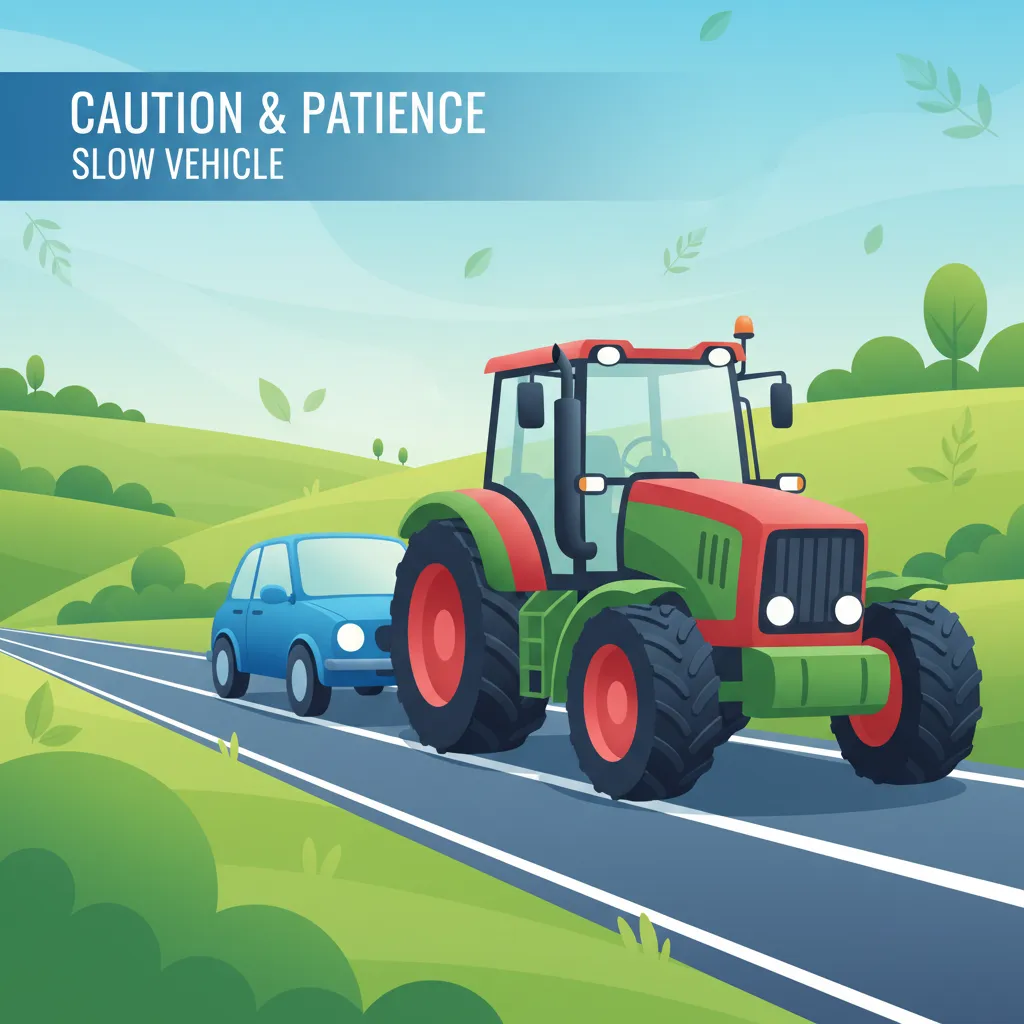
This lesson addresses encounters with slow-moving vehicles, such as tractors, which are common on rural roads. It teaches drivers to be patient, maintain a safe following distance, and only overtake when it is absolutely safe and legal to do so. Recognizing the large size and limited maneuverability of such vehicles is crucial for avoiding accidents.

This lesson equips drivers with the skills to operate a large vehicle within the challenging confines of an urban environment. It addresses how to navigate narrow streets, deal with traffic calming measures, and manage frequent stop-and-go situations while being vigilant for pedestrians and other road users. The content also emphasizes the importance of meticulous route planning to avoid unsuitable roads and the use of anticipation to maintain smooth progress and minimize disruption in congested areas.
This lesson focuses on the practical considerations of cornering large buses, particularly articulated models. It examines turning radius, the effect of the articulation joint, and the importance of maintaining appropriate speed for passenger stability. The content also outlines lane positioning strategies for intersections to avoid over-steering or under-steering.
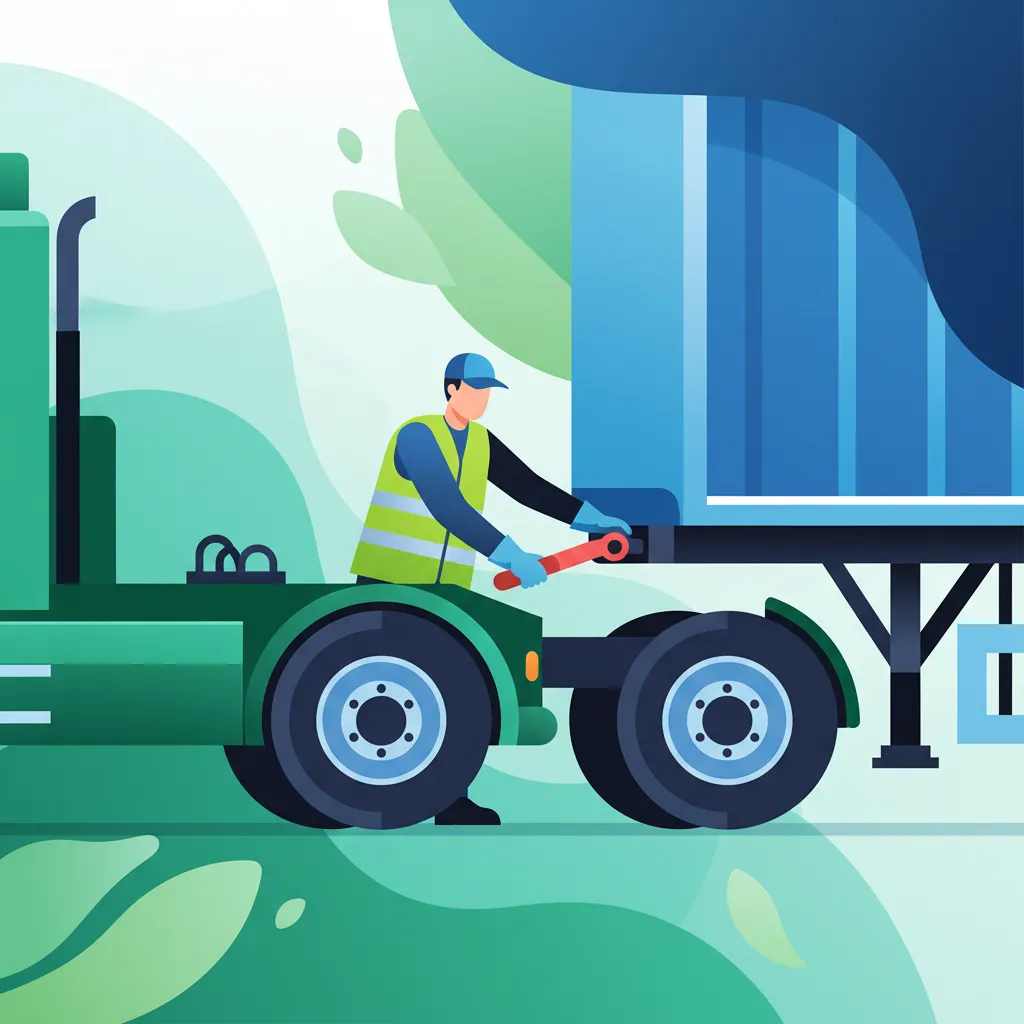
This lesson provides a step-by-step guide to safely coupling and uncoupling trailers, highlighting the correct use of hitches, drawbars, and safety chains. It emphasizes pre-couple inspections, alignment checks, and the necessity of confirming secure connections before movement. Learners will also study procedures for safely uncoupling, including establishing a safe zone and verifying trailer stability.
This lesson explains the specialized techniques required for initiating movement and bringing a heavy, loaded truck to a halt. It emphasizes fine clutch and throttle control to overcome inertia without causing driveline stress or cargo shift. Learners will also study methods for smooth, gradual braking that account for the vehicle's significant momentum, ensuring safety, passenger comfort, and the integrity of the cargo while minimizing wear on the braking system.

This lesson prepares drivers for the event of a vehicle breakdown on a motorway or expressway. It details the correct procedure: pulling over to the emergency lane, activating hazard lights, and placing the warning triangle at the legally required distance. The importance of wearing a reflective vest when outside the vehicle is also a key safety point.
Find clear answers to common questions learners have about Turning Radius, Off-Tracking, and Cornering. Learn how the lesson is structured, which driving theory objectives it supports, and how it fits into the overall learning path of units and curriculum progression in Poland. These explanations help you understand key concepts, lesson flow, and exam focused study goals.
Off-tracking refers to the phenomenon where the rear wheels of a multi-axle vehicle, especially articulated trucks, follow a path that is shorter and closer to the inside of a turn than the front wheels. This means the rear of the vehicle swings wider than the front.
Knowing your truck's turning radius and anticipating off-tracking is vital for safely negotiating turns, especially at intersections and roundabouts. Failing to account for it can lead to hitting curbs, parked cars, or other obstacles, causing damage and potential accidents.
Articulated vehicles (trucks with trailers) exhibit more significant off-tracking than rigid trucks due to the pivot point between the tractor unit and the trailer. The longer the trailer, generally the more pronounced the off-tracking effect.
For a right turn, approach the intersection slightly to the left of your lane to give the rear of your truck and trailer more space to swing out. As you turn, monitor your mirrors and front wheels to ensure you don't hit the curb or oncoming traffic.
Yes, the Polish theory exam for Category C often includes questions related to vehicle dynamics, including how to maneuver large vehicles safely, which directly involves understanding turning radius and off-tracking.
Build custom practice sessions tailored precisely to your needs. Focus on areas requiring improvement, review specific Polish road signs, or master complex traffic rules to ensure full preparation for your official driving license exam.