
Basel’s status as a tri-border city requires drivers to have a clear understanding of Swiss road traffic laws, especially regarding interactions with public transport and complex urban intersections. This guide helps you navigate city-specific scenarios, such as yielding to BVB trams and complying with local parking regulations, ensuring you are fully prepared for your theory test and real-world driving. You will learn how to distinguish between local Swiss requirements and the changing rules encountered when crossing into neighbouring countries.
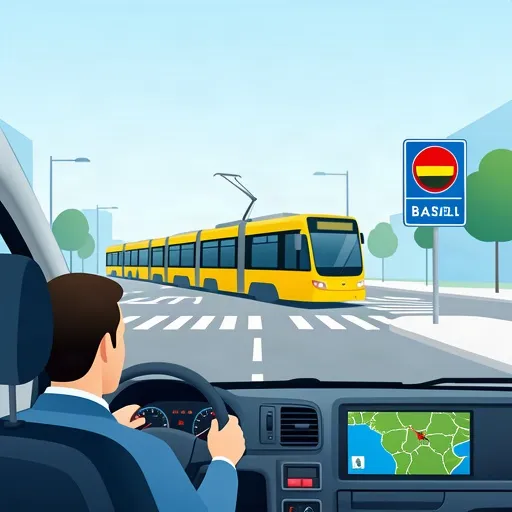
Article content overview
This article covers the essential urban driving rules specific to Basel, with particular emphasis on tram priority which is an absolute legal requirement under Swiss law. The content explains how to navigate Basel's tri-border environment where Swiss, German, and French traffic regulations intersect, and details the parking zone system (blue and white zones) with their respective requirements. Learners should memorize that trams must never be passed when stopped for passenger boarding, and that at unmarked intersections the right-before-left rule applies unless overridden by signage. The exam preparation section provides a clear hierarchy for approaching priority scenarios: signs and signals first, then the right-before-left rule, then cautionary yielding.
A short set of high-value points that capture the most important ideas from this article.
Swiss trams have absolute legal priority over all other road users in urban areas under the Signalisationsverordnung and Strassenverkehrsgesetz (SVG)
Never attempt to pass a stopped tram boarding or alighting passengers; you must wait behind it until the road is clear
When crossing tram tracks at intersections, remain hyper-vigilant as trams cannot deviate from their fixed rails and have longer braking distances
Swiss motorway speed limits (120 km/h) change immediately when crossing into Germany (no general limit) or France (110 km/h in rain)
At unmarked intersections in Basel, apply the 'right-before-left' rule unless Priority Road signs dictate otherwise
BVB (Basler Verkehrs-Betriebe) is Basel's public transport operator; their trams always have priority
Blue parking zones require a Parkscheibe (parking disc) with posted time limits; white zones require payment at a machine
Major roads with Priority Road signs (2.45) take precedence over side streets regardless of position
The hierarchy for priority is: Signs/Signals first, then right-before-left rule, then cautionary yielding
When approaching intersections with tram tracks, assess all road users including cyclists and pedestrians before proceeding
Assuming tram priority is merely a courtesy rather than a legal requirement, leading to incorrect right-of-way decisions in exam scenarios
Mistaking white parking zones for free parking, which results in fines in Basel city center
Forgetting that Swiss regulations apply when taking the theory exam, even though border differences are mentioned for situational awareness
Failing to identify lane markings and directional arrows at complex intersections like those on the Wettsteinbrücke
Assuming straight-road priority when a tram is involved, when trams almost always hold the right of way
Article content overview
A short set of high-value points that capture the most important ideas from this article.
Swiss trams have absolute legal priority over all other road users in urban areas under the Signalisationsverordnung and Strassenverkehrsgesetz (SVG)
Never attempt to pass a stopped tram boarding or alighting passengers; you must wait behind it until the road is clear
When crossing tram tracks at intersections, remain hyper-vigilant as trams cannot deviate from their fixed rails and have longer braking distances
Swiss motorway speed limits (120 km/h) change immediately when crossing into Germany (no general limit) or France (110 km/h in rain)
At unmarked intersections in Basel, apply the 'right-before-left' rule unless Priority Road signs dictate otherwise
BVB (Basler Verkehrs-Betriebe) is Basel's public transport operator; their trams always have priority
Blue parking zones require a Parkscheibe (parking disc) with posted time limits; white zones require payment at a machine
Major roads with Priority Road signs (2.45) take precedence over side streets regardless of position
The hierarchy for priority is: Signs/Signals first, then right-before-left rule, then cautionary yielding
When approaching intersections with tram tracks, assess all road users including cyclists and pedestrians before proceeding
Assuming tram priority is merely a courtesy rather than a legal requirement, leading to incorrect right-of-way decisions in exam scenarios
Mistaking white parking zones for free parking, which results in fines in Basel city center
Forgetting that Swiss regulations apply when taking the theory exam, even though border differences are mentioned for situational awareness
Failing to identify lane markings and directional arrows at complex intersections like those on the Wettsteinbrücke
Assuming straight-road priority when a tram is involved, when trams almost always hold the right of way
Explore related topics, search based questions, and concepts that learners often look up when studying Basel Driving and Tram Rules. These themes reflect real search intent and help you understand how this topic connects to wider driving theory knowledge in Switzerland.
Find clear and practical answers to common questions learners often have about Basel Driving and Tram Rules. This section helps explain difficult points, remove confusion, and reinforce the key driving theory concepts that matter for learners in Switzerland.
Yes. According to Swiss traffic law, trams have priority in almost all situations, including at pedestrian crossings and when entering or leaving stops, unless specific signs or signals indicate otherwise.
Yes. While Swiss tram priority is strict under Swiss law, once you cross the border, you must adhere to the specific traffic regulations of Germany or France. Always be aware of the border signs indicating which country's laws currently apply.
Always observe tram movements carefully and check your mirrors and blind spots. Remember that trams cannot change lanes or stop quickly; therefore, you must grant them priority and never obstruct their path.
When entering Germany, you leave the Swiss speed limit zone. The German Autobahn may have sections without a general speed limit, whereas Swiss motorways strictly enforce a 120 km/h limit. Always watch for speed limit signs at border crossings.
Continue your learning journey by searching our extensive library of Swiss driving theory articles. Explore additional topics, review specific road rules, or deepen your understanding of official traffic procedures to excel in your exam and drive safely in Switzerland.