
Overtaking is a complex aspect of Swiss traffic law that demands precision and strict adherence to specific articles in the VRV and SVG. By learning exactly when and where overtaking is permitted, you will improve your situational awareness and avoid common exam traps that lead to errors. This overview clarifies the legal boundaries of passing, ensuring you are prepared for both the theoretical test and real-world Swiss driving conditions.
Article content overview
Understanding the regulations surrounding overtaking is a cornerstone of safe driving and a frequent focus area in the official Swiss driving theory exam. Governed primarily by Article 35 of the Traffic Rules Ordinance (VRV), these rules are designed to maintain a predictable, fluid, and safe traffic environment. Whether you are navigating busy city streets or high-speed motorways, knowing exactly when to pass and when to hold back is vital for passing your test and staying accident-free.
In Switzerland, the fundamental principle is that you must always overtake on the left. To execute a legal maneuver, you must have a sufficient speed advantage over the vehicle you are passing and ensure that you can return to the right-hand lane without obstructing or endangering the vehicle you have just overtaken. Before initiating any change of lane or passing maneuver, you are legally required to verify that the path is clear, typically using your mirrors and a shoulder check to monitor blind spots.
The theory exam places heavy emphasis on areas where overtaking is forbidden. You must recognize that these rules are not merely guidelines; they are absolute safety measures. Overtaking is strictly prohibited in the following situations:
While the left-side rule is rigid, there is a specific exception known as "driving in parallel columns." On motorways or multi-lane roads where traffic is moving in parallel lanes at similar, slow speeds due to congestion, you may pass a vehicle on the right. This is not a license to weave through traffic; it is a concession to the practical reality of high-volume road capacity. You must never perform a "lane change-pass-lane change" maneuver at high speeds, as this is legally classified as dangerous overtaking and carries significant penalties.
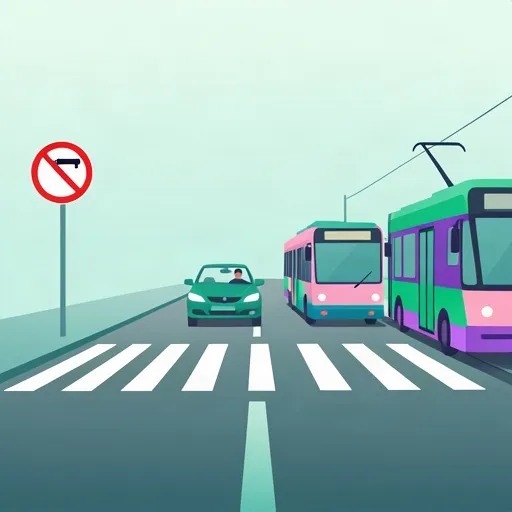
Swiss cities rely heavily on public transport, and the rules for interacting with trams are unique. Unlike other vehicles, trams in Switzerland must almost always be overtaken on the right. Because trams usually operate in the center of the road and have fixed paths, attempting to overtake them on the left is extremely dangerous and, in most cases, prohibited. You must also exercise extreme caution near tram stops without safety islands; if passengers are boarding or alighting, you must wait until they are clear before proceeding.
Illegal overtaking is classified as a traffic violation that can lead to an Ordnungsbusse (fixed fine), typically around CHF 240, though dangerous maneuvers resulting in a public report (Rapport) can lead to much harsher penalties, including license suspension. Examiners look for your ability to identify the "hazard zones" described above. When answering questions, always consider if there is a pedestrian crossing or intersection nearby, as these are the most common "trap" scenarios used in the theory test.
| Scenario | Allowed to Overtake? | Requirement |
|---|---|---|
| Solid Center Line | No | None |
| Pedestrian Crossing (50m) | No | None |
| Motorway (Parallel Traffic) | Yes | Stay in your lane |
| Tram (Moving) | Yes | Only on the right |
| Vehicle turning left | No | Pass on the right (if space permits) |
Swiss overtaking law under Article 35 VRV establishes the left-side pass as the universal rule, with overtaking prohibited near crossings, junctions, and over solid lines. The right-hand exception exists only in slow-moving parallel traffic on multi-lane roads and does not permit aggressive lane changing. Trams receive special treatment and must always be passed on the right. Theory exam questions frequently test knowledge of the 50-meter hazard zones and the distinction between legal parallel traffic passing and dangerous overtaking maneuvers.
A short set of high-value points that capture the most important ideas from this article.
Overtaking in Switzerland must always be done on the left, with a sufficient speed advantage and a clear path to return to lane.
Overtaking is strictly prohibited within 50 meters of pedestrian crossings and road junctions.
The right-hand exception applies only in parallel traffic situations on multi-lane roads, not for general lane changes.
Trams in Switzerland must always be overtaken on the right due to their central road position.
You must perform a shoulder check to verify blind spots before initiating any passing maneuver.
The 50-meter rule: no overtaking within 50m of pedestrian crossings or road junctions.
Solid white center lines may never be crossed for overtaking.
Parallel traffic exception: passing on the right is only legal when traffic flows in parallel columns at similar speeds.
Trams require right-side overtaking only; left-side overtaking of trams is prohibited.
Overtaking a vehicle that has signaled a left turn is forbidden even if the vehicle is moving slowly.
Misusing the right-hand exception by performing high-speed lane-change maneuvers in normal traffic conditions.
Forgetting that trams must be overtaken on the right, not the left, unlike other vehicles.
Assuming overtaking is permitted after passing the 50-meter zone markers near crossings or junctions.
Neglecting to shoulder check and relying solely on mirrors before initiating a pass.
Attempting to overtake a vehicle that is already turning left toward the center of the road.
Article content overview
A short set of high-value points that capture the most important ideas from this article.
Overtaking in Switzerland must always be done on the left, with a sufficient speed advantage and a clear path to return to lane.
Overtaking is strictly prohibited within 50 meters of pedestrian crossings and road junctions.
The right-hand exception applies only in parallel traffic situations on multi-lane roads, not for general lane changes.
Trams in Switzerland must always be overtaken on the right due to their central road position.
You must perform a shoulder check to verify blind spots before initiating any passing maneuver.
The 50-meter rule: no overtaking within 50m of pedestrian crossings or road junctions.
Solid white center lines may never be crossed for overtaking.
Parallel traffic exception: passing on the right is only legal when traffic flows in parallel columns at similar speeds.
Trams require right-side overtaking only; left-side overtaking of trams is prohibited.
Overtaking a vehicle that has signaled a left turn is forbidden even if the vehicle is moving slowly.
Misusing the right-hand exception by performing high-speed lane-change maneuvers in normal traffic conditions.
Forgetting that trams must be overtaken on the right, not the left, unlike other vehicles.
Assuming overtaking is permitted after passing the 50-meter zone markers near crossings or junctions.
Neglecting to shoulder check and relying solely on mirrors before initiating a pass.
Attempting to overtake a vehicle that is already turning left toward the center of the road.
Explore related topics, search based questions, and concepts that learners often look up when studying Swiss Overtaking Rules Explained. These themes reflect real search intent and help you understand how this topic connects to wider driving theory knowledge in Switzerland.
Find clear and practical answers to common questions learners often have about Swiss Overtaking Rules Explained. This section helps explain difficult points, remove confusion, and reinforce the key driving theory concepts that matter for learners in Switzerland.
No, it is generally prohibited. You may only overtake on the right when traffic is moving in parallel lanes at similar, slow speeds, or on lanes clearly marked for different destinations.
Trams must always be overtaken on the right unless the road layout or markings dictate otherwise, or if there is not enough space on the right side.
Overtaking is strictly prohibited within 50 meters of a marked pedestrian crossing.
Illegal overtaking can result in a fixed fine (Ordnungsbusse) of up to CHF 240, and more serious or dangerous maneuvers can lead to a formal report and potential legal prosecution.
Continue your learning journey by searching our extensive library of Swiss driving theory articles. Explore additional topics, review specific road rules, or deepen your understanding of official traffic procedures to excel in your exam and drive safely in Switzerland.