
Understanding pedestrian priority is a fundamental pillar of Swiss traffic law and a common topic in the driving theory exam. This guide clarifies exactly when you must reduce speed or come to a complete stop, focusing on the legal distinction between pedestrians simply standing by the road and those showing a clear intent to cross. You will also learn about the specific rules concerning cyclists at these crossings and the financial penalties associated with failing to yield.
Article content overview
Navigating Swiss roads requires a deep understanding of pedestrian rights, especially when approaching a Fussgängerstreifen (pedestrian crossing). In Switzerland, the legal framework governing these areas is among the strictest in Europe. For any aspiring driver preparing for the Swiss theory exam, understanding these rules is not just about avoiding a fine; it is about ensuring the safety of vulnerable road users and demonstrating the high level of vigilance expected of a licensed driver in Switzerland.
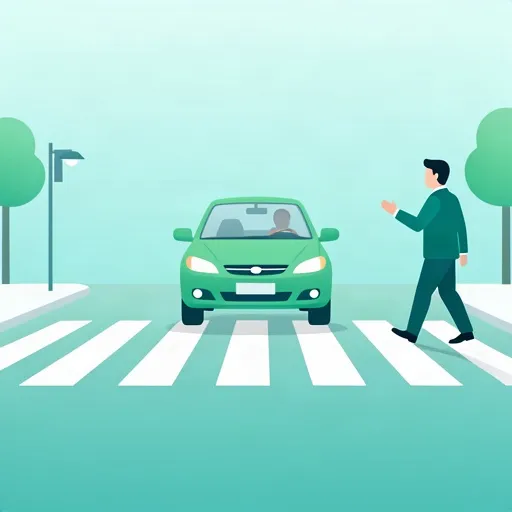
Under Swiss traffic law, specifically Article 6 of the Verkehrsregelnverordnung (VRV), drivers are mandated to yield to pedestrians who are either already on a marked crossing or are waiting to cross and clearly manifest an intent to do so. This legal standard is highly significant because it shifts the focus from the physical position of the pedestrian to their observable behavior. Even if a person has not yet placed a foot on the road, if they are standing at the curb and looking toward traffic or stepping forward in a way that signals a desire to cross, you are legally required to reduce your speed and, if necessary, come to a complete stop.
The legal condition where a pedestrian signals their desire to traverse a crossing through body language, such as waiting at the edge of the curb, looking at approaching traffic, or moving toward the street. Drivers must recognize this as an immediate trigger for their duty to yield.
It is a common error for learners to assume they only need to stop when a pedestrian has already committed to walking onto the road. In the Swiss theory exam, questions often test your ability to differentiate between a pedestrian who is simply standing near a crossing and one who is clearly waiting to cross. If you fail to anticipate this intent, you risk failing your driving test and, more importantly, endangering lives in real-world urban traffic.
A frequently misunderstood area of Swiss road law involves cyclists at pedestrian crossings. According to the current regulations, cyclists do not have the same priority as pedestrians when they are mounted on their bicycles. A cyclist crossing a Fussgängerstreifen while remaining in the saddle does not automatically trigger the same yielding requirement from a driver, unless the cyclist has dismounted and is pushing their bike.
Do not assume you have the right of way over a cyclist who is approaching a crossing at high speed. While the law mandates you only yield to pedestrians and those pushing their bikes, always exercise caution. If a collision occurs, the driver is often held responsible regardless of the technical priority rules due to the principle of "defensive driving" and the inherent vulnerability of the cyclist.
In urban centers like Zurich, pedestrian crossings are frequently integrated with tram infrastructure. A vital rule to remember is that trams always have priority, even at pedestrian crossings. You will often see the "Achtung Tram" marking near these areas, which serves as a reminder that the mass and braking distance of a tram make it impossible for them to stop for pedestrians in the same way a car can. As a driver, you must be hyper-aware that a tram may be approaching behind you or from the opposite direction, and you should never create a situation where a pedestrian is trapped between your vehicle and an oncoming tram.
Failing to grant priority at a marked crossing is a serious infraction in Switzerland. Under the Ordnungsbussenkatalog (fixed fines ordinance), minor instances of failing to yield can result in a fine ranging from CHF 40 to CHF 120. However, these figures are only the starting point. If your failure to yield results in a dangerous situation, near-miss, or actual accident, the matter moves from an administrative fine to criminal prosecution. This will lead to a record entry, significant legal fees, and a potential extension or revocation of your probationary driving license.
Swiss pedestrian priority rules under Article 6 of the Verkehrsregelnverordnung require drivers to yield to pedestrians both when they are on the crossing and when they clearly show intent to cross through observable behavior. A key distinction tested on the Swiss theory exam is recognizing that only dismounted cyclists share pedestrian priority; mounted cyclists do not automatically trigger a yielding requirement. Drivers must also remember that trams hold absolute priority at integrated crossings and should always exercise defensive driving, as liability can extend beyond mere technical right-of-way rules. The consequences of failing to yield range from fixed fines of CHF 40–120 up to criminal prosecution with license implications if a dangerous situation or accident results.
A short set of high-value points that capture the most important ideas from this article.
Under Article 6 of the Swiss VRV, drivers must yield to pedestrians who are on the crossing OR showing clear intent to cross through body language
The legal trigger for yielding is a pedestrian's observable intent, not just their physical presence on the road
Cyclists on a Fussgängerstreifen only have pedestrian priority if they have dismounted and are pushing their bike
Trams always have absolute priority at pedestrian crossings, even over pedestrians, due to their mass and braking distance
Failing to yield can result in fines from CHF 40 to 120, or criminal prosecution if a dangerous situation or accident occurs
A pedestrian simply standing near the curb is not the same as one showing intent to cross - look for eye contact, looking at traffic, or stepping forward
Mounted cyclists do NOT have automatic priority at Fussgängerstreifen; only pedestrians and those pushing bikes do
The defensive driving principle means drivers can still be held responsible in collisions even where technical priority rules favor them
Always scan crossings well in advance and reduce speed proactively before confirming a pedestrian's intentions
Eye contact with pedestrians at crossings helps confirm their intent and is recommended as good practice
Assuming you only need to stop once a pedestrian has actually stepped onto the road, ignoring their expressed intent
Treating a cyclist who is still mounted on their bicycle the same as a pedestrian with priority
Not reducing speed early enough when approaching a crossing with pedestrians present
Forgetting that trams take priority and can trap pedestrians between your vehicle and an oncoming tram
Proceeding before the pedestrian has fully cleared the crossing, not accounting for slower walkers or children
Article content overview
A short set of high-value points that capture the most important ideas from this article.
Under Article 6 of the Swiss VRV, drivers must yield to pedestrians who are on the crossing OR showing clear intent to cross through body language
The legal trigger for yielding is a pedestrian's observable intent, not just their physical presence on the road
Cyclists on a Fussgängerstreifen only have pedestrian priority if they have dismounted and are pushing their bike
Trams always have absolute priority at pedestrian crossings, even over pedestrians, due to their mass and braking distance
Failing to yield can result in fines from CHF 40 to 120, or criminal prosecution if a dangerous situation or accident occurs
A pedestrian simply standing near the curb is not the same as one showing intent to cross - look for eye contact, looking at traffic, or stepping forward
Mounted cyclists do NOT have automatic priority at Fussgängerstreifen; only pedestrians and those pushing bikes do
The defensive driving principle means drivers can still be held responsible in collisions even where technical priority rules favor them
Always scan crossings well in advance and reduce speed proactively before confirming a pedestrian's intentions
Eye contact with pedestrians at crossings helps confirm their intent and is recommended as good practice
Assuming you only need to stop once a pedestrian has actually stepped onto the road, ignoring their expressed intent
Treating a cyclist who is still mounted on their bicycle the same as a pedestrian with priority
Not reducing speed early enough when approaching a crossing with pedestrians present
Forgetting that trams take priority and can trap pedestrians between your vehicle and an oncoming tram
Proceeding before the pedestrian has fully cleared the crossing, not accounting for slower walkers or children
Explore related topics, search based questions, and concepts that learners often look up when studying Swiss Pedestrian Priority Rules. These themes reflect real search intent and help you understand how this topic connects to wider driving theory knowledge in Switzerland.
Find clear and practical answers to common questions learners often have about Swiss Pedestrian Priority Rules. This section helps explain difficult points, remove confusion, and reinforce the key driving theory concepts that matter for learners in Switzerland.
Yes, if the pedestrian is clearly showing an intent to cross, such as looking toward traffic or stepping toward the edge, you must reduce your speed and, if necessary, stop to yield.
No. Cyclists only have the same priority as pedestrians if they dismount and walk their bicycle across the crossing.
Failing to yield is a violation of traffic law and can result in an administrative fine (Ordnungsbusse) of CHF 40–120. If you cause a dangerous situation or an accident, you will face much higher penalties and potential criminal proceedings.
No, the tram always has priority over pedestrians, even at a marked pedestrian crossing.
Continue your learning journey by searching our extensive library of Swiss driving theory articles. Explore additional topics, review specific road rules, or deepen your understanding of official traffic procedures to excel in your exam and drive safely in Switzerland.