
Mastering the rules regarding passenger restraint systems is essential for both your driving theory exam and safe vehicle operation in Switzerland. This article provides a clear overview of the legal obligations for drivers, the specific ECE R44 and R129 standards for child safety seats, and the consequences of non-compliance. You will learn why the driver is held accountable for all occupants and how to apply these safety regulations correctly in everyday traffic situations.
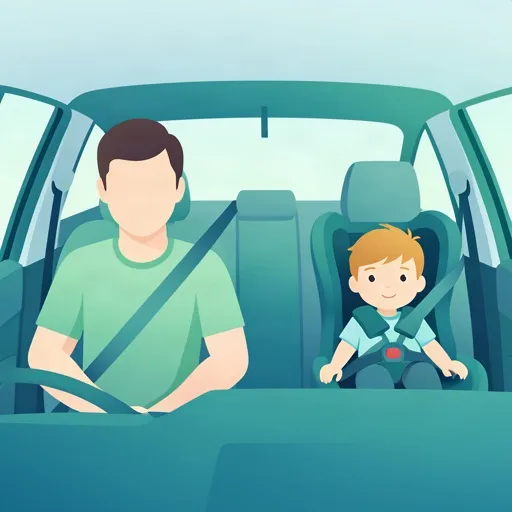
Article content overview
Understanding passenger safety regulations is a fundamental component of the Swiss driving theory exam and a critical real-world obligation for every motorist. According to the Swiss Road Traffic Act (SVG) and the Traffic Rules Ordinance (VRV), the driver holds the legal responsibility to ensure that all occupants, regardless of age or seating position, are properly secured while the vehicle is in motion. Compliance is not only a matter of legal adherence but a proven life-saving measure, as data from the BFU (Swiss Council for Accident Prevention) highlights that wearing a seatbelt effectively doubles your chances of survival in a serious collision.
Under Article 3a of the Traffic Rules Ordinance (VRV), all vehicle occupants are required to wear a seatbelt if the vehicle is equipped with one. This rule applies uniformly across all passenger vehicles, including cars, vans, and buses. As the driver, you are legally accountable for ensuring that your passengers follow these regulations. If a passenger is found unbelted, it is the driver who is held responsible and issued the fine, rather than the individual passenger.
In Switzerland, the driver is held liable for each unbelted passenger. An Ordnungsbusse of CHF 60 per unbelted occupant is issued directly to the driver. This is a common focus in theory exam questions designed to test your understanding of your duty of care.
The regulations concerning children are specific and uncompromising. Children under the age of 12 years, or those who are shorter than 150 centimeters, must be secured in an appropriate, ECE-approved child restraint system (Kindersitz). It is important to note that both conditions—the age threshold and the height requirement—must be evaluated. If a child is under 150 cm, they require a child seat regardless of whether they have already reached their 12th birthday.
The primary goal is to ensure the safety of the child, as standard three-point seatbelts are designed for adult physiology. An improperly secured child faces a significantly higher risk of injury in the event of a sudden stop or collision.
The ECE R44 and R129 (i-Size) standards are the recognized legal benchmarks in Switzerland for child safety seats. These standards ensure that the seat has undergone rigorous testing for structural integrity and crash protection, specifically tailored to the child's weight and height.
While the law is strict, there are narrow exceptions recognized under Swiss traffic legislation:
Properly installing a child seat is as important as the seat itself. If you are placing a child seat in the front passenger position, you must verify the status of the front airbag. For rear-facing child seats, the front airbag must be deactivated; otherwise, the deployment of the airbag during a collision would result in severe or fatal injuries to the child.
| Scenario | Requirement |
|---|---|
| Child < 12 years AND < 150 cm | Approved child seat mandatory |
| Child > 12 years OR > 150 cm | Standard seatbelt allowed |
| Passenger on rear seat | Seatbelt mandatory if fitted |
| Front passenger airbag | Must be off for rear-facing seats |
The Swiss driving theory exam often presents scenarios involving passenger safety to ensure that candidates understand their role as the person in control. Expect questions that test whether you know who receives the fine, the specific height threshold for child seats, and the correct procedure for children in the front seat. Always remember that these laws exist to mitigate the massive physical forces present even at low-speed impacts, where a 30 km/h collision can increase body weight by 20 times during an impact.
Swiss traffic law under VRV Article 3a requires all vehicle occupants to wear seatbelts when fitted, with the driver held legally responsible for compliance. Children under 12 years old or under 150 cm must be secured in an ECE R44 or R129 approved child restraint system, with both criteria evaluated independently. The driver receives a CHF 60 Ordnungsbusse for each unbelted occupant, making this a frequent exam topic. Critical safety requirements include deactivating front airbags for rear-facing seats and recognizing narrow exceptions for taxis, historic vehicles, and documented medical exemptions.
A short set of high-value points that capture the most important ideas from this article.
The driver is legally liable for all unbelted passengers under VRV Article 3a, not the passengers themselves
Children under 12 years of age OR under 150 cm in height must use an approved child restraint system
Both age AND height conditions must be evaluated independently - meeting either threshold triggers the child seat requirement
Rear-facing child seats installed in the front passenger seat require the front airbag to be deactivated before use
ECE R44 and R129 (i-Size) are the European testing standards that approved child safety seats must meet in Switzerland
CHF 60 Ordnungsbusse per unbelted occupant is issued to the driver, not the passenger
Standard three-point seatbelts are designed for adult physiology and are unsuitable for children under 150 cm
Taxi exemption applies only when no appropriate child seat is available and the child is not in the front seat
Historic vehicles never fitted with seatbelts by the manufacturer are exempt from child seat requirements
Medical exemptions require an official certificate confirming seatbelt use is not feasible due to health reasons
Assuming passengers receive fines for being unbelted, when in fact only the driver is liable
Believing only the age threshold matters; height under 150 cm independently mandates a child seat regardless of age
Forgetting to deactivate the front airbag when installing a rear-facing child seat in the front passenger position
Assuming any child seat is acceptable; only ECE R44 or R129 approved restraints satisfy the legal requirement
Confusing the exemption criteria - taxi passengers still cannot sit in the front if no child seat is available
Article content overview
A short set of high-value points that capture the most important ideas from this article.
The driver is legally liable for all unbelted passengers under VRV Article 3a, not the passengers themselves
Children under 12 years of age OR under 150 cm in height must use an approved child restraint system
Both age AND height conditions must be evaluated independently - meeting either threshold triggers the child seat requirement
Rear-facing child seats installed in the front passenger seat require the front airbag to be deactivated before use
ECE R44 and R129 (i-Size) are the European testing standards that approved child safety seats must meet in Switzerland
CHF 60 Ordnungsbusse per unbelted occupant is issued to the driver, not the passenger
Standard three-point seatbelts are designed for adult physiology and are unsuitable for children under 150 cm
Taxi exemption applies only when no appropriate child seat is available and the child is not in the front seat
Historic vehicles never fitted with seatbelts by the manufacturer are exempt from child seat requirements
Medical exemptions require an official certificate confirming seatbelt use is not feasible due to health reasons
Assuming passengers receive fines for being unbelted, when in fact only the driver is liable
Believing only the age threshold matters; height under 150 cm independently mandates a child seat regardless of age
Forgetting to deactivate the front airbag when installing a rear-facing child seat in the front passenger position
Assuming any child seat is acceptable; only ECE R44 or R129 approved restraints satisfy the legal requirement
Confusing the exemption criteria - taxi passengers still cannot sit in the front if no child seat is available
Explore related topics, search based questions, and concepts that learners often look up when studying Swiss Seatbelt and Child Seat Laws. These themes reflect real search intent and help you understand how this topic connects to wider driving theory knowledge in Switzerland.
Find clear and practical answers to common questions learners often have about Swiss Seatbelt and Child Seat Laws. This section helps explain difficult points, remove confusion, and reinforce the key driving theory concepts that matter for learners in Switzerland.
In Switzerland, the driver is legally responsible for ensuring that all passengers are properly belted. Fines for unbelted passengers are issued to the driver, not the individual passenger.
Children under 12 years of age must use a suitable child restraint system if they are under 150 cm in height. Once a child reaches either 150 cm in height or 12 years of age, they may use a standard seatbelt.
Child seats must meet approved European standards, specifically ECE R44 or ECE R129 (i-Size). These labels indicate that the seat is tested for safety and appropriate for the child's weight and height.
Exceptions are very narrow, such as in taxis when no appropriate child seat is available, or in historic vehicles that were never fitted with seatbelts by the manufacturer.
Continue your learning journey by searching our extensive library of Swiss driving theory articles. Explore additional topics, review specific road rules, or deepen your understanding of official traffic procedures to excel in your exam and drive safely in Switzerland.