
This unit focuses on the unique challenges of driving large goods vehicles in urban Swiss environments. You will learn essential strategies for interacting safely with pedestrians, cyclists, and motorcyclists, with a particular emphasis on the hazards presented during right-hand turns. Additionally, we cover how to correctly interpret and comply with various access restrictions, such as weight, height, and environmental zones, ensuring legal and safe operation within cities.
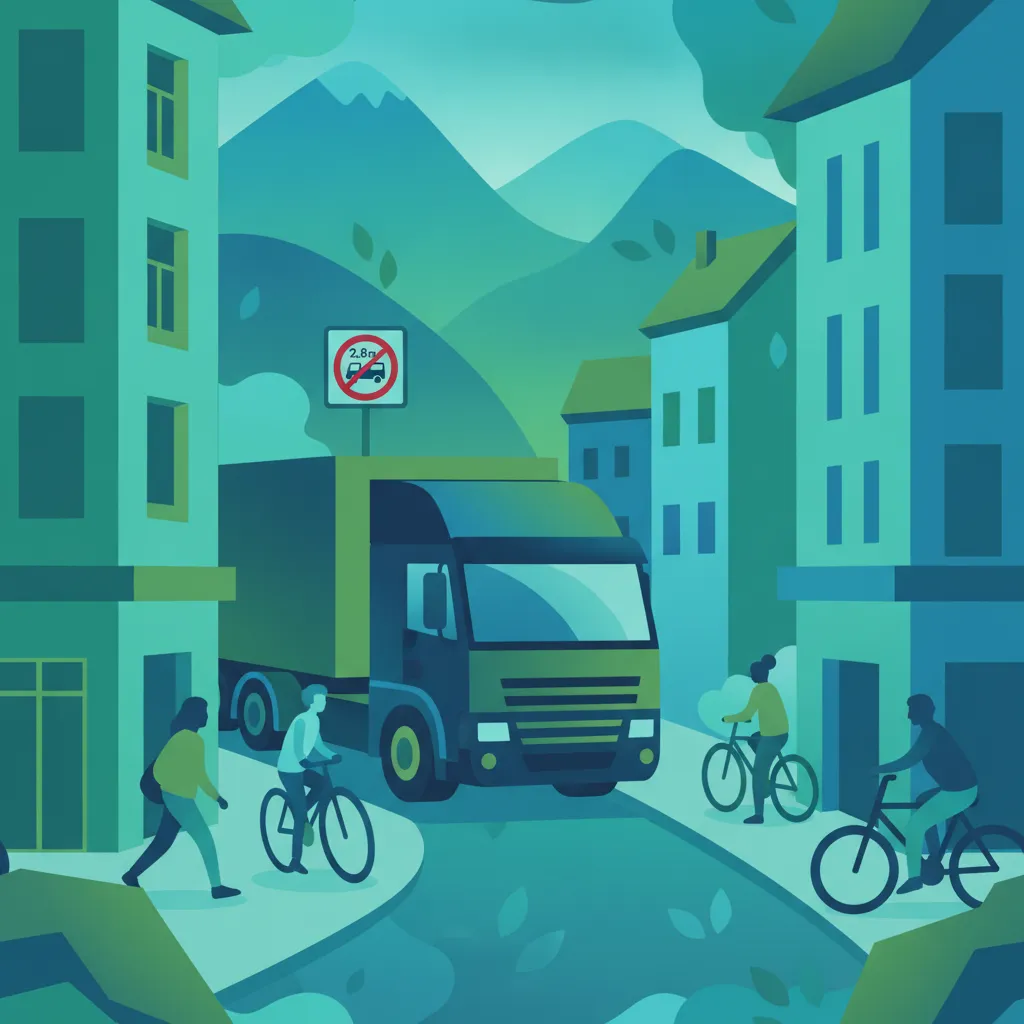
Browse all lessons that make up Urban Deliveries, Vulnerable Road Users and Restricted Environments. Each lesson focuses on specific topics, learning objectives, and core concepts, helping you build essential knowledge and follow a clear, structured progression toward your study goals in Switzerland.
Urban driving requires heightened awareness and careful planning. This lesson covers the challenges of narrow streets, heavy traffic, and the need to identify designated loading and unloading zones. It emphasizes the importance of planning routes in advance to account for time-based access restrictions and to avoid unsuitable roads.
Pedestrians, cyclists, motorcyclists, and e-scooter riders are extremely vulnerable in any interaction with a heavy vehicle. This lesson instills a defensive mindset, teaching drivers to be hyper-aware of VRUs, especially near junctions, crossings, and cycle lanes. It focuses on anticipation and giving VRUs extra space, as they can be unpredictable and are often hidden in blind spots.
The left-hand turn (in Switzerland) is a moment of high risk, as a cyclist can easily be hidden in the vehicle's nearside blind spot. This lesson provides a detailed analysis of this scenario, mandating a slow approach and meticulous, repeated mirror checks before and during the turn. It emphasizes that the driver must assume a cyclist could be there, even if one isn't immediately visible.
Many urban areas have restrictions to manage traffic and protect infrastructure. This lesson teaches drivers to identify and interpret traffic signs that prohibit access based on gross vehicle weight, axle load, height, or width. It also covers the growing prevalence of environmental or low-emission zones, which may restrict entry for older, more polluting vehicles.
Construction sites and industrial areas are non-public roads with their own set of rules and hazards. This lesson covers the need to follow site-specific safety instructions, be aware of moving plant machinery and personnel on the ground, and assess ground conditions. It highlights that reversing is often required and should be done with a signaller wherever possible.
Professional drivers are ambassadors for their company and the entire transport industry. This lesson promotes considerate driving practices, such as avoiding unnecessary use of noisy engine brakes in built-up areas, minimizing engine idling, and operating equipment quietly. This professionalism helps maintain a positive public perception and reduces complaints, particularly during unsociable hours.
Explore high-intent keywords and long-tail search topics learners use when researching Urban Deliveries, Vulnerable Road Users and Restricted Environments. These terms reflect how people search for reliable study materials, structured explanations, and unit-level theory preparation support in Switzerland.
Find clear answers to the most common questions learners ask about Urban Deliveries, Vulnerable Road Users and Restricted Environments. Understand how the unit is organized, what learning goals it supports, and how it contributes to your study progression with structured explanations and practical guidance tailored for learners in Switzerland.
The primary risks involve interactions with vulnerable road users (VRUs) such as pedestrians, cyclists, and motorcyclists, who may not be easily seen. Additionally, navigating complex urban infrastructure, dealing with various access restrictions (weight, height, environmental zones), and managing delivery schedules under time pressure create significant challenges. Understanding these factors is crucial for safe urban operation.
When a truck turns right, its trailer follows a tighter path than the truck's front, creating a 'hidden' space where a cyclist going straight may be in the driver's blind spot. This makes it imperative for drivers to check mirrors extensively, slow down, and ideally signal their intention well in advance, ensuring the path is clear of cyclists before completing the turn.
You must pay close attention to road signs indicating access restrictions. These can include limits on vehicle weight (Gesamtgewicht), height (Höhe), width (Breite), length (Länge), or specific environmental zones (Umweltzonen) that may restrict access based on emission standards. Always verify these signs and consult your route plan or GPS for designated truck routes.
Vulnerable road users are individuals who are not adequately protected by a vehicle's structure and are therefore more susceptible to serious injury in a collision. In Switzerland, this primarily includes pedestrians, cyclists, motorcyclists, and children. Drivers of heavy goods vehicles have a heightened duty of care towards these road users.
Yes, while not always explicitly signed for trucks, considerate driving is expected. This includes avoiding unnecessary engine revving, using quieter routes where possible, and minimizing noise during deliveries, especially during early mornings or late evenings. Adhering to general Swiss traffic rules and showing consideration for residents is paramount.
Exceeding legal limits without proper authorization is illegal and dangerous. If your route requires you to traverse a road with restrictions that your vehicle exceeds, you must plan an alternative route. For exceptional loads, special permits and route planning services are necessary, which go beyond standard theory test knowledge but highlight the importance of route awareness.
All included lessons
Lessons in Urban Deliveries, Vulnerable Road Users and Restricted Environments
See who benefits most from studying Urban Deliveries, Vulnerable Road Users and Restricted Environments. This overview explains how the unit supports different learning needs, what level of knowledge is helpful before starting, and how it fits into the overall study path in Switzerland.
This unit is essential for all aspiring Category C and C1 heavy goods vehicle drivers in Switzerland preparing for their theory exam. It is particularly beneficial for drivers who may be new to operating large vehicles in complex urban settings or those who need to refresh their understanding of specific risks associated with vulnerable road users and access restrictions.

Begin your structured preparation for the official Swiss driving licence theory test today. Browse our comprehensive curriculum, choose your ideal course, and start mastering essential traffic laws, road signs, and practical driving knowledge with confidence.
Browse Swiss Theory CoursesExplore all units and lessons included in this driving theory course.
Begin your structured preparation for the official Swiss driving licence theory test today. Browse our comprehensive curriculum, choose your ideal course, and start mastering essential traffic laws, road signs, and practical driving knowledge with confidence.
Browse Swiss Theory Courses