
This lesson guides Category C and C1 drivers through the unique challenges of operating heavy goods vehicles on construction sites and in industrial zones. You will learn to navigate these non-public environments safely while managing specific risks, such as uneven ground, blind spots, and heavy site machinery, which are vital for your Swiss driving theory exam.

Lesson content overview
Operating heavy goods vehicles, especially Category C and C1 vehicles, on construction sites and within industrial complexes presents a unique set of challenges and safety protocols distinct from public road driving. These environments are characterized by dynamic operations, varied ground conditions, and a constant presence of personnel and specialized machinery. Mastery of site-specific rules, heightened situational awareness, and precise vehicle handling are paramount to ensure safety, prevent accidents, and maintain legal compliance in these restricted, yet highly active, zones.
Construction sites and industrial areas are often classified as non-public roads or private premises, meaning that while standard traffic laws might not apply in their entirety, a strict framework of site-specific safety regulations and operational procedures takes precedence. For professional drivers of heavy goods vehicles, understanding this distinction is crucial. These zones are inherently hazardous due to the continuous movement of plant machinery, the presence of workers on foot, and constantly changing ground conditions or traffic layouts. Failing to adhere to established safety guidelines in these environments can lead to severe consequences, including collisions, vehicle damage, cargo shifting, and serious injuries to personnel.
This lesson specifically addresses the safety protocols, legal responsibilities, and operational considerations that are essential when maneuvering heavy goods vehicles in these challenging settings within the context of the Official Swiss Driving Theory Course for Category C & C1 Goods Vehicles.
Effective operation of heavy goods vehicles in construction sites and industrial areas hinges on several fundamental safety principles. These principles are designed to mitigate the inherent risks associated with large vehicle mass, limited maneuverability, and the dynamic nature of work environments.
Upon entering any construction site or industrial area, the driver of a heavy goods vehicle must immediately seek and strictly adhere to all site-specific safety instructions. These directives, whether written or verbal, are issued by site management, a foreman, or a designated signaller, and they dictate critical aspects such as traffic flow, permissible speed limits, and specific operational constraints. These instructions are designed to synchronize the movements of diverse traffic participants, including vehicles, heavy machinery, and pedestrian workers, into a cohesive safety protocol. Drivers must adjust their speed, follow temporary signage, and obey directional controls, regardless of what standard public road rules might suggest. Disregarding these temporary rules is not only unsafe but also constitutes a legal violation.
Site-specific instructions always supersede ordinary public road traffic rules when operating within a clearly defined construction or industrial area. Always prioritize the safety directives of the site.
Heavy machinery, often referred to as "plant machinery," such as excavators, loaders, cranes, forklifts, and concrete mixers, are common fixtures on construction sites and in industrial zones. These machines may have limited visibility for their operators and often move at slow speeds, yet their size and potential for sudden movements pose significant risks. Drivers of heavy goods vehicles must maintain continuous observation and anticipate the movements of all such equipment. This requires heightened vigilance, wider visual scanning of the area, and maintaining safe distances, as heavy goods vehicles can easily obstruct the view or path of smaller machines or site personnel. Recognizing the blind spots of both your vehicle and the plant machinery is critical.
The physical state of the driving surface, or "ground condition," directly impacts a heavy vehicle’s traction, braking distance, and overall stability, especially when carrying heavy loads. Drivers must evaluate factors such as surface type (e.g., gravel, sand, compacted soil, asphalt), moisture level (dry, damp, wet, icy), and gradient (flat, inclined, decline). Poor ground conditions can significantly affect vehicle control, leading to skidding, reduced braking efficiency, or even overturning. Therefore, drivers must adapt their speed, braking technique, and gear selection proactively. For instance, on loose or muddy terrain, lower gears and a reduced speed are essential to maintain control and prevent the vehicle from becoming stuck or losing traction.
Reversing a heavy goods vehicle often involves significant blind spots and limited maneuverability, particularly in confined or busy site environments. The use of a designated person, known as a "signaller," to guide the driver when backing up is not merely a recommendation but often a mandatory safety practice. The signaller, using standardized hand gestures or flags, provides real-time situational awareness, ensuring the path is clear of obstacles, machinery, and personnel. Drivers must initiate reversing only after receiving clear and unambiguous signals from the signaller, confirming that the path is safe and unobstructed. This coordinated effort is crucial for preventing collisions and ensuring the safety of everyone on site.
Ensuring adequate spacing between your heavy goods vehicle and other site traffic, whether moving or stationary, is a fundamental safety principle. This "safe distance" includes both the longitudinal gap (front-to-rear) and the lateral gap (side-to-side) when passing or overtaking. Heavy vehicles require considerably longer stopping distances than smaller vehicles and can easily obstruct the path of other machines or personnel. Adjusting speed and maintaining appropriate gaps based on the vehicle's length, load weight, and the specific site layout is imperative. In tight spaces or when passing large plant machinery, maintaining a generous lateral clearance minimizes the risk of side-swipe collisions or unexpected movements.
Adjusting your vehicle's speed to suit site-specific limits, prevailing ground conditions, and the flow of site traffic is a non-negotiable aspect of safe operation. Reduced speed improves reaction time, minimizes vehicle sway, and helps control dust and noise levels, which can be significant on a construction site. While some sites have static speed limits posted via temporary signs, drivers must also apply dynamic speed management, reducing speed further due to factors like poor visibility, challenging ground, or the risk of load shift. Compliance with these often-lower speeds is not only a safety measure but also a legal requirement.
The appropriate use of warning signals, including hazard lights, auditory warnings (horn), and visual signals (hand signals or flags by site personnel), is vital for communicating your vehicle's intentions to other site users. Hazard lights indicate a stopped vehicle or an obstruction, while the horn can alert nearby personnel to your presence, especially in areas with limited visibility or high background noise. Signals must be clear, appropriate to the situation, and conform to any site-specific regulations. Misuse of signals, such as driving with hazard lights engaged, can cause confusion and potentially lead to accidents.
Operating heavy goods vehicles (Category C & C1) in Switzerland, whether on public roads or controlled private sites, requires adherence to specific regulations. On construction sites and in industrial areas, these are often augmented by site-specific rules. The following outlines key regulations and best practices derived from Swiss traffic law and occupational safety guidelines.
Drivers of heavy goods vehicles must scrupulously obey all temporary traffic signs, signals, and directives within construction and industrial zones. These can include temporary speed limit signs, directional arrows, lane closures, or stop/go signals from site personnel. These temporary arrangements are mandatory from the moment the vehicle enters the controlled area until it exits. Their purpose is to ensure the safe and orderly flow of traffic and protect workers. Ignoring such signage, even if it contradicts general public road rules, is a serious violation.
Hazard lights are crucial warning signals but must be used correctly. In a construction or industrial setting, hazard lights may be activated only when your heavy vehicle is stationary and poses a potential obstruction or during an emergency breakdown. This alerts other site users to the vehicle's immobility. Driving with hazard lights engaged is generally prohibited as it can cause confusion regarding the vehicle's intentions, potentially leading other operators or workers to misinterpret its movement.
Maintaining adequate spacing is particularly vital when operating large vehicles around heavy machinery. When overtaking slow-moving plant machinery on site roads or internal depot lanes, a minimum lateral distance of 5 meters must generally be maintained. This distance provides a crucial buffer for sudden machine movements, swinging parts (like excavator arms), or unforeseen obstacles. Site-specific markings or instructions might indicate different requirements, which must always be followed. This rule is mandatory and designed to prevent costly and dangerous collisions.
For heavy goods vehicles, reversing in restricted areas, or whenever visibility is limited, typically requires the guidance of a designated signaller. This mandatory practice compensates for the significant blind spots inherent in large vehicles. The signaller ensures the reversing path is clear and communicates directions to the driver using agreed-upon hand signals. Only when site management explicitly provides alternative, equally safe reversing procedures may a driver proceed without a signaller. Always await a clear, confirmed signal before initiating any backward movement.
Stop your vehicle in a safe position, ensuring the signaller is visible and has an unobstructed view of the reversing path.
Communicate with the signaller, ensuring mutual understanding of the planned maneuver.
Wait for the signaller's clear 'go' signal before slowly beginning to reverse.
Maintain constant visual contact with the signaller throughout the maneuver.
Stop immediately if you lose sight of the signaller or if the signaller gives an emergency stop signal.
While Swiss public road speed limits are clearly defined, private roads, including depot lanes and construction site access roads, have their own regulations. Generally, speed limits on such private roads must not exceed 30 km/h unless explicitly signposted otherwise. Furthermore, special limits for heavy vehicles may be even lower due to their size, weight, and the unique hazards present. These reduced speed limits are critical for mitigating risks associated with the presence of workers, pedestrians, and varied equipment. Drivers must comply with these limits, recognizing that a higher speed significantly increases stopping distances and collision severity.
The integrity of load securing is tested severely on uneven or sloped ground, which is common on construction sites. Loads must be secured rigorously to prevent shifting. This may necessitate additional securing measures, such as anti-roll restraints or supplementary lashing, beyond what might be acceptable for level public roads. Load shift can drastically destabilize the vehicle, potentially leading to loss of control, braking failures, or a dangerous rollover, especially on inclines or declines. Drivers must perform a thorough check of load securing before traversing any non-level or rough terrain.
Operating a heavy goods vehicle in construction and industrial areas comes with a specific set of hazards that, if not addressed, can lead to common violations and accidents. Recognizing these pitfalls is the first step towards effective risk mitigation.
Safe driving in dynamic site environments requires constant adaptation to a range of changing conditions, from weather to vehicle state.
Construction and industrial sites are often populated by workers on foot, other light vehicles, or small machinery.
Understanding the underlying physical and human factors behind safety rules helps cement best practices for heavy goods vehicle operations.
To ensure safe and compliant operations of heavy goods vehicles within construction sites and industrial areas in Switzerland, professional drivers must internalize these critical principles:
These core concepts form the definitive knowledge foundation required for safe and lawful operation of heavy goods vehicles within Swiss construction sites and industrial areas.
Construction sites and industrial areas are non-public environments where site-specific rules take precedence over standard traffic law, requiring drivers to follow temporary signage and site management instructions precisely. Safe operation demands heightened awareness of plant machinery blind spots, continuous ground condition assessment, and strict adherence to reversing protocols involving a mandatory signaller. Heavy goods vehicles must maintain generous distances from machinery and pedestrians, adapt speed to conditions, and secure loads more rigorously than on public roads. These practices, grounded in Swiss traffic law and occupational safety standards, protect drivers, vehicles, and site personnel from the unique hazards of dynamic industrial environments.
A short set of high-value points that capture the most important learning from this lesson.
Site-specific safety instructions always supersede standard public road rules when operating within construction or industrial zones.
A designated signaller is mandatory whenever reversing heavy vehicles in restricted or blind-spot areas.
Maintain at least 5 meters lateral clearance when overtaking slow-moving plant machinery on site.
Continuously assess ground conditions and adapt speed, braking, and gear selection accordingly.
Loads must be secured beyond standard requirements when traversing uneven, sloped, or loose terrain.
Explore all units and lessons included in this driving theory course.
Private road speed limits on construction sites generally must not exceed 30 km/h unless otherwise posted.
Hazard lights are for stationary vehicles only; driving with them activated causes dangerous confusion.
Reduced traction on wet, muddy, or loose surfaces requires gentle, progressive braking and engine braking.
Drivers must yield to working plant machinery and pedestrians, not assume priority over them.
Dynamic speed management means reducing speed beyond posted limits based on visibility, ground conditions, or load state.
Continuing at public road speeds despite temporary site speed limit signs, increasing collision risk with slow machinery.
Attempting to reverse without a signaller in confined spaces due to overconfidence in own visibility.
Underestimating braking distances on loose or wet ground, leading to skidding or loss of control.
Failing to secure loads adequately on slopes, causing cargo shift that destabilizes the vehicle.
Using hazard lights while driving, misleading other site users about the vehicle's status.
Lesson content overview
A short set of high-value points that capture the most important learning from this lesson.
Site-specific safety instructions always supersede standard public road rules when operating within construction or industrial zones.
A designated signaller is mandatory whenever reversing heavy vehicles in restricted or blind-spot areas.
Maintain at least 5 meters lateral clearance when overtaking slow-moving plant machinery on site.
Continuously assess ground conditions and adapt speed, braking, and gear selection accordingly.
Loads must be secured beyond standard requirements when traversing uneven, sloped, or loose terrain.
Explore all units and lessons included in this driving theory course.
Private road speed limits on construction sites generally must not exceed 30 km/h unless otherwise posted.
Hazard lights are for stationary vehicles only; driving with them activated causes dangerous confusion.
Reduced traction on wet, muddy, or loose surfaces requires gentle, progressive braking and engine braking.
Drivers must yield to working plant machinery and pedestrians, not assume priority over them.
Dynamic speed management means reducing speed beyond posted limits based on visibility, ground conditions, or load state.
Continuing at public road speeds despite temporary site speed limit signs, increasing collision risk with slow machinery.
Attempting to reverse without a signaller in confined spaces due to overconfidence in own visibility.
Underestimating braking distances on loose or wet ground, leading to skidding or loss of control.
Failing to secure loads adequately on slopes, causing cargo shift that destabilizes the vehicle.
Using hazard lights while driving, misleading other site users about the vehicle's status.
Explore search topics learners often look for when studying Driving on Construction Sites and in Industrial Areas. These topics reflect common questions about road rules, driving situations, safety guidance, and lesson level theory preparation for learners in Switzerland.
Browse additional driving theory lessons that cover connected traffic rules, road signs, and common driving situations related to this topic. Improve your understanding of how different rules interact across everyday traffic scenarios.
Understand critical safety instructions and protocols for operating Category C and C1 vehicles in non-public areas like construction sites and industrial zones. Learn how to manage risks with plant machinery and personnel.

This lesson focuses on general driving safety in areas with a high concentration of children. It stresses the importance of significantly reducing speed, being prepared for unexpected events, and scanning for children between parked cars. The driver must exhibit maximum vigilance in these high-risk environments at all times.

Pedestrians, cyclists, motorcyclists, and e-scooter riders are extremely vulnerable in any interaction with a heavy vehicle. This lesson instills a defensive mindset, teaching drivers to be hyper-aware of VRUs, especially near junctions, crossings, and cycle lanes. It focuses on anticipation and giving VRUs extra space, as they can be unpredictable and are often hidden in blind spots.

Motorway driving requires constant concentration due to high speeds. This lesson emphasizes the importance of staying in the right-hand lane unless overtaking and the specific restrictions on lorry overtaking in Switzerland. It reinforces the need for a following distance of at least four seconds to compensate for the vehicle's long stopping distance and provides guidance on safely merging and exiting.

Rural roads present challenges like narrow lanes, poor surfaces, sharp bends, and limited visibility. This lesson teaches drivers how to position their large vehicle to maximize space and visibility, anticipate oncoming traffic at blind corners, and be aware of specific rural hazards. These hazards include slow-moving agricultural vehicles, animals on the road, and concealed farm entrances.

After stopping for an emergency, making the scene safe is the top priority. This lesson details the procedure: activate hazard warning lights, put on high-visibility clothing before exiting the cab, and place the warning triangle at the correct distance behind the vehicle (at least 100m on motorways). This warns approaching traffic and creates a safer environment for the driver and emergency responders.

Tunnels are enclosed environments where incidents can quickly escalate. This lesson outlines the specific rules for tunnel driving: remove sunglasses, turn on dipped headlights, maintain a safe following distance, and tune the radio to the indicated frequency. It also covers the critical emergency procedures to follow in the event of a fire or breakdown inside a tunnel.

Despite the complex mirror systems, large areas around a truck remain hidden from the driver's view. This lesson maps out these significant blind spots: directly in front, behind, and along both sides of the vehicle. It teaches drivers to be constantly aware of these 'no-zones' and to anticipate that smaller vehicles, cyclists, or pedestrians may be hidden within them, especially before changing lanes or turning.

Turning a long vehicle requires careful planning and execution. This lesson covers the correct procedure: approach, observation, signalling, and positioning the vehicle correctly to allow for the trailer's off-tracking without mounting the kerb. It also highlights the need for constant mirror checks throughout the turn to monitor for cyclists or other vulnerable road users who may enter the danger zone.

Heavy goods vehicles are fitted with specific safety structures to mitigate the severity of collisions with smaller vehicles and vulnerable road users. This lesson explains the function of the rear underrun bar, which prevents cars from going underneath the truck in a rear-end collision. It also covers side guards, which are designed to stop cyclists and pedestrians from falling under the vehicle's wheels during a side impact.
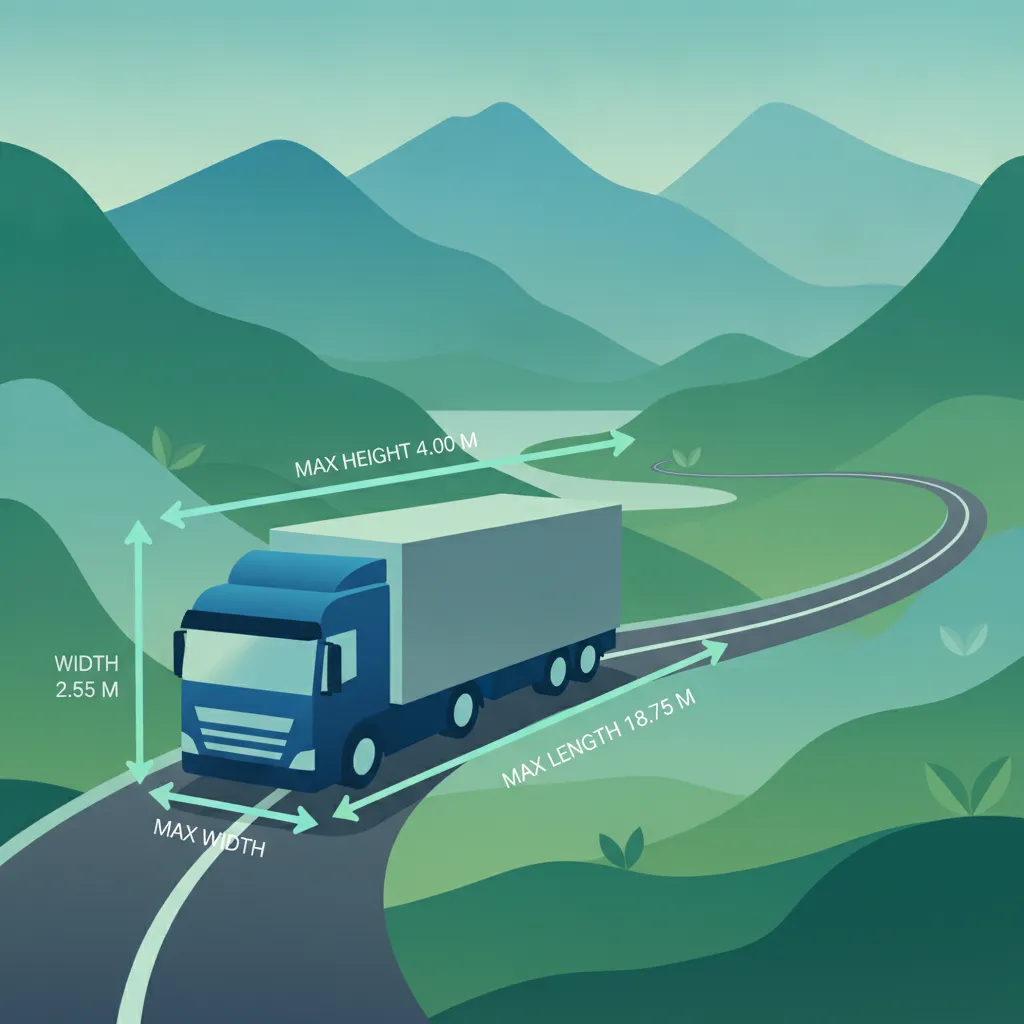
Swiss law strictly regulates the maximum dimensions of commercial vehicles to ensure they can safely navigate the infrastructure. This lesson specifies the standard limits for vehicle height (4.0m), width (2.55m), and length for various lorry and trailer combinations. Adhering to these dimensions is crucial for avoiding collisions with bridges, tunnels, and other structures, and for navigating narrow roads.
Explore the practical challenges of maneuvering heavy goods vehicles in construction sites and industrial zones, including ground condition assessment, reversing with signallers, and managing blind spots and plant machinery interactions.
Rural roads present challenges like narrow lanes, poor surfaces, sharp bends, and limited visibility. This lesson teaches drivers how to position their large vehicle to maximize space and visibility, anticipate oncoming traffic at blind corners, and be aware of specific rural hazards. These hazards include slow-moving agricultural vehicles, animals on the road, and concealed farm entrances.
Despite the complex mirror systems, large areas around a truck remain hidden from the driver's view. This lesson maps out these significant blind spots: directly in front, behind, and along both sides of the vehicle. It teaches drivers to be constantly aware of these 'no-zones' and to anticipate that smaller vehicles, cyclists, or pedestrians may be hidden within them, especially before changing lanes or turning.
Motorway driving requires constant concentration due to high speeds. This lesson emphasizes the importance of staying in the right-hand lane unless overtaking and the specific restrictions on lorry overtaking in Switzerland. It reinforces the need for a following distance of at least four seconds to compensate for the vehicle's long stopping distance and provides guidance on safely merging and exiting.

Urban driving requires heightened awareness and careful planning. This lesson covers the challenges of narrow streets, heavy traffic, and the need to identify designated loading and unloading zones. It emphasizes the importance of planning routes in advance to account for time-based access restrictions and to avoid unsuitable roads.

Unlike cars, heavy vehicles cannot travel on every road. This lesson stresses the importance of using HGV-specific satellite navigation systems or carefully checking maps to plan routes that avoid low bridges, weak bridges, and roads with weight or width restrictions. Proper planning saves time, fuel, and prevents dangerous situations or costly damage.
Pedestrians, cyclists, motorcyclists, and e-scooter riders are extremely vulnerable in any interaction with a heavy vehicle. This lesson instills a defensive mindset, teaching drivers to be hyper-aware of VRUs, especially near junctions, crossings, and cycle lanes. It focuses on anticipation and giving VRUs extra space, as they can be unpredictable and are often hidden in blind spots.
Turning a long vehicle requires careful planning and execution. This lesson covers the correct procedure: approach, observation, signalling, and positioning the vehicle correctly to allow for the trailer's off-tracking without mounting the kerb. It also highlights the need for constant mirror checks throughout the turn to monitor for cyclists or other vulnerable road users who may enter the danger zone.

Heavy vehicles, especially those with a high centre ofgravity, are susceptible to rolling over. This lesson examines the primary causes, including excessive speed on bends or roundabouts, sudden steering manoeuvres, and the 'sloshing' effect of liquid loads in tankers. It reinforces that maintaining a sensible speed and driving smoothly are the best ways to mitigate this serious risk.

Driving in the Alps requires a high level of skill and vehicle sympathy. This lesson covers techniques for climbing steep gradients by selecting the correct gear to maintain momentum without straining the engine. It reiterates the critical importance of using low gears and auxiliary brakes for descending, to ensure the service brakes remain cool and effective for the entire descent.
After stopping for an emergency, making the scene safe is the top priority. This lesson details the procedure: activate hazard warning lights, put on high-visibility clothing before exiting the cab, and place the warning triangle at the correct distance behind the vehicle (at least 100m on motorways). This warns approaching traffic and creates a safer environment for the driver and emergency responders.
Find clear answers to common questions learners have about Driving on Construction Sites and in Industrial Areas. Learn how the lesson is structured, which driving theory objectives it supports, and how it fits into the overall learning path of units and curriculum progression in Switzerland. These explanations help you understand key concepts, lesson flow, and exam focused study goals.
Generally, no. Rules are typically dictated by the site manager's instructions, safety signs, and established site protocols. Always prioritize the instructions of the site supervisor or signaller over general traffic rules.
Heavy goods vehicles carry immense weight. Unprepared, soft, or uneven ground can lead to the vehicle sinking, becoming stuck, or even tipping over, posing a severe safety risk and causing significant operational delays.
A signaller should be used whenever your view is restricted, when manoeuvring in tight or busy areas, or when there is a risk to personnel or surrounding structures. This is a best-practice requirement for all heavy vehicle operators.
Pinpoint specific Swiss traffic rules, road signs, or driving situations you need to master. Use the practice search to start a focused revision session now and build confidence for your official driving theory exam.