
This lesson focuses on the professional duty of care heavy goods vehicle drivers have towards residential communities and urban environments. You will learn how to minimize noise pollution and adopt considerate driving practices to maintain a positive public image and comply with local regulations. This is a vital component of your Category C and C1 training, bridging the gap between technical skill and professional responsibility.

Lesson content overview
As a professional driver of Category C & C1 goods vehicles, your actions significantly impact public perception and the quality of life in residential communities. This lesson, part of the Official Swiss Driving Theory Course for Category C & C1 Goods Vehicles, focuses on the crucial importance of noise reduction and considerate driving practices, particularly in built-up areas. Adopting these professional standards not only helps avoid complaints but also enhances safety, improves fuel efficiency, and supports a positive image for the entire transport industry.
Operating heavy goods vehicles demands a high level of skill and responsibility. In residential zones, where people live and children play, the noise generated by large vehicles can be particularly disruptive. Unnecessary engine noise, loud engine braking, or prolonged idling can lead to resident complaints, negative public perception, and even legal penalties.
By actively working to minimize noise and drive considerately, professional drivers contribute to a quieter environment and foster better relations between the transport industry and local communities. This commitment to quiet operation is especially vital during early mornings, evenings, and night hours when residents are most sensitive to disturbances. Adhering to these principles is a key aspect of professional conduct.
Heavy goods vehicles, by their nature, can generate substantial noise. Identifying the primary sources of this noise is the first step toward effective reduction. Key noise contributors include the engine itself, especially during acceleration or when using engine brakes, and auxiliary equipment necessary for vehicle operation.
Tire noise, particularly on certain road surfaces, can also be a factor, though often less controllable by the driver. Understanding these sources allows drivers to implement specific techniques to mitigate their impact, ensuring a smoother and quieter passage through residential areas.
The engine is the heart of a heavy goods vehicle, and its operation produces significant sound. Loud acceleration, high engine RPMs (revolutions per minute), and inadequate exhaust system maintenance can all amplify engine noise. A well-maintained exhaust system with an effective muffler is crucial for keeping engine sounds within acceptable limits. Drivers must also avoid unnecessary revving.
Engine brakes, while effective for deceleration and preserving service brakes, can produce a distinctive and often loud rumbling sound. This noise is particularly disruptive at lower speeds in quiet residential environments. The appropriate use of engine braking requires careful judgment to balance its benefits with the need for noise reduction.
Many heavy goods vehicles rely on auxiliary equipment such as air compressors, hydraulic pumps, or refrigeration units. While essential for vehicle function or cargo management, these systems can be noisy if not properly maintained or if operated at full power unnecessarily. Drivers must be mindful of the noise levels produced by these systems, especially when parked or stationary in residential areas.
Engine braking is a technique that uses the engine’s natural resistance to slow the vehicle, reducing reliance on the service brakes. While valuable for efficiency and safety on downhill slopes or when approaching traffic, its application in residential areas requires particular care due to potential noise generation.
At higher speeds, the distinct rumble of an engine brake might blend with ambient traffic noise. However, at lower speeds, especially below 20 km/h, this rumble becomes much more pronounced and can be highly disturbing to residents. Therefore, specific considerations apply when using engine brakes in quiet zones.
On moderate downhill gradients or when anticipating a stop from higher speeds (e.g., above 30 km/h), a gentle application of the engine brake, often in a higher gear, can be effective and relatively quiet. This helps reduce wear on the service brakes and maintains control without causing undue disturbance. The goal is smooth, gradual deceleration.
In residential areas, particularly when approaching a stop sign or a red light at speeds below 20 km/h, relying heavily on engine braking by downshifting into very low gears is generally discouraged. This practice often results in a loud, resonating rumble that causes significant noise pollution. In these situations, it is far more considerate and appropriate to use the service brakes for a smooth and quiet stop.
Excessive engine braking at low speeds in residential areas can generate a loud, disturbing rumble. Prioritize the use of service brakes or gentler engine braking in higher gears to maintain quiet operation.
This approach minimizes noise, which is especially critical during noise-sensitive hours like early mornings or late evenings. Balancing the benefits of engine braking with the need for quiet operation is a mark of a professional and considerate driver.
Engine idling occurs when the vehicle's engine is running while the vehicle is stationary. While sometimes necessary for short periods, prolonged idling is a significant source of noise pollution, unnecessary fuel consumption, and increased emissions. Professional drivers must adopt strict idling management practices, particularly in residential areas.
Swiss regulations, and often local ordinances, mandate limits on idling time, especially during specific hours. Adhering to these rules demonstrates professionalism and respect for residents.
Generally, an engine should be turned off if the vehicle is stationary for longer than 30 seconds in residential zones. This rule is even more strictly enforced during night hours, typically between 22:00 and 06:00, when sound travels farther and disturbances are more impactful. The rationale is clear: reduce noise, conserve fuel, and minimize exhaust emissions.
When waiting for more than 30 seconds in a residential area, especially during night hours, turn off your engine to reduce noise and emissions.
For delivery situations where the vehicle is stopped for loading, unloading, or waiting for paperwork, the most considerate action is to switch off the engine. If essential systems require power (e.g., for lifting equipment or refrigeration), drivers should utilize secondary power sources or auxiliary power units designed for quieter operation, if available.
This proactive approach minimizes disturbance and reflects responsible vehicle operation. It also leads to direct benefits in terms of reduced fuel costs for the transport company.
Beyond the primary engine and braking systems, heavy goods vehicles often employ various auxiliary devices that can generate noise. These include air compressors for brake systems, hydraulic pumps for liftgates or cranes, and refrigeration units for temperature-controlled cargo. Operating these components quietly is an integral part of considerate driving in residential environments.
Drivers should always ensure that all auxiliary equipment is well-maintained to prevent excessive noise. Worn-out parts, loose mountings, or insufficient muffling can significantly increase sound output. When operating equipment, drivers should use the lowest effective power setting or mode that allows the task to be completed efficiently.
Wherever possible, avoid running loud auxiliary equipment during noise-sensitive hours (e.g., late at night or early in the morning) if parked near residential buildings. If equipment operation is unavoidable, ensure it is as brief as possible. For instance, if inflating tires, do so efficiently and then promptly shut down the compressor.
The vehicle horn is a critical safety device, but its use is strictly regulated to prevent unnecessary noise pollution. In residential areas, especially during quiet hours, the horn should be used only in situations of imminent danger where a collision cannot otherwise be avoided.
The general rule is that horns are exclusively for warning of danger. This means using the horn for courtesy, to signal your arrival, to express frustration, or to alert pedestrians who are not in immediate peril, is prohibited. Misusing the horn is not only inconsiderate but can also lead to fines.
During nighttime hours (22:00 to 06:00), the restrictions on horn usage in residential areas become even stricter. Unless there is a direct and unavoidable threat to safety, the horn should not be used at all. In situations where a warning is needed but not immediately critical, visual signals (such as hand gestures or flashing headlights briefly, if safe) are preferable.
Use your horn only when absolutely necessary to prevent an imminent collision. Never use it for courtesy or to signal your presence, especially in residential areas and during night hours.
Appropriate speed management is fundamental to considerate driving, particularly in residential zones. It directly impacts safety, noise levels, and overall public perception. Heavy goods vehicle drivers must be acutely aware of posted speed limits and be prepared to adjust their speed further based on prevailing conditions, such as the presence of vulnerable road users or reduced visibility.
In Swiss built-up areas, the default maximum speed limit is typically 30 km/h, with many residential zones designated as 20 km/h zones. It is crucial for heavy vehicle drivers to recognize and strictly adhere to these limits. Exceeding them increases noise from the engine, tires, and airflow, and drastically reduces reaction time, posing a greater risk to pedestrians and cyclists.
Simply adhering to the posted speed limit is often not enough. Drivers must continuously assess the environment and reduce speed further when necessary. This includes situations such as:
Residential areas are often shared spaces where heavy goods vehicles interact closely with vulnerable road users, such as pedestrians and cyclists. A particularly high-risk situation for heavy vehicle drivers is making a right turn (Rechtsabbiegen) when cyclists are present. Understanding and actively mitigating this "right-turn conflict" is paramount for safety and considerate driving.
Heavy goods vehicles have significant blind spots, especially down the right side, making it difficult for drivers to see cyclists who may be alongside the vehicle or approaching from behind in the same lane. When a heavy vehicle turns right, it can easily collide with a cyclist continuing straight or attempting to overtake on the right, even if the driver checks mirrors.
In Switzerland, specific regulations govern right-turn maneuvers. Drivers turning right must yield to cyclists traveling straight ahead on the same lane or those overtaking on the right (Rule 28 of the Swiss Road Traffic Regulations). This means before initiating a right turn, the driver must thoroughly check all mirrors, including blind spot mirrors, and physically check the blind spot, especially on the right side, to ensure no cyclist is present.
Early Signaling: Activate your right-turn signal well in advance to alert all other road users of your intention.
Positioning: Position your vehicle clearly and safely for the turn, but do not move so far to the left that you create a dangerous gap for cyclists on your right.
Mirror Checks: Continuously check your right-side mirrors and blind spot mirrors for cyclists.
Direct Observation: Before turning, make a final, direct head check into your right blind spot (if possible and safe to do so) to confirm the path is clear.
Yield: If a cyclist is present and continuing straight or moving past you on the right, you must yield and wait for them to pass safely before completing your turn.
Slow and Controlled Turn: Execute the turn slowly and deliberately, allowing maximum time to react to unexpected movements from vulnerable road users.
Failing to yield to cyclists in this scenario is a common cause of serious accidents and carries significant legal consequences. Constant vigilance and an understanding of cyclists' vulnerability are essential.
The principles of noise reduction and considerate driving are not merely professional courtesies; they are often enshrined in Swiss law. Drivers of heavy goods vehicles must be aware of and comply with these regulations to avoid penalties and ensure safe, responsible operation within communities.
These rules underscore the legal responsibility of professional drivers to operate their heavy vehicles in a manner that respects public safety and peace.
Even experienced professional drivers can sometimes inadvertently fall into habits that violate principles of considerate driving. Recognizing these common errors is key to improving driving behavior and maintaining a positive professional image.
Considerate driving is not a one-size-fits-all approach; it requires constant adaptation to changing conditions. Environmental factors, vehicle state, and the presence of other road users all influence the best course of action for noise reduction and safety.
Adopting considerate driving practices, particularly those focused on noise reduction, offers a multitude of benefits that extend beyond simply avoiding complaints. These advantages enhance safety, improve operational efficiency, and elevate the professional standing of the driver and their company.
By proactively minimizing noise and driving considerately, heavy goods vehicle drivers cultivate a positive image within communities. This leads to fewer noise complaints, reduces public antagonism towards large vehicles, and supports a more harmonious coexistence between residents and the transport industry. Ultimately, a good reputation can lead to fewer operational restrictions and greater community acceptance.
Smoother driving, reduced speeds in residential areas, and vigilant observation for vulnerable road users (especially cyclists during right turns) directly contribute to a safer driving environment. Less noise also means pedestrians and cyclists are less likely to be startled, improving their ability to react safely. This focus on safety mitigates the risk of accidents, protecting lives and property.
Effective idling management directly reduces fuel consumption and lowers emissions, leading to significant cost savings for transport companies. Proper use of engine braking, while avoiding noisy low-speed application, also prolongs the life of service brakes, reducing maintenance costs and vehicle downtime. Considerate driving techniques also reduce wear and tear on other vehicle components, contributing to overall operational efficiency.
Understanding and adhering to Swiss regulations concerning noise, idling, horn usage, and right-of-way prevents fines and other legal consequences. Proactive compliance ensures that drivers and their companies operate within legal boundaries, avoiding unnecessary scrutiny and potential disruptions to their operations.
This lesson covers the professional responsibility of Category C and C1 drivers to minimize noise and drive considerately in Swiss residential areas. Key topics include engine braking technique (avoiding loud low-speed deceleration), strict idling restrictions (30 seconds maximum, especially 22:00-06:00), horn usage limited to imminent danger only, and residential speed limits typically set at 30 km/h or 20 km/h. The lesson also addresses the critical blind spot hazard when turning right, requiring drivers to yield to cyclists per Swiss Road Traffic Rule 28. Adhering to these practices reduces complaints, improves safety, ensures legal compliance, and cuts fuel costs.
A short set of high-value points that capture the most important learning from this lesson.
Heavy goods vehicle drivers must turn off engines after 30 seconds of idling in residential areas, especially between 22:00 and 06:00.
Engine braking should be avoided at speeds below 20 km/h in residential zones; use service brakes for quiet stops instead.
The horn is strictly for imminent danger warnings only—courtesy honking is prohibited and can result in fines.
Drivers must yield to cyclists traveling straight or overtaking on the right when making right turns, per Swiss Rule 28.
Nighttime driving in residential areas requires extra caution: reduced speeds, minimal noise, and strict adherence to quiet operation.
Explore all units and lessons included in this driving theory course.
Built-up area speed limits are typically 30 km/h, with many residential zones at 20 km/h, potentially lower at night.
The 30-second idling rule is strictly enforced in residential zones, particularly during night hours.
At low speeds in quiet zones, use service brakes or gentle engine braking in higher gears to avoid the loud rumbling characteristic of low-gear engine braking.
Always check blind spots directly before turning right—mirrors alone are insufficient due to significant right-side blind spots for heavy vehicles.
Auxiliary equipment (compressors, hydraulic pumps, refrigeration units) must be operated at the lowest effective setting and for minimal duration in residential areas.
Downshifting to very low gears below 15 km/h for engine braking, creating disruptive rumbling in residential areas.
Leaving the engine running during early morning or late-night deliveries, violating the 30-second idling rule.
Using the horn for non-emergency purposes such as signaling arrival or clearing the way for pedestrians.
Initiating a right turn without physically checking the right blind spot, risking collision with cyclists.
Maintaining 30 km/h through residential zones at night without checking for local 20 km/h night restrictions or slowing for conditions.
Lesson content overview
A short set of high-value points that capture the most important learning from this lesson.
Heavy goods vehicle drivers must turn off engines after 30 seconds of idling in residential areas, especially between 22:00 and 06:00.
Engine braking should be avoided at speeds below 20 km/h in residential zones; use service brakes for quiet stops instead.
The horn is strictly for imminent danger warnings only—courtesy honking is prohibited and can result in fines.
Drivers must yield to cyclists traveling straight or overtaking on the right when making right turns, per Swiss Rule 28.
Nighttime driving in residential areas requires extra caution: reduced speeds, minimal noise, and strict adherence to quiet operation.
Explore all units and lessons included in this driving theory course.
Built-up area speed limits are typically 30 km/h, with many residential zones at 20 km/h, potentially lower at night.
The 30-second idling rule is strictly enforced in residential zones, particularly during night hours.
At low speeds in quiet zones, use service brakes or gentle engine braking in higher gears to avoid the loud rumbling characteristic of low-gear engine braking.
Always check blind spots directly before turning right—mirrors alone are insufficient due to significant right-side blind spots for heavy vehicles.
Auxiliary equipment (compressors, hydraulic pumps, refrigeration units) must be operated at the lowest effective setting and for minimal duration in residential areas.
Downshifting to very low gears below 15 km/h for engine braking, creating disruptive rumbling in residential areas.
Leaving the engine running during early morning or late-night deliveries, violating the 30-second idling rule.
Using the horn for non-emergency purposes such as signaling arrival or clearing the way for pedestrians.
Initiating a right turn without physically checking the right blind spot, risking collision with cyclists.
Maintaining 30 km/h through residential zones at night without checking for local 20 km/h night restrictions or slowing for conditions.
Explore search topics learners often look for when studying Noise Reduction and Considerate Driving in Residential Areas. These topics reflect common questions about road rules, driving situations, safety guidance, and lesson level theory preparation for learners in Switzerland.
Browse additional driving theory lessons that cover connected traffic rules, road signs, and common driving situations related to this topic. Improve your understanding of how different rules interact across everyday traffic scenarios.
Understand the legal framework in Switzerland for heavy goods vehicles regarding noise reduction. Learn about speed limits, engine braking, idling, and horn usage rules in residential zones to avoid complaints and penalties.
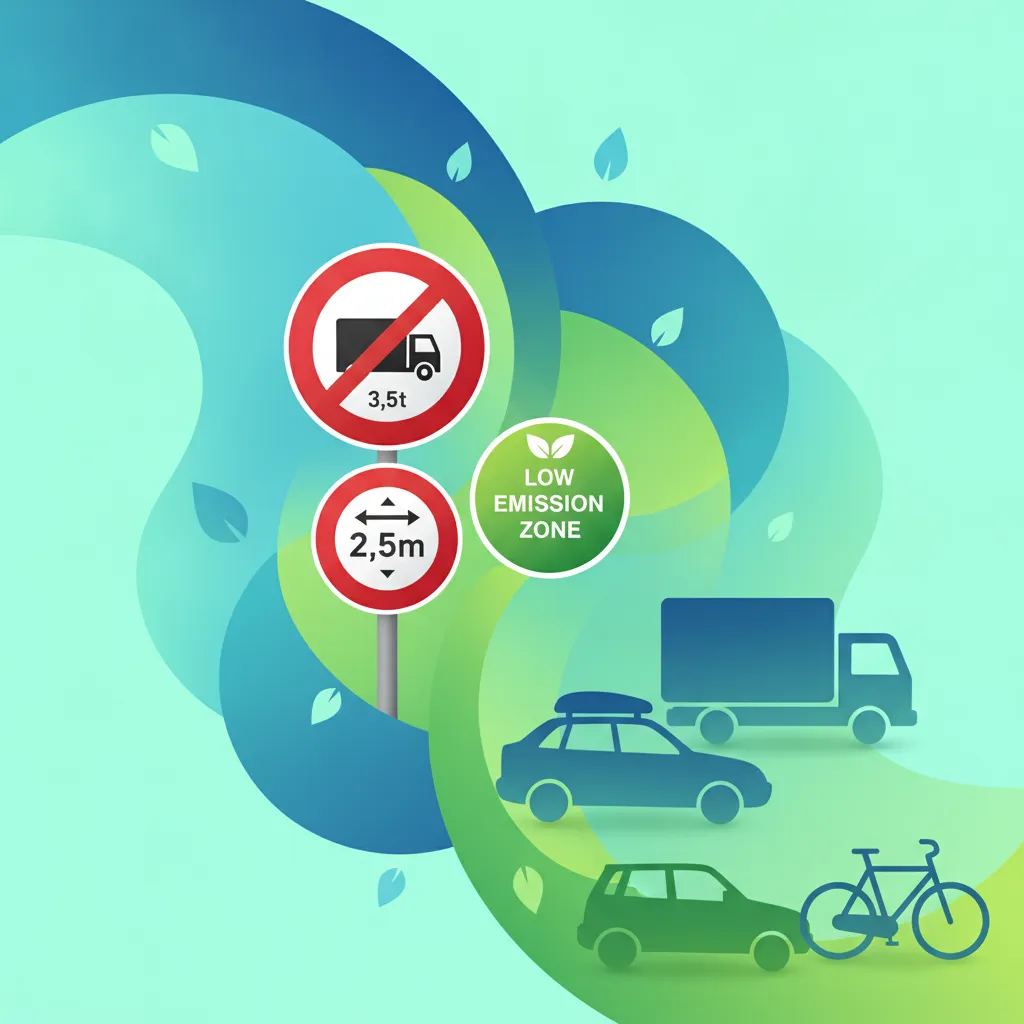
Many urban areas have restrictions to manage traffic and protect infrastructure. This lesson teaches drivers to identify and interpret traffic signs that prohibit access based on gross vehicle weight, axle load, height, or width. It also covers the growing prevalence of environmental or low-emission zones, which may restrict entry for older, more polluting vehicles.

Swiss law strictly regulates the maximum dimensions of commercial vehicles to ensure they can safely navigate the infrastructure. This lesson specifies the standard limits for vehicle height (4.0m), width (2.55m), and length for various lorry and trailer combinations. Adhering to these dimensions is crucial for avoiding collisions with bridges, tunnels, and other structures, and for navigating narrow roads.

Urban driving requires heightened awareness and careful planning. This lesson covers the challenges of narrow streets, heavy traffic, and the need to identify designated loading and unloading zones. It emphasizes the importance of planning routes in advance to account for time-based access restrictions and to avoid unsuitable roads.

Motorway driving requires constant concentration due to high speeds. This lesson emphasizes the importance of staying in the right-hand lane unless overtaking and the specific restrictions on lorry overtaking in Switzerland. It reinforces the need for a following distance of at least four seconds to compensate for the vehicle's long stopping distance and provides guidance on safely merging and exiting.

For professional drivers, traffic violations can have career-altering consequences beyond standard fines. This lesson details the heightened penalties for infringements such as speeding, overloading, insecure loads, and violations of driving time regulations. It outlines the process of warnings, license suspension or withdrawal, and potential criminal liability, emphasizing the importance of strict legal compliance in the transport industry.
Learn how to safely navigate urban and residential areas as a heavy vehicle driver, focusing on interactions with pedestrians and cyclists. Understand right-turn risks and consider the impact of your driving on the community.
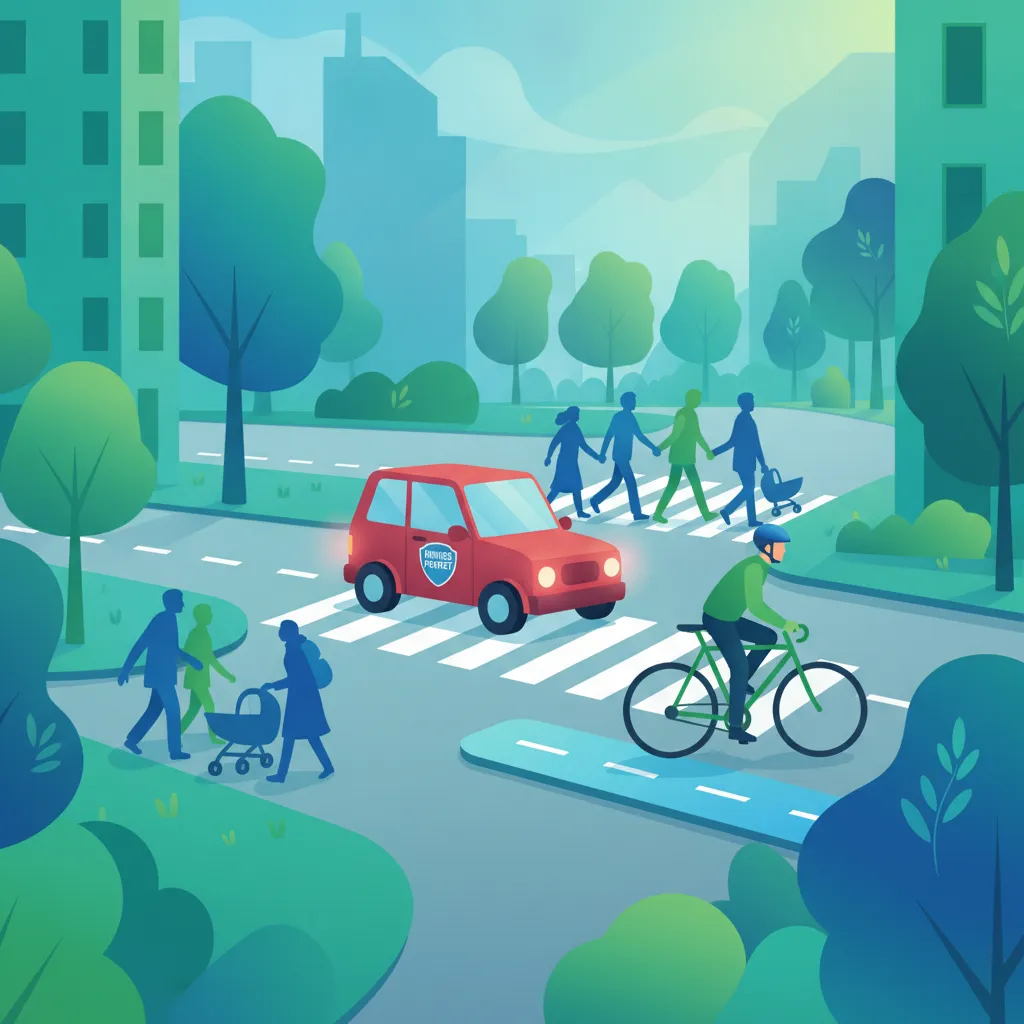
Pedestrians, cyclists, motorcyclists, and e-scooter riders are extremely vulnerable in any interaction with a heavy vehicle. This lesson instills a defensive mindset, teaching drivers to be hyper-aware of VRUs, especially near junctions, crossings, and cycle lanes. It focuses on anticipation and giving VRUs extra space, as they can be unpredictable and are often hidden in blind spots.

This lesson contrasts the interaction dynamics between road users in urban and rural environments, highlighting differing challenges. It discusses the higher density of pedestrians and cyclists in cities versus the presence of agricultural vehicles and wildlife in rural areas. You will learn how speed limits, visibility, and road layout impact safe interactions.

This lesson trains drivers to look beyond other vehicles and actively search for pedestrians, cyclists, and motorcyclists, especially those who may be distracted or unaware. It covers common behavioral patterns of different VRU groups. The goal is to see potential hazards developing early and create time and space to react safely.
Urban driving requires heightened awareness and careful planning. This lesson covers the challenges of narrow streets, heavy traffic, and the need to identify designated loading and unloading zones. It emphasizes the importance of planning routes in advance to account for time-based access restrictions and to avoid unsuitable roads.

This lesson explores the complexities of riding in busy urban areas with a mix of traffic types. It covers strategies for safely navigating alongside buses, trams, cyclists, and pedestrians. Key topics include respecting designated lanes, anticipating the movements of vulnerable road users, and maintaining heightened situational awareness.

This lesson focuses on safe interaction with large vehicles. It highlights the significant blind spots (or 'no-zones') around trucks and buses and teaches riders how to position themselves to remain visible. The content also provides guidance on overtaking large vehicles safely and anticipating their wide turning radius at intersections.

This lesson focuses on general driving safety in areas with a high concentration of children. It stresses the importance of significantly reducing speed, being prepared for unexpected events, and scanning for children between parked cars. The driver must exhibit maximum vigilance in these high-risk environments at all times.

Sharing road space with trams presents unique challenges, including different priority rules and physical hazards like tracks. This lesson covers the Swiss regulations regarding tram priority at junctions and stops. It also provides practical advice on crossing tram tracks safely and maintaining awareness of tram movements.

Rural roads present challenges like narrow lanes, poor surfaces, sharp bends, and limited visibility. This lesson teaches drivers how to position their large vehicle to maximize space and visibility, anticipate oncoming traffic at blind corners, and be aware of specific rural hazards. These hazards include slow-moving agricultural vehicles, animals on the road, and concealed farm entrances.

This lesson explores the specific considerations for cyclists and pedestrians, who are among the most vulnerable road users. It covers the proper use of bicycle lanes, the minimum safe overtaking distance for cyclists, and the legal requirements for yielding at pedestrian crossings. The content reinforces the need for heightened vigilance around these users.
Find clear answers to common questions learners have about Noise Reduction and Considerate Driving in Residential Areas. Learn how the lesson is structured, which driving theory objectives it supports, and how it fits into the overall learning path of units and curriculum progression in Switzerland. These explanations help you understand key concepts, lesson flow, and exam focused study goals.
Professional driving involves managing the impact of your vehicle on the community. The exam tests your awareness of these responsibilities to ensure you are fit to act as a representative of the transport industry, not just a vehicle operator.
In Switzerland, idling is heavily restricted to prevent noise and air pollution. You should always switch off your engine during loading or delivery unless it is required for auxiliary equipment operation that cannot be powered otherwise.
Yes. Questions regarding your duty of care and social responsibility are part of the broader Category C/C1 theory framework. Failing to understand these obligations can lead to incorrect answers in the professional context section.
Yes, especially during night-time and early morning hours. As a professional driver, you must be extra vigilant about using engine brakes or loud air equipment in residential zones during these times to comply with social and local municipal standards.
Pinpoint specific Swiss traffic rules, road signs, or driving situations you need to master. Use the practice search to start a focused revision session now and build confidence for your official driving theory exam.