
This lesson focuses on the specialized environments of ports and industrial sites, which present unique challenges for heavy goods vehicle operators. You will learn to identify site-specific signage, manage complex traffic flows, and apply safety protocols that differ from standard public road rules. Mastering these skills is essential for both your theory exam and your professional career in the Danish transport sector.

Lesson content overview
This lesson covers the specialized skills required for Category C drivers operating in Danish ports and industrial zones, where traffic rules differ significantly from public roads. Key topics include strict adherence to designated lanes and posted speed limits (often 20-30 km/h), mandatory load securing before any movement, and yielding priority to pedestrians and forklifts in their respective zones. Drivers must recognize and obey site-specific signage and personnel instructions, which carry legal weight within these environments. Understanding common mistakes such as wrong-lane navigation, unsecured loads, and incorrect right-of-way assumptions helps drivers maintain safety in these complex, high-density traffic areas.
A short set of high-value points that capture the most important learning from this lesson.
Industrial sites have their own traffic management systems with speed limits typically between 20-30 km/h, often reduced to 10 km/h near loading docks and pedestrian areas.
Drivers must strictly follow designated traffic lanes and road markings, as unauthorized deviation can cause conflicts with specialized equipment and other site users.
Load securing is a legal requirement before any movement within industrial sites, and drivers are legally responsible for verifying stability using appropriate tie-downs.
Site-specific right-of-way rules frequently override standard public road rules, requiring drivers to yield to pedestrians, forklifts, and traffic controllers.
Drivers must quickly interpret specialized signage indicating load areas, forklift crossings, and restricted zones to navigate safely.
Explore all units and lessons included in this driving theory course.
Pedestrians and forklifts typically have priority over HGVs in designated zones, even when public road rules would favour the vehicle.
Forklifts have significant blind spots and limited manoeuvrability, requiring extra space and yielding behaviour from HGV drivers.
Environmental conditions such as rain, fog, poor lighting, and vehicle load weight all require additional speed reduction and increased following distances.
All instructions from site personnel and traffic controllers carry legal weight and must be obeyed immediately.
A pre-movement inspection must verify load security, tie-down points, and load stability before any vehicle movement.
Entering lanes reserved for other traffic types or restricted areas by misinterpreting directional signs, causing congestion or collisions.
Failing to reduce speed adequately in busy loading zones, increasing collision risk with forklifts, personnel, or other vehicles.
Departing from loading docks without verifying load stability, risking load shift, cargo damage, and hazardous road conditions.
Proceeding at intersections assuming standard public road right-of-way applies, when forklifts and site-specific rules actually take precedence.
Not yielding to workers in designated pedestrian crosswalks, especially when visibility is limited by containers or large vehicles.
Lesson content overview
A short set of high-value points that capture the most important learning from this lesson.
Industrial sites have their own traffic management systems with speed limits typically between 20-30 km/h, often reduced to 10 km/h near loading docks and pedestrian areas.
Drivers must strictly follow designated traffic lanes and road markings, as unauthorized deviation can cause conflicts with specialized equipment and other site users.
Load securing is a legal requirement before any movement within industrial sites, and drivers are legally responsible for verifying stability using appropriate tie-downs.
Site-specific right-of-way rules frequently override standard public road rules, requiring drivers to yield to pedestrians, forklifts, and traffic controllers.
Drivers must quickly interpret specialized signage indicating load areas, forklift crossings, and restricted zones to navigate safely.
Explore all units and lessons included in this driving theory course.
Pedestrians and forklifts typically have priority over HGVs in designated zones, even when public road rules would favour the vehicle.
Forklifts have significant blind spots and limited manoeuvrability, requiring extra space and yielding behaviour from HGV drivers.
Environmental conditions such as rain, fog, poor lighting, and vehicle load weight all require additional speed reduction and increased following distances.
All instructions from site personnel and traffic controllers carry legal weight and must be obeyed immediately.
A pre-movement inspection must verify load security, tie-down points, and load stability before any vehicle movement.
Entering lanes reserved for other traffic types or restricted areas by misinterpreting directional signs, causing congestion or collisions.
Failing to reduce speed adequately in busy loading zones, increasing collision risk with forklifts, personnel, or other vehicles.
Departing from loading docks without verifying load stability, risking load shift, cargo damage, and hazardous road conditions.
Proceeding at intersections assuming standard public road right-of-way applies, when forklifts and site-specific rules actually take precedence.
Not yielding to workers in designated pedestrian crosswalks, especially when visibility is limited by containers or large vehicles.
Explore search topics learners often look for when studying Navigating Ports and Industrial Areas. These topics reflect common questions about road rules, driving situations, safety guidance, and lesson level theory preparation for learners in Denmark.
Browse additional driving theory lessons that cover connected traffic rules, road signs, and common driving situations related to this topic. Improve your understanding of how different rules interact across everyday traffic scenarios.
Understand critical safety protocols for navigating Danish ports and industrial zones with heavy goods vehicles. This lesson covers hazard prevention, interaction with machinery, and adherence to site-specific traffic rules to ensure safe operations.

This lesson addresses the specific skills required to navigate around public transport and heavy goods vehicles safely. You will learn the rules for bus lanes, recognize when buses have priority at stops, and understand the unique challenges posed by large vehicles, such as wider turning circles and larger blind spots. The material also provides clear protocols for overtaking these vehicles while maintaining adequate safety margins.

This lesson focuses on the rules and best practices for operating heavy vehicles on motorways and interchanges. It details Danish regulations regarding lane usage and speed limits for lorries, and explains safe techniques for merging into and exiting high-speed traffic. Maintaining a safe and appropriate following distance to allow for longer stopping distances is a key focus of the content.

This lesson provides practical guidance for navigating the challenges of urban deliveries. It details Danish regulations for using loading zones, including time restrictions and parking rules, and offers strategies for effective route planning in dense traffic. The content emphasizes awareness of pedestrian-heavy areas and the importance of maneuvering with caution to ensure public safety during delivery operations.

This lesson covers the core principles of defensive driving in an urban context. It teaches drivers how to anticipate the actions of other road users, maintain safe following distances in dense traffic, and navigate complex intersections with multiple signals. The content emphasizes heightened awareness of pedestrians, cyclists, and unexpected events common in Danish city environments.

This lesson emphasizes the professional driver's heightened responsibility to protect vulnerable road users. It revisits Danish regulations concerning cyclist priority, particularly during right turns, and details the correct procedures for maintaining safe overtaking distances. The content focuses on developing advanced situational awareness, using mirrors and cameras effectively, and anticipating the behavior of pedestrians and cyclists in urban environments.

This lesson provides a step-by-step guide to safe loading and unloading practices. It covers the importance of ensuring proper weight distribution during the process, re-checking cargo securement, and adhering to safety protocols at loading docks. The content also includes ergonomic best practices to prevent driver injury and guidelines for the safe operation of equipment like tail lifts and pallet jacks.

This lesson details the specific procedures for safely transporting a heavy vehicle via ferry. It covers the process of boarding and maneuvering on the ferry deck, the correct methods for securing the vehicle and trailer for sea transit, and the relevant Danish regulations. The content also explains the safety protocols to follow during the crossing and the correct procedure for disembarking upon arrival.

This lesson focuses on the practical skills needed to maneuver a large vehicle in confined environments such as urban delivery zones and loading docks. It teaches how to accurately judge the required space, understand the vehicle's turning radius, and use reference points to position the vehicle precisely. The content covers strategies for navigating tight corners and avoiding fixed obstacles, which is essential for damage-free urban operations.

This lesson provides a clear, safety-oriented protocol for handling a vehicle breakdown or tyre failure. It covers how to safely maneuver the vehicle to the roadside, the correct use of hazard lights and warning triangles to alert other traffic, and procedures for contacting assistance. Adhering to these steps, as required by Danish law, is critical for protecting yourself and other road users from further incident.
This lesson provides guidance for navigating special infrastructure like long bridges, tunnels, and ferries. It covers awareness of height and weight restrictions, managing the effects of strong crosswinds on bridges, and adapting to lighting changes in tunnels. The content also details the procedures for boarding ferries and correctly securing the vehicle for transit.
Learn the unique traffic laws, speed limits, and right-of-way regulations applicable to heavy goods vehicles in Danish ports and industrial areas. This lesson details how these rules differ from public roads and ensures compliant navigation.
This lesson focuses on the rules and best practices for operating heavy vehicles on motorways and interchanges. It details Danish regulations regarding lane usage and speed limits for lorries, and explains safe techniques for merging into and exiting high-speed traffic. Maintaining a safe and appropriate following distance to allow for longer stopping distances is a key focus of the content.
This lesson provides practical guidance for navigating the challenges of urban deliveries. It details Danish regulations for using loading zones, including time restrictions and parking rules, and offers strategies for effective route planning in dense traffic. The content emphasizes awareness of pedestrian-heavy areas and the importance of maneuvering with caution to ensure public safety during delivery operations.

This lesson focuses on the legal dimensional limits—length, width, and height—for heavy goods vehicles and their interaction with road infrastructure. It explains Danish regulations and the importance of planning routes to avoid constraints such as low bridges, narrow tunnels, and weight-restricted roads. Learners will understand how to interpret road signs indicating these limits and the procedures for obtaining permits for oversized loads.
This lesson provides guidance for navigating special infrastructure like long bridges, tunnels, and ferries. It covers awareness of height and weight restrictions, managing the effects of strong crosswinds on bridges, and adapting to lighting changes in tunnels. The content also details the procedures for boarding ferries and correctly securing the vehicle for transit.
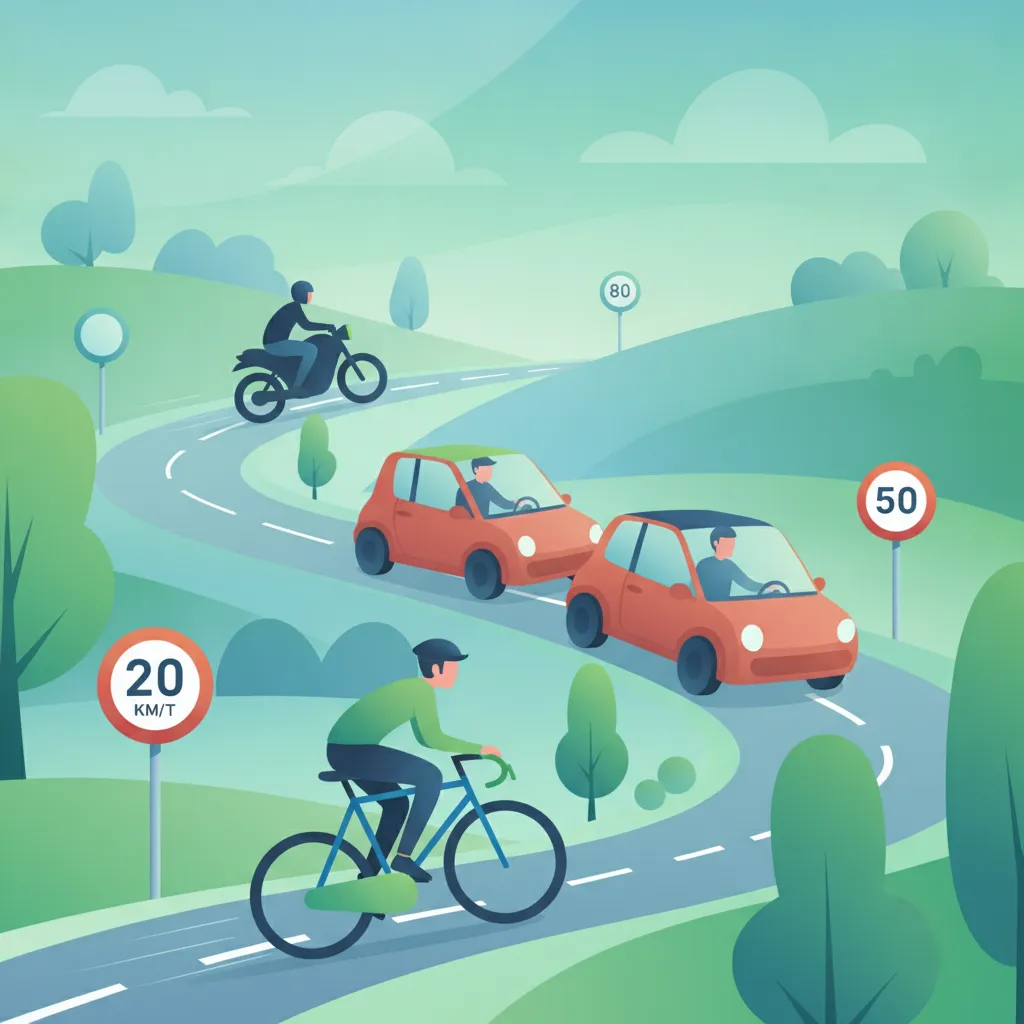
This lesson details the specific speed limits applicable to stor knallert riders in various Danish environments, including urban zones and rural roads. It emphasizes the concept of 'appropriate speed,' which requires adjusting speed based on weather, visibility, and traffic density. The content explains how to manage speed to ensure safety and legal compliance.

Operating a heavy goods vehicle comes with heightened professional and legal responsibilities. This lesson examines the driver's duties regarding pre-trip inspections, load security, and continuous vehicle maintenance. It emphasizes the ethical obligation to protect vulnerable road users like cyclists and pedestrians, and stresses the importance of maintaining professional conduct and adhering to all traffic regulations to ensure road safety.
This lesson addresses the specific skills required to navigate around public transport and heavy goods vehicles safely. You will learn the rules for bus lanes, recognize when buses have priority at stops, and understand the unique challenges posed by large vehicles, such as wider turning circles and larger blind spots. The material also provides clear protocols for overtaking these vehicles while maintaining adequate safety margins.

This lesson details the legal consequences for professional drivers who commit traffic infractions. It explains the Danish system of fines and penalty points for various offenses, from speeding to load security violations, and outlines the conditions that can lead to license suspension. The content underscores the professional and legal obligation to uphold traffic law at all times to maintain a clean driving record.
This lesson emphasizes the professional driver's heightened responsibility to protect vulnerable road users. It revisits Danish regulations concerning cyclist priority, particularly during right turns, and details the correct procedures for maintaining safe overtaking distances. The content focuses on developing advanced situational awareness, using mirrors and cameras effectively, and anticipating the behavior of pedestrians and cyclists in urban environments.

This lesson addresses the combined challenges of navigating narrow rural roads and driving in adverse weather. It explains how to adapt speed and braking techniques for conditions like heavy rain, fog, or ice, which are common on rural routes. The content also integrates these factors into route planning, teaching drivers how to select the safest and most appropriate path while avoiding local weight or height restrictions.
Find clear answers to common questions learners have about Navigating Ports and Industrial Areas. Learn how the lesson is structured, which driving theory objectives it supports, and how it fits into the overall learning path of units and curriculum progression in Denmark. These explanations help you understand key concepts, lesson flow, and exam focused study goals.
While the fundamental rules of priority often apply, ports and industrial sites operate under specific internal traffic management plans. You must always prioritize signs and markings within the site, as they take precedence for safe heavy vehicle operation.
The exam often features complex image-based scenarios. This lesson helps you recognize indicators of industrial zones, allowing you to correctly identify potential hazards and the appropriate legal driving response for those specific settings.
Industrial zones involve unique risks like frequent reversing, heavy machinery, and narrow pathways. Understanding these specific dynamics is a core competency for professional drivers, helping them maintain the strict safety standards required in Denmark.
Use our powerful search tool to pinpoint specific Danish driving theory topics, road signs, or traffic situations you need to review. Start exploring relevant practice sets now to reinforce your knowledge and build confidence for your upcoming driving licence exam.