
This lesson establishes the fundamental rules of the road according to the German Road Traffic Act (StVO). By mastering these core behaviors, you will build the necessary foundation to navigate various traffic scenarios safely and confidently during your Category B exam and in your future driving life.
Lesson content overview
Navigating Germany's roads safely and efficiently requires a thorough understanding of the fundamental behavioral rules outlined in the Straßenverkehrs-Ordnung (StVO), the German Road Traffic Act. This comprehensive guide will equip you with the essential knowledge needed to drive responsibly, avoid accidents, and ensure a smooth flow of traffic. Mastering these core principles is not only crucial for passing your German Category B driving license theory exam but also for becoming a competent and confident driver.
The StVO serves as the bedrock of German road traffic regulations, dictating the conduct of all road users. Its rules are designed to prevent danger, minimize disruptions, and protect everyone on the road, with a particular emphasis on vulnerable groups like pedestrians and cyclists. These regulations are rooted in practical safety principles, legal precedents, and the physics of vehicle movement, aiming to create predictable and safe interactions for all.
Understanding the logic behind these rules helps drivers internalize them, promoting proactive and defensive driving rather than mere rote memorization. This lesson forms a critical operational framework, connecting with other crucial topics such as right-of-way rules, speed limits, and safe stopping distances, which you will explore in more detail throughout your German Driving License Theory – Comprehensive Category B Course.
The StVO outlines several core behavioral principles that govern everyday driving. Adhering to these rules minimizes the need for sudden reactions, reduces the likelihood of collisions, and fosters a harmonious traffic environment.
The most fundamental rule on German roads is the Rechtsfahrgebot, or the obligation to drive on the right side of the carriageway. This principle ensures order and predictability, allowing other drivers to anticipate your position.
The mandatory rule in Germany that vehicles must keep to the right side of the road, unless specific conditions such as overtaking or turning left apply.
On multi-lane roads, this means you should generally remain in the rightmost lane that is clear, only moving to a left lane to overtake or if traffic conditions necessitate. It is a common misconception that one can frequently change lanes to the left simply for convenience; instead, lane changes should be purposeful. For example, on a two-lane road, you should stay in the right lane unless you are actively overtaking another vehicle. This principle is deeply linked to effective lane discipline and safe overtaking maneuvers.
Maintaining an adequate Sicherheitsabstand (safe following distance) is paramount for preventing rear-end collisions. This distance must be sufficient to allow your vehicle to stop completely without colliding with the vehicle ahead, should it brake suddenly.
The general guideline for normal conditions is the "two-second rule." This means you should pick a fixed point on the road (e.g., a sign or bridge), and when the vehicle in front passes it, you should count "one thousand one, one thousand two." If you reach the fixed point before you finish counting, you are too close.
Under adverse conditions such as rain, fog, ice, or reduced visibility, the safe following distance must be significantly increased. The two-second rule is a minimum for ideal conditions.
Relying on a fixed numerical distance in meters is often insufficient, as stopping distances increase exponentially with speed. At 50 km/h, a two-second gap is approximately 28 meters. At 100 km/h, it’s about 56 meters. Proper speed adaptation and understanding stopping distances are directly related to maintaining this critical safety buffer.
While posted speed limits (Geschwindigkeitsbegrenzungen) provide an upper threshold, drivers are always required to adapt their Geschwindigkeit (speed) to prevailing conditions. This includes the road surface, traffic density, weather, visibility, and the condition of your own vehicle and load.
The obligation for drivers to adjust their speed not only to stay within posted limits but also to account for road, traffic, weather, and vehicle conditions to ensure safety.
Failing to adapt speed is a major cause of accidents. For instance, driving at the posted 50 km/h limit in heavy rain with poor visibility might still be considered too fast and unsafe. In such situations, reducing your speed significantly below the limit is mandatory for safety. This principle is a cornerstone of defensive driving and is extensively covered in lessons on speed limits and stopping distances.
At uncontrolled intersections – those without traffic lights, stop signs, or yield signs – the Rechts-vor-Links rule applies. This means drivers must yield Vorfahrt gewähren (give priority) to any vehicle approaching from their right.
"Right before Left" – The fundamental right-of-way rule in Germany, stating that at uncontrolled intersections, drivers must yield to vehicles approaching from their right.
It is crucial to be aware that this rule does not apply universally; it is superseded by priority signs, traffic lights, and police signals. A common misunderstanding is to assume Rechts-vor-Links always applies, ignoring valid signage. Always approach uncontrolled intersections with caution, scanning for traffic from all directions, especially from the right. This rule is a foundational element of priority rules.
Drivers have a special responsibility to protect vulnerable road users. This includes pedestrians, cyclists, and motorcyclists, who are at a higher risk in a collision.
At marked pedestrian crossings (Zebrastreifen), drivers must always stop to allow pedestrians to cross. This is a non-negotiable rule.
When encountering cyclists, particularly in shared lanes or at intersections, drivers must exercise extreme caution. Give them ample space, anticipate their movements, and be prepared to yield. Never assume cyclists will act predictably, especially children. These interactions are vital for promoting road safety and are detailed further in lessons on vulnerable road users.
Overtaking (Überholen) is a maneuver that carries significant risk if not performed correctly. According to StVO regulations, overtaking is generally permitted only on the left side of the vehicle you are passing, and only when it can be done safely without endangering yourself or other road users.
The act of passing a slower vehicle from behind, typically by moving into an adjacent lane (usually the left) and then returning to the original lane.
Strict rules govern when and where overtaking is allowed. It is prohibited by specific traffic signs, road markings like double solid lines (Überholverbot), and in situations where visibility is poor (e.g., blind curves or hillcrests), or when it would impede oncoming traffic. A common error is overtaking on the right, which is generally forbidden unless specific circumstances allow (e.g., in heavy, slow-moving traffic on multi-lane roads where lanes are clearly designated for different directions). Proper use of indicators and careful observation of traffic are essential. This is closely related to lane discipline and lane changes.
Maintaining Spurdisziplin (lane discipline) means staying within your designated lane and using lanes for their intended purpose. On multi-lane roads, this reinforces the Rechtsfahrgebot – staying in the rightmost available lane unless overtaking or preparing to turn.
The practice of maintaining the correct lane position and using lanes for their designated purpose, adhering to road markings and traffic flow.
Specialized lanes, such as bus lanes or bicycle lanes, are restricted to specific types of road users. Unauthorized use of these lanes by general traffic is a violation of StVO and can endanger other road users. Always respect lane markings, whether they are solid lines indicating a prohibition against crossing, or dashed lines permitting lane changes. Understanding lane changes and positioning is crucial here.
When joining a main road from a side road, an on-ramp, or a parking area (Einbauort), drivers must always Vorfahrt gewähren (yield priority) to the traffic already present on the main roadway. This is known as Einordnen und Einfädeln (merging and yielding).
The goal is to adjust your speed and position to merge smoothly and safely into the existing traffic flow without causing disruption or forcing other drivers to take evasive action. A common mistake is assuming that merging traffic always has priority, which is incorrect unless explicitly indicated by signs. On motorways, use the acceleration lane to match the speed of the main traffic before merging. This concept builds directly upon right-of-way rules.
The StVO provides detailed regulations for Halten (waiting), Anhalten (stopping), and Parken (parking). These rules are crucial for maintaining traffic flow and ensuring safety. Generally, stopping is permitted briefly for loading/unloading or passenger pick-up/drop-off, while parking involves leaving the vehicle for a longer period.
Briefly stopping a vehicle for up to three minutes, or for the time it takes to load/unload or pick up/drop off passengers, provided the driver remains with the vehicle or within immediate reach.
Leaving a vehicle for longer than three minutes, or leaving the vehicle without remaining within immediate reach.
Stopping and parking are prohibited in many critical areas, such as:
Überholverbot (no overtaking) zones.Ignoring these rules can lead to fines, towing, and dangerous traffic situations. Always check for signs and road markings (e.g., clearways, no-stopping zones) before stopping or parking.
These regulations are extensively covered in lessons dedicated to parking and stopping.
While excessive speed is a well-recognized hazard, driving too slowly can also be dangerous, particularly on faster roads. Drivers are expected to maintain a Mindestgeschwindigkeit (minimum speed) that allows them to control their vehicle effectively and avoid obstructing the flow of traffic.
The speed below which drivers must not travel where indicated by signs, or a general expectation to drive at a speed that does not obstruct normal traffic flow.
On roads without a specific minimum speed sign, this generally means driving at a speed that is appropriate for the conditions and does not unduly slow down other vehicles. For example, on an urban street with a 50 km/h limit, driving at 15 km/h without a valid reason could be considered obstructing traffic. On motorways, vehicles that cannot reach a speed of at least 60 km/h are generally not permitted. This concept ties into speed adaptation and maintaining smooth traffic flow.
The core behavioral rules are not merely guidelines; they are legally binding regulations enforced by the StVO.
Rechts-vor-Links rule applies, requiring drivers to yield to traffic from the right. This rule is overridden by signs or traffic signals.Zebrastreifen) and exercise particular caution around cyclists, motorcyclists, and children.Halten) or park (Parken), prohibiting these actions in hazardous or obstructive locations.Understanding common mistakes helps new drivers proactively avoid them.
Abstandsunterschreitung): Following too closely, especially at higher speeds, drastically reduces reaction time and increases the risk of rear-end collisions.
Falsches Überholen): Overtaking on the right (where not permitted) or across a solid line (Doppelte durchgezogene Linie) is dangerous and illegal.
Missachtung Rechts-vor-Links): Proceeding into an uncontrolled intersection without yielding to traffic from the right.
Angepasste Geschwindigkeit): Maintaining the posted speed limit during heavy rain, fog, or snow, despite reduced visibility and increased braking distances.
Unberechtigtes Befahren von Sonderfahrspuren): Driving in a designated bus lane (Busspur) or bicycle lane (Radweg).
Falschparken): Stopping or parking on sidewalks, in front of driveways, or in disabled parking bays without authorization.
Missachtung des Vorrangs von Fußgängern): Not stopping at a zebra crossing when pedestrians are waiting to cross or are already crossing.
Falsches Einfädeln): Entering a main road or motorway from an on-ramp without yielding or adjusting speed properly, forcing other drivers to brake or swerve.
Behinderung des Verkehrsflusses): Driving well below the speed of surrounding traffic on a highway or Autobahn without a compelling reason.
Driving rules, while clear, require dynamic application based on varying contexts.
Adverse weather significantly impacts driving safety.
The environment dictates specific behavioral adaptations.
Landstraßen): Often winding, with higher speeds and potential for wildlife. Demands careful speed adaptation and cautious overtaking.Autobahnen): High-speed, multi-lane roads requiring excellent lane discipline, steady speeds, and very careful merging and overtaking.The state of your vehicle directly affects its handling and performance.
Special attention is required when sharing the road with vulnerable users.
Baustellen): Temporary signs and markings often alter speed limits, lane configurations, and overtaking permissions. Drivers must adapt immediately to these changes and proceed with extreme caution.Every rule in the StVO has a direct safety rationale.
This lesson on core behavioral rules is fundamental and integrates with many other topics in the German Driving License Theory – Comprehensive Category B Course.
To solidify your understanding, consider these common scenarios:
Sicherheitsabstand due to reduced grip and visibility.Rechts-vor-Links rule applies. You must yield Vorfahrt gewähren to the vehicle from your right.Zebrastreifen (pedestrian crossing) ahead, clearly intending to cross.Stopplinie (stop line) or the crossing itself, signaling to the pedestrians that it's safe for them to cross.Überholverbot (no overtaking) sign and a double solid line ahead.The core behavioral rules of the StVO are designed for safety and predictability on German roads. They mandate drivers to:
Rechtsfahrgebot).Sicherheitsabstand).Geschwindigkeitsanpassung).Rechts-vor-Links).Überholregeln).Spurdisziplin) and use lanes correctly.Einordnen und Einfädeln).Halten und Parken).Mindestgeschwindigkeit).Adhering to these rules is not just about avoiding fines; it's about making conscious decisions that protect lives, ensure smooth traffic flow, and demonstrate responsible driving. These principles are the backbone of your driving education and practical application on the road.
The core behavioral rules of the StVO form the foundation of safe and predictable driving in Germany, covering obligations to drive on the right, maintain safe distances, adapt speed to conditions, and yield appropriately at intersections and crossings. The Rechtsfahrgebot establishes right-lane discipline, while the two-second rule and Geschwindigkeitsanpassung address safety distances and speed control. The Rechts-vor-Links rule governs uncontrolled intersections, and special protections apply to pedestrians at zebra crossings and vulnerable road users throughout traffic. Safe overtaking requires passing on the left only when legally permitted and physically safe, with strict prohibitions at blind curves, hill crests, and across solid road markings. These principles are interconnected with lane discipline, merging rules, and parking regulations to ensure orderly traffic flow and accident prevention.
A short set of high-value points that capture the most important learning from this lesson.
The Rechtsfahrgebot requires keeping to the right side of the road at all times, using the left lane only for overtaking or turning left.
The two-second rule represents the minimum safe following distance under normal conditions, and must be significantly increased in rain, fog, ice, or poor visibility.
Speed adaptation (Geschwindigkeitsanpassung) is mandatory regardless of posted limits when road, weather, or traffic conditions require slower speeds.
At uncontrolled intersections, the Rechts-vor-Links rule applies: yield to traffic approaching from your right, unless priority signs or signals indicate otherwise.
Overtaking must be performed on the left side only, and only when it can be done safely without violating signs, road markings, or causing hazard to oncoming traffic.
Explore all units and lessons included in this driving theory course.
Halten (stopping) means briefly stopping for up to three minutes with the driver remaining nearby; Parken (parking) means leaving the vehicle longer or unattended.
Pedestrians at zebra crossings (Zebrastreifen) have absolute priority—drivers must always stop completely to allow them to cross.
Overtaking on the right is generally forbidden except in slow-moving traffic on multi-lane roads with clearly designated directional lanes.
Minimum speed requirements exist on certain roads; driving excessively slowly without valid reason can obstruct traffic and cause hazards.
Special lanes such as bus lanes (Busspur) and cycle paths (Radweg) are restricted to designated users only and must not be used by general traffic.
Assuming Rechts-vor-Links applies at all intersections without checking for priority signs, traffic lights, or police signals that override it.
Maintaining the posted speed limit during adverse weather without reducing speed, despite reduced traction and longer braking distances.
Attempting to overtake across double solid lines (Doppelte durchgezogene Linie) or in zones marked with Überholverbot signs.
Failing to yield to pedestrians at zebra crossings by slowing but not stopping, or by trying to pass before pedestrians begin crossing.
Merging onto a motorway without accelerating to match traffic speed, forcing other drivers to brake or take evasive action.
Lesson content overview
A short set of high-value points that capture the most important learning from this lesson.
The Rechtsfahrgebot requires keeping to the right side of the road at all times, using the left lane only for overtaking or turning left.
The two-second rule represents the minimum safe following distance under normal conditions, and must be significantly increased in rain, fog, ice, or poor visibility.
Speed adaptation (Geschwindigkeitsanpassung) is mandatory regardless of posted limits when road, weather, or traffic conditions require slower speeds.
At uncontrolled intersections, the Rechts-vor-Links rule applies: yield to traffic approaching from your right, unless priority signs or signals indicate otherwise.
Overtaking must be performed on the left side only, and only when it can be done safely without violating signs, road markings, or causing hazard to oncoming traffic.
Explore all units and lessons included in this driving theory course.
Halten (stopping) means briefly stopping for up to three minutes with the driver remaining nearby; Parken (parking) means leaving the vehicle longer or unattended.
Pedestrians at zebra crossings (Zebrastreifen) have absolute priority—drivers must always stop completely to allow them to cross.
Overtaking on the right is generally forbidden except in slow-moving traffic on multi-lane roads with clearly designated directional lanes.
Minimum speed requirements exist on certain roads; driving excessively slowly without valid reason can obstruct traffic and cause hazards.
Special lanes such as bus lanes (Busspur) and cycle paths (Radweg) are restricted to designated users only and must not be used by general traffic.
Assuming Rechts-vor-Links applies at all intersections without checking for priority signs, traffic lights, or police signals that override it.
Maintaining the posted speed limit during adverse weather without reducing speed, despite reduced traction and longer braking distances.
Attempting to overtake across double solid lines (Doppelte durchgezogene Linie) or in zones marked with Überholverbot signs.
Failing to yield to pedestrians at zebra crossings by slowing but not stopping, or by trying to pass before pedestrians begin crossing.
Merging onto a motorway without accelerating to match traffic speed, forcing other drivers to brake or take evasive action.
Explore search topics learners often look for when studying Core Behaviour Rules (StVO). These topics reflect common questions about road rules, driving situations, safety guidance, and lesson level theory preparation for learners in Germany.
Browse additional driving theory lessons that cover connected traffic rules, road signs, and common driving situations related to this topic. Improve your understanding of how different rules interact across everyday traffic scenarios.
Expand your understanding of German traffic law with lessons on more complex StVO situations. Explore detailed explanations of right-of-way at tricky junctions, specific rules for different road types, and how core behaviour rules apply in challenging scenarios.
This lesson covers the rules and safety considerations for overtaking ('Überholen'). It explains where overtaking is prohibited and how to assess whether it is safe and necessary to do so. The procedure for checking traffic, signaling, moving out, passing, and safely returning to the lane is detailed, with a strong focus on judging the speed and distance of oncoming traffic.

This lesson focuses on the particular care required when driving near pedestrians, with a special emphasis on children and the elderly, whose behavior can be unpredictable. It covers the rules for yielding at zebra crossings and the importance of reducing speed near schools, playgrounds, and residential areas. The goal is to instill a habit of constant vigilance and readiness to stop.

This lesson focuses on the importance of maintaining a safe following distance ('Sicherheitsabstand') to the vehicle ahead. It teaches practical methods for judging this distance, including the universally applicable two-second rule and the German 'halber Tacho' (half the speedometer reading in meters) rule. The lesson stresses the need to increase this distance in poor weather or when visibility is reduced.

This lesson focuses on identifying road users who require special attention and caution, such as children, the elderly, and individuals with disabilities. It details the appropriate behavior when encountering school buses and public transport, which often involve unpredictable pedestrian movement. A critical topic covered is the legal requirement to form an emergency corridor ('Rettungsgasse') for responding emergency vehicles.

This lesson addresses the critical skill of safely interacting with other road users, particularly vulnerable ones like pedestrians and cyclists. It covers rules for yielding at crosswalks, maintaining a safe passing distance, and being aware of the limited visibility of a moped to car drivers. The focus is on fostering a defensive and cooperative mindset in mixed traffic.
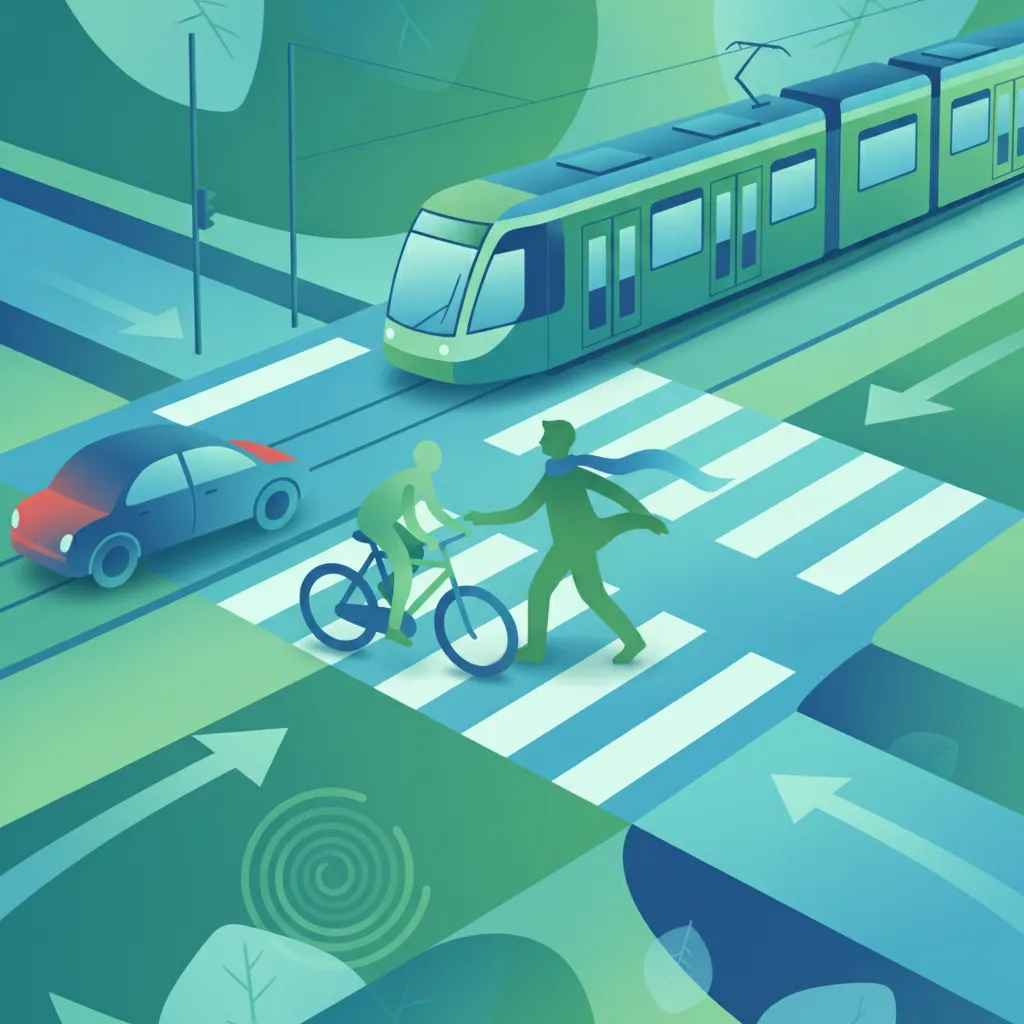
This lesson details the critical right-of-way regulations according to the German StVO. It covers the default 'right before left' rule, the meaning of priority road signs, and specific rules for roundabouts and yielding to pedestrians. A thorough understanding of these priority rules is fundamental for preventing accidents at junctions.
This lesson covers the regulations and safe techniques for overtaking other vehicles in urban environments. It emphasizes the importance of thorough observation, including mirror and blind spot checks, before committing to the maneuver. Learners will understand how to choose a safe gap, manage their speed differential, and maintain strict lane discipline throughout the overtaking process.

This lesson teaches drivers how to safely manage their vehicle in challenging weather. It explains the dangers of aquaplaning in heavy rain, the loss of traction on snow and ice (including 'black ice'), and the severely reduced visibility in fog. You will learn to adjust your speed, increase following distances, and use lights correctly to suit these conditions.

This lesson provides a step-by-step guide to executing turns safely at intersections and other locations. It details the full observation sequence (mirrors, signal, blind spot check) required before initiating a turn. The lesson covers correct lane positioning for both left and right turns and explains the rules for performing U-turns or three-point turns where permitted.
This lesson provides a complete guide to driving on the German Autobahn. It covers the correct procedure for entering and exiting via acceleration and deceleration lanes, the strict lane discipline rule of keeping right ('Rechtsfahrgebot'), and the principle of overtaking only on the left. It also explains the recommended speed limit and the critical procedure for forming an emergency corridor ('Rettungsgasse') in a traffic jam.
Understand how the core StVO behaviour rules, such as keeping right and safe distances, are applied differently in various German driving environments. Learn about specific considerations for city traffic, country roads, and high-speed Autobahn driving.
This lesson teaches drivers how to safely manage their vehicle in challenging weather. It explains the dangers of aquaplaning in heavy rain, the loss of traction on snow and ice (including 'black ice'), and the severely reduced visibility in fog. You will learn to adjust your speed, increase following distances, and use lights correctly to suit these conditions.
This lesson focuses on complex traffic environments where different types of road users share the same space. It provides guidance on situations like driving on streets with integrated tram tracks or where bus and bicycle lanes are part of the roadway. The content emphasizes understanding the specific priority rules and being extra vigilant to anticipate potential conflicts in these busy, shared zones.
This lesson focuses on the particular care required when driving near pedestrians, with a special emphasis on children and the elderly, whose behavior can be unpredictable. It covers the rules for yielding at zebra crossings and the importance of reducing speed near schools, playgrounds, and residential areas. The goal is to instill a habit of constant vigilance and readiness to stop.
This lesson focuses on identifying road users who require special attention and caution, such as children, the elderly, and individuals with disabilities. It details the appropriate behavior when encountering school buses and public transport, which often involve unpredictable pedestrian movement. A critical topic covered is the legal requirement to form an emergency corridor ('Rettungsgasse') for responding emergency vehicles.
This lesson examines the specific hazards associated with driving on rural roads. It covers how to handle narrow lanes, sharp bends, and poor road surfaces, as well as how to anticipate and safely interact with slow-moving agricultural vehicles or livestock. Strategies for speed adaptation due to limited visibility and the risks associated with overtaking in these conditions are thoroughly discussed.
This lesson covers the rules and safety considerations for overtaking ('Überholen'). It explains where overtaking is prohibited and how to assess whether it is safe and necessary to do so. The procedure for checking traffic, signaling, moving out, passing, and safely returning to the lane is detailed, with a strong focus on judging the speed and distance of oncoming traffic.
Find clear answers to common questions learners have about Core Behaviour Rules (StVO). Learn how the lesson is structured, which driving theory objectives it supports, and how it fits into the overall learning path of units and curriculum progression in Germany. These explanations help you understand key concepts, lesson flow, and exam focused study goals.
In Germany, you must drive on the right side of the road at all times. This principle of 'Rechtsfahrgebot' is mandatory unless traffic signs, road markings, or lanes indicate otherwise for specific purposes like turning left or overtaking.
Yes, maintaining a sufficient following distance is a core safety rule. While the two-second rule is a good general guideline, high-speed situations on the Autobahn often require even larger gaps to ensure you can stop safely if the vehicle in front brakes suddenly.
The German theory exam specifically tests your knowledge of the StVO legislation, not just your practical ability. Many questions focus on the legal nuances of when you are allowed to overtake or where you must position your vehicle to be compliant with the law.
By understanding the core behavior rules, you can predict how other road users are legally required to act. This allows you to identify hazardous situations faster because you can spot when someone else is deviating from these standard rules.
Begin your targeted revision now. Use our practice search to quickly find specific German driving theory questions. Filter by StVO rules, road signs, or hazard perception to create your focused study plan. Master challenging areas and prepare confidently for your theoretical driving test.