
This lesson guides you through the statutory speed limits applicable to Category B drivers in Germany. You will learn to navigate speed restrictions on different road types and understand how to adapt your driving to varying traffic, weather, and visibility conditions.
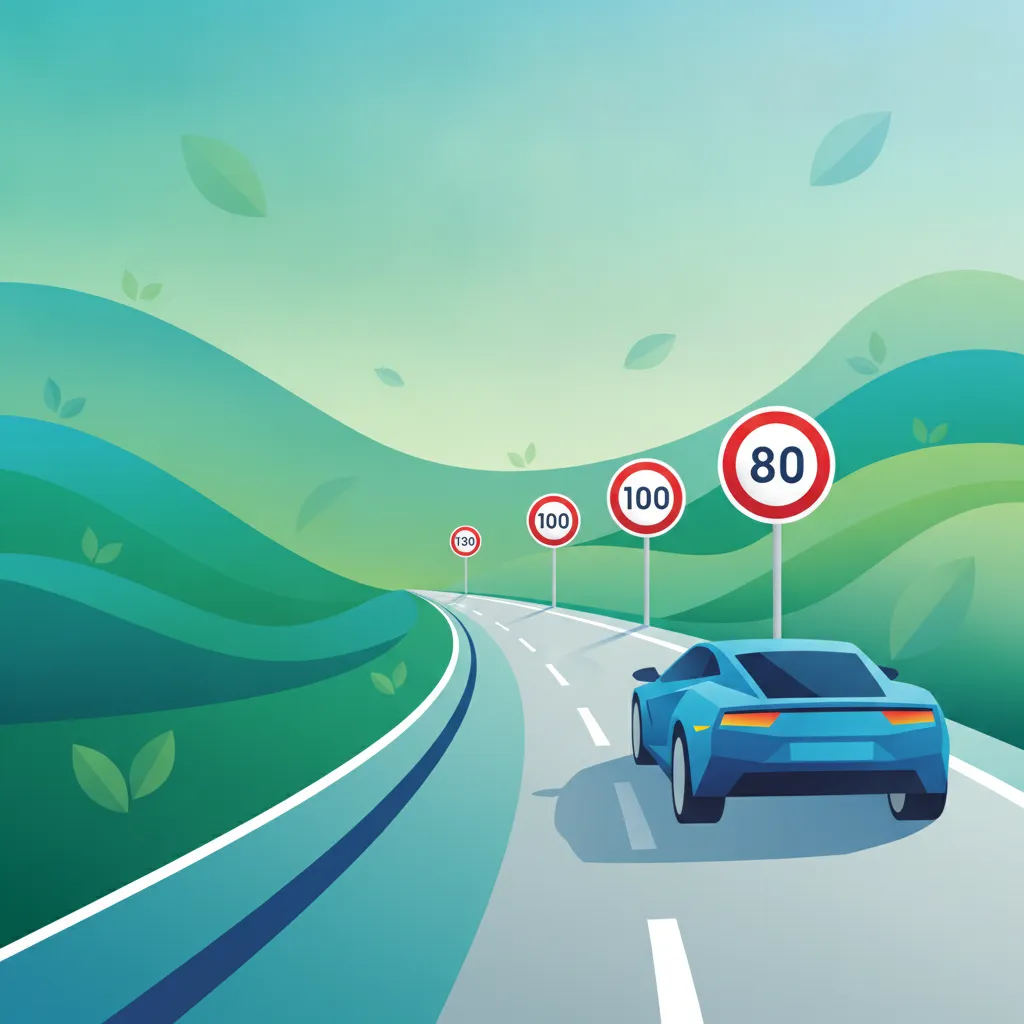
Lesson content overview
Understanding and correctly applying speed limits is a cornerstone of safe and legal driving in Germany. This lesson, part of your German Category B driving license theory course, will delve into the statutory speed limits (gesetzliche Höchstgeschwindigkeit) across various road types, the crucial concept of adapting your speed to prevailing conditions (erlaubte Höchstgeschwindigkeit), and the unique 'recommended speed' (Richtgeschwindigkeit) on the Autobahn. By mastering these principles, you will not only comply with the law but also significantly enhance your safety and that of other road users.
Speed is a critical factor in road safety. It directly influences reaction times, stopping distances, and the severity of potential accidents. German traffic law, specifically the Straßenverkehrs-Ordnung (StVO), sets clear rules for how fast you can drive. However, merely knowing the posted numbers isn't enough; responsible driving demands a constant adaptation of speed to complex, dynamic conditions. This chapter provides a detailed overview to equip you with the knowledge needed to make informed and safe speed choices on German roads.
The statutory speed limit is the legally enforced maximum speed for a particular road segment or type, indicated either by traffic signs or prescribed by law when no signs are present. Drivers must never exceed these limits, regardless of how safe they might feel the conditions are.
Within built-up areas, often referred to as "Innerorts" or "Ortschaften," a general speed limit applies to protect pedestrians, cyclists, and residents.
Upon entering a town or city, indicated by an "Ortstafel" (town sign), the default speed limit automatically becomes 50 km/h, unless specific signage dictates otherwise. This limit applies until you pass the corresponding "Ortstafel" marking the end of the built-up area.
While 50 km/h is the standard, many residential zones or areas near schools, hospitals, or kindergartens have even lower limits, most commonly 30 km/h. These are often designated as "Tempo 30 Zonen" (30 km/h zones).
The rationale behind these lower urban speed limits is to enhance safety for vulnerable road users, reduce noise pollution, and allow drivers sufficient time to react to unexpected hazards common in densely populated areas.
Once you leave a built-up area, the default speed limit on rural roads, known as "Landstraßen," is generally 100 km/h. This applies to all single carriageway roads outside of towns and cities, provided there are no specific signs indicating a different limit.
On some rural roads, particularly those designed for faster traffic with multiple lanes or separated carriageways (similar to motorways but not classified as Autobahns), higher or lower limits might be posted. For instance, specific sections might have a posted limit of 80 km/h due to curves, junctions, or other hazards. Conversely, some high-quality rural roads might have sections where the limit is raised to 120 km/h, though this is less common.
It is important to remember that for certain vehicle types, such as those towing trailers or vehicles over a specific weight, lower statutory speed limits apply, even on rural roads with a 100 km/h limit for passenger cars. For example, vehicles with trailers often have a maximum speed limit of 80 km/h, which can be increased to 100 km/h only under specific conditions and with a special permit.
The German Autobahn system is renowned for its sections without a general statutory speed limit. However, it's a common misconception that there are no limits at all. While some sections are unrestricted, many others have specific posted limits.
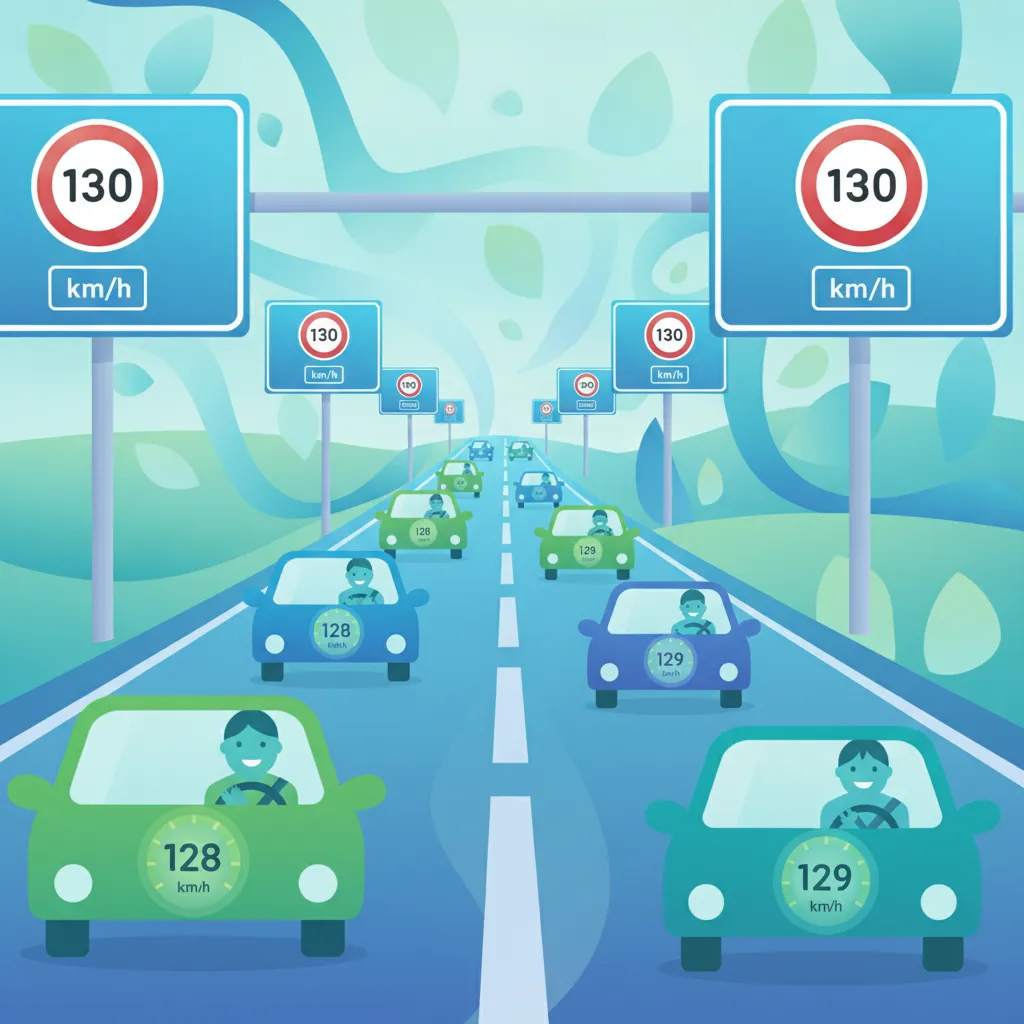
For sections of the Autobahn where no speed limit is explicitly posted by signs, the law provides a recommended speed (Richtgeschwindigkeit) of 130 km/h. This is a non-binding guideline, not a legal maximum. Drivers are free to exceed this speed, provided they maintain control of their vehicle and adapt their speed to all prevailing conditions.
However, many Autobahn sections do have statutory speed limits, often 130 km/h, 120 km/h, 100 km/h, or even lower in construction zones or environmentally sensitive areas. These limits are indicated by standard circular speed limit signs.
Modern Autobahns also frequently utilize Variable Message Signs (VMS). These electronic signs can display dynamic speed limits, which change based on traffic flow, weather conditions, or ongoing roadworks. These dynamically displayed limits are mandatory and must be strictly obeyed.
Even on unrestricted Autobahn sections, heavy vehicles, buses, and vehicles towing trailers are subject to strict statutory speed limits, typically 80 km/h or 100 km/h, regardless of whether a limit is posted for passenger cars.
While statutory speed limits provide a legal maximum, they are often set for ideal driving conditions. In reality, conditions are rarely ideal. This brings us to the crucial concept of the maximum allowed speed (erlaubte Höchstgeschwindigkeit) – the highest speed a driver may safely travel, considering the posted limit and all real-time circumstances. This speed is often lower than the statutory limit.
The Straßenverkehrs-Ordnung (§3 StVO) explicitly requires drivers to adapt their speed. It states that "whoever drives a vehicle may only drive so fast that the vehicle is constantly under control." This means that even if a sign permits 100 km/h, you might legally and safely only be able to drive at 60 km/h due to external factors. Failing to adapt your speed to conditions is a serious offense and a primary cause of accidents.
Drivers must constantly assess and adjust their speed based on a variety of factors:
The decision of what constitutes a "safe speed" under specific conditions rests solely with the driver. It requires constant observation, anticipation, and sound judgment.
As mentioned, on Autobahn sections where no specific speed limit is posted, a recommended speed (Richtgeschwindigkeit) of 130 km/h applies. This concept is unique to Germany and is often a source of confusion for international drivers.
The Richtgeschwindigkeit is a non-binding recommendation. Exceeding 130 km/h on an unrestricted Autobahn section is not, in itself, a traffic violation. However, its purpose is to provide an optimal balance between safety and traffic flow, based on extensive road safety research.
While not legally binding as a limit, exceeding the Richtgeschwindigkeit has significant implications for driver liability in the event of an accident. If you are involved in a collision while traveling significantly faster than 130 km/h on an unrestricted section, you may be held partially or even fully responsible for the accident, even if you were not directly at fault for the initial incident. This is because exceeding the recommended speed is seen as an increased operating risk (erhöhte Betriebsgefahr).
Drivers on unrestricted Autobahn sections are expected to use the Richtgeschwindigkeit as a guideline. If conditions are ideal (good visibility, light traffic, dry roads), traveling above 130 km/h is permissible but comes with increased responsibility and potential liability. If conditions are less than ideal (e.g., moderate rain, slightly heavier traffic), even if no limit is posted, you should consider reducing your speed to or below 130 km/h to align with the maximum allowed speed principle.
Traffic signs are the primary means of communicating statutory speed limits. Recognizing and understanding them is crucial for safe navigation.
Speeding is a serious offense in Germany, with consequences ranging from fines to penalty points and even driving bans. The penalties are stricter within built-up areas (Innerorts) compared to outside built-up areas (Außerorts) due to the higher risk to vulnerable road users.
The penalty system typically involves:
Understanding the physical effects of speed is fundamental to safe driving. Even small increases in speed have a disproportionate impact on safety.
Higher speeds dramatically reduce the margin for error and increase the severity of potential collisions. A pedestrian hit at 50 km/h has a significantly lower chance of survival than one hit at 30 km/h. This scientific reality underpins all speed regulations.
Let's consider a few real-world examples to solidify your understanding of speed selection.
In this scenario, even though the posted limit is 100 km/h, the severe reduction in visibility due to fog mandates a drastic reduction in speed. A safe speed here would likely be 30 km/h or less, allowing the driver to stop within the visible distance. Maintaining 100 km/h would be extremely dangerous and illegal, violating the "maximum allowed speed" principle.
On this unrestricted Autobahn section, the recommended speed is 130 km/h. Drivers can choose to travel faster, for example at 160 km/h, if conditions are ideal and their vehicle and skills permit. However, they must be aware that in the event of an accident, their increased speed above the recommendation could increase their liability, even if they were not the direct cause of the accident. If traffic were to become heavy, or rain started, even 130 km/h might become too fast.
Here, a statutory speed limit of 30 km/h is clearly posted. Drivers must strictly adhere to this limit. Given the presence of children, even 30 km/h might feel fast, and an alert driver would be prepared to reduce speed further if a child were to unexpectedly step into the road. This demonstrates how the statutory limit is a maximum, but the "maximum allowed speed" could be even lower depending on the immediate context.
By diligently applying these principles, you will become a safer, more responsible, and legally compliant driver on German roads.
This lesson covers Germany's statutory speed limits for Category B drivers: 50 km/h in built-up areas, 100 km/h on rural roads, and variable or recommended limits on the Autobahn. A central concept is that the posted limit is a maximum for ideal conditions only, while StVO §3 legally obliges drivers to determine their maximum allowed speed based on real-time factors including weather, visibility, road surface, and traffic. The unique German Richtgeschwindigkeit of 130 km/h on unrestricted Autobahn sections is a non-binding recommendation that, if exceeded, increases driver liability in accidents. Understanding stopping distance physics and obeying dynamic Variable Message Signs are essential for both exam success and real-world safety.
A short set of high-value points that capture the most important learning from this lesson.
Statutory speed limits are maximums under ideal conditions; you must always reduce speed when conditions demand it
Within built-up areas (Innerorts), the default limit is 50 km/h, with common 30 km/h zones near schools and residential areas
On rural roads outside built-up areas (Außerorts), passenger cars default to 100 km/h unless otherwise posted
On unrestricted Autobahn sections, 130 km/h is a non-binding recommendation (Richtgeschwindigkeit), not a legal maximum
The legal concept of erlaubte Höchstgeschwindigkeit means your safe speed may be significantly lower than the posted limit due to weather, visibility, or traffic conditions
Explore all units and lessons included in this driving theory course.
The Ortstafel (yellow town sign) activates the 50 km/h built-up area limit; the same sign with a red diagonal line ends it
Variable Message Signs (VMS) on the Autobahn display mandatory speed limits that must be obeyed
Braking distance increases with the square of speed, meaning doubling your speed quadruples your stopping distance
Exceeding the Richtgeschwindigkeit on unrestricted Autobahn sections increases your liability in accidents even if you are not at fault
Vehicles towing trailers, heavy vehicles, and buses face lower statutory limits (typically 80-100 km/h) regardless of posted limits
Assuming the Richtgeschwindigkeit of 130 km/h is a legal limit rather than a non-binding recommendation
Believing that driving below the posted limit excuses failing to adapt speed to poor conditions like fog or rain
Confusing the end-of-speed-limit sign (single diagonal line) with the end-of-all-restrictions sign (multiple diagonal lines)
Thinking unrestricted Autobahn sections have no limits for all vehicles, when in fact heavy vehicles and trailers have mandatory lower limits
Failing to reduce speed proportionally when visibility is reduced below safe stopping distances
Lesson content overview
A short set of high-value points that capture the most important learning from this lesson.
Statutory speed limits are maximums under ideal conditions; you must always reduce speed when conditions demand it
Within built-up areas (Innerorts), the default limit is 50 km/h, with common 30 km/h zones near schools and residential areas
On rural roads outside built-up areas (Außerorts), passenger cars default to 100 km/h unless otherwise posted
On unrestricted Autobahn sections, 130 km/h is a non-binding recommendation (Richtgeschwindigkeit), not a legal maximum
The legal concept of erlaubte Höchstgeschwindigkeit means your safe speed may be significantly lower than the posted limit due to weather, visibility, or traffic conditions
Explore all units and lessons included in this driving theory course.
The Ortstafel (yellow town sign) activates the 50 km/h built-up area limit; the same sign with a red diagonal line ends it
Variable Message Signs (VMS) on the Autobahn display mandatory speed limits that must be obeyed
Braking distance increases with the square of speed, meaning doubling your speed quadruples your stopping distance
Exceeding the Richtgeschwindigkeit on unrestricted Autobahn sections increases your liability in accidents even if you are not at fault
Vehicles towing trailers, heavy vehicles, and buses face lower statutory limits (typically 80-100 km/h) regardless of posted limits
Assuming the Richtgeschwindigkeit of 130 km/h is a legal limit rather than a non-binding recommendation
Believing that driving below the posted limit excuses failing to adapt speed to poor conditions like fog or rain
Confusing the end-of-speed-limit sign (single diagonal line) with the end-of-all-restrictions sign (multiple diagonal lines)
Thinking unrestricted Autobahn sections have no limits for all vehicles, when in fact heavy vehicles and trailers have mandatory lower limits
Failing to reduce speed proportionally when visibility is reduced below safe stopping distances
Explore search topics learners often look for when studying Speed Limits and Speed Selection. These topics reflect common questions about road rules, driving situations, safety guidance, and lesson level theory preparation for learners in Germany.
Browse additional driving theory lessons that cover connected traffic rules, road signs, and common driving situations related to this topic. Improve your understanding of how different rules interact across everyday traffic scenarios.
Learn how German traffic law requires drivers to adjust their speed based on road conditions, visibility, and traffic density. This covers beyond posted limits to ensure safe driving in various situations, complementing standard speed limit rules.

This lesson teaches drivers how to safely manage their vehicle in challenging weather. It explains the dangers of aquaplaning in heavy rain, the loss of traction on snow and ice (including 'black ice'), and the severely reduced visibility in fog. You will learn to adjust your speed, increase following distances, and use lights correctly to suit these conditions.
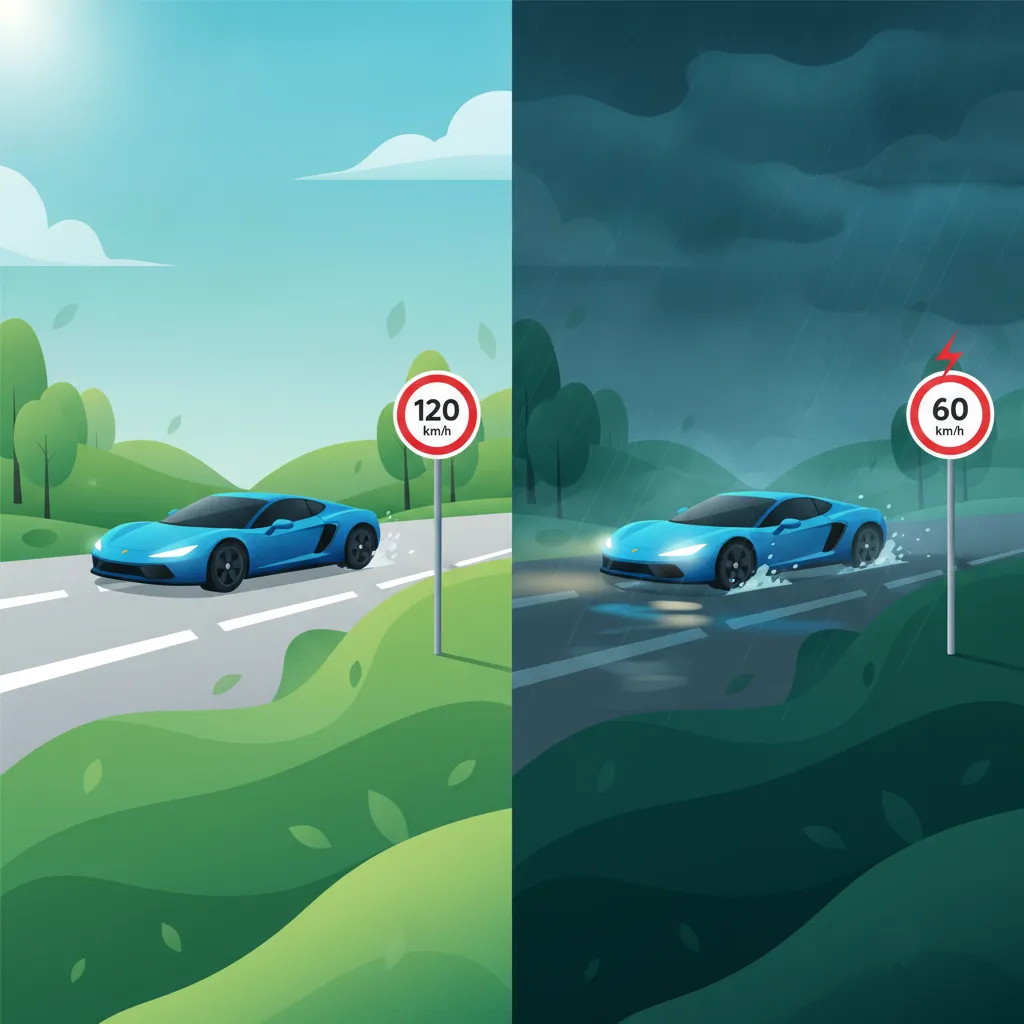
This lesson details the various speed limits applicable in Germany, from urban zones to rural roads. It emphasizes the critical skill of adapting speed to prevailing conditions such as rain, fog, or poor road surfaces. The content explains how external factors significantly impact vehicle handling and stopping distances.

This lesson explores how different weather conditions impact driving safety and vehicle performance. It discusses the risks of hydroplaning in heavy rain, reduced visibility in fog, and loss of traction on snow and ice. Drivers will learn how to adapt their speed, increase following distances, and make smooth control inputs to maintain vehicle stability and prevent skids in these challenging conditions.

This lesson examines the specific hazards posed by different weather conditions. It explains how rain can lead to hydroplaning and reduced grip, how fog impairs visibility, and how strong winds can affect stability. Riders will learn practical strategies, such as reducing speed and increasing following distance, to mitigate these risks.

This lesson provides a complete guide to driving on the German Autobahn. It covers the correct procedure for entering and exiting via acceleration and deceleration lanes, the strict lane discipline rule of keeping right ('Rechtsfahrgebot'), and the principle of overtaking only on the left. It also explains the recommended speed limit and the critical procedure for forming an emergency corridor ('Rettungsgasse') in a traffic jam.

This lesson covers the crucial skills of managing speed and maintaining a safe buffer from other vehicles. It teaches methods for calculating an appropriate following distance, such as the time-gap method, which adapts to different speeds and conditions. Learners will understand how to adjust their speed based on traffic flow, road surface, and weather to ensure they always have enough time and space to stop safely.
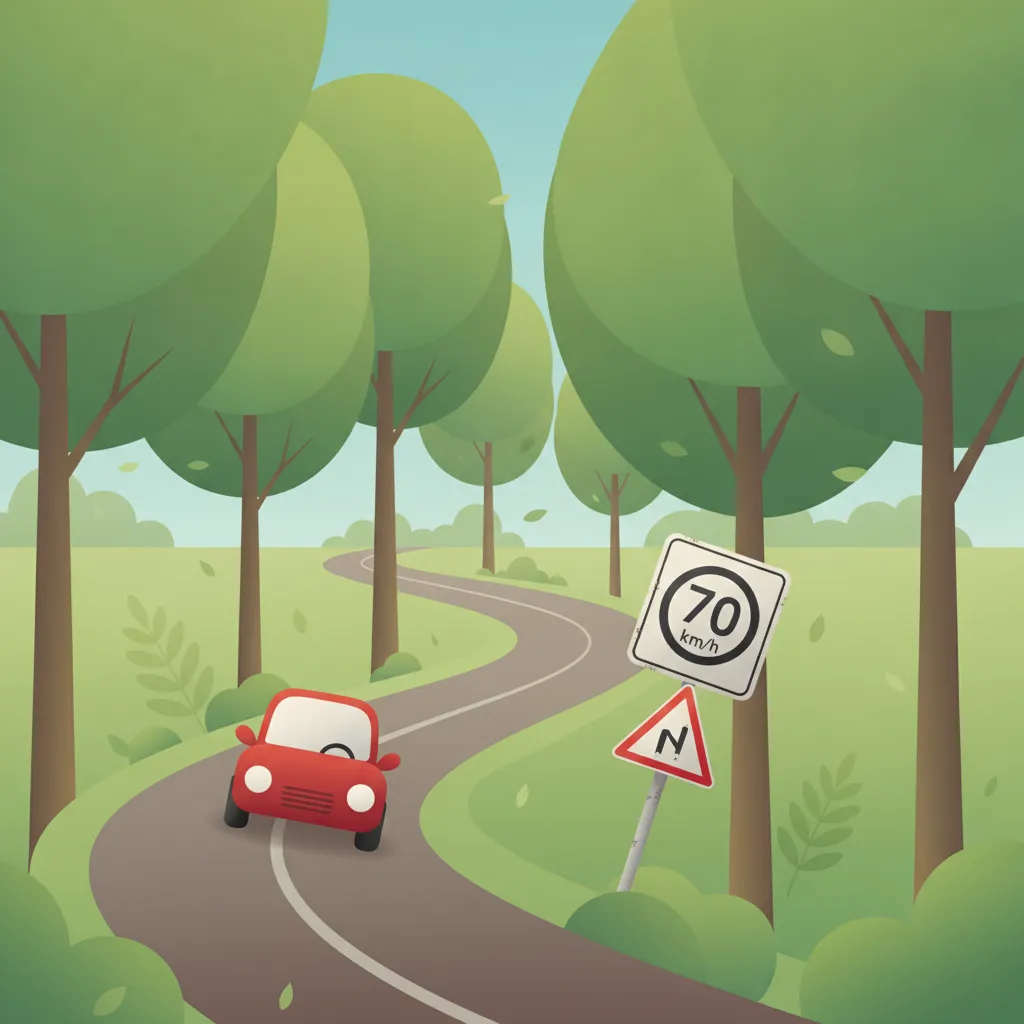
This lesson examines the specific hazards associated with driving on rural roads. It covers how to handle narrow lanes, sharp bends, and poor road surfaces, as well as how to anticipate and safely interact with slow-moving agricultural vehicles or livestock. Strategies for speed adaptation due to limited visibility and the risks associated with overtaking in these conditions are thoroughly discussed.

This lesson explores the critical role of visibility in safe driving, covering topics such as sight distance, managing blind spots, and the correct use of mirrors. It provides guidance on how to adjust your driving in conditions of reduced visibility, such as at night, in fog, or during heavy rain, including the proper use of headlights. The importance of the over-the-shoulder check ('Schulterblick') is also a key focus.

This lesson examines how different weather conditions, such as rain, strong winds, and fog, directly impact motorcycle safety. It explains how wet surfaces reduce tyre grip and increase braking distances, requiring smoother rider inputs. The content also provides strategies for managing reduced visibility and the physical effects of crosswinds on the motorcycle's stability.
Explore the specific speed regulations for German Autobahns, focusing on the concept of 'Richtgeschwindigkeit' (recommended speed) and the conditions under which it applies. Essential knowledge for high-speed driving theory.
This lesson provides a complete guide to driving on the German Autobahn. It covers the correct procedure for entering and exiting via acceleration and deceleration lanes, the strict lane discipline rule of keeping right ('Rechtsfahrgebot'), and the principle of overtaking only on the left. It also explains the recommended speed limit and the critical procedure for forming an emergency corridor ('Rettungsgasse') in a traffic jam.
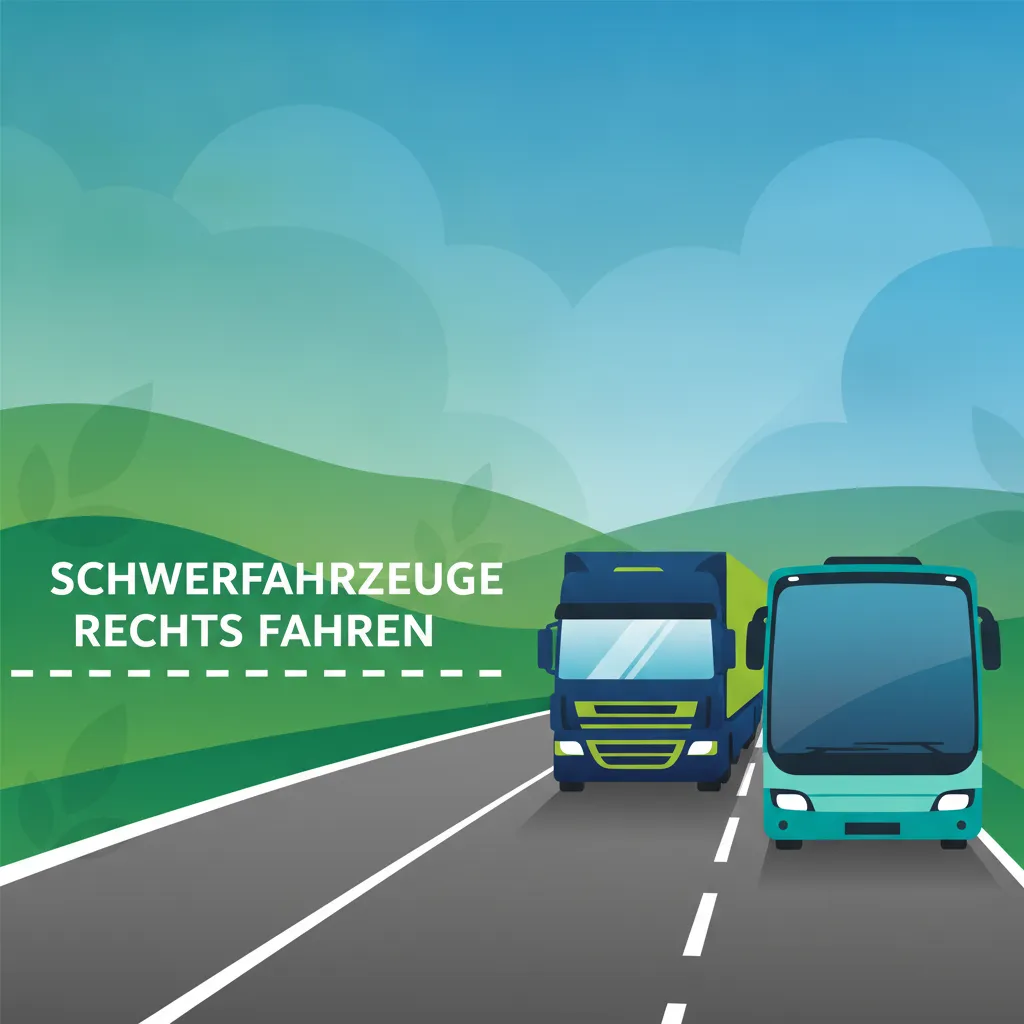
This lesson explains the specific regulations for operating heavy vehicles on Autobahnen, including speed limits, lane discipline, and overtaking rules. It discusses the use of dedicated truck lanes and the importance of maintaining appropriate following distances. The content also covers procedures for merging and exiting high-speed roads safely.

This lesson provides instruction on the rules and best practices for operating a large passenger vehicle on the Autobahn. It covers the principles of strict lane discipline, regulations for minimum speed, and correct procedures for overtaking and merging. The importance of maintaining significantly increased following distances at high speeds and planning for exits well in advance is a key focus.
This lesson details the various speed limits applicable in Germany, from urban zones to rural roads. It emphasizes the critical skill of adapting speed to prevailing conditions such as rain, fog, or poor road surfaces. The content explains how external factors significantly impact vehicle handling and stopping distances.

This lesson details the correct procedures for entering a motorway, using the acceleration lane to match traffic speed, and merging safely. It reinforces the strict lane discipline required, including keeping to the right lane except when overtaking. The content also provides guidance on maintaining increased following distances and performing safe lane changes at high speeds.

This lesson introduces the classification of rural roads and explains how speed limits are determined in these non-urban areas. It covers the German national speed limit for rural roads and how to identify local or temporary restrictions. Learners will understand the importance of adapting their speed to the road's characteristics, such as width, surface condition, and visibility, not just the posted limit.
This lesson covers the crucial skills of managing speed and maintaining a safe buffer from other vehicles. It teaches methods for calculating an appropriate following distance, such as the time-gap method, which adapts to different speeds and conditions. Learners will understand how to adjust their speed based on traffic flow, road surface, and weather to ensure they always have enough time and space to stop safely.
This lesson teaches the importance of adhering to speed limits and how to manage speed effectively, especially when hauling heavy loads. It covers the function of speed-limiters to ensure compliance with legal restrictions. The content also discusses the relationship between speed, fuel consumption, and its effect on braking distance.
Find clear answers to common questions learners have about Speed Limits and Speed Selection. Learn how the lesson is structured, which driving theory objectives it supports, and how it fits into the overall learning path of units and curriculum progression in Germany. These explanations help you understand key concepts, lesson flow, and exam focused study goals.
Within built-up areas, the general speed limit is 50 km/h, unless indicated otherwise by traffic signs. You must always watch for signs that lower this to 30 km/h in residential or school zones.
A blue circular sign with a number represents a minimum speed limit. You must drive at least at the speed indicated, provided that road and weather conditions allow for it safely.
No, the Autobahn has a recommended speed (Richtgeschwindigkeit) of 130 km/h. While not a strict legal maximum everywhere, you can still be held liable for higher speeds if you are involved in an accident, and many sections have posted permanent or variable speed limits.
Even if a road has a high speed limit, the StVO requires you to adjust your speed to ensure you can stop within your field of vision. In rain, snow, or fog, you must drive significantly slower than the posted maximum to maintain safety.
Begin your targeted revision now. Use our practice search to quickly find specific German driving theory questions. Filter by StVO rules, road signs, or hazard perception to create your focused study plan. Master challenging areas and prepare confidently for your theoretical driving test.