
This lesson addresses the unique challenges of driving after dark, an essential skill for all drivers. Within the Adverse Weather and Environmental Conditions unit, you will learn critical techniques for using your headlights correctly and effectively managing glare from oncoming traffic. Mastering these concepts is crucial for safety and for successfully navigating related questions on your Polish Category B theory exam.
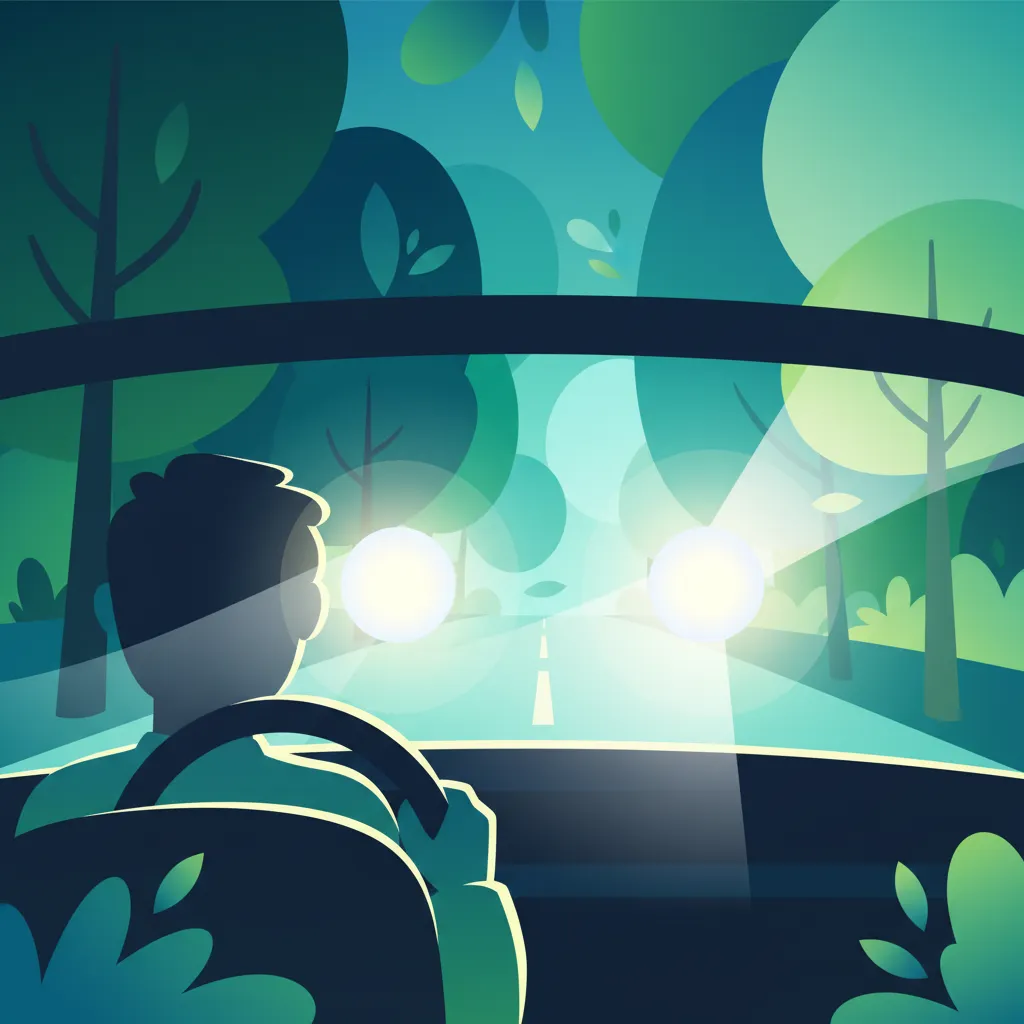
Lesson content overview
Driving after dark presents a unique set of challenges that significantly increase the risk of accidents. Unlike daytime driving, navigating roads at night demands heightened awareness, specific lighting techniques, and an understanding of how our vision and perception are affected by low light conditions. This comprehensive lesson, part of your Polish Category B driving theory preparation, will equip you with the knowledge to safely manage night driving, effectively combat glare, and adapt to varying light environments, ensuring you are prepared for both your exam and real-world driving scenarios under Polish traffic law.
Driving at night significantly alters a driver's visual environment. Human eyes are incredibly adaptable, but this adaptation takes time and comes with limitations. As ambient light diminishes, our eyes undergo a physiological process known as visual adaptation, shifting from daylight (photopic) vision to low-light (mesopic and scotopic) vision. This transition impacts our ability to see colors, judge distances, and detect hazards.
The physiological process by which the human eye adjusts its sensitivity to varying ambient light levels, transitioning between different modes of vision.
Our eyes use two types of photoreceptor cells: cones and rods. Cones are responsible for photopic vision, which occurs in bright light, allowing us to perceive vivid colors and sharp details. As light levels decrease, our vision shifts to mesopic vision, a twilight state where both cones and rods are active, resulting in reduced color perception and visual acuity. In very low light, such as on unlit roads at night, rods become dominant, leading to scotopic vision. Scotopic vision provides excellent sensitivity to movement and shapes in dim light but lacks color discrimination and fine detail.
The transition from bright to dim environments is not instantaneous. For example, when exiting a brightly lit tunnel or a well-illuminated city street onto a dark rural road, your eyes may take up to 30 seconds to fully adapt to the lower light levels. During this period, your perception of depth and ability to spot obstacles will be significantly reduced. Anticipating these changes and adjusting your speed accordingly is crucial for safety.
One of the most critical aspects of night driving is the degradation of distance and speed perception. At night, familiar depth cues like shadows, textures, and the relative size of objects are less distinct or entirely absent. This makes it challenging to accurately estimate how far away other vehicles or obstacles are, and how quickly they are approaching or receding.
The reduced ability to accurately estimate distances and speeds of objects and other vehicles due to low light conditions, diminished contrast, and lack of visual cues.
Consequences of this degraded perception include overestimating safe following distances and underestimating the necessary braking distance. Drivers must consciously compensate for this by increasing their following distance by at least one to two seconds compared to daytime driving and reducing their speed, especially on poorly lit roads. Even if the posted speed limit allows for higher speeds, the safe speed at night might be considerably lower, dictated by your ability to stop within the illuminated distance of your headlights.
Proper use of your vehicle's lighting system is fundamental to safe night driving and legal compliance in Poland. Knowing when to use each type of light ensures you can see adequately while simultaneously preventing glare for other road users.
Low beam headlights, also known as światła mijania or dipped beam, project a downward-angled light pattern that illuminates the road directly ahead without dazzling oncoming drivers or those you are following. This is your primary lighting for most night driving situations.
In Poland, the use of low beam headlights is mandatory in several scenarios under the Polish Road Traffic Act (Ustawa o ruchu drogowym):
Always ensure your low beams are correctly aimed. Misaligned headlights can either fail to illuminate the road adequately or, worse, blind other drivers even on the low beam setting.
High beam headlights, or światła drogowe (main beam), project a brighter, farther-reaching light pattern designed to illuminate the road for a greater distance. They are invaluable for improving visibility on dark, unlit roads, allowing you to spot hazards and road signs much sooner.
However, due to their intensity, high beams must be used with extreme caution to prevent blinding other road users. In Poland, high beams are permitted only when:
Failing to dim your high beams when required is not only dangerous but also a violation of the Road Traffic Act, potentially leading to a fine.
When driving with high beams, constantly scan the road ahead for oncoming headlights or tail lights of vehicles you are approaching.
As soon as you spot an oncoming vehicle or approach a vehicle from behind, anticipate the 150-meter or 30-meter threshold.
Switch promptly to low beam headlights. Most vehicles allow this with a simple flick of a stalk or a button press.
Once the oncoming vehicle has passed, or you have overtaken the vehicle you were following, and the road ahead is clear again, you may switch back to high beam.
Beyond low and high beams, your vehicle is equipped with other lighting systems, each with a specific purpose and legal usage.
Low-mounted auxiliary lights that emit a wide, flat beam intended to cut through fog, heavy rain, or snow, illuminating the road surface without causing significant back-glare.
Fog lights (światła przeciwmgłowe) are designed for conditions of severely reduced visibility. Front fog lights may be used when visibility is less than 50 metres due to fog, heavy rain, or snow. Rear fog lights, which are significantly brighter than regular tail lights, must be used when visibility drops below 50 metres, but crucially, they must be turned off as soon as visibility improves to avoid dazzling drivers behind you. Using fog lights on a clear night is illegal and can cause unnecessary glare for others.
Lights that automatically illuminate when the engine is on, designed to make your vehicle more visible to other road users during daylight hours.
Daytime Running Lights (DRL) are now mandatory on all new vehicles in Poland. While they improve your vehicle's visibility during the day, they are not a substitute for headlights at night. DRLs only illuminate the front of your vehicle and do not provide sufficient illumination of the road surface or activate your rear lights (unless combined with tail lights as part of a specific DRL system). Always ensure your proper low beam headlights are on when driving at night.
Glare, the temporary blindness or reduction in vision caused by bright lights, is a common and dangerous challenge during night driving. It can come from various sources, including oncoming headlights, rear-view mirrors reflecting headlights from behind, streetlights, or even reflections from wet roads.
The dazzling effect caused by bright light entering the eye, which temporarily reduces vision and can lead to a momentary loss of control.
Effective glare management is crucial for maintaining continuous situational awareness and reaction time. Here are key techniques:
Never use your high beams to "flash back" at a driver who has failed to dim their lights. This only worsens the glare situation for both drivers and escalates the risk.
Fatigue is a major contributor to road accidents, and its risk is significantly amplified during night driving. Our natural circadian rhythms dictate periods of alertness and drowsiness, with a pronounced circadian low point typically occurring between 2 AM and 5 AM. Driving during these hours, or for prolonged periods at night, can lead to decreased alertness, slower reaction times, impaired judgment, and even dangerous microsleeps.
A state of physical and mental exhaustion or reduced alertness, which significantly impairs a driver's ability to operate a vehicle safely.
The natural period during the 24-hour cycle (typically between 2 AM and 5 AM) when the body's alertness and performance are at their lowest due to biological rhythms.
In Poland, driving under the influence of fatigue can be considered negligence, and if an accident results, it may carry penalties similar to driving under the influence of alcohol. Recognizing the signs of fatigue and implementing mitigation strategies is therefore critical:
Microsleeps are brief, involuntary episodes of sleep lasting a few seconds, during which a driver can completely lose control of their vehicle. They are a serious risk for fatigued drivers.
Safe night driving is not a one-size-fits-all approach. Different environmental and traffic conditions demand specific adjustments to your lighting, speed, and overall driving strategy.
Adhering to the specific legal requirements for vehicle lighting is paramount for safety and to avoid penalties under Polish law.
The primary legal framework governing road traffic in Poland, encompassing rules for vehicle operation, driver conduct, and vehicle equipment.
Here’s a summary of key regulations related to night driving and light usage:
Being aware of common errors can help you preemptively adjust your driving behavior.
Night driving demands a proactive and adaptive approach. By understanding the limitations of human vision in low light, mastering your vehicle's lighting systems, actively managing glare, recognizing and combating fatigue, and adhering to Polish traffic regulations, you significantly reduce the inherent risks. Remember to adjust your speed, increase following distances, and maintain constant vigilance for a safer journey after dark.
Night driving in Poland requires mastering the use of low beams (Światła mijania) and high beams (Światła drogowe) based on specific legal distances: 150 metres for oncoming traffic, 30 metres when following, and 50 metres visibility for fog lights. Drivers must understand that their eyes need up to 30 seconds to adapt from bright to dark environments, degrading distance perception and increasing stopping distances. Glare management involves avoiding direct eye contact with headlights, keeping windshields clean, and using the anti-glare rear-view mirror setting. Fatigue is a serious risk, with the circadian low point between 2 AM and 5 AM being most dangerous—regular breaks, adequate rest, and recognizing microsleep warning signs are essential for safe night driving on Polish roads.
A short set of high-value points that capture the most important learning from this lesson.
Polish law requires low beams when approaching oncoming traffic within 150 metres and when following another vehicle within 30 metres.
Visual adaptation to darkness takes up to 30 seconds, during which depth perception and hazard detection are significantly reduced.
High beams must never be used in built-up areas or when visibility is reduced by fog, rain, or snow due to back-glare.
The circadian low point between 2 AM and 5 AM creates the highest fatigue risk, making microsleeps a serious hazard.
Daytime Running Lights are not a substitute for headlights at night as they do not illuminate the road or activate rear lights.
Explore all units and lessons included in this driving theory course.
150 metres: mandatory low beam distance for oncoming traffic; 30 metres: mandatory low beam when following another vehicle.
50 metres: visibility threshold for activating fog lights, which must be turned off immediately once visibility improves.
On unlit rural roads, use high beams only when no traffic is within legal thresholds; dim promptly when vehicles appear.
Keep your windshield clean inside and out—dirt and smudges significantly exacerbate headlight glare.
Plan breaks every 2-3 hours on night journeys and never rely solely on caffeine to counteract fatigue.
Failing to dim high beams in time for oncoming traffic or when following another vehicle within 30 metres.
Using high beams or leaving fog lights on in clear conditions or fog, which causes dangerous back-glare.
Assuming daytime running lights provide sufficient illumination—they do not activate rear lights or light the road.
Staring directly at oncoming headlights instead of shifting gaze slightly to the right edge of your lane.
Ignoring early fatigue signs such as frequent yawning, heavy eyelids, or drifting from your lane, leading to microsleeps.
Lesson content overview
A short set of high-value points that capture the most important learning from this lesson.
Polish law requires low beams when approaching oncoming traffic within 150 metres and when following another vehicle within 30 metres.
Visual adaptation to darkness takes up to 30 seconds, during which depth perception and hazard detection are significantly reduced.
High beams must never be used in built-up areas or when visibility is reduced by fog, rain, or snow due to back-glare.
The circadian low point between 2 AM and 5 AM creates the highest fatigue risk, making microsleeps a serious hazard.
Daytime Running Lights are not a substitute for headlights at night as they do not illuminate the road or activate rear lights.
Explore all units and lessons included in this driving theory course.
150 metres: mandatory low beam distance for oncoming traffic; 30 metres: mandatory low beam when following another vehicle.
50 metres: visibility threshold for activating fog lights, which must be turned off immediately once visibility improves.
On unlit rural roads, use high beams only when no traffic is within legal thresholds; dim promptly when vehicles appear.
Keep your windshield clean inside and out—dirt and smudges significantly exacerbate headlight glare.
Plan breaks every 2-3 hours on night journeys and never rely solely on caffeine to counteract fatigue.
Failing to dim high beams in time for oncoming traffic or when following another vehicle within 30 metres.
Using high beams or leaving fog lights on in clear conditions or fog, which causes dangerous back-glare.
Assuming daytime running lights provide sufficient illumination—they do not activate rear lights or light the road.
Staring directly at oncoming headlights instead of shifting gaze slightly to the right edge of your lane.
Ignoring early fatigue signs such as frequent yawning, heavy eyelids, or drifting from your lane, leading to microsleeps.
Explore search topics learners often look for when studying Night Driving, Glare, and Light Adaptation. These topics reflect common questions about road rules, driving situations, safety guidance, and lesson level theory preparation for learners in Poland.
Browse additional driving theory lessons that cover connected traffic rules, road signs, and common driving situations related to this topic. Improve your understanding of how different rules interact across everyday traffic scenarios.
Understand the visual challenges of night driving including glare, reduced visibility, and distance perception. Learn effective techniques for managing headlights, combating glare, and mitigating driver fatigue according to Polish regulations.
This lesson provides essential guidance for driving in fog, one of the most dangerous conditions. It instructs on the correct use of low-beam headlights and fog lights to maximize visibility without causing glare. The core advice is to significantly reduce speed and use the edge of the road or markings as a guide.
This lesson addresses environmental factors that impact rider visibility, such as low light, night conditions, fog, and glare from headlights. Learners will explore strategies for riding safely in reduced visibility, including the use of reflective gear, proper headlamp settings, and appropriate eye protection. The content also covers hazard detection techniques in adverse weather and how to adjust speed to maintain safety, enhancing rider safety across all conditions.

This lesson addresses the critical importance of the driver's physical and mental state. It details the dangers of driving under the influence of alcohol or drugs, explaining the legal blood alcohol concentration limit in Poland. The content also covers the subtle but significant risks of fatigue and distractions, advocating for full attentiveness behind the wheel.
This lesson teaches the crucial concept that drivers must always adapt their speed to the current conditions. It explains how factors like rain, fog, ice, heavy traffic, and poor visibility reduce safety margins and require a lower speed than the posted limit. This principle of defensive driving is essential for preventing accidents in challenging situations.
This lesson provides a detailed breakdown of traffic light operations in Poland. It explains the sequence of red, amber, and green lights, and the specific rules for turning when a green arrow signal is displayed. The meaning of a flashing amber light and the rules for pedestrian crossings at signalized intersections are also covered.
This lesson focuses on traffic control signals, primarily traffic lights. It details the meaning of each color in the sequence—red, amber, and green—as well as flashing signals and arrows for specific turns. The content also covers lane control signals and pedestrian signals to ensure safe and compliant navigation through controlled intersections.

This lesson addresses the critical safety issue of driver fatigue. It explains the physiological causes of fatigue, including disruption to circadian rhythms, and teaches drivers to recognize its early warning signs. The content reviews the legal requirements for breaks and rest periods in detail and provides practical strategies for managing sleep hygiene and using alertness techniques to ensure they remain focused and responsive while on duty, thereby preventing fatigue-related incidents.
This lesson provides a comprehensive breakdown of the right-of-way rules that govern intersections. It explains the clear directives given by traffic lights, stop signs, and yield signs, and clarifies the procedures at unmarked or uncontrolled intersections, where the 'priority to the right' rule often applies. Learners will understand the legal hierarchy of these rules to make correct, safe, and predictable decisions when navigating through any junction, reducing the risk of conflict with other traffic.
This lesson explores the physiological and psychological aspects of driver fatigue, covering its warning signs and strategies for maintaining concentration. It outlines the legal framework for work-time limits and mandatory rest periods, monitored via tachograph. Practical advice on schedule planning and nutrition is provided to help sustain alertness and reduce accident risk.
This lesson explores the unique characteristics of driving on rural roads. It highlights potential hazards such as sharp, unbanked curves, poor road surfaces, and limited visibility due to hills and vegetation. The content teaches drivers to anticipate these conditions and adjust their speed and position to navigate safely.
Master the specific Polish rules for using low beam, high beam, and fog lights at night. Learn when to use each type of light and avoid common mistakes related to vehicle lighting to ensure safety and legal compliance.
This lesson provides essential guidance for driving in fog, one of the most dangerous conditions. It instructs on the correct use of low-beam headlights and fog lights to maximize visibility without causing glare. The core advice is to significantly reduce speed and use the edge of the road or markings as a guide.
This lesson provides a detailed breakdown of traffic light operations in Poland. It explains the sequence of red, amber, and green lights, and the specific rules for turning when a green arrow signal is displayed. The meaning of a flashing amber light and the rules for pedestrian crossings at signalized intersections are also covered.
This lesson focuses on traffic control signals, primarily traffic lights. It details the meaning of each color in the sequence—red, amber, and green—as well as flashing signals and arrows for specific turns. The content also covers lane control signals and pedestrian signals to ensure safe and compliant navigation through controlled intersections.
This lesson details the various parking regulations encountered in residential areas. It explains how to interpret signs indicating permitted parking zones, time restrictions, and areas where parking is prohibited. Correctly positioning the vehicle within marked bays and understanding rules about pavement parking are also covered to avoid fines and obstruction.
This lesson addresses environmental factors that impact rider visibility, such as low light, night conditions, fog, and glare from headlights. Learners will explore strategies for riding safely in reduced visibility, including the use of reflective gear, proper headlamp settings, and appropriate eye protection. The content also covers hazard detection techniques in adverse weather and how to adjust speed to maintain safety, enhancing rider safety across all conditions.
This lesson teaches the crucial concept that drivers must always adapt their speed to the current conditions. It explains how factors like rain, fog, ice, heavy traffic, and poor visibility reduce safety margins and require a lower speed than the posted limit. This principle of defensive driving is essential for preventing accidents in challenging situations.
This lesson emphasizes the importance of systematic observation for safe driving. It teaches how to correctly adjust and use rearview and side mirrors to monitor traffic, and explains why shoulder checks are essential for detecting hazards in blind spots. These techniques are fundamental for safe lane changes, turns, and overall situational awareness.
This lesson details the legal framework for overtaking in Poland. It explains how to interpret road markings, such as solid and double solid lines, and prohibition signs that forbid passing. The content emphasizes the critical need for sufficient sight distance and a clear path before initiating an overtaking maneuver to ensure safety.
This lesson provides a comprehensive breakdown of the right-of-way rules that govern intersections. It explains the clear directives given by traffic lights, stop signs, and yield signs, and clarifies the procedures at unmarked or uncontrolled intersections, where the 'priority to the right' rule often applies. Learners will understand the legal hierarchy of these rules to make correct, safe, and predictable decisions when navigating through any junction, reducing the risk of conflict with other traffic.
This lesson provides a foundational understanding of the Polish road sign system, categorizing signs into three main types: warning, prohibitory/mandatory, and informational. It explains the significance of different shapes and color codes, enabling drivers to quickly interpret their meaning and legal obligation. By mastering the visual language of road signs, learners will be equipped to make correct and safe decisions in any traffic situation they encounter.
Find clear answers to common questions learners have about Night Driving, Glare, and Light Adaptation. Learn how the lesson is structured, which driving theory objectives it supports, and how it fits into the overall learning path of units and curriculum progression in Poland. These explanations help you understand key concepts, lesson flow, and exam focused study goals.
In Poland, you must switch from high beams (drogowe) to low beams (mijania) when approaching an oncoming vehicle, when driving closely behind another vehicle, or when driving in built-up areas with sufficient street lighting. This is to prevent dazzling other drivers and pedestrians, ensuring road safety according to Polish traffic law.
To minimize glare in Poland, avoid looking directly at oncoming headlights. Instead, focus your gaze slightly to the right edge of your lane. This helps preserve your night vision while still allowing you to monitor the road ahead. You can also briefly glance at the road markings or the side of the road.
Yes, in Poland, front fog lights (przednie światła przeciwmgłowe) can be used at night on winding roads, indicated by the A-3 'winding road' sign, even without fog. Rear fog lights (tylne światła przeciwmgłowe) are only allowed when visibility is reduced to 50 metres or less due to fog, heavy rain, or snow. They must be switched off once visibility improves.
Night driving significantly increases accident risk for Category B drivers due to reduced visibility, making it harder to spot hazards like pedestrians, cyclists, or animals. Depth perception is impaired, and glare from other vehicles can temporarily blind drivers. Additionally, driver fatigue is more common at night, impacting reaction times and judgment.
A clean windshield is crucial for night driving in Poland. Dirt, streaks, and smudges can scatter light from headlights and streetlights, increasing glare and reducing overall visibility. Regularly cleaning both the inside and outside of your windshield, along with ensuring your wipers are in good condition, significantly improves clarity and safety after dark.
Build custom practice sessions tailored precisely to your needs. Focus on areas requiring improvement, review specific Polish road signs, or master complex traffic rules to ensure full preparation for your official driving license exam.