
This lesson focuses on your crucial responsibilities as a motorcyclist when approaching pedestrian crossings and interacting with cyclists on Polish roads. You'll learn to identify priority situations and navigate these scenarios safely, building on the general priority rules covered previously. Mastering these interactions is key to passing your Category A theory exam and riding defensively.

Lesson content overview
As a motorcyclist preparing for the Polish Category A license, understanding how to safely interact with the most vulnerable road users – pedestrians and cyclists – is paramount. This lesson delves into the specific responsibilities, legal obligations, and defensive riding techniques required to ensure safety at pedestrian crossings and when sharing the road with cyclists. Unlike other vehicles, motorcycles are smaller, faster-accelerating, and can be less visible, which necessitates a heightened sense of awareness and proactive behavior from the rider.
The interaction between motorcyclists and pedestrians or cyclists involves a complex interplay of legal priority, human perception, and the dynamic physics of a motorcycle. Correct adherence to traffic laws not only prevents collisions but also significantly reduces the severity of injuries, fulfilling a motorcyclist's mandatory legal and ethical obligations. This chapter builds upon foundational knowledge of road signs, general right-of-way rules, and motorcycle stopping distances to provide a comprehensive guide for safe riding practices on Polish roads.
Pedestrian crossings are critical points on any road network, designated to provide safe passage for people on foot. For motorcyclists, these areas demand exceptional vigilance and adherence to specific rules, particularly concerning the absolute right-of-way granted to pedestrians in Poland. Understanding these rules is crucial for preventing accidents and ensuring the safety of all road users.
A zebra crossing, known in Poland as Przejście dla pieszych, is a marked pedestrian crossing identified by distinctive white parallel stripes painted on the road surface. These markings are often accompanied by a specific road sign, signaling its presence to drivers. At these crossings, pedestrians hold absolute legal priority once they have stepped onto the crossing or are within the crossing zone.
This means that as a motorcyclist, you must be prepared to stop and yield to any pedestrian who is either on the crossing or is clearly intending to step onto it. The legal framework in Poland, specifically Article 41 § 2 of the Road Traffic Act, mandates that drivers must yield to pedestrians who have entered a marked pedestrian crossing, irrespective of the presence or absence of traffic signals. It is a common misunderstanding to believe a driver may proceed if a pedestrian is only a few meters away; the law requires stopping if the pedestrian has already entered the crossing area.
While zebra crossings grant unconditional priority to pedestrians, crossings equipped with traffic lights operate differently. At signalized pedestrian crossings, both pedestrians and vehicles are governed by the traffic light signals. Motorcyclists must obey the vehicle signals, stopping on red and proceeding only on green. Pedestrians, in turn, must wait for their designated pedestrian signal to turn green before crossing.
However, even at signalized crossings, a high degree of caution is necessary. A motorcyclist should never assume that a pedestrian will strictly adhere to the signals. Always scan for pedestrians who might disregard a red light, especially children or individuals who may be distracted. Prepare to react defensively, even when you have the legal right-of-way according to the traffic signals.
Effective speed management is the cornerstone of safe interaction at pedestrian crossings. As a motorcyclist, you must reduce your speed sufficiently before reaching a crossing to ensure you can bring your motorcycle to a complete stop within the visible stopping distance, should a pedestrian suddenly appear. This requires anticipation and a proactive approach, rather than last-minute braking.
Several factors influence your necessary speed adaptation: the road surface condition (dry, wet, icy), the motorcycle's load (e.g., carrying a passenger or heavy cargo), and your own reaction time. A good guideline is to reduce speed early enough to be able to stop within at least two seconds of reaching the crossing point. Overestimating your motorcycle's braking efficiency, especially on wet or uneven surfaces, is a dangerous mistake.
Never delay braking until the last moment, particularly on wet roads. Motorcycles have specific traction limits, especially when leaned, which can significantly extend braking distances.
Visual confirmation is a critical technique for ensuring pedestrian safety. This practice involves actively trying to make eye contact with pedestrians at or approaching a crossing, or at least observing clear body language that indicates they have seen you and are aware of your presence. This reduces the element of surprise and allows you to confirm their intentions.
You must slow down enough to allow ample time for this visual assessment. Do not assume pedestrians will automatically look for approaching traffic out of habit. In situations where direct eye contact is impossible, such as when a pedestrian is partially obscured by a parked vehicle, or on a blind curve leading to a crossing, extreme caution and an even greater reduction in speed are required. Waiting until the pedestrian has fully traversed the crossing before proceeding minimizes risk.
The legal framework in Poland unequivocally places the burden of safety on the driver when it comes to pedestrian crossings. The core principle, as outlined in Article 41 § 2, emphasizes the absolute priority of pedestrians at marked crossings (Przejście dla pieszych). This regulation is designed to protect the most vulnerable road users.
Motorcyclists found in violation of this rule, by failing to yield to a pedestrian already on a crossing, face significant penalties. Beyond fines and demerit points, the primary consequence of such a violation is the high risk of severe injury or fatality for the pedestrian and potential legal liability for the motorcyclist. Consistent adherence to these laws is not just about avoiding penalties; it's about upholding fundamental road safety principles.
Sharing the road with cyclists is a daily reality for motorcyclists in Poland. Cyclists, like pedestrians, are vulnerable road users, lacking the protection of a vehicle chassis. Consequently, motorcyclists must adopt specific strategies for safe interaction, including maintaining adequate passing distances, careful lane positioning, and clear communication.
One of the most crucial rules when interacting with cyclists is maintaining a safe passing distance when overtaking. Polish regulations, specifically Article 28 § 2 of the Road Traffic Act, define minimum lateral clearances required for overtaking vulnerable road users.
The minimum lateral distance a motorcyclist must maintain from a cyclist when overtaking. This distance is ≥ 1.5 metres on urban single carriageways and ≥ 2.0 metres on rural roads without dedicated cycle lanes.
This distance provides a vital buffer against sudden movements by the cyclist, such as swerving to avoid a pothole, reacting to wind gusts, or making an unexpected turn. Overtaking too closely dramatically increases the risk of a side-impact collision, which can be catastrophic for a cyclist and destabilizing for a motorcyclist. Always assess the road width and traffic conditions before initiating an overtake to ensure you can maintain the required clearance. If space is insufficient, it is safer to delay the overtaking maneuver.
Effective lane positioning is key to safely sharing the road with cyclists. Cyclists may ride on the main road lane or in a designated cycle lane. When sharing a lane, motorcyclists should anticipate a cyclist's actions and maintain a position that affords them ample space to continue along their intended path safely. This means not riding too close behind a cyclist and being prepared for them to deviate from a straight line.
Consider these points for predictive positioning:
Communication on the road is vital, but the use of the motorcycle horn must be strictly in accordance with Polish law. Article 54 § 1 of the Road Traffic Act stipulates that the horn may only be used to avert immediate danger or to warn of danger. It is explicitly prohibited for simply "alerting" or "annoying" other road users, including cyclists, or to "clear the way."
Using a short, brief horn blast may be acceptable in a genuine emergency, such as a cyclist unexpectedly swerving into your path without seeing you. However, using the horn to signal your intention to overtake a cyclist is generally inappropriate and can startle them, potentially causing them to swerve and create a more dangerous situation. Instead, rely on turn signals, maintaining a safe distance, and clear lane positioning to communicate your intentions.
The legal mandate to maintain a safe distance when overtaking cyclists is enshrined in Polish law, as mentioned, primarily in Article 28 § 2. This article specifically obliges drivers to keep a safe distance from vulnerable road users during an overtaking maneuver. The specified distances (1.5 m on single carriageways, 2.0 m on rural roads without dedicated cycle paths) are not merely suggestions but legal requirements.
Failure to adhere to these distances constitutes a traffic violation and significantly increases the risk of a collision. Motorcyclists must be prepared to abort an overtaking maneuver if the necessary clearance cannot be safely achieved. This commitment to safety overrides any perceived inconvenience of a delayed pass.
Riding a motorcycle safely involves adapting your behavior to a multitude of environmental and situational factors. Interactions with pedestrians and cyclists are particularly sensitive to these variations, demanding flexible and informed decision-making from the rider.
Adverse weather conditions and poor visibility significantly amplify the risks associated with pedestrian crossings and cyclist interactions.
The weight carried by your motorcycle directly affects its braking performance and overall stability. If you are carrying a passenger or heavy cargo, the motorcycle's overall mass increases, which in turn increases the required stopping distance.
The total distance a vehicle travels from the moment the brakes are applied until it comes to a complete stop, including both the rider's perception-reaction distance and the actual braking distance.
When approaching pedestrian crossings or preparing to interact with cyclists while loaded, you must compensate for this increased mass by:
Understanding common errors is as important as knowing the rules. Many accidents involving motorcyclists, pedestrians, and cyclists stem from predictable mistakes.
Accelerating through a zebra crossing when a pedestrian is partially on it. This directly violates pedestrian priority. Always stop and wait until the pedestrian has completely cleared the crossing.
Overtaking a cyclist with less than the required clearance. Insufficient lateral space is a major cause of side-impact collisions. If a safe gap (≥ 1.5 m) cannot be maintained, do not overtake.
Using the horn to 'signal' intention to pass a cyclist. The horn is for warning of immediate danger, not for general communication. Use turn signals and safe positioning instead.
Riding too fast to stop safely at a crossing after a pedestrian steps onto it. This results from poor anticipation. Always reduce speed sufficiently early when approaching any crossing.
Assuming a cyclist will move out of the way. Cyclists have a right to their lane. Give them space and respect their road presence. Never ride on the sidewalk to bypass a cyclist; it's illegal and endangers pedestrians.
Failing to signal before overtaking a cyclist. Proper signaling makes your intentions clear and predictable to other road users.
Adhering to the specific articles of the Polish Road Traffic Act (Prawo o ruchu drogowym) is non-negotiable for obtaining and maintaining a Category A motorcycle license. These regulations form the bedrock of safe and lawful riding.
The following legal articles are particularly pertinent to how motorcyclists must interact with pedestrians and cyclists:
Przejście dla pieszych). This rule underscores the absolute priority of pedestrians at these locations.These article numbers and specific distance values for safe overtaking (1.5 m, 2.0 m) are subject to amendments in Polish law. Always refer to the latest edition of the Polish Prawo o ruchu drogowym and official guidelines for the most current information.
Safe interaction with pedestrians and cyclists is a cornerstone of defensive riding and a fundamental requirement for every motorcyclist in Poland. This comprehensive lesson has outlined the critical principles, legal obligations, and practical techniques necessary to navigate crossings and share roads responsibly.
Remember these core tenets:
Przejście dla pieszych) is absolute. Always be prepared to stop.By internalizing and consistently applying these concepts, you will not only comply with Polish traffic laws but also contribute significantly to road safety, protecting yourself and the most vulnerable users of our roads.
This lesson covers the critical responsibilities of Polish Category A motorcyclists at pedestrian crossings and when sharing roads with cyclists. Pedestrians hold absolute priority at zebra crossings once they have entered, requiring motorcyclists to stop and wait. When overtaking cyclists, a minimum lateral distance of 1.5m in urban areas and 2.0m on rural roads must be maintained as a legal requirement. Effective speed management, visual confirmation through eye contact, and defensive anticipation are essential techniques for safe interactions. The motorcycle horn is restricted to genuine emergency warnings only. These rules are enforced under specific articles of the Polish Road Traffic Act (Prawo o ruchu drogowym), with violations carrying penalties and significant safety risks.
A short set of high-value points that capture the most important learning from this lesson.
Pedestrians have absolute legal priority at zebra crossings (Przejście dla pieszych) once they have entered the crossing area, as mandated by Polish Art. 41 § 2
Safe passing distance from cyclists is legally required at minimum 1.5 metres on urban single carriageways and 2.0 metres on rural roads without dedicated cycle lanes (Art. 28 § 2)
Speed must be reduced early enough to allow a complete stop within visible stopping distance before reaching any pedestrian crossing
The motorcycle horn may only be used to warn of immediate danger, never for general communication or to signal intention to pass
Motorcyclists must never assume cyclists will move out of the way; cyclists have equal right to use their lane
Explore all units and lessons included in this driving theory course.
Zebra crossing pedestrian priority applies as soon as the pedestrian steps onto the marked area, not just when directly in front of your vehicle
Braking distance increases significantly on wet or icy surfaces, requiring earlier speed reduction when approaching crossings or overtaking cyclists
Loaded motorcycles (passenger or cargo) require greater stopping distances and demand more proactive speed management
Visual confirmation through eye contact with pedestrians helps verify their awareness of your approach before proceeding through crossings
Overtaking a cyclist requires aborting the maneuver if safe lateral clearance cannot be maintained; never pass with insufficient gap
Accelerating through a zebra crossing when a pedestrian is already partially on it, directly violating pedestrian priority rules
Overtaking cyclists with less than the required 1.5m clearance, creating dangerous side-impact collision risk
Using the horn to signal intention to pass a cyclist instead of using turn signals and safe lane positioning
Riding too fast to stop safely after a pedestrian steps onto a crossing due to poor anticipation and delayed braking
Assuming a cyclist will move aside and failing to respect their right to the lane, sometimes leading to dangerous sidewalk riding
Lesson content overview
A short set of high-value points that capture the most important learning from this lesson.
Pedestrians have absolute legal priority at zebra crossings (Przejście dla pieszych) once they have entered the crossing area, as mandated by Polish Art. 41 § 2
Safe passing distance from cyclists is legally required at minimum 1.5 metres on urban single carriageways and 2.0 metres on rural roads without dedicated cycle lanes (Art. 28 § 2)
Speed must be reduced early enough to allow a complete stop within visible stopping distance before reaching any pedestrian crossing
The motorcycle horn may only be used to warn of immediate danger, never for general communication or to signal intention to pass
Motorcyclists must never assume cyclists will move out of the way; cyclists have equal right to use their lane
Explore all units and lessons included in this driving theory course.
Zebra crossing pedestrian priority applies as soon as the pedestrian steps onto the marked area, not just when directly in front of your vehicle
Braking distance increases significantly on wet or icy surfaces, requiring earlier speed reduction when approaching crossings or overtaking cyclists
Loaded motorcycles (passenger or cargo) require greater stopping distances and demand more proactive speed management
Visual confirmation through eye contact with pedestrians helps verify their awareness of your approach before proceeding through crossings
Overtaking a cyclist requires aborting the maneuver if safe lateral clearance cannot be maintained; never pass with insufficient gap
Accelerating through a zebra crossing when a pedestrian is already partially on it, directly violating pedestrian priority rules
Overtaking cyclists with less than the required 1.5m clearance, creating dangerous side-impact collision risk
Using the horn to signal intention to pass a cyclist instead of using turn signals and safe lane positioning
Riding too fast to stop safely after a pedestrian steps onto a crossing due to poor anticipation and delayed braking
Assuming a cyclist will move aside and failing to respect their right to the lane, sometimes leading to dangerous sidewalk riding
Explore search topics learners often look for when studying Pedestrian Crossings and Cyclist Interactions. These topics reflect common questions about road rules, driving situations, safety guidance, and lesson level theory preparation for learners in Poland.
Browse additional driving theory lessons that cover connected traffic rules, road signs, and common driving situations related to this topic. Improve your understanding of how different rules interact across everyday traffic scenarios.
Explore advanced scenarios and legal nuances of motorcyclist interactions with vulnerable road users like pedestrians and cyclists in Poland. Understand specific Polish traffic act articles and common pitfalls.
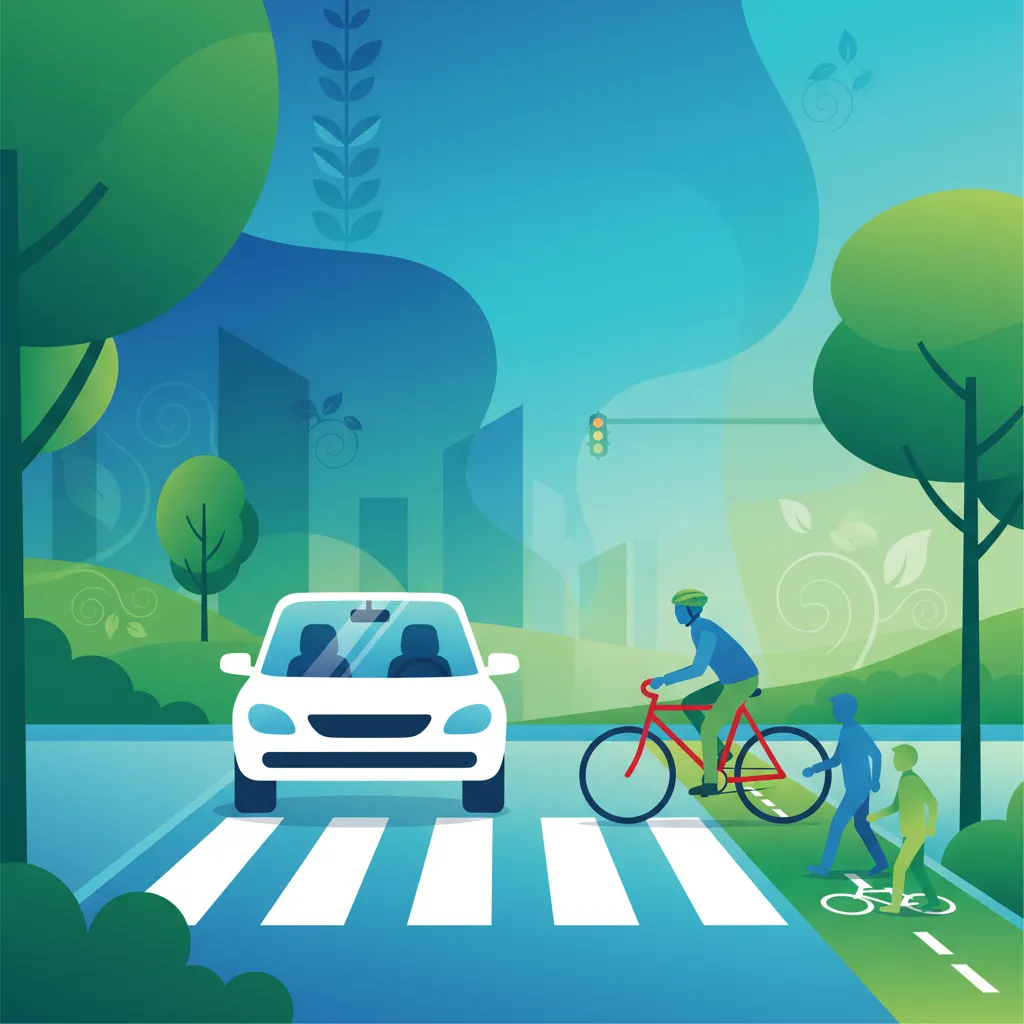
This lesson focuses on safe coexistence with cyclists and pedestrians, who are prevalent in urban areas. It covers the rules for driving alongside dedicated bicycle lanes and the legal requirement to yield to pedestrians at marked crossings. The content stresses the importance of constant awareness, especially when turning at intersections, to prevent conflicts with vulnerable road users.
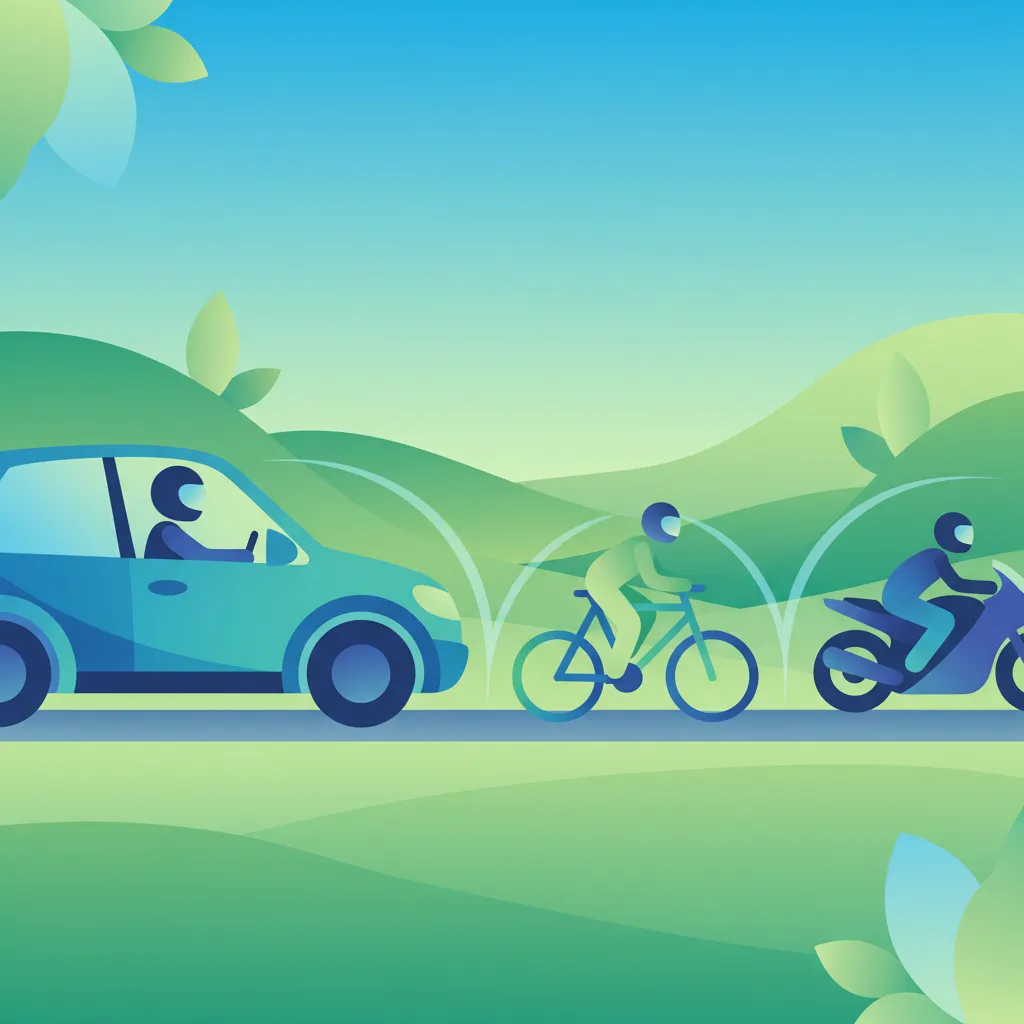
This lesson is dedicated to the safe overtaking of two-wheeled vehicles. It explains the legal requirement to leave a sufficient lateral distance (at least 1 meter) when passing cyclists. The content highlights the vulnerability of these road users and the need for patience, reduced speed, and careful judgment.

This lesson addresses advanced scenarios, including multi-lane intersections and interactions with vulnerable road users. It reinforces the legal obligation to give absolute priority to pedestrians at marked crossings (zebra crossings). The content also covers navigating around traffic islands and using dedicated turning lanes in complex urban environments.
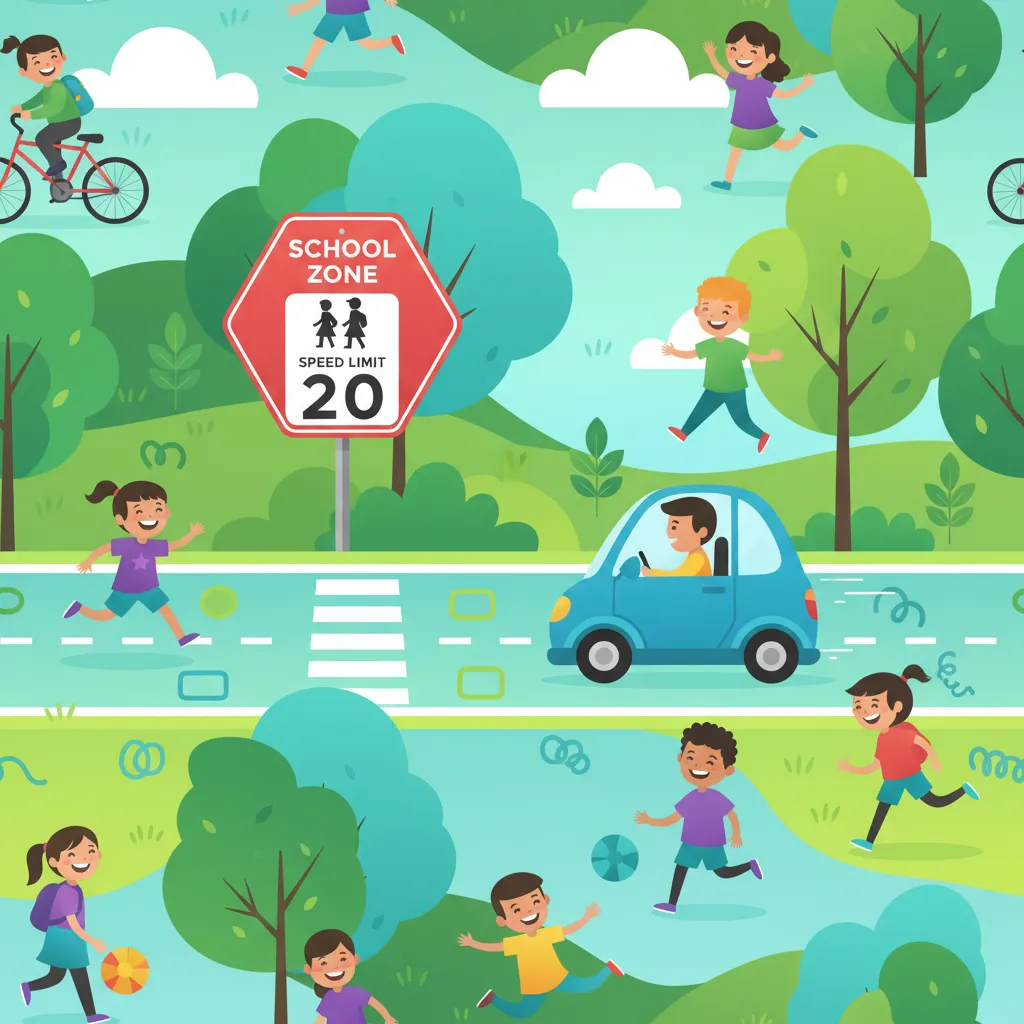
This lesson focuses on areas with high pedestrian activity, requiring special caution. It covers the rules for 'living zones' (strefa zamieszkania), where pedestrians have priority and the speed limit is 20 km/h. The content also addresses regulations for school zones and other designated pedestrian areas to ensure the safety of the most vulnerable road users.

This lesson examines how a tractor driver should interact with a variety of road users, focusing on right-of-way rules at intersections and with cars, trucks, cyclists, and pedestrians. It discusses safe overtaking practices, appropriate signaling to communicate intentions, and the importance of checking blind spots. The lesson highlights the need for heightened caution near schools, villages, and areas with high pedestrian activity.

This lesson highlights the professional driver's heightened responsibility to protect vulnerable road users. It focuses on the significant blind spots around a large truck, particularly during turns in urban areas where pedestrians and cyclists are common. The content teaches strategies for anticipating the unpredictable movements of these users, providing ample space when passing, and using warning signals to communicate intentions clearly, fostering a culture of shared road safety.

This lesson introduces the fundamental principles of right-of-way on Polish roads, explaining how priority road signs determine the flow of traffic at intersections. Learners will explore the hierarchy of vehicle classes and the specific obligations that arise when approaching a yield line or a give-way sign. The content details the legal precedence of main road traffic over secondary road traffic, helping riders safely navigate intersections and avoid right-of-way infractions.

This lesson provides a comprehensive breakdown of the right-of-way rules that govern intersections. It explains the clear directives given by traffic lights, stop signs, and yield signs, and clarifies the procedures at unmarked or uncontrolled intersections, where the 'priority to the right' rule often applies. Learners will understand the legal hierarchy of these rules to make correct, safe, and predictable decisions when navigating through any junction, reducing the risk of conflict with other traffic.

This lesson provides strategies for safely navigating the numerous intersections typical of urban environments. It reinforces the application of priority rules in situations with limited visibility and high traffic volume. Techniques for making turns in narrow streets and being aware of pedestrians and cyclists at junctions are central to the instruction.

In this lesson, learners explore riding on rural and countryside roads, where road markings may be sparse and surface conditions varied. The content covers safe overtaking in single-lane sections, interaction with agricultural vehicles and animals, and the handling of gravel or uneven surfaces. Learners will also study the importance of anticipating curves and adjusting speed to light conditions, equipping them with the skills needed for safe countryside travel.
Learn essential Polish driving theory for motorcyclists regarding pedestrian crossings and cyclist interactions. Covers right-of-way, safe passing distances, and visual communication techniques for enhanced road safety.

This lesson focuses on the unique demands of urban riding within Polish cities, addressing traffic lights, pedestrian zones, one-way streets, and the presence of tram tracks. Learners will study safe lane positioning on narrow roads, blind-spot management, and how to share the road with buses and cyclists. The content also covers strategies for navigating stop-and-go traffic, anticipating signal changes, and maintaining visibility in dense urban environments.
This lesson focuses on safe coexistence with cyclists and pedestrians, who are prevalent in urban areas. It covers the rules for driving alongside dedicated bicycle lanes and the legal requirement to yield to pedestrians at marked crossings. The content stresses the importance of constant awareness, especially when turning at intersections, to prevent conflicts with vulnerable road users.

This lesson outlines strategies for planning escape routes and adopting protective positioning to avoid potential collisions. Learners will study the concept of a defensive riding line that maximizes visibility and provides an optimal safety corridor. The content emphasizes maintaining adequate distance buffers, choosing lanes that reduce exposure to hazards, and preparing for emergency maneuvers such as swift swerves, allowing riders to react quickly in critical situations.
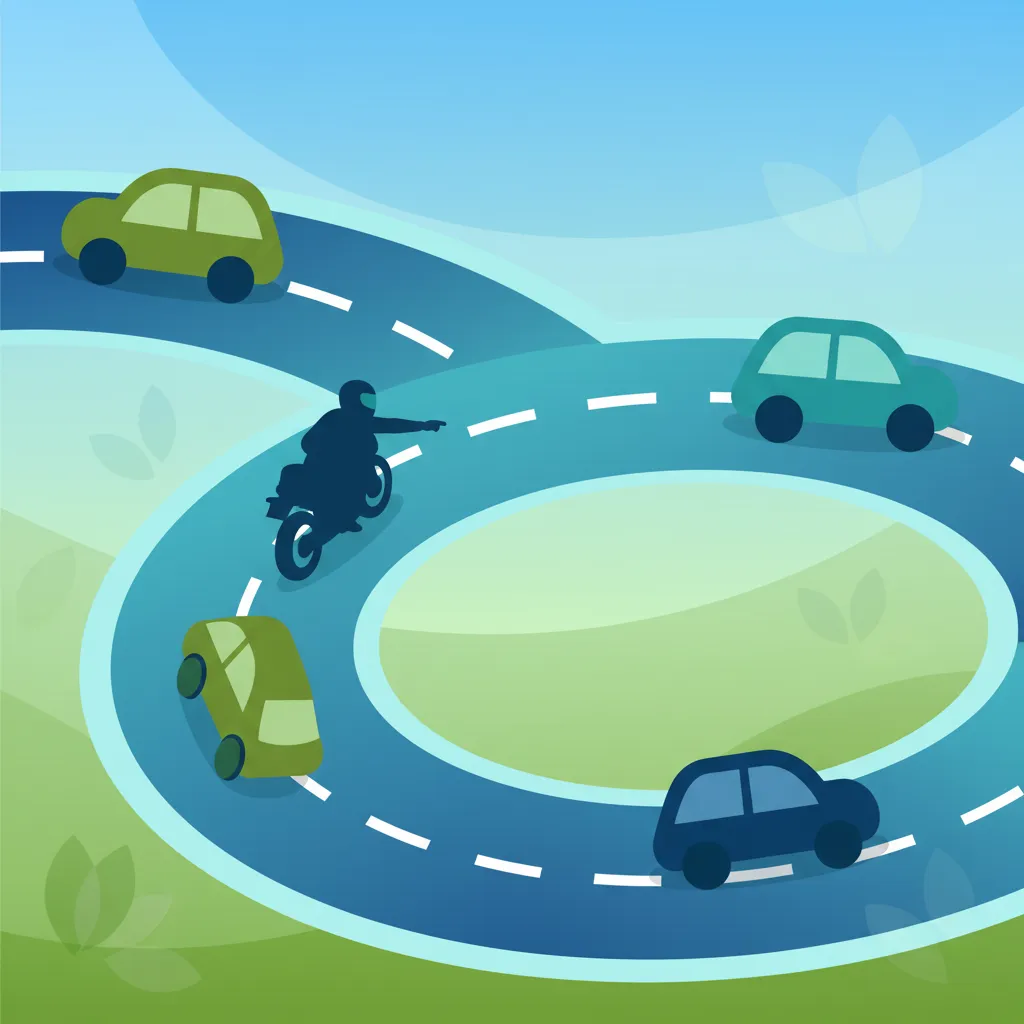
This lesson focuses on the proper techniques for negotiating roundabouts, which are common in Polish urban environments. Learners will learn the correct approach to entering a roundabout, yielding to circulating traffic, selecting the appropriate lane, and signaling intentions when exiting. The lesson also discusses speed adaptation for safe circulation and blind-spot checks before changing lanes within the roundabout, ensuring smooth and legal navigation.
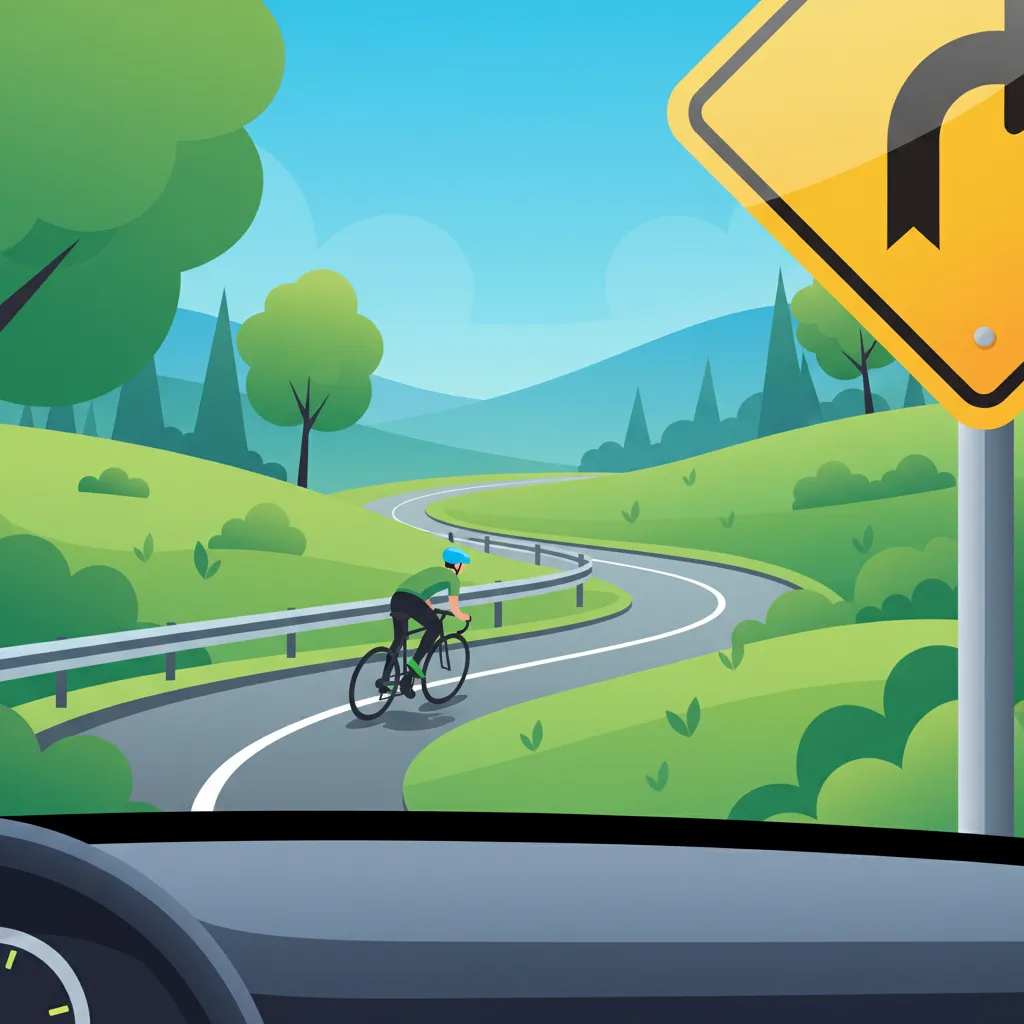
In this lesson, learners study warning signs that alert drivers to potential hazards, focusing on those that are particularly relevant to motorcyclists. The content includes signs indicating curves, slippery surfaces, animal crossings, tram tracks, and construction zones, each requiring specific riding adjustments. The lesson teaches riders how to interpret these signs to anticipate hazards, adjust speed appropriately, and maintain a safe distance from potential dangers.

This lesson examines the variety of pavement markings that define lane structures, traffic flow, and special zones on Polish roads. Learners will study solid and broken lines, lane division markings, and the distinct symbols for bicycle lanes, bus lanes, and tram tracks, all of which affect motorcyclist positioning. The lesson also addresses surface texture indicators that signal changing road conditions, enabling riders to maintain correct lane discipline.
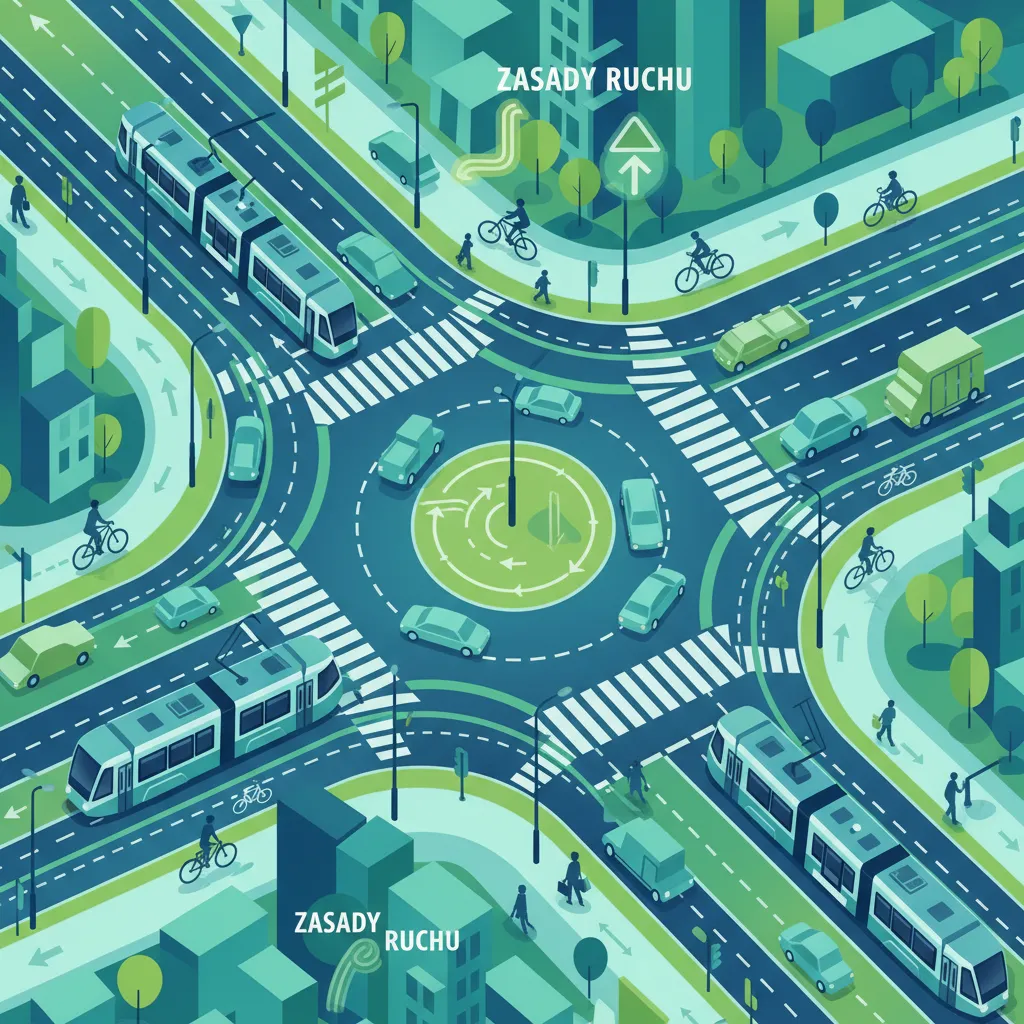
In this lesson, learners investigate complex junctions and intersections found across urban, rural, and highway environments, focusing on multi-lane configurations, traffic light coordination, and roundabout navigation. The content emphasizes priority rules, blind-spot assessment when merging, and safe lane selection for turning maneuvers. Learners will also consider interactions with cyclists and pedestrians, and the importance of adjusting approach speed for safe navigation.
This lesson is dedicated to the safe overtaking of two-wheeled vehicles. It explains the legal requirement to leave a sufficient lateral distance (at least 1 meter) when passing cyclists. The content highlights the vulnerability of these road users and the need for patience, reduced speed, and careful judgment.
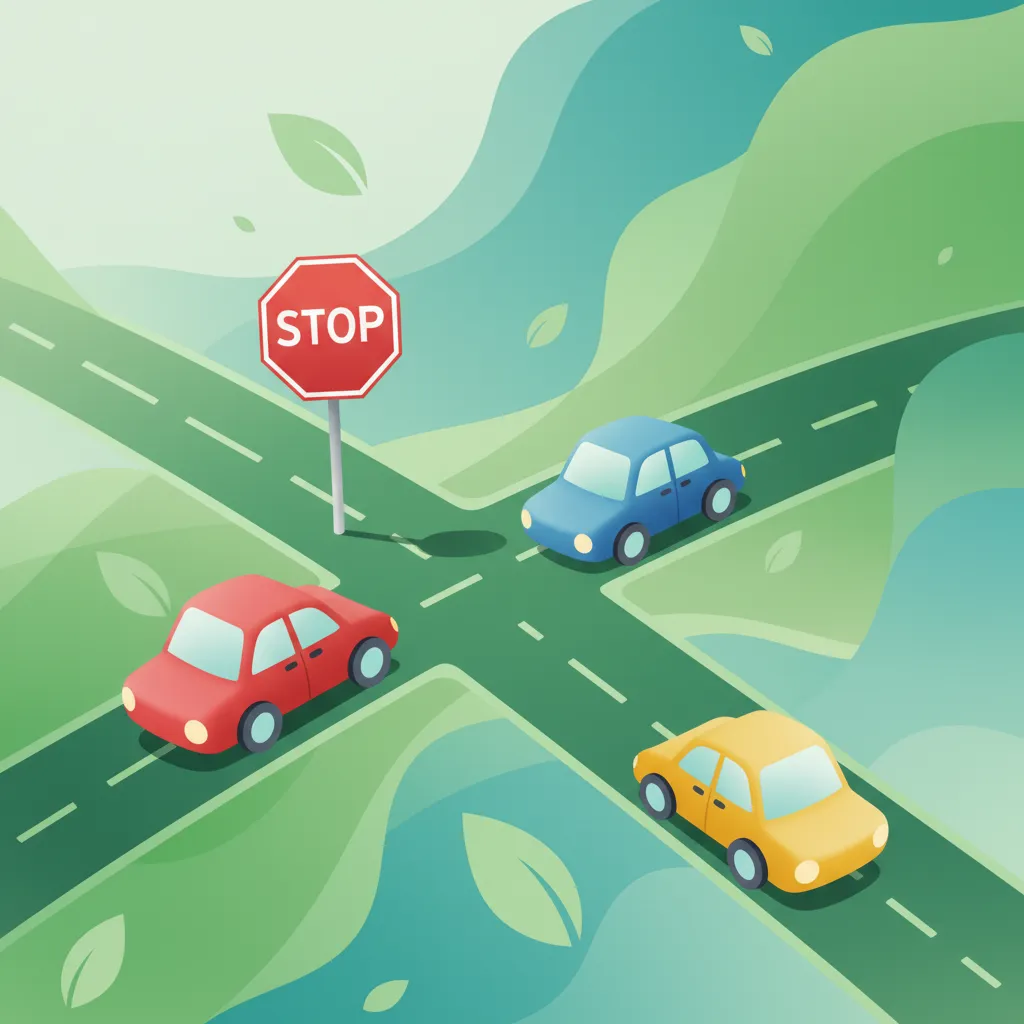
In this lesson, learners examine the specific actions required at stop signs and give-way intersections under Polish traffic regulations. The content explains the legal requirement for a full stop before the stop line, incorporating a visual scan of all directions before proceeding. It also covers the give-way protocol, where riders must yield to traffic already in the intersection or on the main road, emphasizing the need for correct positioning and observation.
This lesson examines the family of regulatory signs that dictate mandatory actions and prohibitions on Polish roads, emphasizing how each sign influences motorcyclist behaviour. Learners will explore the stop, give way, speed limit, and no overtaking signs, understanding the legal obligations they impose. The lesson also highlights signs that specifically affect motorcycles, such as lane restrictions, ensuring riders recognize and obey regulations unique to two-wheel traffic.
Find clear answers to common questions learners have about Pedestrian Crossings and Cyclist Interactions. Learn how the lesson is structured, which driving theory objectives it supports, and how it fits into the overall learning path of units and curriculum progression in Poland. These explanations help you understand key concepts, lesson flow, and exam focused study goals.
In Poland, pedestrians have the right-of-way when approaching or on a zebra crossing (przejście dla pieszych). As a motorcyclist, you must slow down and be prepared to stop, ensuring pedestrians have safely cleared the crossing before proceeding. Never overtake or attempt to pass closely near a crossing.
Cyclists have the same rights as other vehicle drivers but are more vulnerable. Always maintain a safe distance when passing them, ideally at least 1 meter in urban areas and 1.5 meters on faster roads. Anticipate their movements, as they may swerve to avoid obstacles. Check your mirrors and blind spots before overtaking.
You must stop for pedestrians who are already on the zebra crossing or who are clearly intending to cross and are approaching it. It's a proactive approach to safety: if in doubt, slow down and be ready to stop. This prevents potential collisions and shows courtesy.
Even if a pedestrian seems hesitant, you must still yield to them if they are on or very near the crossing. Slow down and make eye contact if possible to confirm their intention. Avoid honking or pressuring them, as they have priority. Your safe approach encourages them to cross.
While this lesson focuses on pedestrian crossings and general cyclist interaction, remember that tram tracks and cycle lanes (drogi dla rowerów) require extra caution. Always be aware of road markings and give cyclists ample space, as they may use lanes that intersect with or run alongside motorcycle paths.
Build custom practice sessions tailored precisely to your needs. Focus on areas requiring improvement, review specific Polish road signs, or master complex traffic rules to ensure full preparation for your official driving license exam.